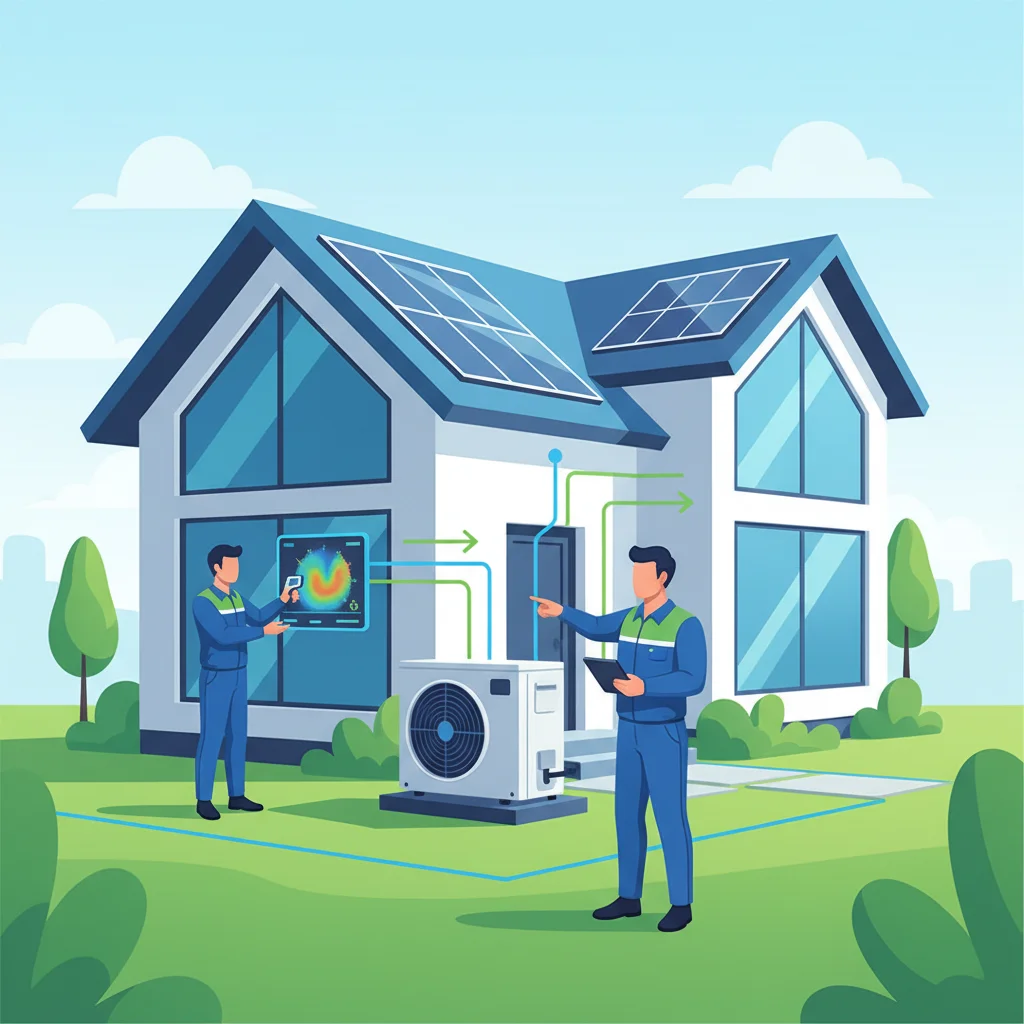
HVAC systems account for 43% of residential energy bills nationwide—but 30% of that energy gets wasted through leaks, dirty filters, and inefficient equipment. And homeowners who skip an energy audit before upgrading their HVAC system leave an average of $1,200 in annual savings on the table, according to the Department of Energy.
How Much Can You Save With an HVAC Energy Audit? (ROI Breakdown)
An HVAC energy audit identifies inefficiencies that cost homeowners $600-$2,400 annually in wasted energy. The 2026 audit process combines blower door tests, thermal imaging, and ductwork inspection to measure air leakage rates and equipment performance. Auditors quantify savings from each recommended upgrade—sealing ducts saves 20-30% on heating and cooling costs, replacing a 10-year-old furnace with an ENERGY STAR model saves $200-$400 annually, and fixing air leaks saves $150-$300 per year.
The audit itself costs $200-$500 depending on home size and equipment complexity. But the average household recoups that cost within 3-6 months through energy savings identified in the report. So a $400 audit that identifies $1,600 in annual waste pays for itself in 3 months—and delivers $1,200 net savings in year one alone.
California utility companies subsidize audit costs through programs like PG&E Home Energy Checkup ($0-$75 copay) and SoCalGas Residential Energy Efficiency Rebate ($100 audit credit). The federal Energy Efficient Home Improvement Credit (Section 25C) ended for property placed in service after December 31, 2025 (IRS FS-2025-05). Federal tax credits for this work have ended, but state, local and utility rebates may still apply; check what is available at your address with the DuloCore rebate calculator.
"Home energy audits are the most cost-effective way to identify energy waste and prioritize improvements with the highest return on investment." — U.S. Department of Energy
Check if your local utility offers subsidized HVAC efficiency audits before paying retail rates.
What's Your ROI Payback Period for HVAC Efficiency Improvements?
Payback periods vary by upgrade type and baseline efficiency. Sealing duct leaks pays back in 1-2 years with average costs of $300-$800 and annual savings of $400-$700. Furnace replacement pays back in 5-8 years with $4,000-$6,000 upfront costs and $500-$800 annual savings. Heat pump installation pays back in 6-10 years with $8,000-$15,000 costs and $900-$1,800 annual savings depending on climate zone.
But 2026 federal tax credits accelerate payback timelines by covering 30% of equipment costs. So a $12,000 heat pump drops to $8,400 after the $3,600 federal credit—cutting payback from 8 years to 5.5 years with $1,500 annual savings. And California's TECH Clean California program adds $3,000-$7,000 in instant rebates for qualifying heat pump installations, further reducing payback to 3-4 years.
The audit report ranks upgrades by cost-effectiveness using simple payback calculations (cost ÷ annual savings = years). Homeowners prioritize improvements with payback periods under 5 years first, then tackle longer-term upgrades as budget allows. And financing options through programs like PACE (Property Assessed Clean Energy) spread costs over 10-20 years with payments offset by immediate energy savings.
Use our free rebate calculator to model payback periods for your specific equipment and location.
Is Your Climate Zone Right for HVAC Audits and Upgrades?
Climate zone determines which HVAC upgrades deliver the highest returns. California has 16 climate zones ranging from coastal moderate (Zone 6) to desert extreme heat (Zone 15) to mountain cold (Zone 16). And each zone has different heating-cooling ratios that affect audit recommendations and payback periods.
Coastal zones 3-7 prioritize heat pump installations because mild temperatures allow year-round efficiency of 300-400% (HSPF2 10+). Desert zones 10-15 prioritize duct sealing and high-SEER air conditioning because cooling loads dominate and every 1 SEER increase saves $60-$100 annually. Mountain zones 1-2 and 16 prioritize furnace upgrades and insulation because heating costs exceed cooling by 3:1 ratios.
But all climate zones benefit from air sealing and duct testing—the audit's blower door test measures air changes per hour (ACH) and identifies leak points costing $200-$600 annually regardless of location. So even mild coastal climates see 15-25% energy savings from sealing identified leaks.
ENERGY STAR recommends audits every 3-5 years or when equipment reaches 10+ years old. And California Title 24 building codes now require duct testing for all new HVAC installations to verify less than 6% total leakage—but existing homes average 20-40% duct leakage until audited and sealed.
How Does an HVAC Audit Compare to Other Home Energy Solutions?
HVAC audits target the largest energy user in most homes—heating and cooling account for 43% of residential energy consumption compared to 18% for water heating, 12% for lighting, and 27% for appliances and electronics. So HVAC improvements deliver 2-3x larger savings than other efficiency upgrades on a dollar-for-dollar basis.
A $500 HVAC audit identifying $1,600 in annual savings beats a $500 LED lighting upgrade saving $200 annually or a $500 smart thermostat saving $180 annually. But the audit also identifies non-HVAC issues—infrared cameras detect insulation gaps, blower door tests find air leaks around windows and doors, and combustion analysis checks water heater efficiency.
Solar panel installations cost $15,000-$30,000 and offset electricity bills by 70-100%, but most homes see better ROI by completing an HVAC audit first and reducing baseline energy consumption by 20-40% before sizing solar arrays. The federal Residential Clean Energy Credit (Section 25D) ended for expenditures made after December 31, 2025, and the IRS treats an expenditure as made when installation is completed (IRS FS-2025-05).
Whole-home energy audits ($400-$700) include HVAC testing plus attic insulation inspection, window efficiency analysis, and appliance load testing. But standalone HVAC audits ($200-$500) provide sufficient data for homeowners focused on heating and cooling costs alone.
What Are the Alternatives to a Full HVAC Replacement After an Audit?
Most audits identify 5-10 improvement opportunities ranging from free DIY fixes to $15,000+ equipment replacements. And 60-70% of total savings come from low-cost fixes under $1,000—duct sealing, filter upgrades, thermostat optimization, and outdoor unit cleaning.
Duct sealing costs $300-$800 and eliminates 20-30% of heating and cooling waste in homes with typical 25-35% leakage rates. Upgrading to MERV 13 filters costs $15-$25 per replacement but improves airflow 10-15% compared to cheap fiberglass filters, reducing runtime and energy consumption. Smart thermostats cost $150-$300 installed and save $130-$145 annually through optimized scheduling and zone control.
Partial system upgrades offer middle-ground options—replacing a 1-ton outdoor condenser unit costs $2,000-$3,500 versus $8,000-$12,000 for full system replacement, but still delivers 30-40% efficiency gains if indoor components are compatible. And variable-speed blower motor retrofits cost $800-$1,500 but cut fan energy consumption by 50-70% compared to single-speed motors.
But homeowners with equipment 15+ years old see better long-term value from full replacement. SEER ratings have increased from 10-13 in 2010 models to 15-25 in 2026 models, and AFUE ratings have climbed from 80-85% to 95-98% in high-efficiency furnaces. So a $6,000 furnace replacement saves $600-$900 annually over a 15-year-old 80% AFUE unit—paying back in 7-10 years and lasting another 15-20 years.
Review energy tax credits to identify federal and state incentives for partial and full system upgrades.
How Much Does an HVAC Energy Audit Cost and When Will You Break Even?
National average audit costs range from $200-$500 for basic assessments to $400-$700 for comprehensive whole-home audits. California utility companies subsidize costs through energy efficiency programs—PG&E charges $0-$75 copays for income-qualified homeowners and $75-$150 for standard residential audits. SoCalGas offers $100 rebates on approved contractor audits, and SDG&E provides free virtual audits plus $50 in-person upgrades.
The audit report itemizes findings with cost estimates and savings projections for each recommended improvement. Average reports identify $1,200-$2,400 in annual savings opportunities across 6-10 action items. So a $300 audit with $1,800 identified savings breaks even in 2 months if homeowners implement top recommendations.
But break-even timelines depend on follow-through rates. Homeowners who complete 80%+ of recommended improvements within 12 months see average first-year savings of $1,400-$2,200. Those who cherry-pick only free/low-cost fixes see $400-$800 first-year savings. And homeowners who ignore audit findings waste the $200-$500 audit cost entirely.
Financing options accelerate implementation without upfront costs. California PACE programs offer 10-20 year loans for energy efficiency upgrades with 5-8% interest rates paid through property tax bills. And contractor-financed payment plans spread $5,000-$15,000 HVAC replacements over 60-84 months with $80-$200 monthly payments offset by $100-$200 monthly energy savings.
Compare your options with a rebate calculator to model total costs and timelines.
Official Sources
- U.S. Department of Energy - Energy Saver Guide — Federal resources on home energy audits and HVAC efficiency improvements
- ENERGY STAR Home Energy Audits — Guidance on finding certified auditors and understanding audit reports
- DSIRE - Database of State Incentives for Renewables & Efficiency — Comprehensive database of California utility rebates and federal tax credits for HVAC upgrades (note: the federal 25C and 25D credits ended for projects completed after December 31, 2025)
Related Reading: Learn more about Ashrae Energy Audit Levels Explained and Attic Fan Energy Savings Audit.
Related Reading: Learn more about Hvac Maintenance Energy Savings.
Related Reading: Learn more about Energy Audit Log Cabin.
Related Reading: Learn more about Indoor Air Quality Energy Audit and Vapor Barrier Energy Audit.
Frequently Asked Questions
What is an HVAC energy audit and why do I need one?
An HVAC energy audit measures heating and cooling system efficiency through blower door tests, thermal imaging, and ductwork inspection. Auditors identify air leaks, measure equipment performance, and quantify energy waste costing $600-$2,400 annually in typical California homes. The audit report prioritizes improvements by ROI and identifies utility rebates and federal tax credits worth $1,000-$10,000 for qualifying upgrades.
How much does an HVAC energy audit cost?
HVAC audits cost $200-$500 for standalone assessments and $400-$700 for comprehensive whole-home evaluations. California utilities subsidize costs—PG&E charges $0-$150 depending on income, SoCalGas offers $100 rebates, and SDG&E provides free virtual audits. Independent certified auditors charge $300-$600 for 2-3 hour assessments including blower door testing, thermal imaging, and detailed improvement reports.
Are HVAC energy audits required to qualify for rebates?
Most California utility rebates and federal tax credits don't require pre-upgrade audits, but 15-20% of programs mandate professional energy assessments for high-value incentives above $3,000. PG&E Energy Upgrade California requires whole-home audits for $4,000-$6,500 package rebates. And TECH Clean California heat pump rebates ($3,000-$7,000) require contractor load calculations that include audit-level testing. Always verify program requirements before purchasing equipment.
How long does an HVAC energy audit take to complete?
Standard HVAC audits take 2-3 hours for blower door testing, ductwork inspection, thermostat analysis, and equipment performance measurements. Comprehensive whole-home audits take 3-5 hours including attic insulation inspection, window efficiency testing, and appliance load analysis. Auditors deliver preliminary findings on-site and email detailed reports within 3-7 business days with cost estimates and savings projections for each recommended improvement.
What's the difference between an HVAC energy audit and a home energy audit?
HVAC audits focus exclusively on heating, cooling, and ventilation systems—testing duct leakage, airflow, equipment efficiency, and thermostat performance. Whole-home energy audits include HVAC testing plus insulation analysis, air sealing, window efficiency, water heater performance, and appliance energy consumption. HVAC audits cost $200-$500 and target the 43% of energy consumption from heating and cooling. Whole-home audits cost $400-$700 and address all energy uses across lighting, appliances, and building envelope.
Ready to find your energy savings? Use our free rebate calculator to discover HVAC efficiency rebates and tax credits available for your home. Calculate your potential savings in under 2 minutes—no signup required.
Last reviewed: April 14, 2026. Reviewed by DuloCore Energy Specialists. About the team.
Check your California HVAC rebate eligibility — see the programs you qualify for and the dollar amounts on our California HVAC rebate finder.