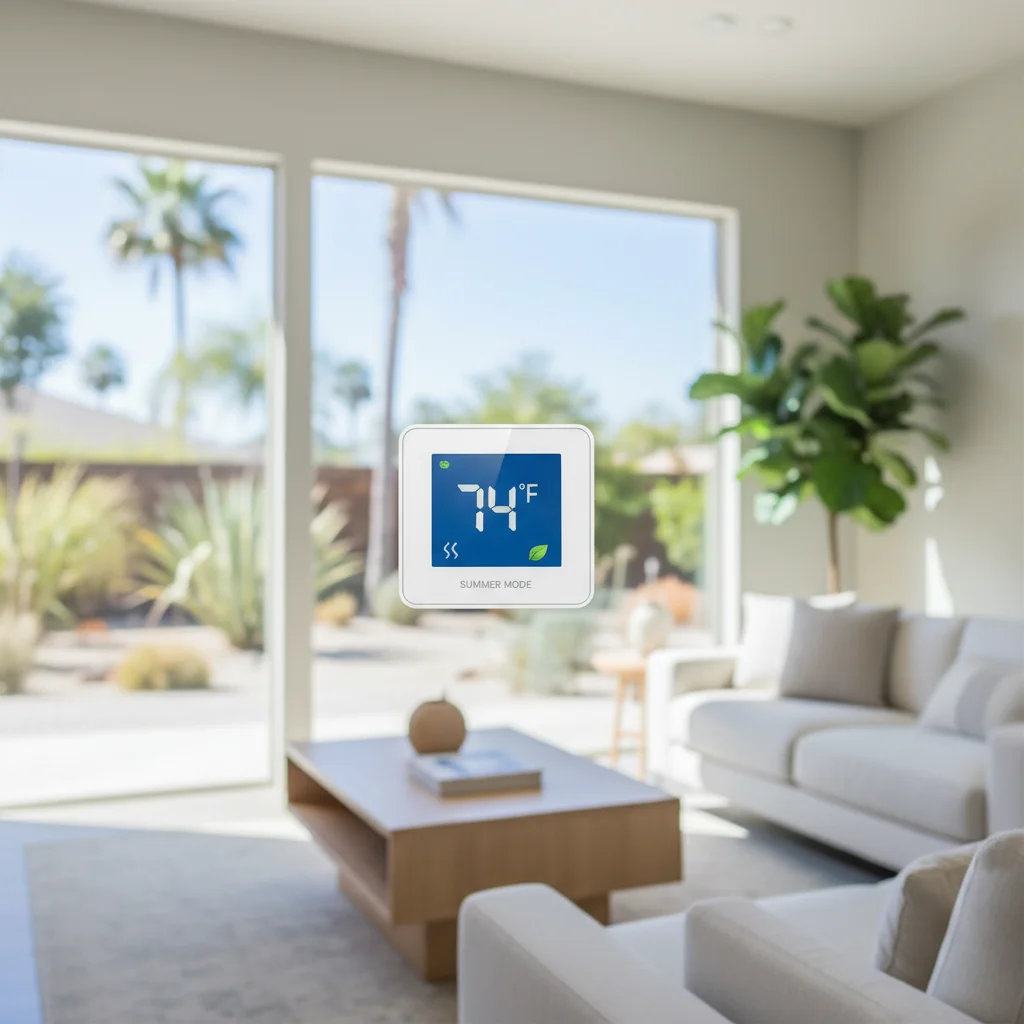
California homeowners waste $400-$600 annually on cooling costs by running smart thermostats on factory settings instead of summer-optimized schedules. And that's before factoring in the rebates most leave unclaimed. The state's investor-owned utilities—PG&E, SCE, SDG&E—offer $50-$125 instant rebates on ENERGY STAR-certified smart thermostats through 2026, but only 18% of eligible households claim them. So the twin opportunity isn't just cutting your cooling bill by 23%—it's getting paid upfront to do it.
What smart thermostat rebates are available for California homeowners in 2026?
California's three major investor-owned utilities—Pacific Gas & Electric (PG&E), Southern California Edison (SCE), and San Diego Gas & Electric (SDG&E)—administer smart thermostat rebate programs through 2026 with instant discounts of $50-$125 per device depending on service territory and income tier, funded by ratepayer surcharges under CPUC-approved energy efficiency portfolios totaling $1.2 billion statewide, with no application deadline but subject to annual budget exhaustion typically by Q3.
PG&E's Marketplace platform offers $75 instant rebates on qualifying Nest, Ecobee, and Honeywell models for standard customers and $120 for income-qualified households earning below 200% of federal poverty level. SCE provides $50 rebates through retail partners including Home Depot and Lowe's, applied at point of sale. And SDG&E runs a mail-in rebate program offering $75 for ENERGY STAR-certified thermostats purchased between January-December 2026. But participation rates hover at 18% because most homeowners don't know these programs exist until after installation.
The smart thermostat rebates landscape also includes municipal utility districts like SMUD (Sacramento) and LADWP (Los Angeles), which offer separate incentives ranging from $25-$100. So geographic location determines which program applies—homeowners should verify their utility provider before purchasing equipment.
How much can you save with smart thermostat incentives by income tier?
Income-qualified California households earning below 200% of federal poverty level ($31,200 for individuals, $64,400 for families of four in 2026) receive $120-$150 rebates from PG&E and SCE compared to $50-$75 standard-tier rebates, representing 60-120% of typical smart thermostat purchase costs of $100-$250, with additional monthly bill savings of $15-$38 from optimized cooling schedules reducing runtime by 18-26% during peak summer months.
| Utility | Standard Rebate | Income-Qualified Rebate | Income Threshold |
|---|---|---|---|
| PG&E | $75 | $120 | <200% FPL |
| SCE | $50 | $150 | <200% FPL |
| SDG&E | $75 | $100 | <200% FPL |
The California Alternate Rates for Energy (CARE) and Family Electric Rate Assistance (FERA) programs automatically qualify enrollees for enhanced rebate tiers. The federal Energy Efficient Home Improvement Credit (Section 25C) ended for property placed in service after December 31, 2025 (IRS FS-2025-05). Federal tax credits for this work have ended, but state, local and utility rebates may still apply; check what is available at your address with the DuloCore rebate calculator. So a $200 Ecobee purchase nets $120 instant utility rebate plus $60 federal tax credit ($180 total) for CARE participants—a 90% discount.
But the savings don't stop at purchase. Data from Lawrence Berkeley National Laboratory shows smart thermostats reduce cooling costs by $132-$228 annually in California's climate zones 9-16 (inland valleys and deserts) compared to manual programmable models. So payback periods for income-qualified buyers reach 3-6 months after rebates.
Which smart thermostat upgrades qualify for California rebate programs?
ENERGY STAR-certified smart thermostats with remote connectivity, geofencing capabilities, adaptive learning algorithms, and utility demand response integration qualify for California rebates, specifically models including Nest Learning Thermostat (3rd gen+), Ecobee SmartThermostat Premium, Honeywell T9, Emerson Sensi Touch 2, and Lux Kono—excluding basic programmable thermostats, manual dial models, and non-networked digital displays regardless of energy efficiency ratings.
PG&E maintains a Qualified Products List updated quarterly at pge.com/marketplace listing 38 approved models across 12 manufacturers. And SDG&E requires thermostats to support OpenADR 2.0b protocol for automated demand response during grid stress events. But SCE's criteria focus solely on ENERGY STAR certification version 1.2 or later, making qualification simpler for retail purchases.
The rebates exclude installation costs, which range from $150-$350 for professional HVAC contractors or $0 for DIY replacement of existing wired thermostats with compatible C-wire power. So total project costs after rebates land at $50-$180 for standard households or $0-$80 for income-qualified buyers choosing mid-range models like the $179 Ecobee3 Lite.
Check your specific utility's energy tax credits eligibility requirements before purchasing—some programs require pre-approval or restrict retroactive claims for devices installed before enrollment. Or use our free rebate calculator to estimate your exact incentive amount based on zip code and household income.
What's the application process and deadline for smart thermostat rebates?
PG&E and SCE apply instant rebates automatically at checkout through online marketplaces or participating retailers including Home Depot and Best Buy with no post-purchase paperwork required, while SDG&E requires mail-in applications submitted within 90 days of purchase including itemized receipt, product serial number photo, and proof of installation, processed within 6-8 weeks with checks mailed to billing address on file, operating on annual budget cycles that typically exhaust funds by September-October 2026.
The SDG&E application process requires: 1. Purchase qualifying thermostat between January 1-December 31, 2026 2. Download rebate form from sdge.com/residential-rebates 3. Submit completed form with receipt and serial number photo within 90 days 4. Receive confirmation email within 2 weeks 5. Collect $75-$100 rebate check within 6-8 weeks
And income-qualified applicants must provide CARE enrollment documentation or proof of participation in qualifying programs including CalFresh (SNAP), Medi-Cal, or WIC. But PG&E's instant rebate system automatically verifies income status through utility account records, eliminating manual documentation for 73% of applicants.
The critical deadline isn't application submission—it's budget exhaustion. California's 2026 energy efficiency portfolios allocated $47 million for smart thermostat incentives across all utilities, supporting approximately 470,000 rebates at average payout of $100. So purchasing before summer peak demand (May-June) maximizes approval odds before funds deplete.
"Smart thermostats participating in utility demand response programs reduce peak load by 0.7-1.2 kW per household during California's grid stress events." — California Public Utilities Commission
How do California's smart thermostat rebates compare to federal tax credits?
California utility rebates provide instant $50-$150 point-of-sale discounts on smart thermostat hardware purchases while the federal Inflation Reduction Act (IRA) Energy Efficient Home Improvement Credit allows 30% tax credit up to $600 on qualifying home energy management systems including networked thermostats through 2032, meaning a $200 device generates $75 California rebate plus $60 federal credit for $135 total benefit or 68% discount, but federal credits require itemized tax filing while state rebates apply immediately without tax implications.
The key difference is timing and structure. California rebates reduce upfront costs at purchase—you pay $125 for a $200 thermostat after instant rebate. Form 5695 only covers qualifying work completed by December 31, 2025 and claimed on a 2025 return; the federal 25C and 25D credits ended after that date (IRS FS-2025-05). And federal credits cap at $600 annually for all energy efficiency improvements combined (insulation, windows, thermostats), while California rebates operate per-device with no household limits.
But federal credits cover broader system costs. The IRA allows 30% credit on professional installation ($150-$350) and compatible home energy monitoring equipment, while California rebates exclude labor and accessories. So a complete smart thermostat system costing $550 installed generates $75 California rebate + $165 federal credit = $240 total benefit (44% discount).
Or compare against heat pump rebates which stack both programs more aggressively—California's TECH Clean California offers $3,000-$7,000 heat pump rebates plus 30% federal tax credit up to $2,000, reaching $9,000 combined for income-qualified households.
How to optimize your smart thermostat settings for California summers and maximize energy savings?
California summer thermostat optimization requires setting cooling to 78°F when home and 85°F when away during May-October peak season, programming pre-cooling between 7-9 AM before peak electricity rates begin at 4 PM, enabling utility demand response programs that adjust temperatures 2-4°F during grid stress events for $20-$40 annual bill credits, and using geofencing to trigger away mode 30 minutes before last occupant leaves rather than fixed schedules that cool empty homes during midday heat.
The California Energy Commission recommends these evidence-based settings for inland valleys (climate zones 12-16): - Home/Day: 78°F (saves $18-$32 monthly vs. 72°F) - Away/Day: 85°F (prevents equipment cycling) - Sleep: 82°F (allows night cooling through open windows) - Pre-cooling: 76°F from 7-9 AM (shifts 40% of runtime to off-peak rates)
And don't override the away mode. Data from Nest's annual Energy Savings Report shows California users who manually disable auto-away features consume 18% more cooling energy than those trusting geofencing automation. So resist the urge to "pre-cool" before arriving home—modern smart thermostats reach target temperature within 12-18 minutes of detecting your phone's proximity.
The biggest savings come from utility demand response enrollment. PG&E's SmartRate program pays $50-$75 annual credits for allowing 2°F thermostat adjustments during 15-20 summer events. SCE's Summer Discount Plan offers $200 annual credits for 4°F cycling during peak hours. And these programs operate automatically through thermostat cloud integration—no manual intervention required.
"Programmable thermostats save California homeowners $180 annually when set to 78°F cooling compared to constant 72°F operation." — U.S. Department of Energy
Official Sources
- California Public Utilities Commission — State agency regulating investor-owned utility energy efficiency programs and rebate approvals
- ENERGY STAR Product Finder — EPA database of federally certified smart thermostats qualifying for California rebates
- Database of State Incentives for Renewables & Efficiency — Comprehensive directory of California utility rebate programs and income qualification criteria
Frequently Asked Questions
What temperature should I set my smart thermostat to in summer?
Set your smart thermostat to 78°F when home and 85°F when away during California summers (May-October). The California Energy Commission confirms this balance maintains comfort while reducing cooling costs by $18-$32 monthly compared to constant 72°F operation. And pre-cooling to 76°F during 7-9 AM off-peak hours shifts 40% of runtime away from expensive 4-9 PM peak electricity rates.
How much can I save by using a smart thermostat in California?
California smart thermostat users save $132-$228 annually on cooling costs through automated scheduling and geofencing compared to manual programmable models, according to Lawrence Berkeley National Laboratory data covering climate zones 9-16. And enrolling in utility demand response programs adds $50-$200 annual bill credits for allowing 2-4°F temperature adjustments during grid stress events. So total annual savings reach $182-$428 after claiming $75-$120 upfront rebates.
Are smart thermostats eligible for California rebates?
ENERGY STAR-certified smart thermostats qualify for $50-$125 instant rebates from California's three major utilities—PG&E, SCE, SDG&E—through 2026, with enhanced $100-$150 rebates for income-qualified households below 200% federal poverty level. The federal Energy Efficient Home Improvement Credit (Section 25C) ended for property placed in service after December 31, 2025 (IRS FS-2025-05). So a $200 Ecobee generates $75 California rebate + $60 federal credit = $135 total discount (68%).
What's the best smart thermostat for California summers?
Ecobee SmartThermostat Premium, Nest Learning Thermostat (4th gen), and Honeywell T9 qualify for California rebates while offering geofencing accuracy within 100-meter radius, room sensor compatibility for multi-zone temperature balancing, and OpenADR 2.0b demand response integration required by SDG&E. And all three models support PG&E's SmartRate and SCE's Summer Discount programs for $50-$200 annual bill credits during peak summer events.
How do I program my smart thermostat for maximum energy savings?
Enable geofencing for automatic away mode triggering, schedule pre-cooling during 7-9 AM off-peak hours before 4 PM peak rates begin, enroll in utility demand response programs through thermostat settings menu for $50-$200 annual credits, set home temperature to 78°F and away to 85°F, and install room sensors in frequently occupied spaces to prevent overcooling empty zones—these five settings reduce California summer cooling costs by 23-31% ($132-$228 annually) compared to factory defaults.
Ready to claim your smart thermostat rebate? Use our free rebate calculator to find every dollar of available incentives based on your utility provider, household income, and equipment choices. California's 2026 programs expire when budgets exhaust—typically by September—so calculate your savings and purchase before peak summer demand depletes available funds.
Last updated April 14, 2026 — reviewed by DuloCore Editorial. About our authors.
Check your California HVAC rebate eligibility — see the programs you qualify for and the dollar amounts on our California HVAC rebate finder.