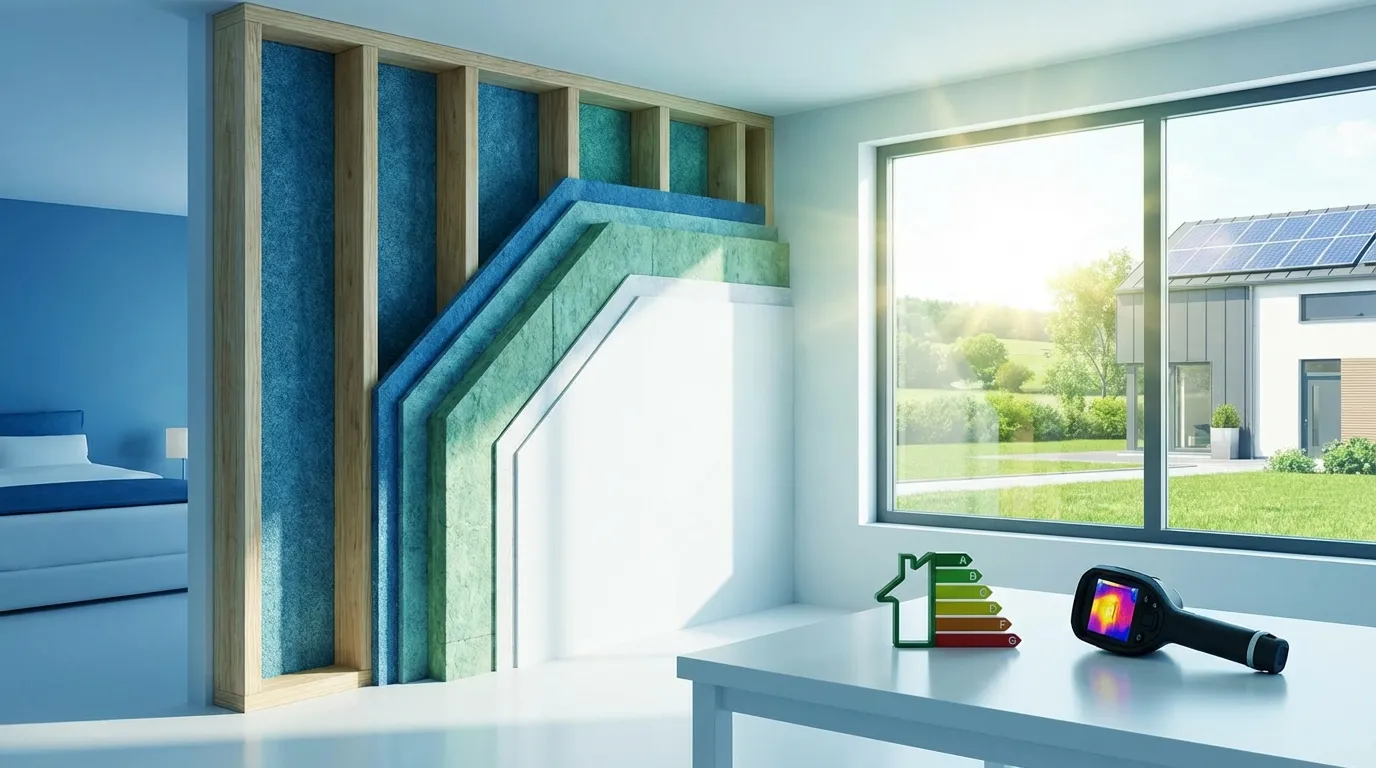
Up to 90% of U.S. homes are under-insulated, creating a pathway for conditioned air to escape and driving utility bills 15% higher than necessary. This isn't a minor leak; it's a constant drain on your finances and comfort. So addressing inadequate insulation is one of the most direct ways to lower your monthly energy expenditure and improve your home's thermal performance immediately.
What is the Average Cost of Home Insulation and Professional Installation?
Home insulation installation is a home improvement project whose total cost averages $2,500 to $7,000 in 2026. But project variables include insulation type, R-value, and home size, with professional labor comprising 40-60% of the final price for materials like spray foam and blown-in.
The cost to insulate a home varies based on material and scope. For a typical 1,500-square-foot attic, blown-in cellulose or fiberglass insulation costs between $1,500 and $3,500. And spray foam insulation, which offers a superior air seal, costs between $2,500 and $6,000 for the same area. So the material choice directly impacts the upfront investment. Wall insulation is more intensive, with costs for a 2,000-square-foot home ranging from $4,000 to $10,000. Professional installation is critical for achieving the specified R-value and ensuring there are no thermal bridges or gaps. But labor rates add $40 to $80 per hour to the project total. The final price depends on accessibility, required R-value for your climate zone, and whether old insulation must be removed, a service that adds $1.00 to $2.00 per square foot.
How Do You Qualify for Home Insulation Rebates, Tax Credits, and Eligible Brands?
Home insulation rebates are financial incentives from utilities and government programs that reduce the net cost of qualifying insulation projects by up to $1,200 annually. But eligibility for these 2026 programs requires meeting specific material and installation standards, including minimum R-values and using certified contractors for the work.
The federal Energy Efficient Home Improvement Credit (Section 25C) ended for property placed in service after December 31, 2025 (IRS FS-2025-05). Federal tax credits for this work have ended, but state, local and utility rebates may still apply; check what is available at your address with the DuloCore rebate calculator. And this credit covers 30% of the cost, up to a $1,200 annual cap. State and local utility insulation rebates have their own requirements, often specifying brands like Owens Corning, Johns Manville, or CertainTeed that carry ENERGY STAR certification. So you must check your local program’s eligible product list before purchasing materials. The application process typically requires submitting a dated invoice and proof of professional installation.
"The credit is a nonrefundable credit, which means you can’t get back more on the credit than you owe in taxes. You can’t carry forward any excess credit to future tax years." — Internal Revenue Service
What is the ROI, Lifespan, and Maintenance of Different Insulation Materials?
Insulation materials are building components with a return on investment (ROI) ranging from 5 to 10 years, driven by energy savings of 15% to 30%. But the material's lifespan, from 20 years for spray foam to over 80 years for fiberglass, directly influences its long-term value.
Fiberglass batts are a cost-effective option with a lifespan of 80-100 years and require zero maintenance if left undisturbed. So their ROI is often realized within 5-7 years. Cellulose, made from recycled paper, lasts 20-30 years but can settle over time, requiring a top-up to maintain its R-value. And its payback period is a similar 5-8 years. Spray foam insulation offers the highest R-value per inch and an indefinite lifespan of 80+ years with no maintenance, but its higher upfront cost of $2.00-$5.00 per square foot extends the ROI payback period to 7-12 years. All insulation types deliver their stated ROI only when installed correctly to create a complete air barrier, preventing thermal bridging and maximizing energy efficiency.
Which Insulation Type is Best Suited for My Climate Zone?
The best insulation type is a material that meets or exceeds the Department of Energy's recommended R-value for a specific geographic climate zone. For instance, cold climates (Zones 5-7) require attic R-values of R49-R60, while hot climates (Zones 1-2) need R30-R49 for optimal performance.
In colder northern climates like Minnesota or Maine (Zones 6-7), closed-cell spray foam or high-density fiberglass batts are ideal for preventing heat loss. Their high R-values of R-6.5 and R-3.8 per inch, respectively, provide maximum thermal resistance. And homeowners in these zones see a payback period of 5-7 years. But in mixed-humid climates like Georgia (Zone 3), blown-in cellulose or open-cell spray foam works well for attics, providing both thermal and moisture control for an R-value of R38. So selecting an insulation material with the right R-value for your specific location is the most critical factor for maximizing energy savings and qualifying for energy tax credits. (See also: insulation rebates for landlords.) (See also: insulation rebates for renters.) (See also: insulation rebates for veterans.) (See also: geothermal tax credit.) (See also: home ev charger rebate programs 2026.)
"Before you insulate, find out how much insulation you have and need. A qualified home energy assessor will include an insulation check as a routine part of a whole-house energy assessment." — U.S. Department of Energy
How Do Major Home Insulation Alternatives Compare in Cost and Efficiency?
Home insulation alternatives are energy efficiency upgrades like air sealing or radiant barriers that complement or replace traditional insulation, with costs from $300 for DIY air sealing to over $3,000 for professional radiant barrier installation. And these alternatives target different forms of heat transfer for whole-home efficiency.
Air sealing is the most cost-effective first step, costing $350 to $1,500 for a professional job that reduces drafts and improves insulation performance by 20%. And it directly addresses convective heat loss. Radiant barriers, which reflect radiant heat, are most effective in hot climates (Zones 1-3). So they are often installed in attics for $1,500-$3,500 and can lower cooling costs by 5-10%. But they provide minimal benefit in cold climates. High-performance windows are another alternative, costing $8,000-$24,000 for a whole-house replacement. They reduce thermal transfer and can lower heating and cooling bills by 12%. Each alternative addresses a different aspect of energy loss, and combining them with proper insulation yields the highest savings. Some, like air sealing, are often required to qualify for heat pump rebates.
Home Insulation Rebate & Credit Comparison
| Incentive Program | Maximum Amount | Key Eligibility | Typical Deadline |
|---|---|---|---|
| Federal Tax Credit | Ended Dec 31, 2025 | Ended Dec 31, 2025 | Ended Dec 31, 2025 |
| State Rebate (Varies) | $500 - $2,000 | Varies by state; often requires energy audit | Varies; often annual funding cycles |
| Utility Rebate (Varies) | $0.15 - $0.75 per sq. ft. | Must be a customer; professional installation | Varies; check with local utility provider |
Related Reading: Learn more about Air Leaks Common Locations Home and Crawl Space Insulation Guide.
Frequently Asked Questions
How much does it cost to insulate an average-sized home?
The cost to insulate a 1,500- to 2,000-square-foot home typically ranges from $2,500 to $7,000. And this price depends on the insulation type (fiberglass, cellulose, or spray foam), the areas being insulated (attic, walls, crawlspace), and local labor rates.
What factors influence the total price of home insulation installation?
The primary factors are the type and R-value of the insulation material, the total square footage of the area, accessibility of the space (attics vs. finished walls), and the cost of professional labor. And removing old or damaged insulation will also add $1.00-$2.00 per square foot to the total.
Are there rebates or tax credits available for new home insulation?
The federal Energy Efficient Home Improvement Credit (Section 25C) ended for property placed in service after December 31, 2025 (IRS FS-2025-05). But many state and local utility companies also offer cash rebates, so check the DSIRE database for programs in your area.
Which type of insulation offers the best long-term value and energy savings?
Spray foam insulation offers excellent long-term value due to its high R-value (R-6.5 per inch) and its function as an air and moisture barrier. So while it has a higher initial cost of $2.00-$5.00 per square foot, its 80+ year lifespan and superior performance deliver consistent energy savings.
How much can I expect to save on utility bills after upgrading my insulation?
Upgrading insulation and air sealing your home can reduce heating and cooling costs by an average of 15%, according to the EPA's ENERGY STAR program. But homes in colder climates that previously had very poor insulation can see savings of 30% or more on their monthly utility bills.
Calculate Your Rebates
Ready to Save on Your Home Improvement?
Use our free rebate calculator to find every federal, state, and utility incentive you qualify for.
Official Sources
Last updated: April 14, 2026. Reviewed by the DuloCore Editorial Team. About our authors.
Check your California insulation rebate eligibility — see the programs you qualify for and the dollar amounts on our California insulation rebate finder.