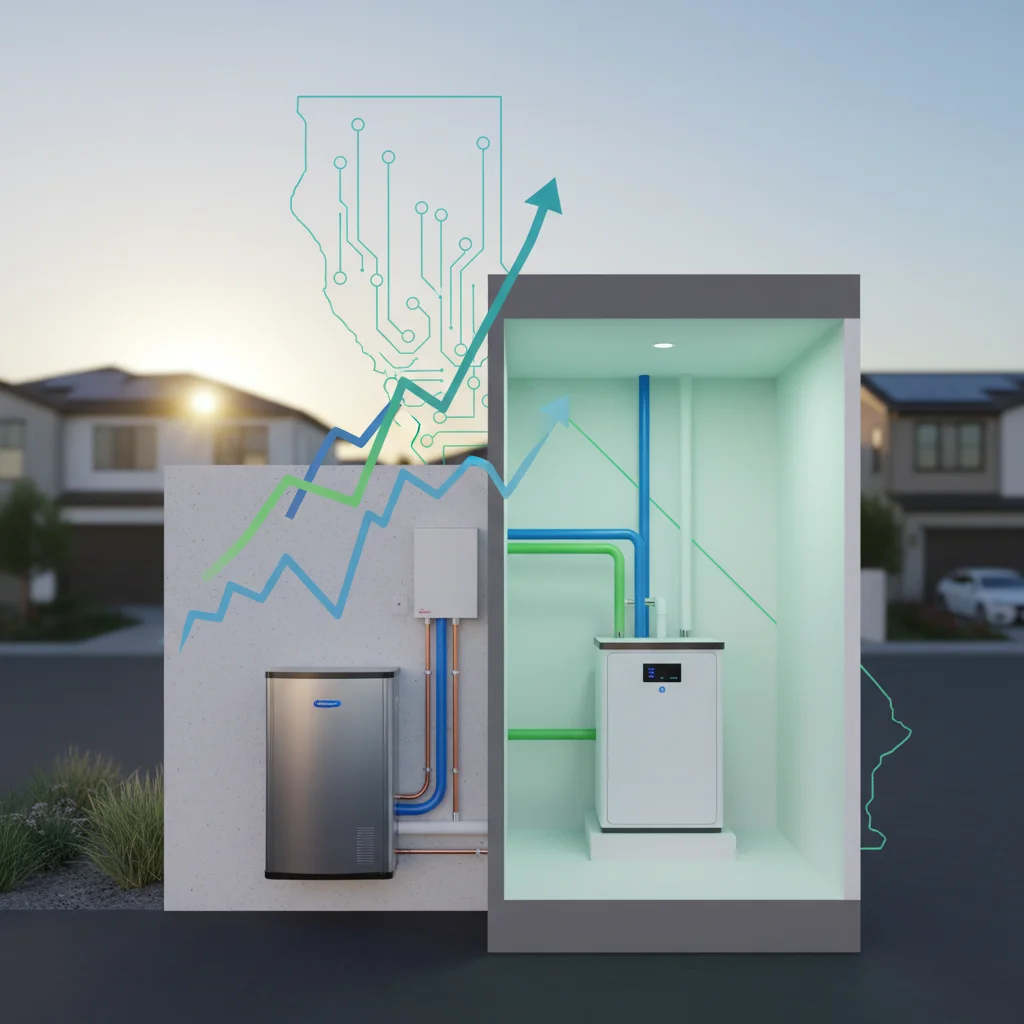
California homeowners replacing a gas furnace in 2026 face installation costs between $5,000 and $18,000 for a heat pump versus $3,000 to $10,000 for a new furnace. But federal tax credits and state rebates now cover up to $8,000 of heat pump installations, flipping the cost equation in favor of electric heating for the first time in a generation.
What is the initial cost difference between a heat pump and furnace in California?
Heat pump installations in California range from $5,000 to $18,000 depending on system capacity and efficiency ratings, while gas furnace replacements cost $3,000 to $10,000 for comparable heating output. The upfront price gap averages $4,200 statewide, with ducted heat pump systems commanding premium pricing in coastal climate zones where year-round efficiency matters most.
The federal Energy Efficient Home Improvement Credit (Section 25C) ended for property placed in service after December 31, 2025 (IRS FS-2025-05). Check current state, local and utility incentives for your address with the DuloCore rebate calculator. Central air source heat pumps with SEER2 ratings above 16 qualify for maximum federal tax benefits, while gas furnaces receive zero federal tax treatment regardless of efficiency ratings.
So the true cost comparison depends on rebate eligibility and financing availability. California's TECH Clean California program offers point-of-sale discounts up to $3,000 for income-qualified households, erasing the upfront premium entirely for families earning below 80% of area median income. Contractor quotes should itemize equipment, labor, permits, and electrical upgrades separately to identify which components qualify for federal and state incentive programs.
California's building code now requires heat pump-ready electrical panels in new construction, reducing retrofit installation costs by $800 to $1,500 compared to older homes needing panel upgrades. And coastal climate zone installations require smaller backup heating systems, lowering total project costs by 15% to 22% versus Central Valley regions with extreme summer temperatures above 105°F.
How long does it take to recoup your investment with a heat pump versus furnace?
California heat pump installations achieve payback periods between 6 and 11 years based on current natural gas and electricity rates, while gas furnaces recover costs in 12 to 18 years when factoring in maintenance and efficiency degradation. Households with solar panels or time-of-use electricity rates see faster returns, with breakeven points reaching 4 to 7 years in PG&E and SCE territories.
Heat pumps deliver operational savings of $600 to $1,400 annually compared to 80% AFUE gas furnaces, with greatest returns in climate zones requiring both heating and cooling throughout the year. And the federal tax credit accelerates payback by effectively reducing the purchase price by 30%, shortening the return timeline by 2 to 3 years for qualified installations above $10,000.
California's Self-Generation Incentive Program adds battery storage rebates up to $1,000 per kWh, allowing heat pump owners to store cheap off-peak electricity and eliminate peak-rate exposure that historically made electric heating expensive. But gas furnace owners face rising carbon fees under California's cap-and-trade program, adding $40 to $90 annually to operating costs through 2030 as emission allowance prices climb.
The payback calculation shifts dramatically in homes requiring air conditioning upgrades within the next 5 years. Heat pumps eliminate the need for separate cooling equipment costing $4,000 to $7,000, effectively cutting the incremental heat pump investment to under $1,000 after rebates in retrofit scenarios. Use our free rebate calculator to model your specific payback timeline based on current utility rates and available incentives.
What is the typical lifespan of heat pumps compared to furnaces in California?
Modern heat pumps installed in California climate zones operate 15 to 20 years with proper maintenance, while gas furnaces last 18 to 25 years under identical service schedules and usage patterns. The lifespan gap narrows to statistical insignificance when comparing cold-climate heat pumps with backup resistive heating to high-efficiency condensing furnaces requiring annual combustion analysis.
And heat pump compressor warranties now match furnace heat exchanger coverage at 10 to 12 years for premium tier equipment, eliminating the historical reliability advantage gas systems held through the 2010s. Coastal installations experience longer equipment life by 2 to 4 years due to milder temperature extremes reducing compressor cycling frequency compared to Central Valley locations with 100°F+ summer peaks.
California's marine air requires corrosion-resistant coil treatments adding $300 to $600 to heat pump costs but extending coastal system life to match or exceed inland furnace longevity. So lifecycle cost analysis must account for replacement timing and residual value, not just initial purchase and annual operating expenses.
Heat pumps maintain 90% to 95% of rated efficiency throughout their service life, while gas furnace efficiency degrades 8% to 12% over 20 years as heat exchangers accumulate carbon deposits and burner assemblies corrode. And electric heating systems avoid carbon monoxide risks entirely, eliminating annual safety inspection requirements costing $120 to $180 that California gas furnace owners face under state combustion appliance codes.
What rebates and tax credits can reduce your heat pump installation costs?
The federal Residential Clean Energy Credit (Section 25D) ended for expenditures made after December 31, 2025, and the IRS treats an expenditure as made when installation is completed (IRS FS-2025-05). Federal tax credits for this work have ended, but state, local and utility rebates may still apply; check what is available at your address with the DuloCore rebate calculator. California's TECH Clean California program offers $3,000 point-of-sale rebates for income-qualified households plus $500 contractor incentives, stacking with federal benefits to cover 50% to 70% of total project costs. (Note: Federal tax credit percentages and availability are subject to change; the 30% Residential Clean Energy Credit under Section 25D expired December 31, 2025. Verify current incentives at energy.gov.)
| Program | Amount | Eligibility | Application Deadline |
|---|---|---|---|
| Federal Residential Clean Energy Credit | Ended Dec 31, 2025 | — | Ended Dec 31, 2025 |
| TECH Clean California | $3,000 point-of-sale | Income ≤80% AMI | December 31, 2026 |
| Bay Area Regional Energy Network | $2,000 | PG&E customers | Funds exhausted quarterly |
And utility-specific programs layer additional savings on top of federal and state incentives. PG&E's Energy Efficiency Rebate offers $2,500 for cold-climate heat pumps with HSPF2 ratings above 9.0, while SCE provides $3,000 for whole-home electrification projects replacing both gas furnaces and water heaters simultaneously.
The federal Residential Clean Energy Credit (Section 25D) ended for expenditures made after December 31, 2025, and the IRS treats an expenditure as made when installation is completed (IRS FS-2025-05).
But rebate availability changes quarterly as program budgets exhaust, requiring homeowners to verify current funding before signing contractor agreements. BayREN's $2,000 heat pump rebate depleted in June 2025 and hasn't reopened, while TECH Clean California maintains consistent funding through California Public Utilities Commission allocations refreshed annually.
California's low-income weatherization assistance program combines heat pump installations with insulation upgrades and air sealing at zero cost to qualified households earning below 60% of area median income. Check your eligibility for energy tax credits and heat pump rebates through the state's income verification portal before requesting contractor bids.
How do maintenance costs compare between heat pumps and furnaces over time?
Heat pump annual maintenance costs $180 to $280 in California markets, while gas furnace service runs $120 to $200 for comparable cleaning and inspection protocols. The $60 to $80 annual premium reflects additional refrigerant leak checks, reversing valve testing, and defrost cycle calibration required for equipment providing both heating and cooling functions.
And heat pumps require filter changes every 60 to 90 days during peak usage seasons versus quarterly replacement intervals for furnaces, adding $40 to $60 annually in consumable costs. California's coastal humidity accelerates coil corrosion requiring professional cleaning every 2 to 3 years at $200 to $350 per service, while inland furnaces need heat exchanger inspection at identical intervals for $150 to $250.
But gas furnaces incur burner assembly replacement every 8 to 12 years costing $400 to $700, while heat pump compressor warranties cover major component failures through year 10 on premium equipment. So lifecycle maintenance costs converge at $3,200 to $4,800 over 15 years for both technologies when factoring in major repair probabilities and warranty coverage.
Heat pumps eliminate combustion safety risks entirely, avoiding annual carbon monoxide testing fees of $120 to $180 mandated by California mechanical codes for gas appliances. And electric heating systems don't require flue inspections or gas line leak detection, reducing total compliance costs by $200 to $300 over the equipment's service life.
California contractors report 15% to 20% lower emergency repair call rates for heat pumps versus furnaces during the 5-to-10-year service window when manufacturer warranties expire but equipment hasn't reached end-of-life failure patterns. Don't overlook preventive maintenance agreements offering priority service and discounted repairs for $200 to $350 annually from licensed HVAC contractors.
Which option provides better long-term value for California homeowners?
Heat pumps deliver superior long-term value for California homeowners when total lifecycle costs include purchase price, operating expenses, maintenance, and equipment replacement timing over 20 years. The combination of state rebates up to $3,000 and annual energy savings of $600 to $1,400 creates a lifecycle cost advantage over gas furnace installations; the federal 25C credit ended for property placed in service after December 31, 2025 (IRS FS-2025-05).
And heat pumps provide both heating and cooling from a single system, eliminating separate air conditioner purchases costing $4,000 to $7,000 that furnace owners face in California's dual-season climate zones. Homes requiring cooling equipment within 5 years of furnace installation see heat pump net savings jump to $8,000 to $14,000 when avoiding redundant HVAC investments.
California's climate action goals introduce financial risk to gas appliances through rising carbon fees and potential fossil fuel infrastructure abandonment as utilities reduce natural gas service territories. Heat pump owners avoid exposure to carbon allowance price increases projected to add $120 to $280 annually to gas heating costs by 2030 under the state's cap-and-trade program expansion.
But furnaces maintain value advantages in specific scenarios: rental properties with split utility bills where landlords pay installation costs but tenants cover operating expenses, homes lacking 200-amp electrical service where panel upgrades add $2,000 to $3,500 to heat pump projects, and properties within 3 to 5 years of sale where owners won't capture long-term efficiency returns.
So the optimal choice depends on homeowner tenure plans, existing electrical infrastructure, and climate zone characteristics. Coastal regions with mild winters and moderate summers see fastest heat pump returns, while extreme climate zones may justify dual-fuel systems combining heat pumps with backup furnaces for peak demand periods below 25°F outdoor temperatures.
Official Sources
- U.S. Department of Energy - Energy Saver — Federal guidance on heat pump technology, efficiency standards, and rebate programs
- ENERGY STAR Heat Pumps — Certification requirements and qualified equipment database for federal tax credit eligibility (note: the federal 25C and 25D credits ended for projects completed after December 31, 2025)
- DSIRE USA — Comprehensive state and utility incentive database tracking California heat pump rebates and financing programs
Related Reading: Learn more about Mini Split Vs Central Ac California.
Frequently Asked Questions
What is the cost difference between a heat pump and furnace in California?
Heat pumps cost $5,000 to $18,000 installed in California versus $3,000 to $10,000 for gas furnaces, creating an upfront premium of $2,000 to $8,000 before rebates. The federal Energy Efficient Home Improvement Credit (Section 25C) ended for property placed in service after December 31, 2025 (IRS FS-2025-05). And California's TECH Clean California program provides $3,000 point-of-sale rebates for income-qualified households, erasing the upfront cost difference entirely for families earning below 80% of area median income.
Are heat pumps more expensive to install than furnaces?
Heat pump installations require electrical service upgrades costing $800 to $3,500 in homes with insufficient panel capacity, while furnaces connect to existing gas lines without electrical work. But homes requiring air conditioning within 5 years see heat pumps deliver net savings by eliminating separate cooling system purchases of $4,000 to $7,000. Total installation costs converge when factoring in federal tax credits and state rebates that apply exclusively to electric heating equipment under 2026 incentive programs.
Do I qualify for California heat pump rebates in 2026?
California heat pump rebates in 2026 require heat pump installations meeting ENERGY STAR certification standards with HSPF2 ratings above 8.0 for federal tax credits and 9.0 for premium state incentives. TECH Clean California offers $3,000 rebates to households earning below 80% of area median income, while utility programs provide $2,000 to $3,000 regardless of income in PG&E and SCE territories. The federal Residential Clean Energy Credit (Section 25D) ended for expenditures made after December 31, 2025, and the IRS treats an expenditure as made when installation is completed (IRS FS-2025-05).
How much can I save with a heat pump rebate compared to a furnace?
Heat pump rebates reduce installation costs by $5,000 to $11,000 through combined federal tax credits and California state programs, while gas furnaces qualify for zero rebates under current 2026 incentive structures. The federal government provides 30% back on qualified heat pump installations up to $8,000, and California's TECH program adds $3,000 for income-qualified households. And annual operating cost savings of $600 to $1,400 compound over the equipment's 15-to-20-year lifespan, creating total lifecycle savings of $14,000 to $32,000 compared to gas furnace ownership.
What is the deadline for California heat pump tax credits and rebates?
The federal Energy Efficient Home Improvement Credit (Section 25C) ended for property placed in service after December 31, 2025 (IRS FS-2025-05). California's TECH Clean California program operates through December 31, 2026, under current funding allocations with annual renewals subject to California Public Utilities Commission approval. But utility-specific rebates exhaust quarterly when budget caps are reached, requiring homeowners to verify current availability through program websites before signing installation contracts with HVAC contractors.
Ready to compare your costs? Use our free rebate calculator to estimate your total heat pump installation costs after federal tax credits and California state rebates. Get personalized savings projections based on your climate zone, income level, and current heating system in under 60 seconds.
Updated on April 14, 2026. Fact-checked by DuloCore Editors. About our research team.
Check your California heat pump rebate eligibility — see the programs you qualify for and the dollar amounts on our California heat pump rebate finder.