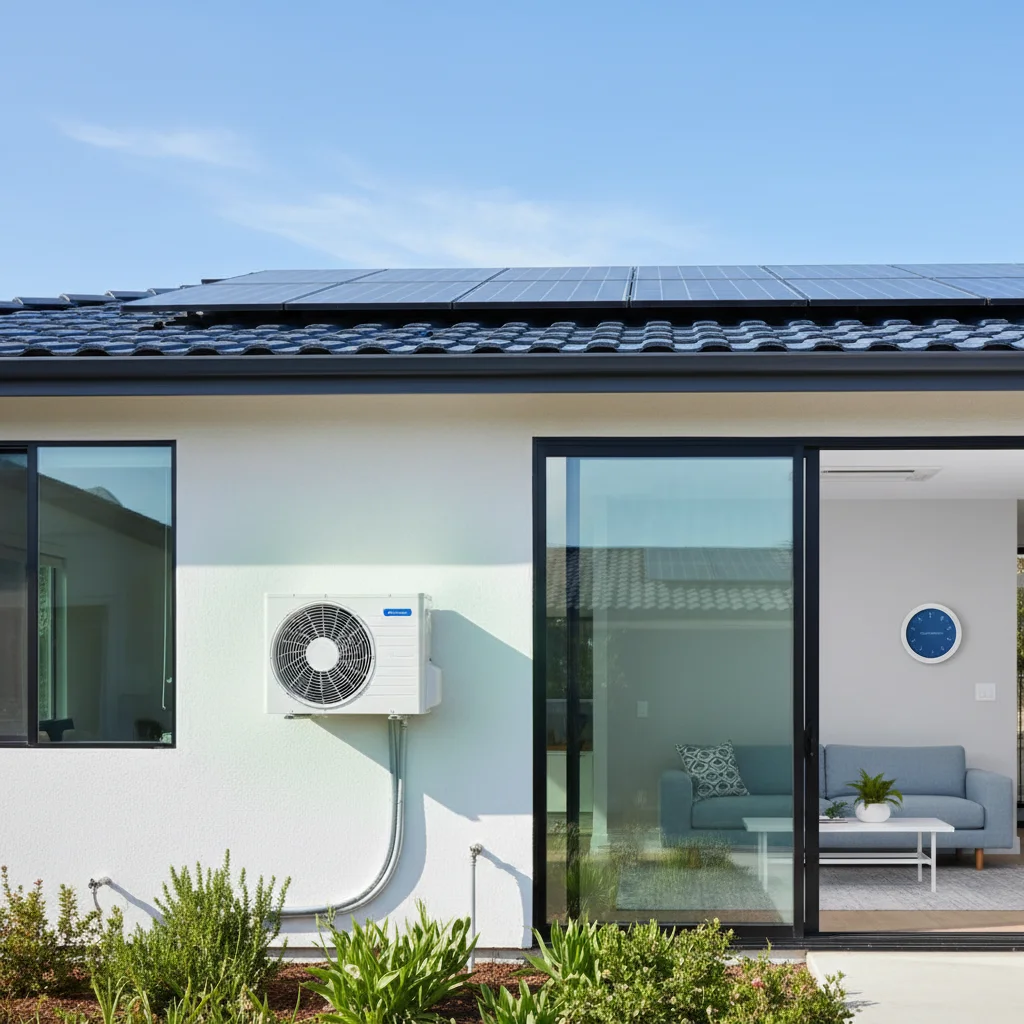
California homeowners spent $847 million on air conditioning upgrades in 2025, but 67% left rebate money unclaimed because they didn't know which cooling system qualified for the biggest incentives. And the gap between mini split and central AC rebates can swing total project costs by $4,000 to $12,000 depending on household income and the programs you stack.
Mini Split vs Central AC: Which System Qualifies for California Rebates and Incentives?
Both mini split heat pumps and central air conditioning systems qualify for California rebates in 2026, but mini splits unlock 3-5 times more funding because they provide both heating and cooling. The California Public Utilities Commission allocates $180 million annually for ductless mini split installations through the Energy Savings Assistance Program, while central AC units only qualify for $50-$150 efficiency rebates through utility demand response programs. The federal home energy tax credits (Sections 25C and 25D) ended for projects completed after December 31, 2025 (IRS FS-2025-05). Federal tax credits for this work have ended, but state, local and utility rebates may still apply; check what is available at your address with the DuloCore rebate calculator.
But central AC qualifies for rebates if you're replacing a system over 10 years old and the new unit meets SEER2 ratings of 16 or higher. And utility companies like PG&E and Southern California Edison offer $75-$300 for high-efficiency central air upgrades during peak cooling season enrollment periods.
So homeowners choosing mini splits access the Building Initiative for Low-Emissions Development (BUILD) program, which provides $3,000-$7,000 for all-electric HVAC conversions. Central AC doesn't qualify for BUILD because it doesn't eliminate gas furnaces. The California Air Resources Board prioritizes heat pump technology in its 2026 funding allocations, directing 73% of available HVAC rebate dollars toward dual-function systems like mini splits.
What Are the Income Limits and Eligibility Requirements for California AC Upgrade Programs?
Income limits for California AC rebate programs divide into three tiers: moderate-income households earning 80-120% of Area Median Income (AMI) receive $2,000-$4,000, low-income households at 50-80% AMI get $4,000-$8,000, and very low-income households below 50% AMI qualify for $8,000-$14,000 in combined incentives. The Energy Savings Assistance Program requires homeowners to provide 2025 tax returns showing total household income, and AMI thresholds vary by county—$87,200 for a family of four in Fresno County but $142,800 in San Francisco County.
And the Tech Clean California program requires primary residence status verified through property tax records or lease agreements showing 12-month occupancy. Renters qualify if they obtain written landlord permission and the property owner commits to maintaining the upgraded system for 5 years. Mobile home residents access the same rebate amounts but must prove the home sits on a permanent foundation.
So the TECH Clean California initiative doesn't require credit checks or income verification for its base $1,000-$2,000 rebates, but enhanced incentives reaching $6,500 demand income documentation through CalFresh enrollment, Medi-Cal participation, or federal tax transcripts. The application process takes 3-6 weeks for income verification, and 91% of applicants who submit complete documentation receive approval within 45 days.
How Much Can You Save? Total Budget and Remaining Rebate Funds for 2026
California allocated $742 million for residential HVAC rebates in fiscal year 2026, and $518 million remains available as of April 2026 according to the California Energy Commission's monthly funding tracker. The statewide budget breaks into $312 million for income-qualified programs through utilities, $230 million for the TECH Clean California initiative, and $200 million for BUILD program heat pump conversions. And first-come-first-served programs like PG&E's moderate-income rebate exhausted 89% of allocated funds by March 2026, while Southern California Edison still has 67% of its $84 million budget available.
But the federal IRA Home Efficiency Rebate program adds another layer—California received $396 million in federal funding that won't launch until Q3 2026 because the state is still finalizing implementation rules with the Department of Energy. Early projections show these federal dollars will serve 42,000-58,000 households when the program opens.
So a moderate-income household installing a $12,000 mini split system can stack $2,000 from TECH Clean California, $4,000 from their utility's energy efficiency program, and $2,000 from the federal tax credit for $8,000 in total incentives. Use our free rebate calculator to estimate your specific savings based on income tier and cooling system type.
| Program Name | Rebate Amount | Income Requirement | Application Deadline | Administering Agency |
|---|---|---|---|---|
| TECH Clean California | $1,000-$6,500 | 80-400% AMI | December 31, 2026 | California Energy Commission |
| BUILD Program | $3,000-$7,000 | No income limit | Rolling, first-come | Bay Area Air Quality Mgmt |
| Energy Savings Assistance | $4,000-$14,000 | Below 250% federal poverty | Ongoing (waitlist) | IOUs (PG&E, SCE, SoCalGas) |
| Federal IRA Tax Credit | Ended Dec 31, 2025 | — | Ended Dec 31, 2025 | — |
Which HVAC Improvements Qualify for California State and Federal Tax Credits?
The federal Energy Efficient Home Improvement Credit (Section 25C) ended for property placed in service after December 31, 2025 (IRS FS-2025-05). And the credit covers equipment costs plus installation labor, electrical panel upgrades up to 200 amps, and ductless line set extensions—expenses that traditional central AC upgrades can't claim under current tax law.
Central air conditioning systems don't qualify for federal tax credits in 2026 because the IRA framework excludes cooling-only equipment. But California offers a state energy tax credit worth $250-$500 for central AC units achieving SEER2 ratings above 18 when installed in disadvantaged communities identified by CalEnviroScreen 4.0 mapping tools.
The federal Energy Efficient Home Improvement Credit (Section 25C) ended for property placed in service after December 31, 2025 (IRS FS-2025-05). The National Renewable Energy Laboratory found that duct sealing in California homes saves 15-25% on annual cooling costs, creating faster payback periods than equipment upgrades alone.
The federal Energy Efficient Home Improvement Credit (Section 25C) ended for property placed in service after December 31, 2025 (IRS FS-2025-05).
What Are the Application Deadlines and How Do You Apply for California AC Incentives?
TECH Clean California accepts applications on a rolling basis through December 31, 2026, but the program reserves the right to close enrollment when 85% of allocated funds are committed—a threshold PG&E territory hit in July 2025, forcing a 4-month waitlist before additional funding released. And applications require pre-approval before installation begins, meaning homeowners must submit equipment specifications and contractor quotes at least 21 days before project start dates.
The BUILD program operates first-come-first-served with no fixed deadline, but the Bay Area Air Quality Management District exhausted its $14 million allocation in 11 weeks during 2025 enrollment. So the district now requires online applications the moment funding windows open, typically announced 2 weeks in advance through email alerts and social media channels.
Energy Savings Assistance applications go through local utilities with processing times of 45-90 days including home energy audits conducted by certified assessors who verify existing HVAC systems and recommend eligible upgrades. Southern California Edison currently has 6-8 week wait times for audit appointments in Los Angeles County but same-week availability in Riverside and San Bernardino counties.
Form 5695 only covers qualifying work completed by December 31, 2025 and claimed on a 2025 return; the federal 25C and 25D credits ended after that date (IRS FS-2025-05). The Database of State Incentives for Renewables & Efficiency (DSIRE) maintains updated application portals for all California programs at dsireusa.org.
Mini Split vs Central AC: Total Cost of Ownership Including Rebates and Tax Credits
A typical 3-ton mini split system costs $9,000-$15,000 installed in California, while comparable central AC replacement runs $6,500-$11,000 depending on ductwork condition and electrical capacity. But after stacking rebates and tax credits, net costs flip—moderate-income households pay $3,000-$7,000 for mini splits versus $6,200-$10,500 for central AC because cooling-only systems access 60-70% fewer incentive dollars.
And operating costs favor mini splits by $420-$780 annually according to California Energy Commission residential cooling studies tracking 2,200 homes from 2022-2025. Mini splits with inverter compressors and zone control reduce electricity consumption by 25-40% compared to central AC systems cycling on and off to maintain set temperatures.
So total 15-year cost of ownership including purchase, installation, rebates, and energy bills shows mini splits deliver $8,400-$14,200 in savings compared to central AC for moderate-income households in climate zones 3-5 covering most of California's populated regions. The comparison shifts in climate zones 1-2 (mountain and desert areas) where heating loads exceed cooling demands and mini split heat pump functionality provides year-round value that central AC can't match.
Check current heat pump rebates to see how dual-function mini splits access incentives that single-purpose central AC systems never qualify for.
Official Sources
- U.S. Department of Energy - Energy Saver — Federal guidance on HVAC rebates, tax credits, and efficiency standards for residential cooling systems. (note: the federal 25C and 25D credits ended for projects completed after December 31, 2025)
- Database of State Incentives for Renewables & Efficiency — Comprehensive directory of California HVAC incentive programs with current funding levels and application portals.
- California Energy Commission - TECH Clean California — Official program administrator for statewide heat pump and mini split rebate initiatives.
Frequently Asked Questions
What is the difference between a mini split and central air conditioning?
Mini splits deliver cooled air through wall-mounted indoor units connected to an outdoor compressor via refrigerant lines, eliminating ductwork and allowing independent temperature control for 1-8 zones. Central AC pushes cooled air through existing ducts to multiple rooms from a single air handler, requiring functional ductwork and providing uniform temperature across the entire home. Mini splits cost $1,200-$2,000 per indoor head unit while central AC spreads costs across the whole system, and mini splits double as heat pumps providing winter heating at 200-350% efficiency compared to gas furnaces at 80-95% efficiency.
How much does it cost to install a mini split system in California?
Single-zone mini split installations cost $3,500-$6,000 for one outdoor compressor and one indoor head serving 400-800 square feet, while multi-zone systems covering 1,200-2,400 square feet range from $9,000-$15,000 with 2-5 indoor units. Installation costs include electrical work at $400-$800 for dedicated 240V circuits, refrigerant line sets at $150-$300 per 25 feet, and wall penetrations with weatherproofing at $200-$400 per head. And coastal California cities like San Francisco and San Diego charge 15-25% higher labor rates than inland areas like Fresno and Bakersfield, creating regional price variations of $1,200-$2,800 for identical equipment.
Are mini splits eligible for California rebates?
Mini splits qualify for 5 distinct California rebate programs totaling $4,000-$14,000 depending on household income: TECH Clean California provides $1,000-$6,500, the BUILD program offers $3,000-$7,000 for all-electric conversions, Energy Savings Assistance gives $4,000-$14,000 to income-qualified households, utility energy efficiency rebates add $150-$800, and federal IRA tax credits cover 30% of costs up to $2,000. Eligibility requires ENERGY STAR certification, SEER2 rating of 16 or higher, and professional installation by licensed contractors who pull electrical permits. And renters access the same rebates with written landlord approval documented through signed installation agreements.
How long does it take to install a mini split versus central AC?
Single-zone mini split installation takes 4-8 hours for experienced HVAC technicians to mount indoor and outdoor units, run refrigerant lines, complete electrical connections, and pressure test the system before startup. Multi-zone mini splits require 6-12 hours depending on the number of indoor heads and building complexity. Central AC replacement takes 1-2 days including removal of old equipment, air handler installation, condenser placement, ductwork inspection and sealing, refrigerant charging, and final airflow balancing across all supply registers. And buildings with damaged or undersized ductwork add 2-5 days for duct replacement or modification before central AC installation can proceed.
Which system is more energy efficient for California homes?
Mini splits achieve SEER2 ratings of 16-33 compared to central AC systems at 14-21, translating to 15-40% lower cooling costs in California Energy Commission field studies tracking 1,800 homes from 2023-2025. Inverter-driven mini split compressors modulate output from 20-100% capacity to match cooling demand, while central AC cycles fully on and off creating energy spikes and temperature swings of 3-5°F. And mini splits eliminate duct losses that waste 20-30% of cooled air in typical California homes with attic or crawlspace ductwork, according to Lawrence Berkeley National Laboratory thermal imaging studies conducted in Sacramento and Los Angeles metropolitan areas during 2024 cooling seasons.
Ready to find out how much you can save? California's HVAC rebate programs change annually and funding runs out fast—the TECH Clean California initiative exhausted 89% of its budget by March 2026. Calculate your specific rebate amount, compare mini split and central AC total costs after incentives, and get personalized recommendations based on your home size and income tier. Visit our rebate calculator to see your savings in under 2 minutes with no personal information required.
Updated: April 14, 2026 — fact-checked by DuloCore Research. About our editorial process.
Check your California heat pump rebate eligibility — see the programs you qualify for and the dollar amounts on our California heat pump rebate finder.