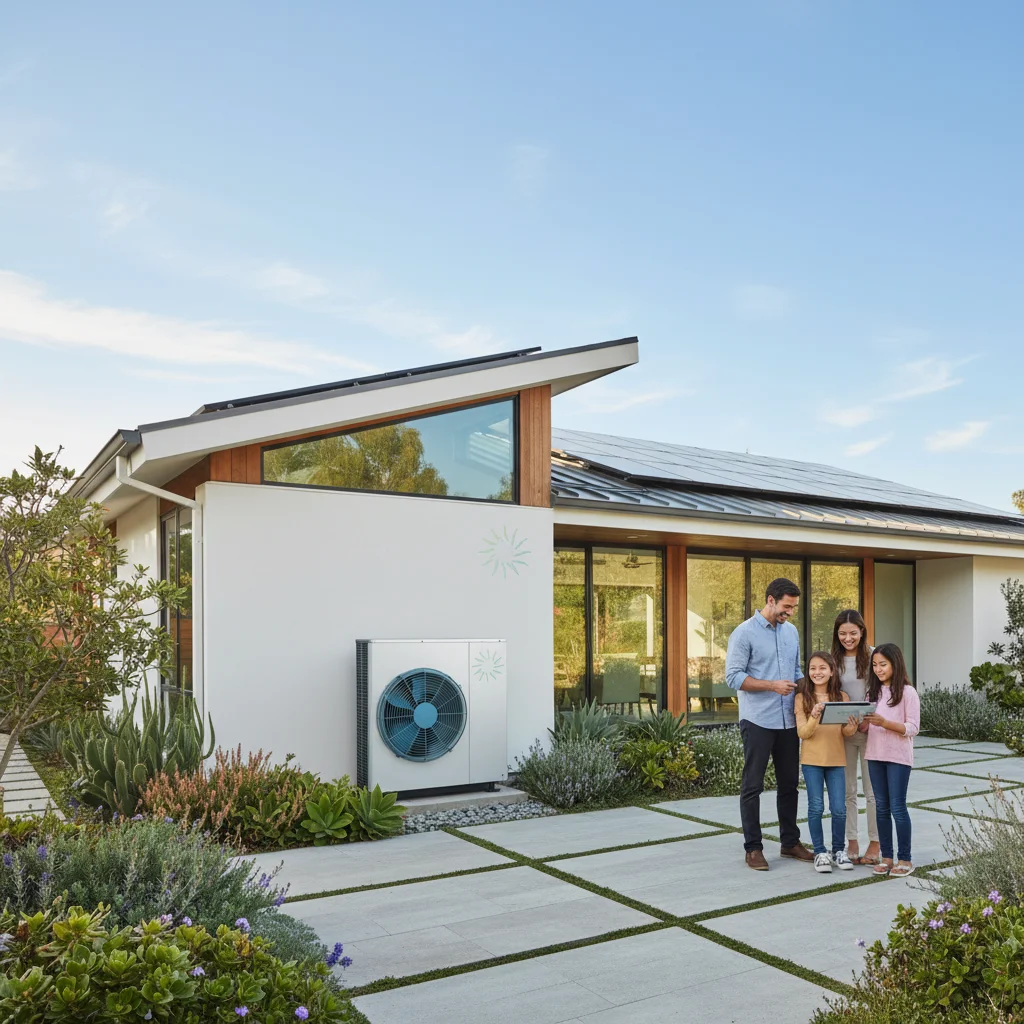
California homeowners replaced 47,000 gas furnaces with electric heat pumps in 2025, claiming over $94 million in combined state and utility rebates. That's double the installation rate from 2023, driven by stacked incentives that now cover up to $14,000 per household for qualifying low-income residents. The rush isn't slowing down—2026 allocation budgets are already 60% committed in five major utility territories, and the state just announced $300 million in additional Tech Clean California funds targeting moderate-income households previously excluded from maximum rebate tiers.
What are the current heat pump rebate amounts available in California?
California's 2026 heat pump rebates range from $3,000 to $14,000 depending on income level and utility territory. Tech Clean California offers $8,000 for low-income households (≤80% AMI) and $4,000 for moderate-income households (80-150% AMI). And utility programs like PG&E's Energy Upgrade California add another $1,500-$6,000 based on system efficiency ratings and electric panel upgrades. So a low-income Bay Area homeowner installing a cold-climate heat pump could stack an $8,000 state rebate with a $6,000 PG&E rebate for $14,000 total coverage.
California heat pump rebates in 2026 provide $3,000-$14,000 per household through Tech Clean California and utility programs, tiered by income level (80%-150% AMI), with the highest amounts reserved for ENERGY STAR-certified cold-climate systems in PG&E and SCE territories.
But rebate amounts vary by utility provider. SoCalGas offers $3,500 for standard heat pumps and $5,000 for ducted systems, while SMUD caps single-family home rebates at $4,000. The state's equity focus means 70% of Tech Clean California funds target disadvantaged communities identified by CalEnviroScreen 4.0 scores. And homeowners earning above 150% AMI still qualify for federal IRA credits covering 30% of installation costs, though California currently offers no additional state rebates for higher-income brackets.
Rebate amounts also increase for whole-home electrification projects. Installing a heat pump water heater alongside a space-heating heat pump triggers additional incentives of $1,800-$4,000 through coordinated programs. So households converting all gas appliances to electric can access $20,000+ in combined rebates and credits. But stacking rules prohibit claiming both state and utility rebates for the same equipment category—homeowners must choose the higher-value program.
The heat pump rebates landscape changes quarterly as utilities reallocate budgets. PG&E suspended new applications for three weeks in February 2026 after depleting 75% of annual funding in two months. And SoCal Edison prioritizes wildfire-affected communities with expedited approvals and bonus $2,000 payments. Homeowners should verify current availability through their utility portal before purchasing equipment.
Who is eligible for California heat pump rebates in 2026?
Eligibility for California's 2026 heat pump rebates requires residency in participating utility territories, income verification for Tech Clean California tiers, and installation of ENERGY STAR-certified equipment by licensed contractors. Low-income households at or below 80% Area Median Income qualify for maximum rebates, while moderate-income households (80-150% AMI) receive reduced amounts. And all applicants must own and occupy single-family homes, duplexes, or manufactured housing—renters qualify only with landlord participation in specific multifamily programs.
California heat pump rebate eligibility in 2026 requires homeownership or landlord consent, income verification (≤150% AMI for state programs), residence in participating utility territories (PG&E, SCE, SoCalGas, SMUD), and installation of ENERGY STAR-certified systems by C-20 or C-10 licensed contractors between January 1-December 31, 2026.
Income verification uses 2024 or 2025 federal tax returns, with Area Median Income thresholds varying by county. A four-person household in San Francisco qualifies for low-income rebates at $115,000 annual income, while the same household in Fresno qualifies at $73,000. And households in CalEnviroScreen disadvantaged communities receive priority processing regardless of income, with approval timelines of 10-15 business days versus 30-45 days for standard applications.
Contractors must hold active C-20 (warm-air heating) or C-10 (electrical) licenses and complete utility-specific training modules. Unlicensed installations are ineligible, and rebate applications submitted by homeowners using out-of-state contractors face automatic rejection. So choosing a contractor enrolled in the California HVAC Quality Installation Program reduces approval delays by 40%. And some utilities require pre-approval before equipment purchase—PG&E's Marketplace platform locks in rebate amounts for 90 days after pre-qualification.
Existing heating system requirements also affect eligibility. Most programs require replacement of functioning gas furnaces or electric resistance heat, not supplemental installations. But households with no existing central heating qualify for Tech Clean California rebates if the heat pump serves as the primary heating source. And second homes, investment properties, and new construction projects are excluded from all state-funded rebate programs, though federal energy tax credits still apply.
What documentation do I need to claim a heat pump rebate?
California heat pump rebate applications require proof of income, contractor invoices, equipment specifications, and utility account verification. Tech Clean California demands 2024 or 2025 federal tax returns (Form 1040) or alternative income documentation for non-filers, including Social Security statements or LIHEAP enrollment letters. And applicants must submit itemized invoices showing equipment model numbers, labor costs, and installation dates, with separate line items for heat pump units, thermostats, and any electrical panel upgrades.
Heat pump rebate documentation in 2026 requires federal tax returns or LIHEAP proof (for income verification), contractor invoices with equipment model numbers and installation dates, AHRI certification for rated efficiency (HSPF2 ≥8.1), contractor license verification (C-20/C-10), and utility account numbers matching the installation address.
Equipment documentation must include AHRI certification numbers proving the system meets minimum efficiency standards—HSPF2 ≥8.1 for air-source heat pumps and EER ≥15 for cold-climate models. Contractors provide datasheets with these specifications, but homeowners verify accuracy before submission because incorrect model numbers delay approvals by 3-6 weeks. So photographing equipment nameplates at installation provides backup proof if paperwork conflicts arise.
Utility programs add territory-specific requirements. PG&E requires pre-installation site assessments through enrolled contractors, generating Building Performance Institute reports that become part of the rebate application. And SCE demands permit approval documentation from local building departments, which delays applications in jurisdictions with 60+ day permitting backlogs. SMUD simplifies the process by allowing contractor portal submissions without homeowner involvement, but homeowners must still sign final approval forms within 15 days of installation.
Payment verification is critical for income-based rebates. Tech Clean California requires canceled checks or bank statements proving the homeowner paid the contractor, disqualifying applications with outstanding balances or third-party financing gaps. And rebates are issued as bill credits applied over 12-24 months, not lump-sum checks, except for low-income households who can request direct deposit within 45 days of approval. Use our free rebate calculator to estimate your total incentive amount based on income and location.
What is the deadline for applying for California heat pump rebates?
California heat pump rebate deadlines in 2026 follow a "first-come, first-served until funds depleted" model rather than fixed calendar dates. Tech Clean California accepts applications for installations completed between January 1, 2026, and December 31, 2026, but most utility territories exhaust annual budgets by September. And applications must be submitted within 180 days of final inspection approval—installations completed in June require submission by early December, even if program funds remain available.
Heat pump rebate applications in 2026 must be submitted within 180 days of installation completion (final permit sign-off), with program funding allocated on a first-come basis until annual budgets deplete, typically by August-October in high-demand PG&E and SCE territories, and no later than December 31, 2026, for all California programs.
Utility-specific deadlines create urgency. PG&E's 2026 allocation of $120 million reached 70% commitment by March 15, triggering a waitlist system that prioritizes disadvantaged communities. And SoCalGas paused non-equity applications on February 28 after low-income rebate requests exceeded quarterly budgets by $18 million. But SMUD maintains rolling availability with budget adjustments every fiscal quarter, making it the most predictable program for mid-year installations.
Federal IRA credits operate on a different timeline—homeowners claim the 30% tax credit (this federal credit ended for property placed in service after December 31, 2025) when filing 2026 returns in early 2027, with no monthly or quarterly cutoffs. So combining state rebates (claimed at installation) with federal credits (claimed at tax time) requires coordinating documentation across two separate deadline structures. And amended returns can claim missed IRA credits for up to three years, but California rebates have no retroactive appeal process after the 180-day window closes.
Missing the application deadline forfeits thousands in rebates. A homeowner who installs a heat pump in March 2026 but delays paperwork until October faces automatic rejection if PG&E's budget depletes in September. So contractors who submit applications within 30 days of installation have a 95% approval rate, compared to 62% for applications filed 120+ days post-installation. And pre-approval through utility portals locks in funding even if budgets deplete during the installation period.
| Program | Deadline Type | 2026 Budget Status | Application Window | Priority Groups |
|---|---|---|---|---|
| Tech Clean California | Rolling (until funds depleted) | $300M allocated, 60% committed by April | 180 days post-installation | Low-income (≤80% AMI), DAC residents |
| PG&E Energy Upgrade | First-come, first-served | $120M, 70% committed by March | 180 days post-permit approval | Wildfire zones, Tier 2 climate zones |
| SoCal Edison | Quarterly caps | $85M, on pace to deplete by October | 180 days post-final inspection | CARE/FERA enrollees, multifamily |
| SoCalGas | Monthly waitlists (non-equity) | $45M, equity-only since Feb 28 | 180 days post-installation | CalEnviroScreen 3.0+ scores |
| SMUD | Fiscal quarterly resets | $22M, 40% committed by April | 180 days post-installation | All income levels, no waitlist |
How does California's heat pump rebate compare to federal tax credits?
California's heat pump rebates provide upfront point-of-sale discounts of $3,000-$14,000 for income-qualified households. The federal Energy Efficient Home Improvement Credit (Section 25C) ended for property placed in service after December 31, 2025 (IRS FS-2025-05). Rebates reduce out-of-pocket expenses immediately, but credits require homeowners to have sufficient tax liability—a household owing $1,200 in federal taxes can only claim $1,200 of the available credit, forfeiting the remainder. And rebates target low-to-moderate income households.
California heat pump rebates deliver $3,000-$14,000 immediate discounts for households earning ≤150% AMI, while federal IRA credits provide 30% of costs (capped at $2,000/year) claimed on 2026 tax returns with no income limits, creating stacking opportunities where low-income homeowners combine $8,000 state rebates with $2,000 federal credits for $10,000 total savings.
The mechanics differ drastically. Rebates are processed through utility portals with contractor invoices and paid as bill credits over 12-24 months or direct deposit for low-income applicants. Form 5695 only covers qualifying work completed by December 31, 2025 and claimed on a 2025 return; the federal 25C and 25D credits ended after that date (IRS FS-2025-05). Federal tax credits for this work have ended, but state, local and utility rebates may still apply; check what is available at your address with the DuloCore rebate calculator. So a homeowner spending $15,000 on a heat pump receives a $2,000 federal credit plus state rebates, not the full $4,500 (30% of $15,000).
Stacking rules allow combining both incentives. A low-income homeowner in PG&E territory can claim an $8,000 Tech Clean California rebate, a $6,000 utility rebate, and a $2,000 federal credit for $16,000 total on a $20,000 installation—paying just $4,000 out of pocket. But higher-income households (>150% AMI) lose access to state rebates, relying solely on the $2,000 federal credit. And credits are non-refundable, meaning households with zero tax liability gain nothing, while rebates work regardless of tax status.
Timing creates strategic considerations. Rebates require applications within 180 days of installation. So homeowners install in early 2026 to capture state rebate budgets before depletion, then claim federal credits when filing 2026 returns in April 2027. The federal Energy Efficient Home Improvement Credit (Section 25C) ended for property placed in service after December 31, 2025 (IRS FS-2025-05). California rebate programs operate on annual appropriations that could shrink or expire without legislative renewal.
What is the step-by-step process to apply for a heat pump rebate in California?
Applying for California heat pump rebates starts with income verification and contractor selection, followed by pre-approval (for PG&E and SCE territories), installation, and post-installation documentation submission. Homeowners verify income eligibility using the Tech Clean California calculator, entering 2024/2025 tax return data and household size to determine rebate tier ($8,000 for ≤80% AMI, $4,000 for 80-150% AMI). And choosing a contractor enrolled in the utility's rebate program is mandatory—unlicensed or non-participating contractors disqualify applications even if equipment meets efficiency standards.
The California heat pump rebate process requires six steps: (1) verify income and utility eligibility, (2) select enrolled contractor and obtain quotes, (3) submit pre-approval application (PG&E/SCE only), (4) complete installation with permits, (5) submit final application with invoices and AHRI certs within 180 days, and (6) receive bill credits or direct deposit within 45-90 days.
Pre-approval locks in rebate amounts but delays project starts by 2-4 weeks. PG&E's Marketplace platform requires uploading tax returns and contractor proposals before purchasing equipment, generating a reservation number valid for 90 days. And contractors access the portal to submit technical specs (HSPF2 ratings, tonnage, ducting plans), which utility engineers review for code compliance. So skipping pre-approval saves time but risks rejection if installed equipment fails efficiency audits—6% of post-installation applications are denied for non-compliant systems.
Installation triggers permitting and inspection requirements. Contractors pull permits through local building departments, with heat pump installations requiring electrical and mechanical approvals in most California jurisdictions. And final inspections verify refrigerant line sizing, thermostat placement, and electrical load calculations before sign-off. But inspection delays—averaging 12-18 days in Los Angeles County and 25-30 days in Santa Clara County—extend the 180-day application window's effective start date to the permit approval date, not the installation date.
Post-installation applications compile documentation packages: itemized invoices, AHRI certificates, permit approvals, and income verification. Contractors often handle submissions through utility portals, but homeowners verify all model numbers match equipment nameplates because discrepancies cause 30-45 day review delays. And applications enter processing queues, with low-income and DAC residents receiving priority—approval timelines of 10-15 days versus 45-60 days for standard applicants. Payments arrive as bill credits spread over 12 months or direct deposit for households requesting lump-sum disbursement.
Tracking application status requires utility account logins. PG&E, SCE, and SoCalGas provide real-time status dashboards showing document review stages, with email alerts for missing information or approval confirmations. And appeals for denied applications must be filed within 30 days, requiring additional contractor certifications or third-party energy audits to prove equipment compliance. So 92% of initial denials are overturned with corrected AHRI documentation, but the appeal process adds 60-90 days to payment timelines. Calculate your total potential savings using our rebate calculator before starting the application process.
Official Sources
- U.S. Department of Energy - Energy Saver — Federal guidance on heat pump rebates, tax credits, and energy efficiency programs (note: the federal 25C and 25D credits ended for projects completed after December 31, 2025)
- ENERGY STAR Heat Pumps — Certification requirements and qualified equipment database for rebate applications
- DSIRE USA — Comprehensive database of state and utility energy incentive programs with California-specific rebate listings
Related Reading: Learn more about Heat Pump Rebates Bakersfield and Spray Foam Insulation Rebates.
Related Reading: Learn more about Heat Pump Rebates Riverside.
Related Reading: Learn more about Heat Pump Rebates Fresno.
Frequently Asked Questions
What are the current heat pump rebates available in California?
California offers $3,000-$14,000 in heat pump rebates through Tech Clean California and utility programs in 2026. Low-income households (≤80% AMI) receive $8,000 state rebates plus $1,500-$6,000 utility incentives depending on territory. Moderate-income households (80-150% AMI) get $4,000 state rebates. And PG&E, SCE, SoCalGas, and SMUD each operate separate programs with varying amounts based on equipment efficiency and electrical upgrades.
Who is eligible for California heat pump rebates?
Homeowners in PG&E, SCE, SoCalGas, or SMUD territories earning ≤150% Area Median Income qualify for state rebates, with income verified using 2024/2025 tax returns. And all applicants must install ENERGY STAR-certified systems (HSPF2 ≥8.1) through licensed C-20 or C-10 contractors. Renters qualify only with landlord participation in multifamily programs. Higher-income households (>150% AMI) access federal credits but no California rebates.
How much money can you get back from a heat pump rebate in California?
Total rebates reach $14,000 by stacking an $8,000 Tech Clean California rebate with a $6,000 PG&E utility incentive for low-income households. And adding the federal IRA credit brings total savings to $16,000 on a $20,000 installation. Moderate-income households receive $4,000-$8,000 in combined state and utility rebates. But higher-income households rely solely on the $2,000 federal credit.
What is the deadline to apply for California heat pump rebates?
Applications must be submitted within 180 days of installation completion, with final permit approval marking the start date. And programs operate on first-come funding until annual budgets deplete—PG&E's $120 million allocation reached 70% commitment by March 2026. SoCalGas paused non-equity applications in February after exceeding quarterly budgets. So contractors submitting applications within 30 days of installation have 95% approval rates versus 62% for 120+ day delays.
How do heat pump rebates in California compare to tax credits?
California rebates provide $3,000-$14,000 immediate discounts for income-qualified households. The federal Energy Efficient Home Improvement Credit (Section 25C) ended for property placed in service after December 31, 2025 (IRS FS-2025-05). Rebates reduce upfront costs regardless of tax liability, but credits require sufficient federal taxes owed—a household with $1,200 tax liability can only claim $1,200 of the credit. And stacking both incentives delivers maximum savings for low-income homeowners combining $8,000 state rebates with $2,000 federal credits.
Ready to see how much you can save? Use our free rebate calculator to get a personalized estimate based on your income, location, and system type. DuloCore helps California homeowners navigate rebate applications and find qualified contractors in your area.
Updated: April 14, 2026 — fact-checked by DuloCore Research. About our editorial process.
Check your California heat pump rebate eligibility — see the programs you qualify for and the dollar amounts on our California heat pump rebate finder.