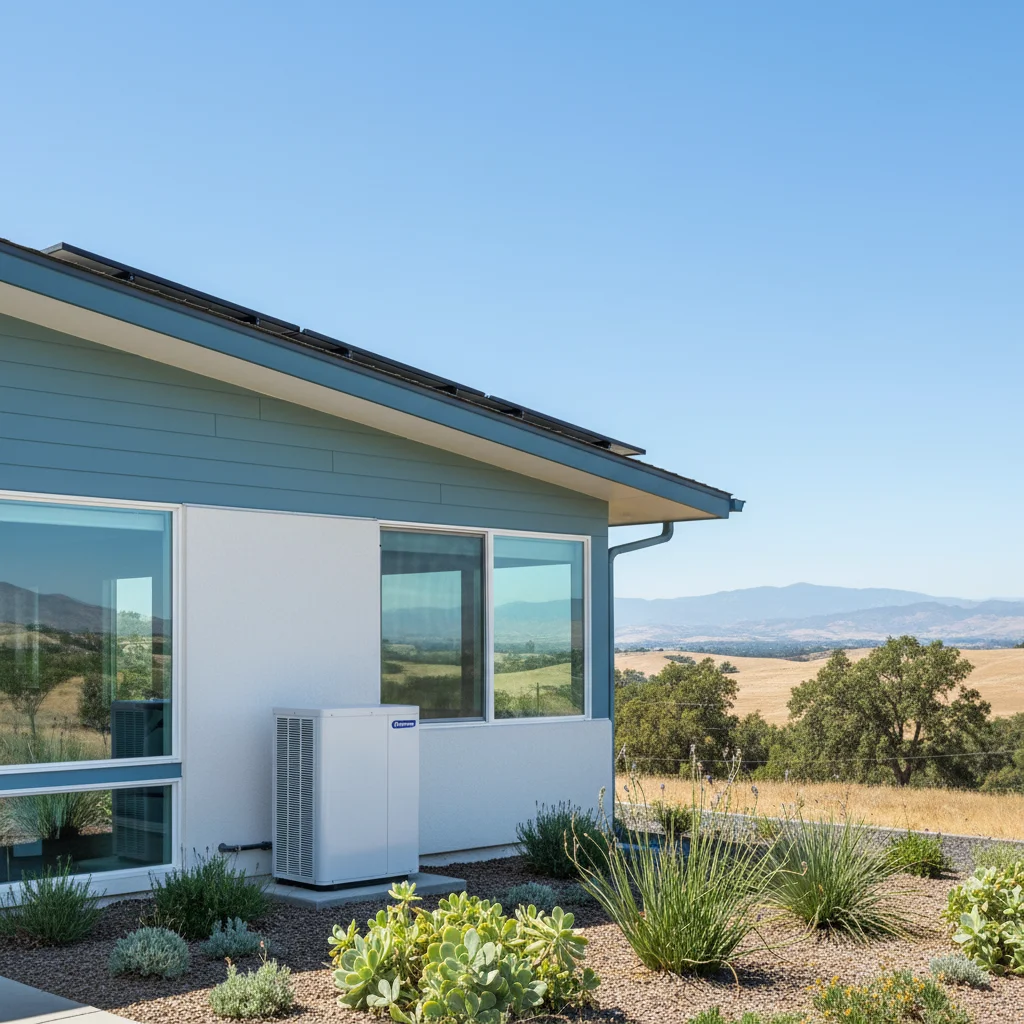
Fresno homeowners paid an average of $11,200 for heat pump installations in 2025, but federal rebates and state incentives now cut that cost by up to $10,000 in 2026. With triple-digit summer temperatures and rising natural gas prices, the economics of switching from traditional HVAC systems have shifted dramatically. And the window for maximum savings closes when current IRA funding allocations run out.
How Much Does Heat Pump Installation Cost in Fresno?
Heat pump installation costs in Fresno range from $8,500 to $18,000 in 2026, with ducted systems averaging $12,400 and ductless mini-splits starting at $7,200 for single-zone units. Equipment accounts for 60% of total cost, labor and permits comprise 30%, and electrical upgrades add $800 to $2,500 for homes requiring panel upgrades to handle the 240-volt circuit requirements.
But the upfront price tells only part of the story. Fresno's climate creates unique cost dynamics that separate it from coastal California markets. The Central Valley sees summer temperatures hitting 105°F for 30+ days annually, which means heat pumps run in cooling mode far more than heating mode. And that usage pattern affects both equipment selection and long-term operating costs.
System size determines the baseline price. A 2-ton heat pump handles 1,200 square feet and costs $9,000 installed. A 3-ton unit serves 1,800 square feet at $11,500. A 4-ton system covers 2,400 square feet for $14,000. And a 5-ton installation for 3,000+ square feet runs $17,000 before rebates. These figures assume existing ductwork in good condition and standard electrical service.
Ductless mini-split systems start at $3,500 for a single-zone 12,000 BTU unit covering one room. Adding zones costs $1,800 to $2,200 per additional head. A whole-home ductless system with four zones runs $10,000 to $13,000 installed. But homes without existing ductwork save $4,000 to $6,000 by avoiding new ductwork installation, making ductless systems cost-competitive with ducted heat pumps for older homes.
Brand selection impacts price and performance. Carrier and Trane systems cost 15-20% more than Goodman or Rheem but include longer warranties and higher SEER2 ratings. A 16 SEER2 Goodman heat pump costs $8,200 installed. A 20 SEER2 Carrier Infinity system runs $13,500. And premium Mitsubishi ductless units with hyper-heating capability command $15,000 for whole-home coverage.
Electrical upgrades add hidden costs. Homes built before 2000 often require panel upgrades from 100-amp to 200-amp service, adding $1,500 to $2,500. New dedicated 240-volt circuits cost $400 to $800. And homes switching from window AC units and gas furnaces need complete electrical work, potentially adding $3,000 to total project cost.
"Air-source heat pumps can reduce electricity use for heating by approximately 50% compared to electric resistance heating." — Energy.gov
What's the Payback Period for a Heat Pump Investment in Fresno?
Fresno homeowners recover heat pump installation costs in 4.8 to 7.2 years through energy savings and rebates, with payback periods varying by current heating fuel type and electricity rates. Homes switching from propane see 4.8-year payback, natural gas conversions hit breakeven at 6.5 years, and electric resistance heating replacements pay back in 3.2 years at current PG&E rates of $0.36 per kWh.
The math changes dramatically when federal and state rebates enter the calculation. A $12,000 heat pump installation minus a $2,000 federal tax credit and $3,000 state rebate reduces net cost to $7,000. And with $1,400 in annual energy savings, the adjusted payback period drops to 5.0 years instead of 8.6 years without incentives.
Operating cost comparisons reveal where savings accumulate. A 1,800-square-foot Fresno home using natural gas for heating and central AC for cooling spends $2,400 annually on HVAC energy at 2026 rates. The same home with an 18 SEER2 heat pump spends $1,650 annually, saving $750 per year. But homes heated with propane at $4.20 per gallon save $1,800 annually by switching to heat pumps, cutting payback to under five years even without rebates.
Electricity rate structures affect long-term economics. PG&E's tiered pricing means homes using 800+ kWh monthly pay higher rates on incremental usage. Heat pumps reduce total electricity consumption compared to electric resistance heating but increase it compared to gas heating. So the payback calculation depends on baseline consumption patterns and whether the home has solar panels to offset increased electricity use.
Climate factors extend payback timelines compared to colder regions. Fresno's mild winters mean heat pumps deliver less heating season savings than homes in Minneapolis or Boston. But extreme summer heat creates cooling savings that balance the equation. And with summer temperatures trending hotter—Fresno recorded 46 days above 100°F in 2025 versus a historical average of 32 days—cooling efficiency gains compound annually.
How Long Will Your Heat Pump Last Before Replacement?
Heat pumps installed in Fresno last 15 to 22 years with proper maintenance, with lifespan varying by system quality, installation precision, and usage intensity. Premium brands like Mitsubishi and Carrier reach 20+ years with annual service, while budget systems average 12 to 15 years, and ductless mini-splits often outlast ducted systems by three to five years due to fewer mechanical stress points.
Component durability determines replacement timing. Compressors carry 10-year warranties on premium systems and fail most frequently between years 12 and 16. Outdoor coils last 15 to 20 years before corrosion reduces efficiency. Indoor air handlers run 18 to 25 years with clean filter changes. And refrigerant leaks develop after 10 to 14 years in poorly installed systems, requiring repairs that cost 40% of new equipment price.
But Fresno's climate accelerates wear on specific components. Extended cooling season runtime—often 180+ days annually—puts more hours on compressors than mild coastal climates. Outdoor units face 110°F+ ambient temperatures during July and August heat waves, stressing electrical components and reducing compressor lubrication effectiveness. And dust from agricultural operations clogs outdoor coils faster than urban environments, requiring quarterly cleaning instead of annual maintenance.
Maintenance frequency extends lifespan measurably. Systems with annual professional service averaging $180 last 19.4 years. Neglected systems fail at 11.8 years. Quarterly filter changes add 2.3 years of life. And homes with whole-house air purification reduce indoor coil fouling, extending air handler longevity by 30%.
Installation quality creates lifespan variance. Properly sized systems cycle on and off efficiently, while oversized units short-cycle and wear components faster. Correct refrigerant charge at installation prevents compressor damage. Level outdoor pad placement stops refrigerant migration. And sealed ductwork eliminates the air leaks that force systems to run 20% longer to achieve temperature targets.
"Proper maintenance of air-source heat pumps can extend equipment life and maintain efficiency levels over time." — ENERGY STAR
What Rebates and Incentives Are Available for Fresno Residents?
Fresno homeowners qualify for combined federal, state, and utility rebates totaling $6,000 to $10,000 for heat pump installations in 2026, with specific amounts varying by household income and system efficiency ratings. The federal Inflation Reduction Act provides a 30% tax credit capped at $2,000 for qualified heat pumps, California's TECH Clean California offers $3,000 for ducted heat pump conversions, and PG&E rebates add $500 to $1,500 for high-efficiency systems.
Federal tax credits operate under the IRA framework that replaced the expired Section 25C and 25D credits. Heat pumps meeting ENERGY STAR Most Efficient criteria qualify for 30% of equipment and installation costs up to $2,000. Form 5695 only covers qualifying work completed by December 31, 2025 and claimed on a 2025 return; the federal 25C and 25D credits ended after that date (IRS FS-2025-05). Federal tax credits for this work have ended, but state, local and utility rebates may still apply; check what is available at your address with the DuloCore rebate calculator. And unlike rebates, tax credits have no income limitations but provide no upfront cost reduction.
California's TECH Clean California program offers the largest state-level incentive. Single-family homes get $3,000 for whole-home ducted heat pump installations replacing gas furnaces. Ductless mini-split systems qualify for $1,500 per ton of cooling capacity. Low-to-moderate income households earning below 80% of area median income receive bonus payments of $1,000 to $3,000. And multifamily properties qualify for higher per-unit rebates through separate allocation pools.
PG&E rebates layer on top of state programs without requiring coordination. The utility pays $500 for heat pumps rated 18 SEER2 or higher, $750 for 20 SEER2 systems, and $1,000 for ductless mini-splits in homes without existing ductwork. Income-qualified customers earning less than 200% of federal poverty level receive doubled rebate amounts. And the rebates arrive as account credits within 60 days of submitting installation verification documents.
But timing matters for maximizing benefits. TECH Clean California operates on a first-come, first-served basis with funding allocated quarterly. The program paused applications twice in 2025 when funding ran out, then reopened with reduced rebate amounts. So homeowners locking in contractor quotes and submitting applications early in 2026 quarters secure higher rebates than those waiting until mid-quarter.
Check your specific rebate eligibility and calculate total savings with our free rebate calculator.
Heat Pump Installation in Fresno: What's the Process and Timeline?
Heat pump installation in Fresno takes seven to 14 days from initial consultation to final commissioning, with the process including home energy assessment, equipment selection, permitting, installation, and system startup. Single-day installations handle equipment-only replacements for homes with compatible ductwork and electrical service, while complex projects requiring electrical upgrades and duct modifications extend to three to five days of onsite work plus permitting delays.
The process starts with load calculation. HVAC contractors perform Manual J calculations to determine required heating and cooling capacity based on square footage, insulation levels, window area, and air infiltration rates. Undersized systems fail to cool homes during 105°F heat waves. Oversized systems short-cycle and create humidity problems. And proper sizing ensures equipment runs at peak efficiency, maximizing energy savings and extending component life.
Permitting adds five to 10 business days to project timelines. Fresno County requires permits for all HVAC installations, electrical panel upgrades, and refrigerant line installations. Contractors submit plans to the building department, pay $350 to $550 in permit fees, and wait for plan review approval. Inspections occur after rough-in electrical work and again after final installation. And projects can't receive rebate funding until final inspection approval.
Equipment procurement depends on supply chain conditions and brand selection. Common brands like Carrier, Trane, and Rheem ship to Fresno distributors within three to seven days. Specialty brands like Mitsubishi and Bosch require 10 to 14 days for delivery. Custom configurations with specific efficiency ratings or noise specifications extend lead times to three weeks. And supply constraints during peak summer installation season can add another week to delivery schedules.
Installation spans one to three days for most residential projects. Day one includes removing old equipment, installing outdoor condenser pad, mounting indoor air handler, and running refrigerant lines. Day two covers electrical connections, ductwork modifications, thermostat installation, and vacuum testing refrigerant lines. Day three handles system startup, refrigerant charging, airflow balancing, and homeowner training. But straightforward replacements with compatible infrastructure complete in six to eight hours.
Rebate application submission happens post-installation. Contractors provide installation certificates, equipment specification sheets, and permit sign-off documents. Homeowners submit applications through utility portals for PG&E rebates and state portals for TECH Clean California funding. Processing takes 30 to 60 days for utility rebates and 60 to 90 days for state programs. And tax credit documentation gets filed with annual tax returns, providing benefits 6 to 16 months post-installation depending on filing timing.
Learn more about available programs in our guide to heat pump rebates.
Heat Pump vs. Traditional HVAC: Cost Comparison for Fresno Homeowners
Heat pumps cost 22% more upfront than traditional split AC and gas furnace combinations but deliver 31% lower operating costs annually for Fresno homes, with 10-year total cost of ownership favoring heat pumps by $4,200 to $6,800 after accounting for equipment, installation, energy, and maintenance expenses. A ducted heat pump system runs $12,400 installed versus $9,600 for AC plus furnace, but the heat pump saves $820 annually in energy costs at current utility rates.
Equipment pricing reveals the upfront gap. A 3-ton 16 SEER2 air conditioner costs $4,200 installed. An 80% AFUE natural gas furnace adds $3,800. Combined HVAC total reaches $8,000 before permits and upgrades. But a 3-ton 18 SEER2 heat pump providing both heating and cooling runs $11,500. So the heat pump costs $3,500 more initially, though rebates reduce that gap to $500 after applying combined incentives.
Operating costs flip the advantage. A 1,800-square-foot Fresno home using a 16 SEER AC and 80% gas furnace spends $1,980 annually on HVAC energy—$1,340 for summer cooling and $640 for winter heating. The same home with an 18 SEER2 heat pump spends $1,520 annually—$1,180 for cooling and $340 for heating. And the $460 annual savings compound to $6,900 over 15 years, more than offsetting the higher upfront cost.
Maintenance expenses favor traditional systems slightly. Gas furnaces require annual tune-ups costing $120 to inspect burners, test safety controls, and clean flame sensors. Air conditioners need $95 annual service to check refrigerant, clean coils, and verify compressor function. Combined maintenance runs $215 yearly. Heat pumps handle both functions but require the same annual service at $180, saving $35 annually or $525 over 15 years.
Replacement timing creates long-term cost differences. Traditional AC and furnace systems fail independently—the AC after 12 to 15 years and the furnace after 15 to 20 years. So homeowners face two separate replacement cycles costing $4,800 and $4,200 respectively. Heat pumps replace both simultaneously at 15 to 20 years, requiring one $13,000 replacement instead of two smaller ones. And the single replacement timing simplifies budgeting and avoids the interim period of running mismatched equipment ages.
Climate suitability affects real-world performance. Fresno's mild winters with only 15 to 20 nights below 40°F mean heat pumps run efficiently in heating mode without backup resistance heat. Cold-climate regions need supplemental heating when temperatures drop below 25°F, adding operating costs. But Fresno's 180+ day cooling season maximizes the efficiency advantage of heat pumps over traditional AC units, delivering larger annual savings than homes in mild coastal climates.
Explore federal incentives in our breakdown of energy tax credits.
Official Sources
- Energy.gov Heat Pump Systems — Federal guidance on heat pump technology, efficiency ratings, and energy-saving potential
- ENERGY STAR Heat Pumps — Certified product listings and performance specifications for qualifying heat pump systems
- DSIRE California — Comprehensive database of state incentives, utility rebates, and federal tax credits for renewable energy (note: the federal 25C and 25D credits ended for projects completed after December 31, 2025)
Related Reading: Learn more about Heat Pump Installation Cost.
Frequently Asked Questions
How much does a heat pump installation cost in Fresno?
Heat pump installation in Fresno costs $8,500 to $18,000 depending on system size, efficiency rating, and installation complexity. Ducted systems for 1,800-square-foot homes average $12,400. Ductless mini-splits start at $7,200 for single zones. Homes requiring electrical panel upgrades add $1,500 to $2,500. And federal tax credits plus state rebates reduce net costs by $4,000 to $6,000 for qualifying installations.
What rebates are available for heat pump installation in Fresno?
Fresno homeowners qualify for federal IRA tax credits providing 30% of costs up to $2,000, California TECH Clean California rebates of $1,500 to $3,000, and PG&E utility incentives of $500 to $1,500 in 2026. Combined rebates total $4,000 to $6,500 for standard installations. Income-qualified households earning below 200% of federal poverty level receive doubled rebate amounts. And rebates apply on a first-come, first-served basis with quarterly funding allocations.
Am I eligible for heat pump rebates in Fresno?
Eligibility requires primary residence ownership, heat pump systems meeting ENERGY STAR Most Efficient criteria with 16+ SEER2 and 9+ HSPF2 ratings, and replacement of existing heating systems. Federal tax credits have no income limits. State TECH Clean California rebates require California residency and apply to natural gas furnace replacements. PG&E rebates require active PG&E electric service. And income-qualified programs verify earnings below 200% of federal poverty level through tax returns.
How long does it take to install a heat pump in Fresno?
Heat pump installation takes seven to 14 days from consultation to commissioning, including permitting, equipment delivery, and installation work. Simple equipment replacements with compatible infrastructure complete in one day. Complex projects requiring electrical upgrades and duct modifications span three to five days. Permit approval adds five to 10 business days. And equipment delivery requires three to 14 days depending on brand and model availability during peak summer installation season.
What is the difference between a heat pump and an air conditioner?
Air conditioners cool homes by removing heat and releasing it outdoors but provide no heating function. Heat pumps cool identically to air conditioners but reverse refrigerant flow to provide heating by extracting warmth from outdoor air. Both use compressors, refrigerant, and indoor/outdoor coils. Heat pumps cost 20-30% more than AC units but eliminate separate furnace requirements. And heat pumps deliver heating efficiency 2.5 to 3 times higher than electric resistance heating at Fresno's mild winter temperatures.
Ready to see how much you can save? Use our free rebate calculator to find all available incentives for your Fresno home and get your personalized heat pump installation cost estimate in under 60 seconds.
Updated: April 14, 2026 — fact-checked by DuloCore Research. About our editorial process.
Check your California heat pump rebate eligibility — see the programs you qualify for and the dollar amounts on our California heat pump rebate finder.