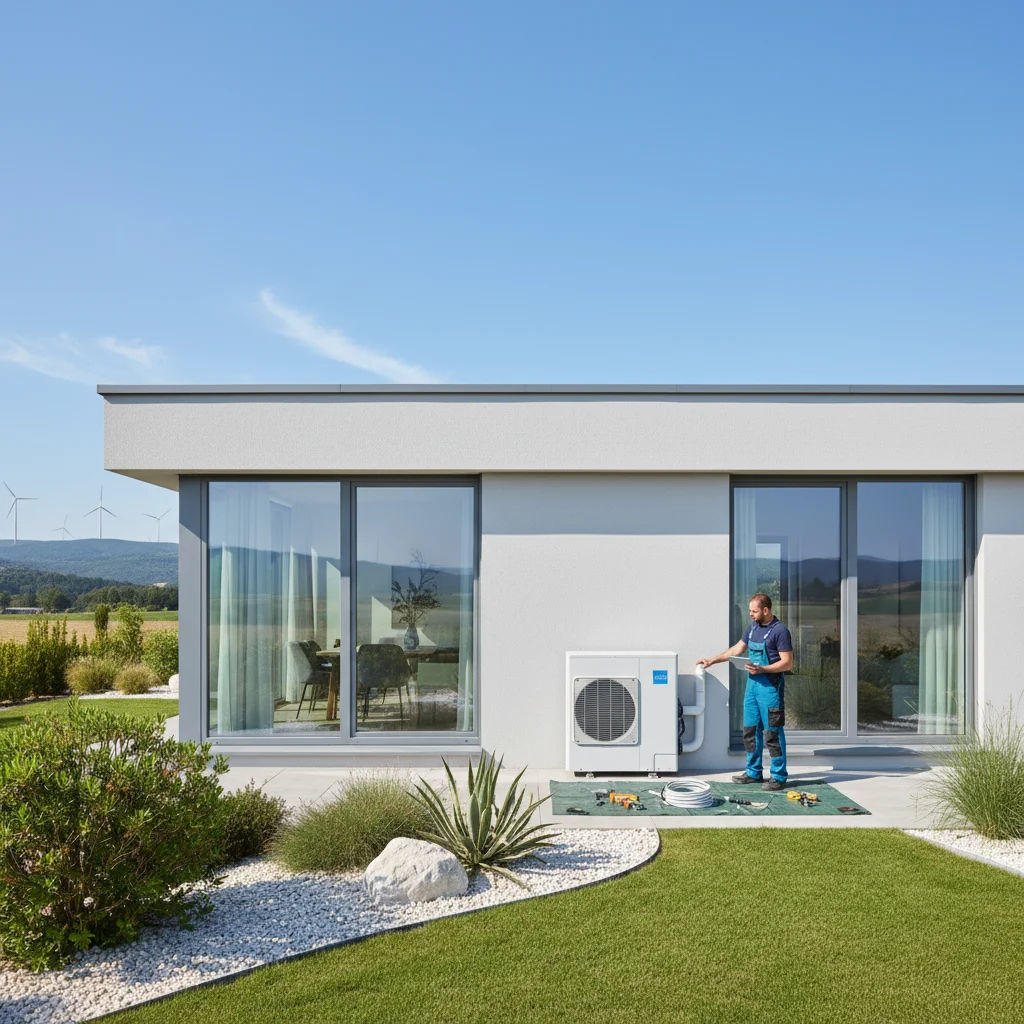
Homeowners in California spent an average of $14,800 on heat pump installations in 2025, but federal tax credits and state rebates slashed that number to $7,200 or less for eligible households. The federal Energy Efficient Home Improvement Credit (Section 25C) ended for property placed in service after December 31, 2025 (IRS FS-2025-05). Federal tax credits for this work have ended, but state, local and utility rebates may still apply; check what is available at your address with the DuloCore rebate calculator.
How Much Does Heat Pump Installation Cost in 2026?
Heat pump installation costs in 2026 range from $5,500 to $23,000 depending on system type, home size, and labor rates, with ducted air-source systems averaging $8,000 to $15,000, ductless mini-splits costing $3,000 to $10,000 per zone, and ground-source geothermal systems requiring $15,000 to $35,000 for complete installation in California.
But the upfront price tells only half the story. The federal Residential Clean Energy Credit (Section 25D) ended for expenditures made after December 31, 2025, and the IRS treats an expenditure as made when installation is completed (IRS FS-2025-05). California's TECH Clean California program adds $3,000 to $6,500 in point-of-sale rebates for single-family homes replacing gas heating systems with electric heat pumps. So a homeowner installing a $12,000 ducted heat pump receives a $3,600 federal credit and up to $6,500 in state rebates, bringing net costs down to $1,900.
Labor accounts for 35% to 50% of total installation costs, with HVAC contractors charging $85 to $150 per hour in California's major metro areas. A typical ducted heat pump installation requires 16 to 24 hours of labor, including refrigerant line installation, electrical upgrades, and ductwork modifications. And homes without existing ductwork face additional costs of $3,500 to $8,000 for new duct installation, making ductless mini-split systems more cost-effective for older homes with radiators or baseboard heating.
Equipment costs vary by efficiency rating and capacity. A 16 SEER2 heat pump costs $4,200 to $6,800, while high-efficiency 20+ SEER2 models run $6,500 to $10,500 for the same tonnage. But higher SEER2 ratings qualify for enhanced rebates through utility company programs—Pacific Gas & Electric offers an additional $2,000 for systems rated 18 SEER2 or higher. System capacity requirements range from 2 tons for 1,200-square-foot homes to 5 tons for 3,000-square-foot properties, with costs increasing $1,200 to $1,800 per additional ton.
Geothermal heat pumps carry premium installation costs due to ground loop installation. Vertical closed-loop systems require drilling 150 to 300 feet deep at $15 to $25 per foot, while horizontal loops need 1,500 to 2,500 linear feet of trenching at $6 to $12 per foot. The federal Residential Clean Energy Credit (Section 25D) ended for expenditures made after December 31, 2025, and the IRS treats an expenditure as made when installation is completed (IRS FS-2025-05).
Use our free rebate calculator to estimate your total heat pump costs after all available federal credits and state rebates.
What Is the ROI and Payback Period for a Heat Pump System?
Heat pump systems deliver 150% to 300% return on investment over their 15-year lifespan in California, with payback periods ranging from 3 to 8 years depending on replaced heating system type, utility rates, and home insulation quality, as gas furnace replacements break even faster due to California's $2.50 per therm natural gas prices compared to $0.28 per kWh electricity rates.
Homeowners replacing gas furnaces see the fastest payback. A household spending $2,400 annually on natural gas heating cuts costs to $900 with a high-efficiency heat pump, saving $1,500 per year. So a $10,000 system nets positive cash flow in 6.6 years after accounting for a $3,600 federal credit and $4,500 in state rebates. And annual energy savings compound over the system's 15-year lifespan, delivering $22,500 in total utility bill reductions.
Electric resistance heating replacements provide immediate savings. Homes using electric baseboards or wall heaters spend $3,800 to $5,200 annually on heating in California's climate zones 3 through 16. Heat pumps reduce those costs by 60% to 70%, saving $2,300 to $3,600 per year. But these properties typically lack ductwork, requiring ductless mini-split installations that cost less than ducted systems—the net result is payback periods of 3 to 5 years.
Cooling-only upgrades extend payback timelines. Replacing a functioning central air conditioner with a heat pump adds heating capability but saves less on annual energy costs in California's mild climate. These installations pay back in 8 to 12 years through combined heating and cooling savings of $800 to $1,200 annually. So the economic case strengthens when replacing both a gas furnace and an aging AC unit simultaneously—systems typically replaced together every 15 to 20 years anyway.
Property value appreciation adds 2% to 4% to homes with heat pump systems in California real estate markets, according to 2025 Zillow data. And homes with electric heat pumps qualify for lower rates on some homeowners insurance policies due to reduced fire risk compared to gas appliances.
How Does Heat Pump Cost Compare to Traditional Heating Alternatives?
Heat pump installation costs average $8,000 to $15,000 compared to $5,000 to $10,000 for gas furnace replacements and $3,500 to $7,500 for central air conditioner units, but heat pumps provide both heating and cooling in a single system while delivering 200% to 400% efficiency versus 80% to 98% for gas furnaces, eliminating the need for separate HVAC equipment.
Gas furnace and AC combinations cost $8,500 to $17,500 for complete installation—nearly identical to ducted heat pump pricing. But split systems require two maintenance schedules, two warranty registrations, and two eventual replacements. And California's building codes now require electric-ready new construction, with 58 cities banning gas hookups in new residential buildings as of January 2026.
Boiler replacements run $6,000 to $12,000 for equipment and labor, but hydronic heating systems can't provide air conditioning. Homeowners adding central AC to boiler-heated homes spend an additional $5,500 to $9,500, bringing total costs to $11,500 to $21,500. So ductless mini-split heat pumps offer equivalent comfort at lower installed costs for radiator-heated homes.
Electric resistance heating costs $2,500 to $5,000 to install but operates at 100% efficiency versus 300% for heat pumps. A home spending $3,800 annually on baseboard heat drops costs to $1,200 with a heat pump—$2,600 in annual savings. And the $6,000 to $10,000 heat pump installation pays back in 2.3 to 3.8 years even without rebates.
Geothermal systems cost $15,000 to $35,000 installed but last 25+ years for indoor components and 50+ years for ground loops. Gas furnaces require replacement every 15 to 20 years at $5,000 to $10,000 each cycle, totaling $10,000 to $20,000 over 25 years. So geothermal installations break even within their lifespan through both energy savings and avoided replacement costs.
Here's how California's major rebate programs compare for 2026:
| Program | Rebate Amount | Eligibility | Application Deadline |
|---|---|---|---|
| IRA Federal Tax Credit | Ended Dec 31, 2025 | Ended Dec 31, 2025 | Ended Dec 31, 2025 |
| TECH Clean California | $3,000-$6,500 for single-family homes | Gas heating replacement only | December 31, 2026 (subject to funding) |
| PG&E Energy Efficiency Rebates | $2,000-$4,000 for 18+ SEER2 systems | PG&E customers only | Ongoing (first-come, first-served) |
Check our heat pump rebates guide for utility-specific program details in your service territory.
How Long Will Your Heat Pump Last and What's the Expected Lifespan?
Heat pump systems last 15 to 20 years for air-source units and 20 to 25 years for geothermal equipment, with compressors carrying 10-year manufacturer warranties and ground loops guaranteed for 25 to 50 years, while proper maintenance extends operational lifespan by 3 to 5 years compared to neglected systems that fail at 12 to 15 years.
Compressor longevity determines system lifespan. The compressor cycles 2,000 to 3,000 times annually in California's mild climate compared to 4,000 to 6,000 cycles in regions with extreme winters, reducing wear on internal components. So California-installed heat pumps typically reach 18 to 22 years of service life versus 12 to 16 years in northeastern states.
Installation quality impacts durability as much as equipment selection. Systems with undersized refrigerant lines lose 15% to 25% efficiency and experience compressor failures 3 to 5 years earlier than properly sized installations. And ductwork leaks force systems to run longer cycles, accelerating wear. So hiring HVAC contractors certified through North American Technician Excellence (NATE) adds $800 to $1,500 to installation costs but extends equipment life by 4 to 6 years.
Coastal installations face corrosion challenges. Salt air degrades outdoor unit coils within 8 to 12 years without protective coatings, compared to 15 to 20 years for inland installations. Manufacturers offer marine-grade coatings that add $400 to $800 to equipment costs but double coastal lifespan. And properties within 5 miles of the Pacific Ocean benefit from these upgrades.
Ductless mini-splits outlast ducted systems by 2 to 4 years due to simpler mechanical designs. Mini-split outdoor units last 18 to 22 years while indoor air handlers reach 20 to 25 years with routine filter cleaning. But homes with multiple zones need 2 to 6 indoor units at $800 to $1,500 each for eventual replacement, compared to single air handler replacement costs of $1,200 to $2,500 for ducted systems.
What Maintenance Does a Heat Pump Require and How Much Will It Cost?
Heat pump systems require professional maintenance once annually at $150 to $300 per visit, plus homeowner-performed filter changes every 30 to 90 days costing $15 to $40 per filter, with total annual maintenance costs ranging from $200 to $450 compared to $180 to $350 for gas furnace and air conditioner combinations maintained separately.
Annual professional service includes refrigerant level checks, electrical connection inspection, condensate drain cleaning, and outdoor coil washing. HVAC technicians spend 60 to 90 minutes per heat pump maintenance visit compared to 45 to 60 minutes for furnace-only service. And combined systems reduce total maintenance time versus separate furnace and AC service calls that require 90 to 120 combined minutes.
Filter replacement schedules depend on system type and household conditions. Ducted systems use 16x25-inch filters costing $25 to $40 for MERV 11-13 ratings, replaced every 60 to 90 days in homes without pets. Ductless mini-splits have washable filters requiring monthly cleaning but zero replacement costs for 8 to 10 years. So five-year filter costs total $500 to $800 for ducted systems versus $0 for mini-splits.
Refrigerant leaks cost $350 to $800 to repair depending on leak location and refrigerant type. R-410A refrigerant costs $80 to $150 per pound, with typical recharge quantities of 2 to 4 pounds for residential systems. But properly installed systems lose less than 5% of refrigerant over their 15-year lifespan. And annual maintenance catches leaks early, reducing emergency repair costs by 60% to 75%.
Outdoor unit cleaning prevents efficiency loss. Coils clogged with cottonwood seeds, leaves, and dirt reduce efficiency by 15% to 30%, increasing annual operating costs by $180 to $450. DIY coil cleaning with garden hoses and coil cleaner sprays costs $15 to $25 annually, while professional cleaning during maintenance visits adds no incremental cost.
Extended warranties cover parts for 5 to 10 years at $400 to $900 upfront costs. These plans eliminate $800 to $2,500 in potential compressor replacement costs but average $80 to $180 annually. So homeowners keeping emergency funds of $1,500 to $2,000 for HVAC repairs save money versus warranty purchases over system lifespans.
What Federal and State Rebates Can Reduce Your Installation Costs?
The federal home energy tax credits (Sections 25C and 25D) ended for projects completed after December 31, 2025 (IRS FS-2025-05). California's TECH Clean California program provides $3,000 to $6,500 in point-of-sale rebates for gas heating replacements, and utility companies offer additional $1,000 to $4,000 rebates for high-efficiency equipment.
The federal Residential Clean Energy Credit (Section 25D) ended for expenditures made after December 31, 2025, and the IRS treats an expenditure as made when installation is completed (IRS FS-2025-05). Form 5695 only covers qualifying work completed by December 31, 2025 and claimed on a 2025 return; the federal 25C and 25D credits ended after that date (IRS FS-2025-05). And the credit carries forward to future tax years if it exceeds current-year tax owed, ensuring full value realization even for households with low tax bills.
The federal Residential Clean Energy Credit (Section 25D) ended for expenditures made after December 31, 2025, and the IRS treats an expenditure as made when installation is completed (IRS FS-2025-05).
TECH Clean California rebates apply at the point of sale, reducing upfront costs immediately rather than waiting for tax season. Single-family homes replacing gas furnaces or boilers receive $3,000 base rebates, increasing to $6,500 for households at or below 80% area median income. And the program requires contractor participation—homeowners select from a network of 800+ qualified HVAC installers statewide.
Utility rebates stack with federal and state incentives. Pacific Gas & Electric offers $2,000 for heat pumps rated 18 SEER2 or higher, Southern California Edison provides $3,000 for ducted systems and $1,500 per indoor unit for ductless installations, and Sacramento Municipal Utility District rebates reach $4,000 for geothermal systems. But utility programs operate on first-come, first-served funding allocation, typically exhausting annual budgets by September or October.
Low-income households qualify for enhanced benefits through the Grid Alternatives program, which provides fully subsidized heat pump installations worth $12,000 to $18,000 at zero homeowner cost. Eligibility requires household income at or below 80% area median income ($85,000 for four-person households in most California counties). And the program serves 2,500 to 3,500 homes annually with 6 to 12-month waitlists depending on region.
Local air quality management districts offer additional rebates for gas appliance replacements. Bay Area AQMD provides $3,000 for heat pump installations replacing gas furnaces, South Coast AQMD offers $3,000 to $5,500 depending on household income, and San Joaquin Valley APCD rebates reach $4,500 for homes in disadvantaged communities. Applications require proof of gas service disconnection or permanent capping.
Calculate your combined rebate eligibility with our rebate calculator to see total net costs after all federal, state, utility, and local incentives.
Official Sources
- Department of Energy: Heat Pumps — Federal guidance on heat pump technology, efficiency ratings, and system selection
- ENERGY STAR Heat Pump Specifications — Efficiency requirements and certified product database
- DSIRE: California Incentives — Comprehensive database of federal, state, and utility energy incentives
Frequently Asked Questions
How much does a heat pump installation cost?
Heat pump installation costs range from $5,500 to $23,000 depending on system type, with ducted air-source systems averaging $8,000 to $15,000, ductless mini-splits costing $3,000 to $10,000 per zone, and geothermal systems requiring $15,000 to $35,000. Labor accounts for 35% to 50% of total costs at $85 to $150 per hour. Federal tax credits reduce net costs by 30%, while California state rebates provide an additional $3,000 to $6,500 for gas heating replacements.
What rebates are available for heat pump installation?
The federal Residential Clean Energy Credit (Section 25D) ended for expenditures made after December 31, 2025, and the IRS treats an expenditure as made when installation is completed (IRS FS-2025-05). California's TECH Clean California provides $3,000 to $6,500 for gas furnace replacements. Utility companies offer $1,000 to $4,000 for high-efficiency systems, and local air quality districts add $3,000 to $5,500 in select regions. These incentives stack, reducing a $12,000 installation to $1,900 net cost.
Are heat pumps eligible for tax credits in 2026?
The federal Residential Clean Energy Credit (Section 25D) ended for expenditures made after December 31, 2025, and the IRS treats an expenditure as made when installation is completed (IRS FS-2025-05). Air-source systems receive up to $2,000 annually, while geothermal installations have no cap. Form 5695 only covers qualifying work completed by December 31, 2025 and claimed on a 2025 return; the federal 25C and 25D credits ended after that date (IRS FS-2025-05). The credit applies to primary residences and carries forward to future years if it exceeds current tax liability.
How long does it take to get a heat pump rebate?
Federal tax credits apply when filing annual tax returns, delivering refunds or reducing tax owed within 21 days of e-filing or 6 to 8 weeks for paper returns. TECH Clean California rebates apply at point of sale as instant invoice reductions. Utility rebates process in 4 to 8 weeks after installation verification. And local air quality district rebates take 8 to 16 weeks from application submission to check issuance.
What's the difference between a heat pump and an air conditioner?
Heat pumps provide both heating and cooling by reversing refrigerant flow direction, while air conditioners only cool. Both systems move heat using refrigerant and compressors, but heat pumps include reversing valves that switch between heating and cooling modes. So heat pumps replace both furnaces and air conditioners in a single unit. Equipment costs are $1,200 to $2,500 higher than AC-only units but eliminate separate furnace installation expenses of $5,000 to $10,000.
Ready to find out how much you'll save? Use our free rebate calculator to calculate your total heat pump costs after federal tax credits, California state rebates, and utility incentives. Get your personalized savings estimate in 60 seconds.
Last updated April 14, 2026 — reviewed by DuloCore Editorial. About our authors.
Check your California heat pump rebate eligibility — see the programs you qualify for and the dollar amounts on our California heat pump rebate finder.