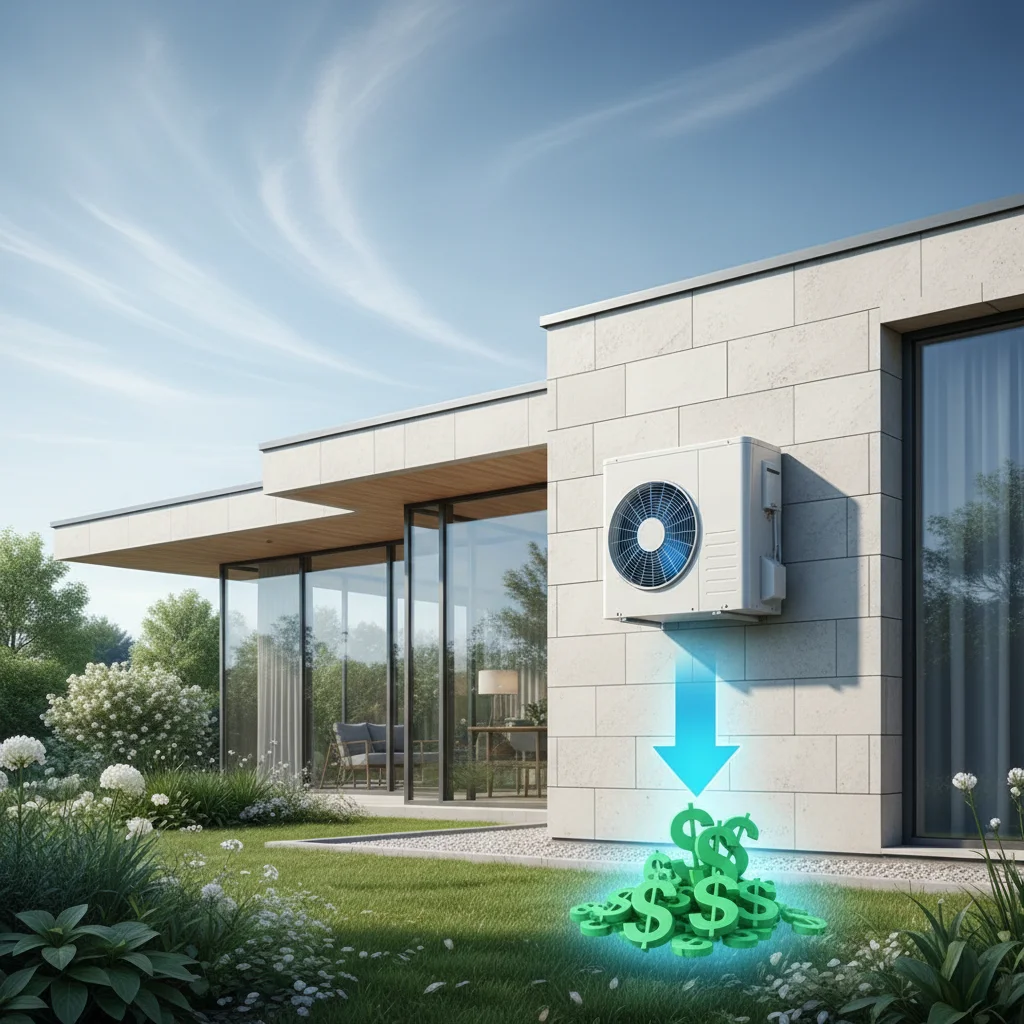
A homeowner in Sacramento who installed a $12,000 heat pump in January 2026 walked away paying $2,400 after stacking federal tax credits with California's TECH Clean California rebate. And that same household will save $840 annually on heating and cooling bills compared to their old gas furnace and central AC system. But thousands of eligible homeowners leave $8,000 to $14,000 in rebate money unclaimed every year because they don't know which programs they qualify for or how to combine them.
How Much Does a Heat Pump Cost Before and After Rebates?
Heat pump installation costs $8,000 to $18,000 before incentives depending on system size, brand, and ductwork modifications. The federal Energy Efficient Home Improvement Credit (Section 25C) ended for property placed in service after December 31, 2025 (IRS FS-2025-05). Federal tax credits for this work have ended, but state, local and utility rebates may still apply; check what is available at your address with the DuloCore rebate calculator. State and utility rebates add $1,000 to $8,000 in direct payments. Combined incentives reduce net costs to $2,000 to $8,000 for most California homeowners in 2026.
So here's the tension: homeowners face steep upfront costs that block climate-friendly upgrades, but layered rebate programs can cut final bills by 70% to 85%. The problem isn't whether incentives exist—it's knowing which ones apply to your income bracket, home type, and installation timeline.
What Drives Heat Pump Installation Costs
Equipment accounts for 40% to 50% of total project costs. A 3-ton ducted air-source heat pump costs $4,500 to $7,000 for the outdoor unit and air handler. Labor runs $3,000 to $6,000 depending on ductwork condition, electrical panel upgrades, and permits. And mini-split systems without existing ducts add $1,500 to $3,000 per indoor head unit.
Electrical upgrades push costs higher when existing panels can't handle heat pump loads. A 200-amp panel upgrade costs $1,500 to $3,000. But that upgrade work also qualifies for the federal tax credit when performed as part of heat pump installation.
Federal Tax Credit Calculation
The federal Energy Efficient Home Improvement Credit (Section 25C) ended for property placed in service after December 31, 2025 (IRS FS-2025-05). A $15,000 installation generates a $4,500 tax credit applied to federal tax liability for the year of installation. So homeowners without sufficient tax liability can't capture the full credit value—it doesn't roll over or refund as cash.
And contractors must provide Manufacturer Certification Statements confirming equipment meets efficiency requirements. Without that documentation, the IRS rejects credit claims during audits.
What Income Limits Apply to Heat Pump Rebate Programs?
Federal Home Electrification and Appliance Rebates (HEAR) provide $8,000 for households earning below 80% of area median income and $4,000 for households at 80% to 150% AMI. California's TECH Clean California program offers $3,000 to $7,000 with no income restrictions through participating contractors. Utility programs like PG&E's Energy Efficiency Rebates provide $2,000 to $3,000 for residential customers regardless of income.
Income limits reset annually based on HUD area median income data. A family of four in Sacramento qualifies for maximum HEAR rebates with household income below $85,000 in 2026. And those limits jump to $106,000 in San Francisco due to higher regional costs.
How Income Verification Works
State HEAR programs require documentation through tax returns, W-2 forms, or pay stubs covering the most recent 12 months. And self-employed applicants submit Schedule C tax forms or quarterly profit-and-loss statements. Contractors often handle verification through program portals before installation begins.
California hasn't released final HEAR program guidelines as of April 2026. But early guidance indicates 2024 or 2025 tax returns will establish eligibility for installations completed in 2026. So recent income changes could affect qualification depending on which tax year the state selects.
What Documentation Do You Need to Qualify for Heat Pump Rebates?
Heat pump rebate applications require proof of purchase receipts, contractor invoices with itemized costs, Manufacturer Certification Statements showing ENERGY STAR compliance, building permits, and signed installation certificates. Income-qualified programs add tax returns, W-2 forms, or three months of pay stubs. And utility rebates need account numbers proving the installation address matches the applicant's service location.
Equipment Certification Requirements
Heat pumps must meet minimum ENERGY STAR efficiency ratings to qualify for federal and state rebates. Air-source heat pumps need 16 SEER2 cooling and 9.5 HSPF2 heating ratings. And geothermal systems require 17 EER cooling with 4.1 COP heating performance.
Manufacturers provide certification documents listing model numbers, efficiency ratings, and AHRI certification numbers. Contractors submit these through program portals alongside installation photos showing outdoor unit placement and electrical connections. Without manufacturer certifications, both federal tax credits and state rebates get denied.
Contractor Licensing Verification
California requires C-20 HVAC contractor licenses for heat pump installations. And TECH Clean California only approves rebates for work performed by program-enrolled contractors who've completed training modules. So homeowners must verify contractor participation before signing contracts to ensure rebate eligibility.
DIY installations don't qualify for any California rebate programs or federal tax credits. The IRS requires licensed contractor labor for all claims. And state programs audit contractor licenses against C-20 records to prevent fraud.
Is Pre-Approval Required Before Installing Your Heat Pump?
Income-qualified HEAR rebates require pre-approval through state program portals before starting work. TECH Clean California processes applications after installation through enrolled contractors. Form 5695 only covers qualifying work completed by December 31, 2025 and claimed on a 2025 return; the federal 25C and 25D credits ended after that date (IRS FS-2025-05). Utility rebates vary by provider—PG&E and SCE allow post-installation applications within 180 days while SMUD requires pre-approval for rebates above $1,000.
Pre-approval timelines range from 5 business days for utility programs to 45 days for state HEAR applications. And funding depletes throughout the year as applications get approved. So delayed pre-approval submissions risk losing rebate eligibility when program budgets run out.
Why Pre-Approval Matters for Income-Qualified Programs
States reserve HEAR funding for pre-approved applications to prevent budget overruns. And California's initial $181 million HEAR allocation will serve roughly 20,000 to 25,000 households based on average rebate amounts. Without pre-approval, installations completed before funding reservation face rejection even when households qualify.
Pre-approval locks in rebate amounts under current program rules. So homeowners with January 2026 approvals receive guaranteed funding even if program budgets get cut or income limits change mid-year.
What's the Timeline and Deadline for Submitting Rebate Applications?
State HEAR programs accept applications through December 2031 or until funding depletes. TECH Clean California processes applications year-round with no published end date. And utility rebates require submission within 90 to 180 days after installation completion depending on provider terms.
Application Processing Times
TECH Clean California approves applications and issues payments within 30 to 45 days after contractor submission. Utility programs like PG&E process rebates in 6 to 8 weeks. And state HEAR programs haven't published processing timelines—early estimates suggest 60 to 90 days from complete application to payment.
"Rebates are available on a first-come, first-served basis until funds are depleted." — ENERGY STAR Heat Pump Information
But homeowners can't access that value until they receive refunds or reduce tax payments owed. So cash flow timing differs between instant utility rebates and delayed federal credit benefits.
Can You Stack Multiple Rebates to Lower Your Heat Pump Cost?
California HEAR rebates stack with TECH Clean California and utility programs because they come from separate funding sources. But some utility providers reduce rebate amounts when applicants receive TECH Clean California incentives to prevent double-dipping. And federal tax credits apply to out-of-pocket costs after all rebates get subtracted from total project expenses.
Maximum Stacking Scenarios
A Sacramento homeowner earning $75,000 annually qualifies for $8,000 HEAR rebate, $3,000 TECH Clean California rebate, and $2,000 SMUD utility rebate on a $15,000 heat pump installation. Out-of-pocket cost drops to $2,000 before applying the 30% federal tax credit. And that $600 federal credit reduces final net cost to $1,400—a 91% discount from original installation price.
Higher-income households above HEAR limits still stack TECH Clean California and utility rebates with federal credits. A $15,000 installation nets $3,000 TECH rebate, $2,000 utility rebate, and $3,000 federal credit for $7,000 total savings. So final cost lands at $8,000—a 47% reduction.
Stacking Restrictions by Program
PG&E's Energy Upgrade California program prohibits combining their $3,000 heat pump rebate with TECH Clean California's $3,000 incentive. Homeowners must choose one program or the other. But TECH Clean California stacks freely with SCE, SMUD, and other municipal utility rebates across the state.
The IRS calculates credits based on net costs after subtracting all cash rebates, but those rebates don't disqualify the credit itself. Use our free rebate calculator to model exact stacking scenarios for your income level and utility provider.
What's the Application Process for Heat Pump Rebates Step-by-Step?
First, verify income eligibility for HEAR programs through state portal pre-qualification tools. Second, select a TECH Clean California enrolled contractor from the program directory and obtain installation quotes. Third, submit pre-approval applications for income-qualified programs 4 to 6 weeks before planned installation. Fourth, complete installation and collect contractor invoices, permits, and manufacturer certifications. Fifth, submit rebate applications through program portals within required timeframes. Form 5695 only covers qualifying work completed by December 31, 2025 and claimed on a 2025 return; the federal 25C and 25D credits ended after that date (IRS FS-2025-05).
Pre-Installation Steps
Contractors enrolled in TECH Clean California handle most application paperwork directly through program systems. And they verify equipment meets efficiency requirements before purchasing units. So homeowners should confirm contractor enrollment status before signing contracts to avoid disqualification.
Income verification documents need collection 2 to 3 weeks before application submission. Tax returns, W-2s, or pay stubs must show names matching utility account records. And married couples filing jointly must include both spouses' income in household calculations for HEAR program qualification.
Post-Installation Documentation
Final inspection reports and signed completion certificates confirm installations meet building codes and manufacturer specifications. Contractors photograph outdoor unit installations, electrical panel connections, and thermostat programming as proof of proper setup. And building departments provide permit closure documents showing work passed inspection.
California's HEAR program will likely require energy modeling reports showing projected savings compared to replaced equipment. So contractors may need to document existing system efficiency ratings before removal to establish baseline performance for savings calculations.
Federal Tax Credit Filing
IRS Form 5695 calculates residential energy tax credits based on qualified improvement costs. Homeowners enter total project costs on Part II Line 22a and multiply by 30% to determine credit amounts. And that credit reduces tax liability dollar-for-dollar up to the calculated amount—it's not a deduction that reduces taxable income.
Manufacturer Certification Statements must be retained for three years after filing in case the IRS requests documentation during audits. But those statements don't get submitted with returns—they're only provided if the IRS sends audit notices.
Official Sources
- IRS Energy Incentives for Individuals — Federal tax credit guidance and Form 5695 instructions (note: the federal 25C and 25D credits ended for projects completed after December 31, 2025)
- ENERGY STAR Heat Pumps — Efficiency requirements and qualified equipment lists
- DOE Energy Saver — Home electrification rebate program updates and state implementation timelines
Related Reading: Learn more about Heat Pump Rebates 2026 and Heat Pump Rebates Bakersfield.
Related Reading: Learn more about Heat Pump Rebates Fresno.
Frequently Asked Questions
How much does a heat pump cost after federal rebates?
Heat pump costs drop from $8,000-$18,000 to $2,000-$8,000 after combining federal 30% tax credit (this federal credit ended for property placed in service after December 31, 2025)s with state and utility rebates. Low-income households earning below 80% area median income access $8,000 HEAR rebates plus $3,000 state incentives. And middle-income families above HEAR thresholds still save $5,000 to $7,000 through federal credits and utility programs in 2026.
Are heat pump rebates available in my state?
California offers TECH Clean California statewide plus utility-specific programs through PG&E, SCE, SMUD, and municipal providers. Federal HEAR rebates launch in California during 2026 through the state energy office. The federal Energy Efficient Home Improvement Credit (Section 25C) ended for property placed in service after December 31, 2025 (IRS FS-2025-05). Check heat pump rebates for California-specific program details.
What makes you eligible for heat pump rebates?
Income-qualified HEAR rebates require household earnings below 150% area median income verified through tax returns. Equipment must meet ENERGY STAR efficiency minimums of 16 SEER2 and 9.5 HSPF2 for air-source systems. And installations need licensed C-20 HVAC contractor completion with building permits for all California programs. The federal Energy Efficient Home Improvement Credit (Section 25C) ended for property placed in service after December 31, 2025 (IRS FS-2025-05).
How long does it take to receive a heat pump rebate?
TECH Clean California processes payments within 30-45 days after contractor application submission. Utility programs like PG&E issue rebates in 6-8 weeks from complete application receipt. State HEAR programs haven't published timelines but early estimates suggest 60-90 days.
Is a heat pump cheaper than an air conditioner after rebates?
Heat pump installations cost $2,000-$4,000 more than air conditioner replacements before rebates due to heating functionality. But heat pumps qualify for $5,000-$14,000 in combined incentives while AC-only systems receive minimal rebates. So net costs favor heat pumps by $3,000-$8,000 after all incentives. And heat pumps eliminate separate furnace costs, saving $1,200-$2,400 on dual-system replacements.
Ready to calculate your exact savings? Use our free rebate calculator to see how much you'll save on a heat pump installation with federal, state, and utility incentives combined. Get personalized results based on your income, home size, and zip code in under 2 minutes.
Last updated April 14, 2026 — reviewed by DuloCore Editorial. About our authors.
Check your California heat pump rebate eligibility — see the programs you qualify for and the dollar amounts on our California heat pump rebate finder.