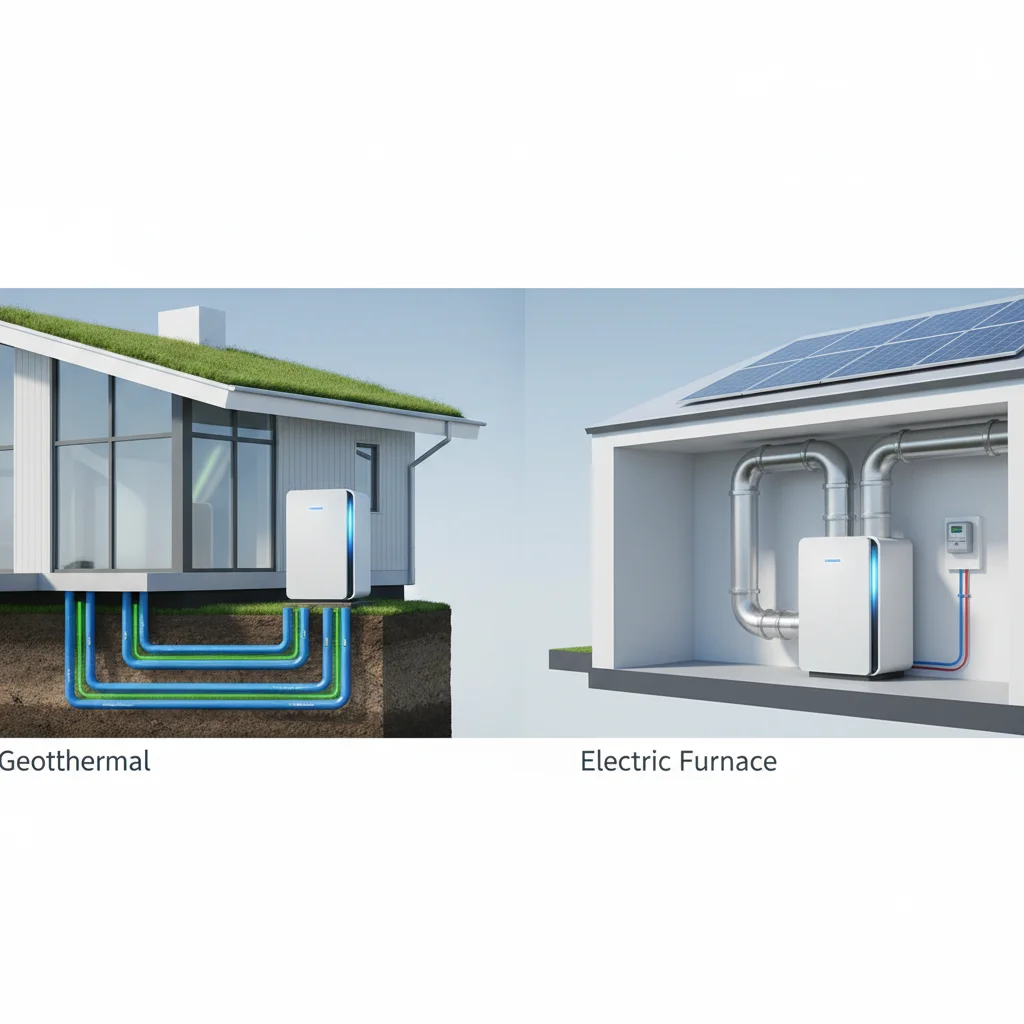
California homeowners who switch from electric furnace heating to geothermal heat pumps cut their annual heating and cooling costs by 40-60%, saving between $800 and $2,400 per year depending on home size and climate zone. The gap widens during extreme weather months, when electric resistance heating spikes utility bills by 200% or more compared to ground-source heat pump operation.
What's the ROI and payback period for switching from electric furnace to geothermal?
Geothermal heat pumps deliver return on investment through energy savings that offset the $15,000-$25,000 upfront cost difference between geothermal and electric furnace systems. California homeowners see payback periods of 5-10 years when factoring in federal tax credits and utility rebates that reduce net installation costs by 30-50%.
The math breaks down like this: a 2,000-square-foot home in Sacramento pays roughly $1,800 annually for electric furnace heating and air conditioning. The same home with a geothermal system pays $720-$900 annually—a difference of $900-$1,080 per year. With a net system cost of $12,000 after federal credits, the payback period lands at 11-13 years. But homeowners in the Central Valley or Inland Empire regions with higher cooling loads see faster payback of 7-9 years.
And the calculation improves when electricity rates climb. Pacific Gas & Electric raised rates by 13% in 2026, shortening payback timelines by 12-18 months for homes that switched to geothermal between 2024 and 2025. So the ROI accelerates as utility costs increase while geothermal operating expenses remain stable.
Maintenance costs favor geothermal systems over 20-year ownership periods. Electric furnaces require heating element replacement every 8-12 years at $400-$800 per replacement, while geothermal ground loops carry 50-year warranties with minimal intervention beyond filter changes and refrigerant checks.
How much can you save annually with geothermal vs electric furnace heating?
Annual savings range from $800 to $2,400 depending on home size, insulation quality, and regional climate patterns across California. Geothermal systems achieve efficiency ratings of 300-500% compared to electric furnaces that max out at 100% efficiency, meaning geothermal delivers 3-5 units of heat for every unit of electricity consumed.
A 1,500-square-foot home in Fresno with an electric furnace consumes 12,000-15,000 kWh annually for heating and cooling at $0.28-$0.32 per kWh—totaling $3,360-$4,800 per year. The same home with a geothermal heat pump uses 3,600-5,000 kWh at the same rates, dropping annual costs to $1,008-$1,600. That's $2,352-$3,200 in annual savings.
But coastal homeowners see smaller gaps. A San Diego residence with mild winters and moderate cooling needs saves $600-$900 annually because electric furnace runtime stays low. So climate zone matters more than system type for homes in temperate regions.
"Geothermal heat pumps are the most energy-efficient heating and cooling systems available, using 25% to 50% less electricity than conventional heating or cooling systems." — U.S. Department of Energy
Savings compound when pairing geothermal with solar panels. Homeowners who generate 60-80% of their electricity through rooftop solar reduce geothermal operating costs to $200-$400 annually, achieving near-zero energy bills for heating and cooling.
What are the upfront costs and financing options for each system?
Electric furnace installation costs $3,000-$6,000 for a complete system including ductwork modifications, electrical panel upgrades, and labor. Geothermal heat pump installations range from $18,000 to $35,000 depending on loop type—horizontal, vertical, or pond—and site conditions that affect drilling complexity.
Horizontal ground loops cost $18,000-$25,000 for homes with 0.25-acre lots or larger, requiring trenches 4-6 feet deep and 100-400 feet long. Vertical loops run $25,000-$35,000 for properties with limited land, drilling 150-400 feet deep in boreholes spaced 15-20 feet apart. And pond loops drop to $10,000-$18,000 when homeowners have access to a body of water at least 8 feet deep and within 200 feet of the home.
The federal Residential Clean Energy Credit (Section 25D) ended for expenditures made after December 31, 2025, and the IRS treats an expenditure as made when installation is completed (IRS FS-2025-05). Federal tax credits for this work have ended, but state, local and utility rebates may still apply; check what is available at your address with the DuloCore rebate calculator. California's Tech Clean California program adds $3,000-$4,000 in point-of-sale rebates for income-qualified households, stacking with federal incentives.
Financing options include: - PACE (Property Assessed Clean Energy) loans with 20-year terms and 5.5-7% interest rates, repaid through property tax bills - FHA PowerSaver loans up to $25,000 with 15-year terms - Utility on-bill financing through SMUD and SoCalGas with 10-year repayment at 0-3% interest - Home equity lines of credit (HELOCs) with variable rates currently at 7-9%
Or homeowners refinance mortgages to include geothermal costs, locking in 30-year fixed rates at 6-7% as of April 2026. Check your eligibility for energy tax credits to maximize savings.
Are you eligible for federal tax credits and rebates for geothermal installation?
The federal Residential Clean Energy Credit (Section 25D) ended for expenditures made after December 31, 2025, and the IRS treats an expenditure as made when installation is completed (IRS FS-2025-05). The credit drops to 26% in 2033 and 22% in 2034 before expiring.
The IRS defines qualified geothermal systems as those meeting ENERGY STAR certification standards with efficiency ratings of 14.1 EER or higher for closed-loop systems and 16.2 EER for open-loop configurations. Electric furnaces don't qualify for federal tax credits because they lack renewable energy components.
California adds state-level incentives through regional programs: - SMUD offers $3,500 rebates for geothermal installations in Sacramento County - LADWP provides $4,000-$6,000 for Los Angeles residents replacing electric resistance heating - PG&E's Energy Efficiency Rebate Program covers $2,500-$4,000 for all-electric homes upgrading to geothermal
But income-restricted programs deliver larger benefits. The California Energy Commission's Equity Multifamily program allocates $10,000-$15,000 per unit for properties serving households at or below 80% area median income. And single-family homes under the Tech Clean California initiative receive $8,000-$12,000 in combined rebates plus 0% financing.
Use our free rebate calculator to find your specific savings and available programs based on income, location, and current heating system.
How long does it take to install geothermal vs electric furnace?
Electric furnace installations take 1-3 days for straightforward replacements in homes with existing ductwork and adequate electrical service. Projects requiring panel upgrades or duct modifications extend to 4-6 days.
Geothermal heat pump installations span 3-7 days for horizontal loop systems and 5-10 days for vertical drilling projects. The timeline breaks into two phases: loop installation (2-6 days) and indoor equipment setup (1-2 days).
Horizontal loop projects move fastest on open lots with sandy or loamy soil, completing excavation in 1-2 days. Clay soils or rocky terrain add 2-3 days for trenching and backfilling. Vertical drilling takes 2-4 days per borehole depending on depth and rock hardness, with most residential systems requiring 2-6 boreholes.
Weather impacts geothermal timelines more than electric furnace work. Rain delays horizontal trenching by 1-3 days until soil dries enough for heavy equipment. But indoor electric furnace installation proceeds regardless of outdoor conditions.
And permitting adds 2-6 weeks before work begins. California counties require mechanical, electrical, and sometimes well permits for geothermal systems, with processing times varying by jurisdiction workload. Electric furnaces need only mechanical and electrical permits that clear in 1-2 weeks.
Peak season scheduling stretches timelines by 50-100%. HVAC contractors book 4-8 weeks out during April-August when demand surges, while November-February appointments open within 1-3 weeks.
Geothermal vs electric furnace: which system lasts longer and costs less to maintain?
Geothermal ground loops last 50+ years with zero maintenance beyond initial installation, backed by warranties that typically run 25-50 years on underground piping. Indoor heat pump components operate 20-25 years before requiring replacement, doubling the 10-15 year lifespan of electric furnaces.
Electric furnaces need heating element replacement every 8-12 years at $400-$800 per service call. Blower motors fail after 10-15 years, costing $450-$650 to replace. And circuit boards malfunction at 12-18 year marks, adding $300-$500 in repairs.
Geothermal maintenance costs $150-$300 annually for professional inspections that check refrigerant levels, clean filters, and verify loop pressure. Electric furnaces require $100-$200 annual tune-ups that include filter changes, element inspection, and blower cleaning.
But geothermal systems avoid the catastrophic failures common in electric furnaces. A burned-out heating element on a 15°F night creates an emergency service call at $500-$1,200 including overtime labor. Geothermal heat pumps continue operating even when outdoor temperatures plunge because ground temperature stays constant at 50-60°F year-round.
Total 20-year ownership costs tell the complete story. An electric furnace costs $3,000-$6,000 initially, plus $2,000-$4,000 in annual energy bills, plus $3,000-$5,000 in repairs and part replacements, plus full system replacement at year 15 for another $3,500-$6,500. That totals $51,500-$90,500 over two decades.
A geothermal system costs $12,000-$22,000 net after federal credits, plus $800-$1,600 in annual energy costs, plus $3,000-$6,000 in maintenance over 20 years. The 20-year total lands at $31,000-$54,000—saving $20,500-$36,500 compared to electric furnace ownership.
Explore heat pump rebates to reduce upfront costs further.
Official Sources
- U.S. Department of Energy - Geothermal Heat Pumps — Federal guidance on geothermal technology, efficiency ratings, and installation best practices
- ENERGY STAR Rebate Finder — Database of federal, state, and utility incentives for energy-efficient home upgrades
- DSIRE USA — Comprehensive directory of renewable energy and energy efficiency incentives by state
Related Reading: Learn more about Energy Audit Reduce Electric Bill and Furnace Energy Audit Inspection Points.
Frequently Asked Questions
What is the difference between a geothermal heat pump and an electric furnace?
Geothermal heat pumps transfer heat between the ground and the home using underground pipes filled with water or refrigerant, achieving 300-500% efficiency. Electric furnaces generate heat through resistance coils that convert electricity to warmth at 100% efficiency. Geothermal systems provide both heating and cooling in one unit, while electric furnaces require separate air conditioning systems.
How much can you save with a geothermal heat pump vs electric furnace?
California homeowners save $800-$2,400 annually by switching from electric furnaces to geothermal heat pumps, depending on home size and climate zone. Savings peak in regions with high cooling loads like the Central Valley and Inland Empire, where annual energy costs drop from $3,360-$4,800 to $1,008-$1,600.
Are geothermal heat pumps eligible for tax credits or rebates?
Geothermal installations qualify for the 30% federal Residential Clean Energy Credit through 2032, reducing costs by $5,400-$10,500 on typical systems. California adds $2,500-$6,000 in utility rebates through SMUD, LADWP, and PG&E programs, with income-qualified households receiving $8,000-$15,000 in combined state incentives. Electric furnaces don't qualify for federal credits. Review details on the geothermal tax credit page.
How long does it take to install a geothermal heat pump compared to an electric furnace?
Electric furnace installation takes 1-3 days for straightforward replacements, extending to 4-6 days when ductwork or electrical upgrades are needed. Geothermal systems require 3-7 days for horizontal loop installations and 5-10 days for vertical drilling projects, plus 2-6 weeks for permit processing before work begins.
What is the lifespan of a geothermal system versus an electric furnace?
Geothermal ground loops last 50+ years with minimal maintenance, while indoor heat pump components operate 20-25 years before replacement. Electric furnaces last 10-15 years and require heating element replacement every 8-12 years at $400-$800 per service. Total 20-year ownership costs favor geothermal by $20,500-$36,500.
Ready to switch to geothermal and start saving? Use our rebate calculator to find your exact costs, available incentives, and payback period based on your home's location and current heating system. Get personalized estimates in under 2 minutes.
Updated: April 14, 2026 — fact-checked by DuloCore Research. About our editorial process.
Check your California heat pump rebate eligibility — see the programs you qualify for and the dollar amounts on our California heat pump rebate finder.