Update (2026): The federal Energy Efficient Home Improvement Credit (Section 25C) expired December 31, 2025, following the passage of the OBBBA. Check state and local programs for current incentives.
A staggering 43% of a typical U.S. home's energy bill goes toward heating and cooling alone. So when an auditor inspects your furnace, they aren't just checking for safety; they're searching for the specific inefficiencies that cost you hundreds of dollars each winter. And identifying these weak points is the first step to unlocking thousands in government and utility rebates for high-efficiency upgrades.
What is a furnace energy audit, and how does it unlock potential savings?
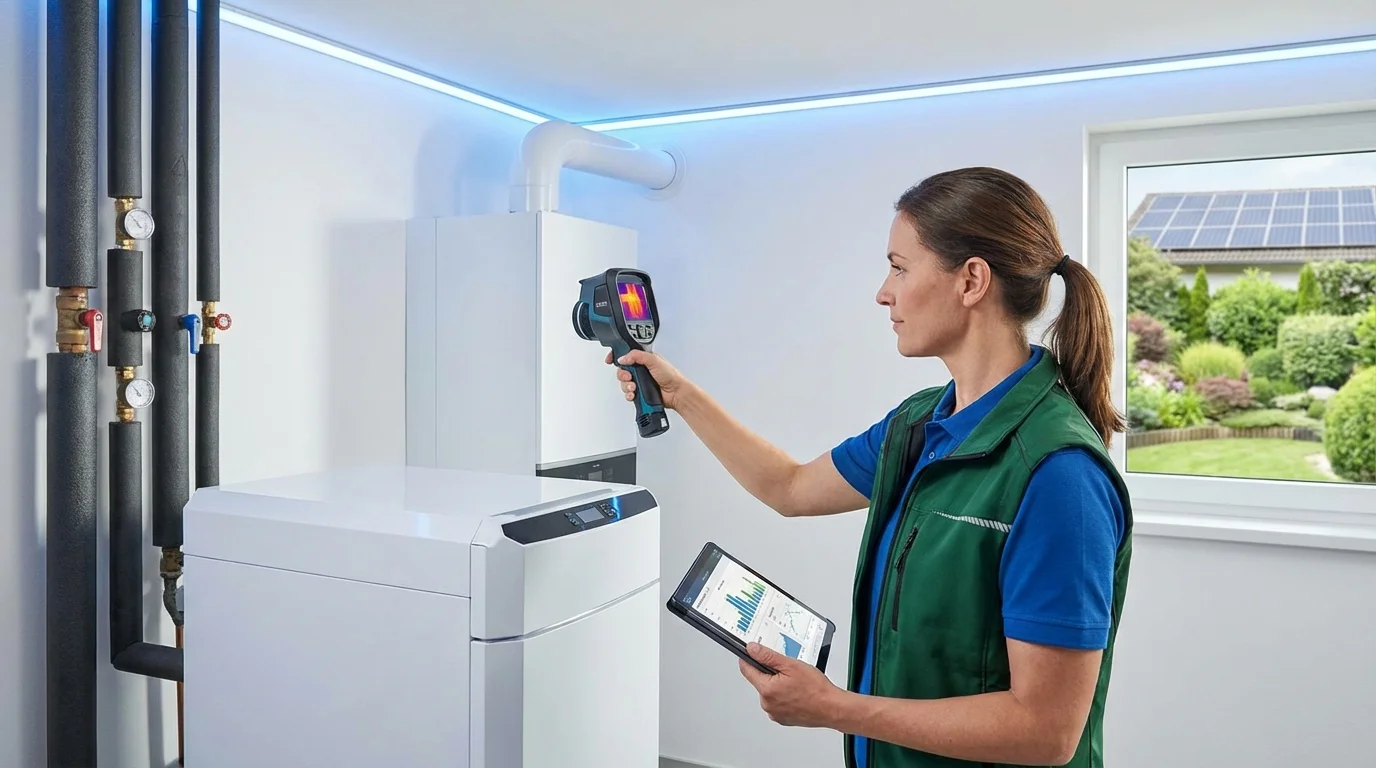
A furnace energy audit is a diagnostic inspection that identifies specific points of energy loss and inefficiency in a home's heating system. And professional auditors use tools like blower doors and infrared cameras to pinpoint issues, generating a report that qualifies homeowners for 2026 state and federal rebates.
But why does this matter? A standard furnace check-up focuses on function and safety. A home energy audit, however, is a financial tool. So the detailed findings—like a measured 78% AFUE (Annual Fuel Utilization Efficiency) or a 25% duct leakage rate—provide the exact documentation required to access up to $8,000 in point-of-sale rebates for a new system. Without this certified report, homeowners are ineligible for most high-value incentive programs.
Which furnace inspection points qualify for the highest rebates and eligible equipment upgrades?
Furnace inspection points qualifying for 2026 rebates include AFUE ratings below 95%, excessive combustion gas leakage, and ductwork leakage exceeding 15%. So auditors specifically test these metrics to certify eligibility for high-efficiency gas furnaces, electric heat pumps, and geothermal systems, which often carry the highest incentive values.
The auditor's report is the key. It documents the existing system's performance deficiencies, such as poor heat exchanger function or improper venting, which waste fuel. And this data directly validates the need for an upgrade under programs like the Home Electrification and Appliance Rebate (HEAR) program. So, an audit finding of an 80% AFUE furnace directly qualifies a household for incentives to install a 97% AFUE model or switch to an ENERGY STAR certified heat pump, unlocking heat pump rebates of up to $8,000.
How much can you save, and are there income limits for furnace upgrade incentives?
Homeowners save between $2,000 and $14,000 on furnace upgrades through 2026 federal programs, with specific amounts tied to household income. And low-to-moderate-income households (below 150% of the Area Median Income) often qualify for 100% of the equipment and installation cost, up to program maximums.
The Inflation Reduction Act (IRA) establishes clear income tiers. For instance, households earning less than 80% of the Area Median Income (AMI) can receive a rebate covering the full cost of a new heat pump, up to $8,000. But households between 80% and 150% of AMI are eligible for a rebate covering 50% of the cost. So, all homeowners also benefit from federal energy tax credits, which provide a 30% credit up to $2,000 for qualifying furnace or heat pump installations, with no income restrictions. Use our free rebate calculator to find your exact savings.
"Saving money on your energy bills is one of the fastest ways to see a return on your investment in your home." — U.S. Department of Energy
What's the application process, deadlines, and current funding status for state and utility furnace rebates?
The 2026 application process for furnace rebates typically requires submitting the energy audit report, contractor invoice, and proof of purchase to a state energy office or utility portal. And most programs operate on a first-come, first-served basis until annual funds, allocated through December 31, 2025, are depleted.
Homeowners must act quickly. So once a qualifying furnace or heat pump is installed, the application window is often 60-90 days. But funding status varies by state; for example, California's TECH Clean California program and New York's NYSERDA initiatives have distinct funding pools and deadlines. And it is critical to verify current program funding on your state's energy office website before beginning a project, as popular programs often exhaust their annual budgets by the third quarter.
Can you stack furnace incentives, and what are the contractor requirements?
Homeowners can stack federal tax credits with state and utility rebates for furnace upgrades in 2026, but not two federal incentives for the same equipment. And contractor requirements mandate the use of licensed, and often program-approved, installers to ensure the work qualifies for reimbursement.
For example, a homeowner can combine a $2,000 federal tax credit for a new furnace with a $1,500 rebate from their local utility. But that same homeowner cannot claim both the HEAR rebate and a federal tax credit for the same heat pump installation. So, programs require installation by contractors holding specific state licenses (e.g., HVAC C-20 in California) and sometimes require additional certifications, like those from the Building Performance Institute (BPI), to guarantee the work meets energy-efficiency standards.
"Many state and local governments offer incentives for energy efficiency and renewables that can be combined with federal tax credits." — DSIRE
| Incentive Program (2026) | Max Rebate/Credit | Income Limit | Deadline |
|---|---|---|---|
| Federal HEAR Rebate | $8,000 | <150% AMI | Dec 31, 2025 |
| Federal Tax Credit | Ended Dec 31, 2025 | — | Dec 31, 2025 |
| State/Utility Rebates | $500 - $3,000+ | Varies by program | Varies (check annually) |
Official Sources
- ENERGY STAR — A U.S. Environmental Protection Agency program providing credible, objective information on the energy efficiency of products.
- IRS Home Energy Credits — Official guidance from the Internal Revenue Service on federal tax credits for home energy improvements. (note: the federal 25C and 25D credits ended for projects completed after December 31, 2025)
- Database of State Incentives for Renewables & Efficiency (DSIRE) — The most comprehensive source of information on incentives and policies that support renewables and energy efficiency in the United States.
Related Reading: Learn more about What To Fix First After Energy Audit.
Related Reading: Learn more about Ductwork Inspection Energy Audit.
Frequently Asked Questions
What furnace inspection points are crucial for rebate eligibility?
Crucial inspection points for 2026 rebate eligibility are the Annual Fuel Utilization Efficiency (AFUE) rating, duct leakage percentage, and carbon monoxide (CO) levels in flue gas. So if your furnace's AFUE is below 95% or duct leakage exceeds 15% of total airflow, the audit report will officially recommend an upgrade, which is the primary documentation needed to unlock state and federal incentives.
What specific components of my furnace will an energy auditor examine?
An energy auditor will examine the heat exchanger for cracks, the burner and pilot light for efficient combustion, the flue pipe for proper ventilation, and the blower motor for correct airflow. And they will also test the thermostat's calibration and inspect the filter for blockages. So, these component checks provide a complete picture of the unit's operational efficiency and safety, with findings documented in the final report.
How do audit findings on my furnace's efficiency relate to potential rebate amounts?
Audit findings directly correlate to rebate amounts. For instance, a report documenting a furnace operating at 70% AFUE qualifies a low-income household for a rebate covering 100% of the cost (up to $8,000) for a new high-efficiency heat pump. But a furnace at 85% AFUE may only qualify for a smaller, flat-rate utility rebate of $500 for a 96% AFUE furnace upgrade.
Are the inspection points for a furnace energy audit different from a standard HVAC check-up?
Yes, the inspection points are different. A standard HVAC check-up focuses on operational safety and preventative maintenance, like cleaning coils and checking refrigerant. But a furnace energy audit uses diagnostic tools like blower doors and combustion analyzers to quantify energy waste. So the audit's goal is to produce a data-driven report with an energy efficiency score, which is required for most 2026 rebate applications.
What information from the furnace energy audit report is needed to claim rebates?
To claim 2026 rebates, you need the section of the audit report that lists your existing furnace's model, serial number, and measured AFUE percentage. And you will also need the auditor's official recommendation for replacement or upgrades, including the proposed efficiency rating of the new equipment. So, this data validates that the upgrade meets the specific efficiency gain requirements of the rebate program.
Unlock Your Furnace Rebates
Don't leave money on the table. A furnace energy audit is the first step to accessing thousands in government incentives. Use our free tool to see the exact rebate amounts you qualify for in your area.
Calculate Your Savings NowLast updated April 14, 2026 — reviewed by DuloCore Editorial. About our authors.