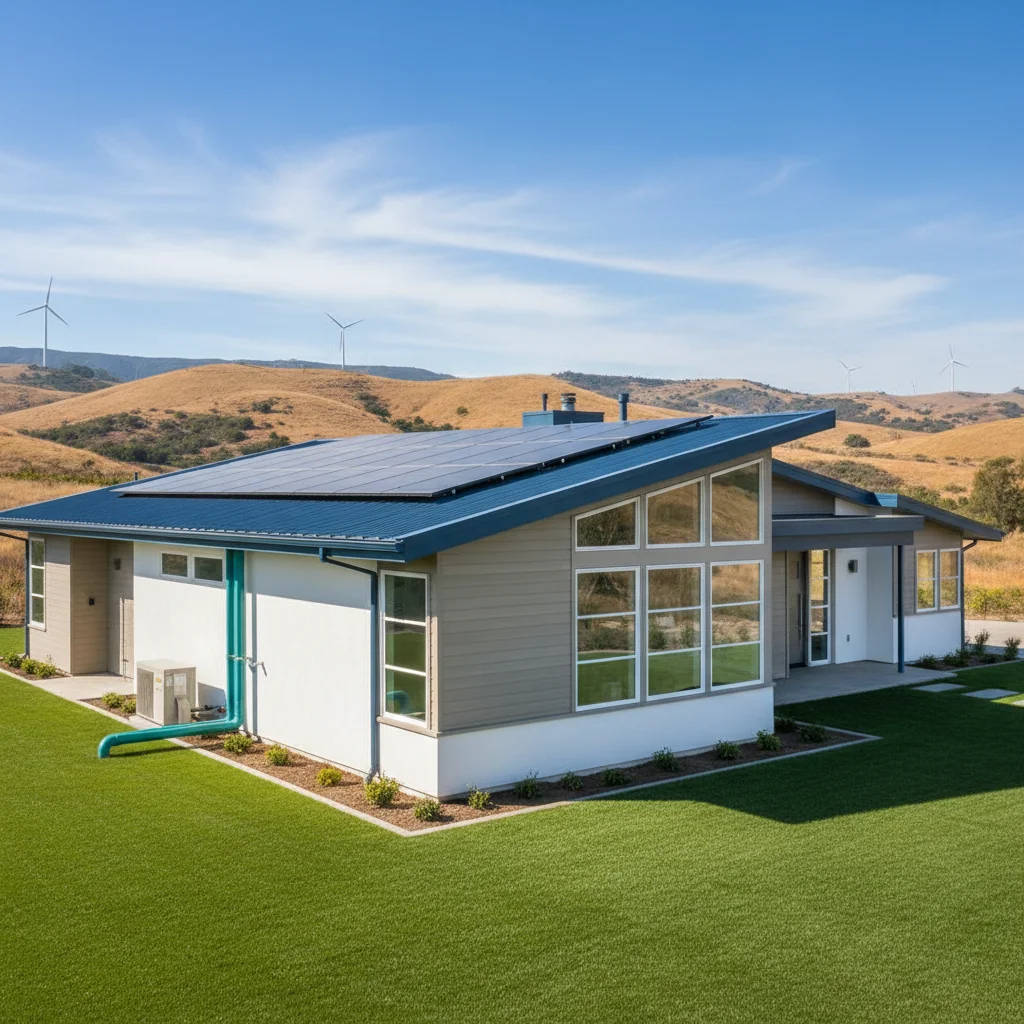
California homeowners installed 3,200 geothermal heat pump systems in 2025, claiming an average federal tax credit of $6,800. And the rush isn't slowing down. The federal Residential Clean Energy Credit (Section 25D) ended for expenditures made after December 31, 2025, and the IRS treats an expenditure as made when installation is completed (IRS FS-2025-05). Federal tax credits for this work have ended, but state, local and utility rebates may still apply; check what is available at your address with the DuloCore rebate calculator. But California eliminated its state-level geothermal tax credit in 2024, leaving homeowners to navigate a fragmented landscape of utility rebates and local incentives that vary by location and income.
Is the California Geothermal Tax Credit Refundable or Non-Refundable in 2026?
California discontinued its state geothermal tax credit in 2024. The federal Residential Clean Energy Credit (Section 25D) ended for expenditures made after December 31, 2025, and the IRS treats an expenditure as made when installation is completed (IRS FS-2025-05).
The federal Residential Clean Energy Credit (Section 25D) ended for expenditures made after December 31, 2025, and the IRS treats an expenditure as made when installation is completed (IRS FS-2025-05). And installation costs average $18,000 to $25,000 for residential systems. But labor-intensive projects in rocky soil or tight urban lots push costs to $35,000.
California homeowners can still use utility rebates from Pacific Gas & Electric, Southern California Edison, and Sacramento Municipal Utility District. PG&E's Energy Savings Assistance Program offers $3,000 to $6,000 for income-qualified households installing heat pumps. SMUD's Residential Heat Pump Incentive pays $2,500 for geothermal systems replacing natural gas heating. Or homeowners layer local rebates—like Bay Area Air Quality Management District's $3,000 incentive—to reduce net costs further.
What Documentation Do You Need to Claim the Geothermal Tax Credit?
Form 5695 only covers qualifying work completed by December 31, 2025 and claimed on a 2025 return; the federal 25C and 25D credits ended after that date (IRS FS-2025-05). The form requires the total installation cost, property address, and system installation date. And taxpayers must attach the manufacturer's certification statement confirming the heat pump meets ENERGY STAR requirements or equivalent efficiency standards.
Required documentation includes:
- Itemized invoice from the contractor showing equipment costs, labor charges, ground loop installation, and total project cost
- Manufacturer's certification confirming ENERGY STAR compliance or minimum efficiency rating (EER ≥ 3.3, COP ≥ 3.1 for heating)
- IRS Form 5695 only for qualifying work completed by December 31, 2025 (IRS FS-2025-05)
- Proof of payment such as canceled checks, credit card statements, or bank transfers dated within the tax year the system was completed
The installation must occur at the taxpayer's primary or secondary U.S. residence. Rental properties don't qualify unless the owner occupies the unit. And the system must be "placed in service" during the tax year—meaning fully installed, operational, and generating heating or cooling.
California contractors typically provide a "tax credit eligibility letter" summarizing the system's specifications, installation date, and ENERGY STAR certification. Or homeowners download the manufacturer's certification directly from the ENERGY STAR product database at energystar.gov. HVAC manufacturers like WaterFurnace, ClimateMaster, and Trane publish standardized certification letters for tax credit purposes.
How Much Can You Claim for a Geothermal Heat Pump Installation in California?
The federal Residential Clean Energy Credit (Section 25D) ended for expenditures made after December 31, 2025, and the IRS treats an expenditure as made when installation is completed (IRS FS-2025-05).
Qualified costs include:
- Heat pump unit (compressor, heat exchanger, controls)
- Ground loop system (vertical boreholes, horizontal trenches, pond loops)
- Labor charges (excavation, drilling, plumbing, electrical)
- Piping and materials (polyethylene loops, grout, backfill)
- System testing and commissioning
So a typical 5-ton residential geothermal system costs $22,000 ($18,000 equipment and labor, $4,000 ground loop). Homeowners in earthquake-prone areas like Los Angeles pay $5,000 to $8,000 extra for seismic-resistant mounting and deeper boreholes.
Non-qualified costs include:
- HVAC ductwork (unless part of the original installation)
- Thermostats and controls (unless integrated into the heat pump system)
- Extended warranties (not considered installation costs)
- Landscaping restoration (reseeding lawns over ground loops doesn't qualify)
Use our free rebate calculator to estimate California utility incentives for your specific address and household income.
Who Qualifies for California's Geothermal Tax Credit in 2026?
The federal Residential Clean Energy Credit (Section 25D) ended for expenditures made after December 31, 2025, and the IRS treats an expenditure as made when installation is completed (IRS FS-2025-05). California's state rebates cap eligibility at 80% to 120% of area median income depending on the program.
Before the credit ended, qualifying installations included:
- Single-family homes (owner-occupied primary or vacation homes)
- Condominiums and townhomes (if the owner pays for and benefits from the system)
- New construction (if the taxpayer purchases before occupancy and pays for the system)
- Manufactured homes (if used as a primary residence)
The system must meet ENERGY STAR efficiency requirements or equivalent standards set by the Consortium for Energy Efficiency. Ground-source heat pumps must achieve a minimum Energy Efficiency Ratio (EER) of 3.3 for cooling and a Coefficient of Performance (COP) of 3.1 for heating. California's Title 24 building code requires higher efficiency for new construction—EER ≥ 3.5 and COP ≥ 3.3.
"Geothermal heat pumps use the constant temperature of the earth as the exchange medium instead of outside air, making them highly efficient in all climates." — U.S. Department of Energy Geothermal Heat Pumps
What's the Step-by-Step Process to Claim Your Geothermal Tax Credit?
Form 5695 only covers qualifying work completed by December 31, 2025 and claimed on a 2025 return; the federal 25C and 25D credits ended after that date (IRS FS-2025-05).
Step 1: Verify system eligibility Confirm the geothermal heat pump meets ENERGY STAR requirements by checking the manufacturer's certification statement or searching the ENERGY STAR product database. California contractors specializing in geothermal heat pumps provide tax credit eligibility letters documenting efficiency ratings.
Step 2: Gather installation documentation Collect itemized invoices showing equipment costs, labor charges, ground loop installation, permitting fees, and total project cost. Or request a detailed cost breakdown from the contractor separating qualified and non-qualified expenses like landscaping restoration.
Form 5695 only covers qualifying work completed by December 31, 2025 and claimed on a 2025 return; the federal 25C and 25D credits ended after that date (IRS FS-2025-05). Form 5695 only covers qualifying work completed by December 31, 2025 and claimed on a 2025 return; the federal 25C and 25D credits ended after that date (IRS FS-2025-05).
Form 5695 only covers qualifying work completed by December 31, 2025 and claimed on a 2025 return; the federal 25C and 25D credits ended after that date (IRS FS-2025-05).
Step 5: Retain documentation for seven years Form 5695 only covers qualifying work completed by December 31, 2025 and claimed on a 2025 return; the federal 25C and 25D credits ended after that date (IRS FS-2025-05). California homeowners claiming utility rebates also keep rebate approval letters and payment records to prove cost basis.
Form 5695 only covers qualifying work completed by December 31, 2025 and claimed on a 2025 return; the federal 25C and 25D credits ended after that date (IRS FS-2025-05). Or homeowners hiring CPAs or Enrolled Agents provide the contractor's invoice and manufacturer's certification—the preparer handles the rest.
How Does California's Geothermal Credit Compare to Federal Tax Incentives?
The federal Residential Clean Energy Credit (Section 25D) ended for expenditures made after December 31, 2025, and the IRS treats an expenditure as made when installation is completed (IRS FS-2025-05). And California's current incentive landscape centers on utility rebates—PG&E, SCE, and SMUD offer $2,500 to $6,000 cash rebates paid within 60 to 90 days of installation.
California's utility rebates prioritize low- and moderate-income households earning 80% to 120% of area median income. So a San Francisco homeowner earning $150,000 annually qualifies for zero utility rebates. But a Sacramento family earning $68,000 receives a $4,500 SMUD rebate, reducing a $18,000 system cost to $13,500.
Federal incentives compared to California programs:
| Program | Type | Amount | Income Limit | Timeline |
|---|---|---|---|---|
| Federal Residential Clean Energy Credit | Ended Dec 31, 2025 | Ended Dec 31, 2025 | — | Ended Dec 31, 2025 |
| PG&E Energy Savings Assistance | Rebate | $3,000-$6,000 | ≤200% federal poverty level | 2026 only |
| SMUD Residential Heat Pump Incentive | Rebate | $2,500 | None | Ongoing |
| BAAQMD Wood Smoke Reduction | Rebate | $3,000 | None | Ongoing |
Solar panel installations fell under the same federal credit, which ended for expenditures made after December 31, 2025 (IRS FS-2025-05). But geothermal systems reduce heating and cooling costs by 40% to 60% year-round, while solar offsets electricity only during daylight hours.
California's Self-Generation Incentive Program (SGIP) excludes geothermal heat pumps, focusing instead on battery storage paired with solar. So homeowners seeking energy independence combine geothermal for HVAC with solar plus batteries for electricity. Explore energy tax credits to compare geothermal, solar, battery, and EV charger incentives.
Official Sources
- U.S. Department of Energy: Save Energy, Save Money — Federal energy efficiency guidance and rebate information
- IRS Energy Efficient Home Improvement Credit — Official tax credit eligibility, forms, and documentation requirements (note: the federal 25C and 25D credits ended for projects completed after December 31, 2025)
- Database of State Incentives for Renewables & Efficiency — Comprehensive California and federal incentive database
Related Reading: Learn more about California Geothermal Rebates 2026.
Frequently Asked Questions
What is the geothermal tax credit in California for 2026?
California offers no state geothermal tax credit in 2026. The federal Residential Clean Energy Credit (Section 25D) ended for expenditures made after December 31, 2025, and the IRS treats an expenditure as made when installation is completed (IRS FS-2025-05). Homeowners can use utility rebates from PG&E ($3,000-$6,000), SMUD ($2,500), or local air quality districts ($3,000) to reduce net costs.
Am I eligible for the geothermal tax credit in California?
The federal Residential Clean Energy Credit (Section 25D) ended for expenditures made after December 31, 2025, and the IRS treats an expenditure as made when installation is completed (IRS FS-2025-05). California utility rebates restrict eligibility to households earning 80% to 200% of area median income depending on the program.
How much money can I get from the geothermal tax credit?
The federal Residential Clean Energy Credit (Section 25D) ended for expenditures made after December 31, 2025, and the IRS treats an expenditure as made when installation is completed (IRS FS-2025-05). Utility rebates add $2,500 to $6,000, reducing total out-of-pocket costs to $14,000 to $22,500 for systems averaging $20,000 to $25,000.
What is the deadline to claim the geothermal tax credit in California?
The federal Residential Clean Energy Credit (Section 25D) ended for expenditures made after December 31, 2025, and the IRS treats an expenditure as made when installation is completed (IRS FS-2025-05). Form 5695 only covers qualifying work completed by December 31, 2025 and claimed on a 2025 return; the federal 25C and 25D credits ended after that date (IRS FS-2025-05).
How does the geothermal tax credit compare to solar tax credits?
The federal Residential Clean Energy Credit (Section 25D) ended for expenditures made after December 31, 2025, and the IRS treats an expenditure as made when installation is completed (IRS FS-2025-05). But geothermal reduces heating and cooling costs year-round by 40% to 60%, while solar offsets electricity only during daylight.
Ready to calculate your total savings? Use our free rebate calculator to estimate your California utility rebates and net installation costs based on your address, household income, and system size. Get personalized results in 60 seconds.
Last updated April 14, 2026 — reviewed by DuloCore Editorial. About our authors.
Check your California heat pump rebate eligibility — see the programs you qualify for and the dollar amounts on our California heat pump rebate finder.