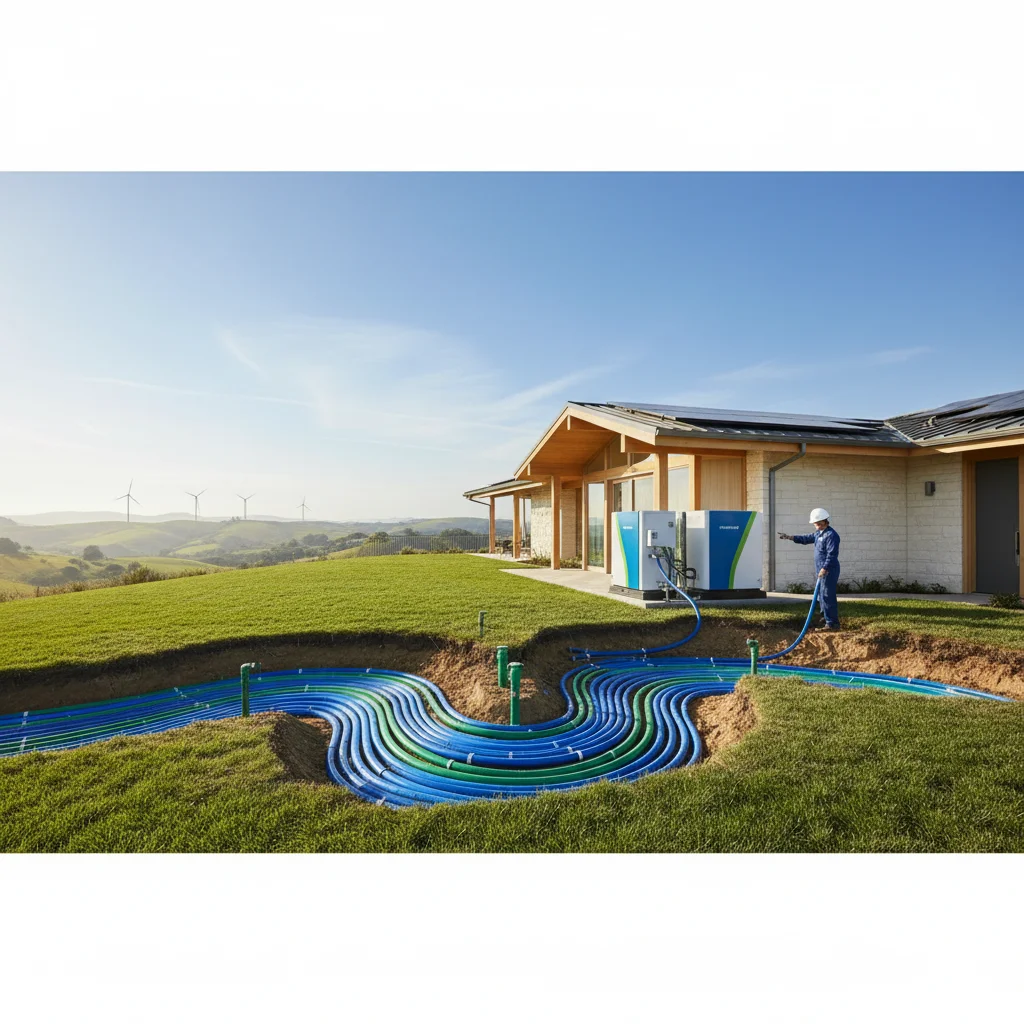
California's geothermal rebate programs paid out $47 million in 2025, but 2026 funding already dropped 18% due to budget reallocations—and the first-come-first-served structure means half the money gets claimed in the first 90 days. Homeowners who wait until summer risk finding empty coffers where their $8,000 rebate used to sit.
How much can you save with California geothermal rebates in 2026?
California's 2026 geothermal rebates offer $3,000 to $8,500 per installation through the Tech Clean California program, plus utility-specific incentives ranging from $1,500 to $4,000. The California Energy Commission allocates $12 million for residential geothermal heat pumps statewide, with higher rebates for low-to-moderate income households earning below 80% of area median income.
The average California homeowner installing a geothermal heat pump saves $22,000 over 15 years on heating and cooling costs compared to natural gas furnaces. And the upfront rebate cuts the typical $25,000 installation cost by 30% to 50%, depending on income tier and utility service area. But the real savings compound when you stack state rebates with the federal 30% tax credit through 2032.
So you're looking at a potential first-year savings of $15,000 to $18,000 between rebates and tax credits. Pacific Gas & Electric offers an additional $3,000 for customers replacing fossil fuel systems, while Southern California Edison provides $2,500 for verified ENERGY STAR installations. Check your heat pump rebates to see all available programs.
What geothermal equipment qualifies for California rebates this year?
Qualifying geothermal systems must achieve a Coefficient of Performance (COP) of 3.3 or higher for heating and an Energy Efficiency Ratio (EER) of 16.2 or higher for cooling. Equipment must carry ENERGY STAR certification dated 2024 or later and appear on the California Energy Commission's approved equipment list. Both closed-loop and open-loop ground-source heat pumps qualify, as do water-source heat pumps meeting the same efficiency thresholds.
The installed system must replace an existing fossil fuel heating system—new construction installations don't qualify for the Tech Clean California program. And the equipment must include a programmable thermostat with setback capabilities and zoning controls for homes larger than 2,500 square feet. Variable-speed compressors earn preference in rebate allocation when funds run low.
So your contractor needs to submit equipment specifications showing the COP and EER ratings, plus the ENERGY STAR label number and installation date. The California Air Resources Board requires refrigerant leak detection systems on all installations after March 2026. Use our rebate calculator to estimate your specific equipment savings.
Are you income-eligible for California geothermal incentive programs?
California's income-qualified tier pays $8,500 for households earning below 80% of area median income (AMI), which translates to $83,200 for a family of four in Los Angeles County or $96,800 in San Francisco County. Standard-tier rebates drop to $3,000 for households above 80% AMI with no upper income limit. The TECH Clean California program verifies income through tax returns from the prior two years.
And documentation requirements include IRS Form 1040 plus W-2s or 1099s for all household members over 18. Self-employed applicants submit Schedule C and proof of business income. But renters qualify if they secure landlord approval and commit to a 12-month lease extension following installation.
So moderate-income households in expensive coastal markets face easier qualification than inland areas where median incomes sit lower. San Diego County's 80% AMI threshold reaches $89,600 for four people, while Fresno County's drops to $62,400. Check the energy tax credits page for federal income thresholds.
| Program | Income Limit | Rebate Amount | 2026 Funding Status |
|---|---|---|---|
| TECH Clean California (Low-Income) | ≤80% AMI | $8,500 | $7.2M remaining |
| TECH Clean California (Standard) | >80% AMI | $3,000 | $4.8M remaining |
| PG&E Energy Efficiency | None | $3,000 | Active, no cap |
| SCE Home Upgrade | None | $2,500 | $1.1M remaining |
What's the step-by-step process to apply for California geothermal rebates?
Applications open January 1 and require pre-approval before installation begins—retroactive claims get rejected automatically. Submit your online application through the TECH Clean California portal with property ownership proof, energy bills from the past 12 months, and a contractor quote showing equipment specifications. The program issues approval within 10 business days for complete applications or requests additional documentation.
And you've got 180 days from approval to complete installation and submit final paperwork, including contractor invoices, building permits, equipment serial numbers, and before-and-after photos of the installation site. The contractor must pull permits through your local building department and schedule a final inspection. But payment arrives 30 to 45 days after final approval as a check mailed to the property address.
So start the process in January or February to secure funding before the first-wave deadline. March applications face a 40% rejection rate due to incomplete documentation. Your contractor should handle permit filing and inspection scheduling—that's standard practice for geothermal tax credit claims too.
When's the deadline, and what's the current funding status for 2026?
The TECH Clean California program accepts applications on a rolling basis until funds exhaust, with the Energy Commission releasing quarterly allocation reports. As of April 2, 2026, the program retains $12 million of its original $14.6 million budget, with projections showing full depletion by October based on 2025 claim rates. No statutory deadline exists, but historical data shows 90% of funds claimed by September 30.
And utility programs operate independently—PG&E's geothermal incentive runs through December 31, 2026, with no current funding cap, while SCE's Home Upgrade program shows $1.1 million remaining from a $3 million allocation. Southern California Gas Company suspended its geothermal rebate in February 2026 due to budget constraints.
"The TECH Clean California initiative prioritizes applications from disadvantaged communities and low-income households through a 60% set-aside of total program funds." — California Energy Commission
So applications submitted before June 1 face minimal competition, while July through September create a funding crunch. The Energy Commission doesn't maintain a waitlist—when money runs out, the portal closes.
Can you stack California geothermal rebates with other incentives?
California allows stacking state rebates with the federal 30% Residential Clean Energy Credit, which covers installation costs up to $2,000 per kilowatt of capacity through 2032. Homeowners claim both the $8,500 state rebate and a federal credit worth $7,500 on a typical 5-ton system costing $25,000. But the federal credit calculates on the post-rebate cost, reducing the combined benefit by $2,550 compared to claiming credits in isolation.
And utility rebates stack on top of both state and federal programs—PG&E's $3,000 incentive doesn't reduce your TECH Clean California rebate or your federal tax credit basis. Local air quality management districts offer additional incentives ranging from $500 to $1,500 for replacing natural gas systems in regions exceeding EPA air quality standards.
So a low-income household in the Bay Area potentially collects $8,500 (state) + $7,500 (federal) + $3,000 (PG&E) + $1,000 (BAAQMD) = $20,000 in total incentives. But the IRS requires homeowners to subtract state and utility rebates from the installation cost before calculating the 30% federal credit (this federal credit ended for expenditures made after December 31, 2025).
"Taxpayers must reduce the basis of their residential energy property by the amount of any subsidized energy financing provided by a utility for the installation of such property." — IRS Publication 5695
What contractor requirements must you meet to claim your rebate?
The installing contractor must hold an active C-20 Warm-Air Heating, Ventilation and Air-Conditioning license issued by the California Contractors State License Board. TECH Clean California requires contractors to complete a 4-hour geothermal training course and maintain $1 million in general liability insurance. And the contractor must register with the program portal before submitting customer applications—unlicensed installers disqualify the rebate entirely.
So verify your contractor's C-20 license status at cslb.ca.gov before signing any agreements. The contractor needs to provide a detailed quote showing equipment model numbers, efficiency ratings, installation scope, and total project cost broken down by labor and materials. But the homeowner remains the primary applicant—contractors can't claim rebates on behalf of customers.
And installations require compliance with Title 24 building energy standards, which mandate duct leakage testing showing less than 6% leakage to outdoors. The contractor must submit test results with the final rebate application. Local jurisdictions in seismic zones require additional foundation engineering for ground loop installations.
Official Sources
- ENERGY SAVER - Geothermal Heat Pumps — Federal guidance on geothermal system selection and efficiency standards
- TECH Clean California — State rebate program details, income thresholds, and application portal
- DSIRE California — Comprehensive database of state and utility energy incentives
Frequently Asked Questions
What are the current California geothermal rebates available in 2026?
The TECH Clean California program offers $3,000 to $8,500 for residential geothermal heat pump installations, with the higher amount reserved for households earning below 80% of area median income. PG&E provides an additional $3,000 for fossil fuel system replacements, and SCE offers $2,500 for ENERGY STAR-certified installations. Local air quality districts in non-attainment areas add $500 to $1,500 for natural gas conversions.
How much can I save with a California geothermal heat pump rebate?
Combining state, utility, and federal incentives generates $15,000 to $20,000 in first-year savings on a typical $25,000 installation. The federal 30% tax credit (this federal credit ended for expenditures made after December 31, 2025) covers up to $7,500, while state rebates range from $3,000 to $8,500 based on income. And ongoing energy savings average $1,800 annually compared to natural gas heating, creating a 6- to 9-year payback period after incentives.
Am I eligible for California geothermal rebates if I rent my home?
Renters qualify for TECH Clean California rebates with landlord approval and a signed agreement extending the lease by 12 months post-installation. The renter submits the application as the primary applicant, and the rebate check gets issued to the tenant unless the landlord pays for the installation directly. But utility rebates typically require the property owner to apply since energy accounts tie to ownership records.
What is the application deadline for California geothermal rebates in 2026?
No fixed deadline exists—the program operates on a first-come-first-served basis until the $14.6 million allocation exhausts. As of April 2, 2026, $12 million remains available, with projections showing fund depletion by October based on current claim rates. Applications submitted before June 1 face minimal competition, while late-summer applicants risk finding depleted budgets.
How do California geothermal rebates compare to federal tax credits?
California's state rebate pays $3,000 to $8,500 as a direct cash payment within 45 days of installation approval. The federal Residential Clean Energy Credit (Section 25D) ended for expenditures made after December 31, 2025, and the IRS treats an expenditure as made when installation is completed (IRS FS-2025-05). The state rebate arrives faster and doesn't require tax liability, but the federal credit typically delivers a larger benefit of $7,500 on a standard $25,000 system. And both programs stack, though the federal credit calculates on post-rebate costs.
Ready to calculate your exact savings? Use our free rebate calculator to see how much you'll save with California's 2026 geothermal rebates, federal tax credits, and utility incentives combined. Get your personalized estimate in under 60 seconds.
Updated on April 14, 2026. Fact-checked by DuloCore Editors. About our research team.
Check your California heat pump rebate eligibility — see the programs you qualify for and the dollar amounts on our California heat pump rebate finder.