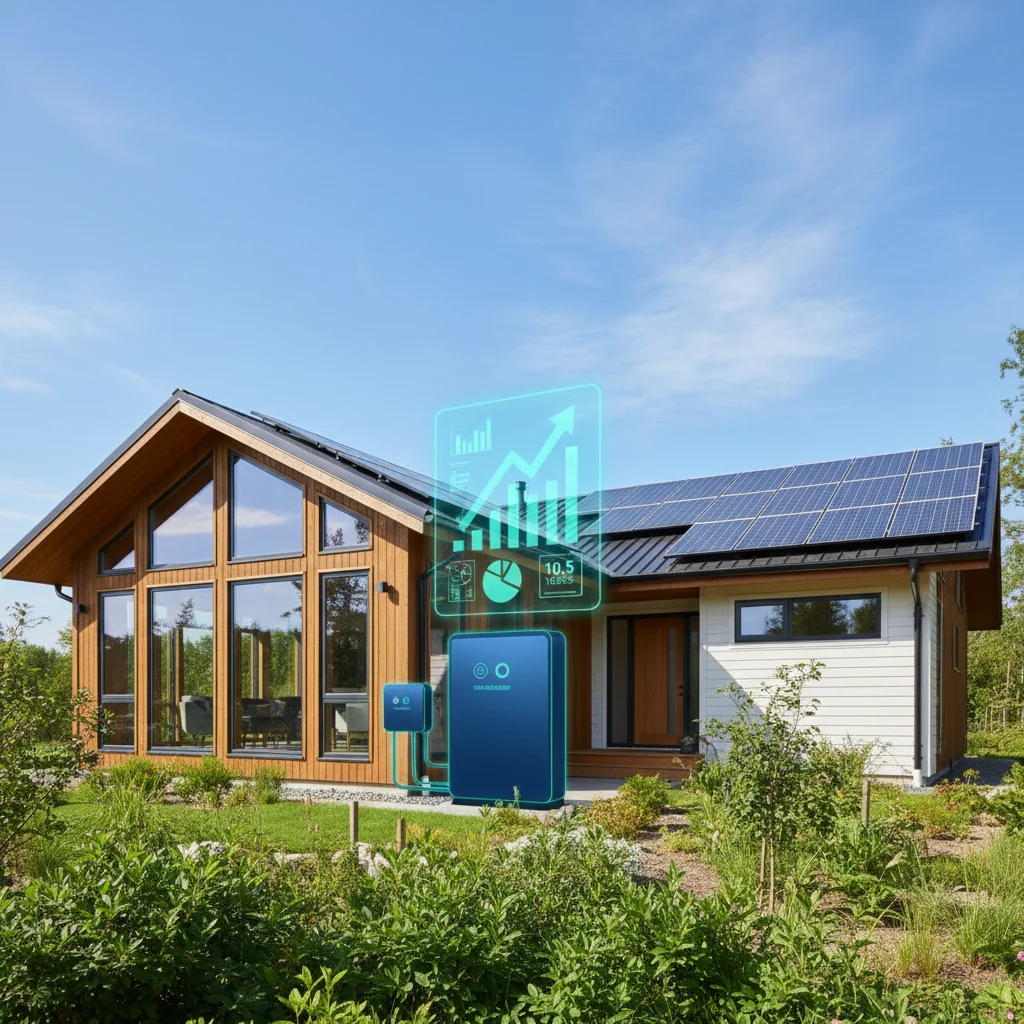
Installing a geothermal heat pump costs $15,000 to $25,000 upfront, yet the system saves homeowners $800 to $1,500 annually on heating and cooling bills. For California homeowners evaluating this technology in 2026, the math hinges on payback period, federal tax credits, and ground loop lifespan. And the numbers tell a compelling story when compared against traditional HVAC systems that burn through $2,000+ in annual energy costs.
How Long Does It Take to Recoup Your Geothermal Heat Pump Investment?
Geothermal heat pump systems deliver payback periods of 5 to 10 years for most residential installations in 2026, depending on climate zone, existing HVAC efficiency, and utility rates. Homes in cold climates with high heating costs recover investment faster, while moderate climates see longer timelines. The IRA federal tax credit covering 30% of installation costs through 2032 cuts payback periods by 2 to 3 years compared to pre-2022 installations.
California homeowners paying $0.32 per kWh see faster ROI than national averages. A $20,000 geothermal system qualifies for $6,000 in federal credits, reducing net cost to $14,000. Annual savings of $1,200 deliver full payback in 11.7 years without state incentives. But utility rebates and time-of-use rate optimization shorten this timeline.
Ground loop systems eliminate furnace replacement costs every 15 to 20 years. Traditional gas furnaces cost $4,500 to $8,000 to replace, while geothermal ground loops last 50+ years. So total cost of ownership over 25 years favors geothermal by $12,000 to $18,000.
Energy costs compound ROI calculations. Natural gas prices increased 47% from 2021 to 2026, while geothermal systems lock in electric-only operating costs. And homes with solar panels achieve near-zero operational costs when pairing geothermal with photovoltaic systems.
"Geothermal heat pumps can reduce energy consumption and corresponding emissions by more than 40% compared to air source heat pumps and up to 70% compared to electric resistance heating with standard air conditioning." — U.S. Department of Energy
What's the Payback Period for a Geothermal System in Your Climate Zone?
Climate zone determines geothermal payback periods through heating and cooling demand. California Climate Zone 3 (coastal regions) sees 8 to 12 year payback, while Zone 16 (mountain areas) delivers 5 to 7 year returns due to extreme temperature swings. Zones with 3,000+ heating degree days maximize geothermal efficiency against propane or oil furnaces costing $3,500+ annually to operate.
Cooling-dominated climates show longer payback periods. Central Valley homes running air conditioning 120+ days annually save $900 to $1,300 per year, delivering 10 to 14 year payback timelines. But heating-dominated zones see geothermal systems replace $2,800+ annual heating bills with $800 electric costs.
Soil thermal conductivity affects installation costs and efficiency. Rocky soil requires more expensive drilling at $25 to $35 per linear foot versus $15 to $25 for clay or sand. And horizontal loop systems in areas with 0.5+ acres cost $10,000 to $15,000 less than vertical loops but require more land.
Water table depth influences system performance. Homes with water tables 10 to 30 feet deep achieve 400% to 500% efficiency ratings (COP of 4.0 to 5.0), while dry regions see 300% to 400% efficiency. So desert installations face longer payback periods despite high cooling costs.
Use our free rebate calculator to model payback timelines for your specific climate zone and energy costs.
How Does Geothermal ROI Compare to Air Source Heat Pumps and Traditional HVAC?
Geothermal systems cost $15,000 to $25,000 installed versus $5,000 to $12,000 for air source heat pumps and $6,000 to $10,000 for gas furnace plus AC combinations in 2026. Air source systems deliver 5 to 7 year payback periods, while geothermal requires 7 to 12 years depending on climate. But lifespan differences reverse long-term economics.
Air source heat pumps last 15 to 20 years before compressor replacement at $3,500 to $6,000. Geothermal indoor units last 20 to 25 years, while ground loops function for 50+ years without replacement. Over 30 years, homeowners replace air source systems twice versus one geothermal indoor unit replacement.
Annual operating costs favor geothermal by $400 to $900 per year. A 2,000 square foot California home spends $1,800 annually on air source heat pump electricity versus $1,100 for geothermal. Traditional gas furnace plus AC systems cost $2,200+ annually with 2026 natural gas and electric rates.
"ENERGY STAR certified geothermal heat pumps have higher efficiency ratings for heating and cooling, leading to energy savings and reduced greenhouse gas emissions." — ENERGY STAR
Federal tax credits equalize upfront costs. The IRA provides 30% credits on both geothermal and air source installations through 2032, dropping to 26% in 2033. A $20,000 geothermal system nets $14,000 after credits, while a $10,000 air source system costs $7,000. And the $7,000 price gap closes in 10 to 15 years through operational savings.
Maintenance costs differ by $200 to $400 annually. Air source systems require coil cleaning, refrigerant checks, and outdoor unit protection totaling $300 to $500 per year. Geothermal systems need filter changes and annual inspections costing $150 to $250 annually.
Learn more about heat pump rebates available in California for 2026.
What's the Real Lifespan of a Geothermal Heat Pump and How Does It Affect Your ROI?
Geothermal ground loops last 50 to 100 years when properly installed, while indoor heat pump units function for 20 to 25 years before replacement. This longevity transforms ROI calculations by eliminating recurring equipment costs that plague air source and traditional HVAC systems requiring replacement every 15 to 20 years.
Indoor unit replacement costs $6,000 to $10,000 at year 20 to 25, but ground loops remain functional. So second-generation equipment installations skip $8,000 to $15,000 in excavation and loop installation costs. And homes selling before year 25 transfer a premium asset to buyers seeking lower operating costs.
Loop piping uses high-density polyethylene rated for 200+ year lifespan in stable soil conditions. But soil shifting, tree root intrusion, or poor installation practices reduce functional life to 30 to 40 years. And closed-loop systems using antifreeze mixtures require fluid replacement every 10 to 15 years at $800 to $1,500.
Heat exchanger fouling affects efficiency over time. Systems lose 5% to 10% efficiency after 15 to 20 years without professional cleaning. Annual maintenance preserving 95%+ efficiency costs $150 to $250, while deferred maintenance cuts annual savings by $100 to $200.
Component replacement schedules impact total cost of ownership. Circulation pumps last 15 to 20 years at $600 to $1,200 replacement cost. Compressors function for 20 to 25 years before $2,500 to $4,000 replacement. So budgeting $5,000 to $8,000 in major repairs from year 15 to 25 maintains realistic ROI projections.
What Maintenance Does a Geothermal System Require and How Much Will It Cost Over 25 Years?
Geothermal heat pump maintenance costs $150 to $300 annually for professional inspections, totaling $3,750 to $7,500 over 25 years. Annual service includes filter replacement ($50 to $100), refrigerant level checks, circulation pump inspection, and heat exchanger evaluation. DIY filter changes reduce annual costs by $50 to $80 compared to full-service contracts.
Ground loop antifreeze requires replacement every 10 to 15 years at $800 to $1,500 per service. Closed-loop systems using methanol or propylene glycol mixtures degrade through thermal cycling and oxygen exposure. And fluid contamination reduces heat transfer efficiency by 15% to 25%, cutting annual savings by $180 to $375.
Circulation pump replacement occurs at year 15 to 20, costing $600 to $1,200 installed. Pumps moving fluid through 300 to 500 feet of buried piping wear through bearing and seal degradation. And variable-speed pumps add $200 to $400 to replacement costs versus single-speed models.
Duct cleaning every 5 to 7 years maintains air quality at $400 to $600 per service. Geothermal systems move 400 to 600 CFM through ductwork accumulating dust, pollen, and moisture. So neglected ducts reduce efficiency by 10% to 15% and trigger respiratory issues.
Total 25-year maintenance costs range from $8,000 to $14,000 including antifreeze replacement, pump overhaul, and professional inspections. Traditional HVAC systems require $12,000 to $18,000 in maintenance plus two full system replacements at $12,000 to $20,000. And geothermal's maintenance advantage delivers $16,000 to $24,000 in avoided costs over the same period.
How Do Federal Tax Credits and Rebates Impact Your Geothermal Payback Timeline?
The IRA federal tax credit provides 30% of geothermal installation costs as a non-refundable credit through 2032, reducing to 26% in 2033 and 22% in 2034. A $20,000 system qualifies for $6,000 in 2026, cutting net cost to $14,000. And the credit covers equipment, labor, ground loop installation, and ductwork modifications without dollar caps.
State and utility rebates stack with federal credits. California utilities offer $1,000 to $3,000 for geothermal installations meeting ENERGY STAR efficiency criteria. And local air quality districts provide $500 to $1,500 for replacing gas furnaces with electric heat pumps in disadvantaged communities.
Credit timing affects cash flow planning. The federal credit applies to tax year 2026 returns filed in early 2027, creating 12 to 16 month reimbursement delays. Homeowners without $6,000 in tax liability carry forward unused credits to subsequent years. So high-income households realize immediate benefit, while retirees with limited income see extended payback periods.
"The Residential Clean Energy Credit offers a 30% tax credit for qualified geothermal heat pump property expenditures through 2032." — Database of State Incentives for Renewables & Efficiency (Note: Federal tax credit percentages and availability are subject to change; the 30% Residential Clean Energy Credit under Section 25D expired December 31, 2025. Verify current incentives at energy.gov.)
Financing options incorporate tax credit expectations. Home equity loans at 7% to 9% APR allow upfront payment with credit reimbursement in year two. And contractor financing at 0% APR for 18 to 24 months bridges the tax credit gap without interest charges.
Review current energy tax credits to maximize your geothermal installation savings in 2026.
Official Sources
- U.S. Department of Energy: Geothermal Heat Pumps — Federal efficiency data and technology guidance
- ENERGY STAR Geothermal Heat Pumps — Certified product listings and efficiency standards
- DSIRE: Geothermal Incentives — Comprehensive state and federal rebate database
Related Reading: Learn more about Home Energy Audit Roi Calculator and Insulation Roi Calculator.
Frequently Asked Questions
How much can you save with a geothermal heat pump?
Geothermal heat pumps save California homeowners $800 to $1,500 annually compared to traditional HVAC systems burning natural gas and electricity. Savings depend on existing system efficiency, home size, climate zone, and utility rates. Homes replacing propane or oil furnaces save $2,000 to $3,500 per year. And pairing geothermal with solar panels eliminates 90% to 100% of heating and cooling costs.
Are geothermal heat pumps eligible for federal tax credits?
Geothermal heat pump installations qualify for the IRA 30% federal tax credit through 2032, covering equipment, labor, and ground loop installation without dollar limits. The credit drops to 26% in 2033 and 22% in 2034 before expiring. A $20,000 installation receives $6,000 back as a non-refundable tax credit on 2026 returns. And the credit applies to new construction and existing home retrofits.
What is the ROI timeline for a geothermal heat pump installation?
ROI timelines range from 5 to 12 years depending on climate zone, existing HVAC costs, and available incentives. California mountain regions with high heating costs see 5 to 7 year payback, while coastal areas require 8 to 12 years. The 30% federal tax credit cuts payback periods by 2 to 3 years. And 50+ year ground loop lifespan delivers $20,000 to $35,000 in avoided replacement costs over 30 years compared to traditional systems.
How does a geothermal heat pump compare to an air source heat pump?
Geothermal systems cost $15,000 to $25,000 versus $5,000 to $12,000 for air source heat pumps but deliver 400% to 500% efficiency versus 250% to 350% for air source models. Annual operating costs favor geothermal by $400 to $900. Air source equipment lasts 15 to 20 years, while geothermal ground loops function for 50+ years. So geothermal wins on 20+ year ownership despite higher upfront costs.
What factors affect geothermal heat pump efficiency and savings?
Ground temperature stability, soil thermal conductivity, loop depth, and system sizing determine efficiency. California coastal zones with stable 60°F to 65°F ground temperatures achieve 450% to 500% efficiency year-round. Rocky soil reduces heat transfer by 15% to 25% versus clay or saturated sand. Undersized systems run constantly in extreme weather, cutting efficiency by 20% to 30%. And proper duct sealing preserves 95%+ of generated heating and cooling.
Ready to calculate your geothermal savings? Use our free rebate calculator to get personalized ROI projections based on your home size, climate zone, and current energy costs. See exactly how much you'll save with federal tax credits and local utility rebates in 2026.
Updated on April 14, 2026. Fact-checked by DuloCore Editors. About our research team.
Check your California heat pump rebate eligibility — see the programs you qualify for and the dollar amounts on our California heat pump rebate finder.