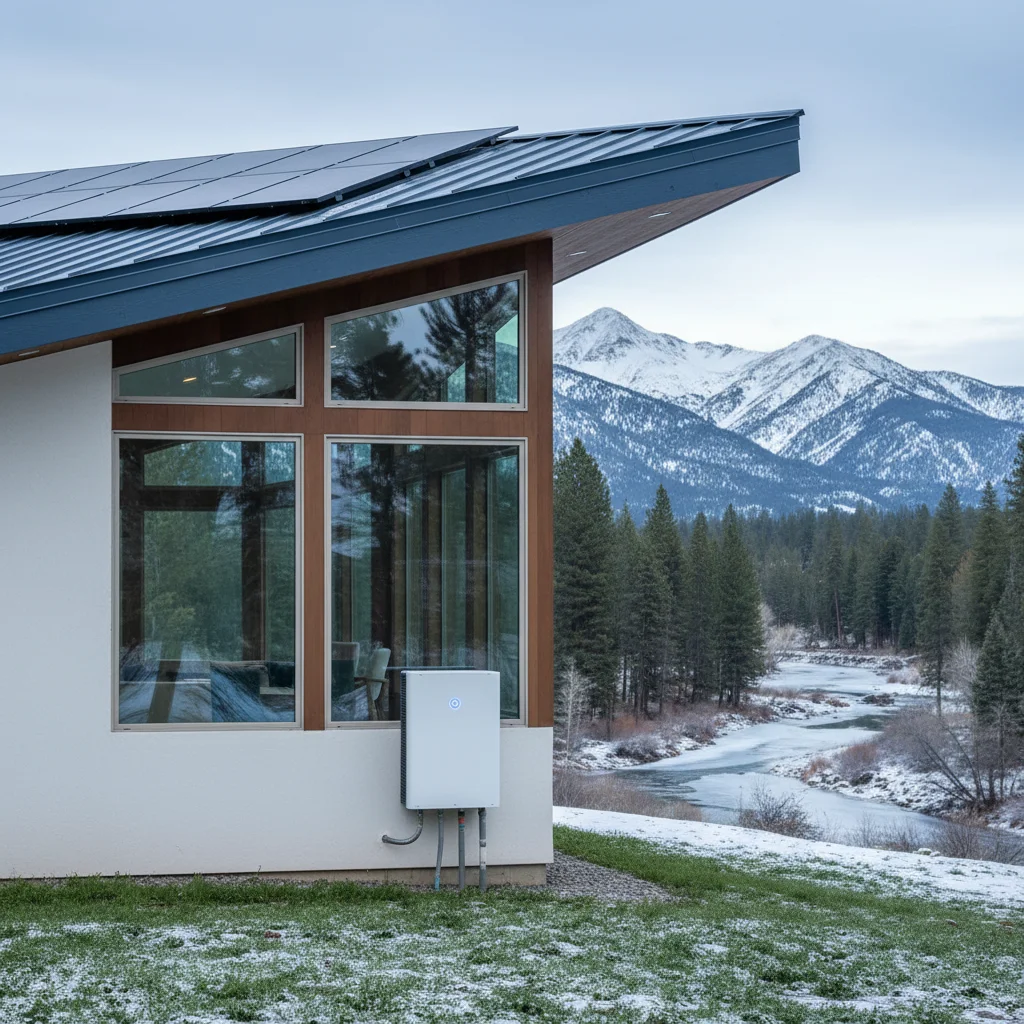
California's mountain communities see winter lows of -10°F to 15°F, yet heat pump adoption in these regions jumped 47% between 2024 and 2025. And the trend accelerated in 2026 as homeowners in Truckee, Mammoth Lakes, and Big Bear discovered that modern cold climate heat pumps operate efficiently in temperatures as low as -13°F while delivering heating and cooling from a single system.
What's the realistic payback period for a cold climate heat pump in California?
Cold climate heat pumps in California deliver a 6 to 9-year payback period when factoring in $8,000 to $14,000 in combined federal and state rebates. Homeowners replacing dual systems—furnace plus air conditioner—see faster returns of 5 to 7 years due to elimination of natural gas service fees averaging $25 monthly.
Energy costs drive the payback math. Natural gas furnaces in California's mountain counties cost $1,200 to $1,800 annually to operate, while cold climate heat pumps run on electricity at $900 to $1,300 per year for the same heating load. And the $300 to $500 annual savings compound when combined with elimination of air conditioning costs during summer months.
Installation costs range from $12,000 to $18,000 for ducted systems and $8,000 to $14,000 for ductless mini-splits. But the IRA federal tax credit covers 30% of total project costs through 2032, reducing net investment by $2,400 to $5,400. So a $15,000 installation drops to $10,500 after federal incentives, with additional state rebates bringing the final cost to $6,500 to $8,000.
California's Tech Clean California program adds $3,000 to $8,000 in point-of-sale rebates for income-qualified households. Moderate-income residents earning 80% to 150% of area median income receive $3,000 for ducted systems and $2,000 for ductless configurations. And low-income households below 80% of area median income qualify for $8,000 rebates that cover 50% to 65% of installation costs.
Use our free rebate calculator to estimate your specific payback period based on your current heating costs and available incentives.
How do cold climate heat pumps compare to traditional furnaces and air conditioners?
Cold climate heat pumps deliver 250% to 400% efficiency compared to 95% maximum efficiency from gas furnaces, meaning they produce 2.5 to 4 units of heat for every unit of electricity consumed. Traditional furnaces convert fuel to heat at a 1:1 ratio after accounting for combustion losses.
| System Type | Annual Operating Cost | Equipment Lifespan | Combined Rebates | Net Installation Cost |
|---|---|---|---|---|
| Cold Climate Heat Pump | $900-$1,300 | 15-20 years | $8,000-$14,000 | $6,500-$10,000 |
| Gas Furnace + AC | $1,500-$2,100 | 12-15 years (furnace), 10-14 years (AC) | $0-$2,000 | $10,000-$14,000 |
| Electric Resistance | $2,200-$3,400 | 20-25 years | $0-$500 | $3,000-$5,000 |
Operational flexibility separates heat pumps from legacy systems. Furnaces require separate air conditioning equipment, doubling maintenance schedules and increasing failure points. But heat pumps reverse refrigerant flow to provide cooling in summer and heating in winter from a single outdoor unit.
Performance in extreme cold defines the cold climate variant. Standard heat pumps lose capacity below 35°F and require expensive backup electric resistance heating. Cold climate models maintain 75% to 100% rated capacity at 5°F and continue operating at reduced capacity down to -13°F without supplemental heat.
California's climate zones favor heat pumps over combustion heating. Coastal regions rarely see temperatures below 32°F, while mountain communities average 40 to 60 nights per year below 20°F. And cold climate heat pumps handle both environments without the carbon monoxide risks and combustion air requirements of gas furnaces.
"Air-source heat pumps can provide efficient heating and cooling for your home. When properly installed, an air-source heat pump can deliver one-and-a-half to three times more heat energy to a home than the electrical energy it consumes." — U.S. Department of Energy
How long will a cold climate heat pump last, and what affects its lifespan?
Cold climate heat pumps last 15 to 20 years in California's varied climates, with coastal installations reaching 18 to 22 years due to milder operating conditions. Mountain systems exposed to extended heating seasons and temperature extremes below 0°F average 14 to 18 years before compressor failure or refrigerant loss requires replacement.
Maintenance frequency directly impacts longevity. Annual professional servicing costs $150 to $250 and includes refrigerant level checks, electrical connection tightening, and coil cleaning. So homeowners who skip maintenance see average lifespans drop to 11 to 14 years, while those adhering to manufacturer service schedules reach the upper end of the 15 to 20-year range.
Operating hours determine wear rates. Systems in Truckee or Mammoth Lakes run 2,000 to 2,500 hours annually for heating and 300 to 500 hours for cooling, totaling 2,300 to 3,000 operational hours. Coastal systems in Monterey or San Luis Obispo operate 800 to 1,200 hours yearly. And the 2.5× higher duty cycle in mountain regions accelerates component wear, reducing expected lifespan by 2 to 4 years compared to mild climate installations.
Compressor quality drives replacement timelines. Premium models from Mitsubishi, Fujitsu, and Daikin use variable-speed inverter compressors rated for 20,000 to 30,000 hours of operation. Budget systems with single-speed compressors fail at 15,000 to 20,000 hours. So mountain homeowners investing in inverter-driven systems reach 17 to 20-year lifespans despite harsh conditions.
Warranty coverage reflects expected durability. Manufacturers offer 10-year compressor warranties and 5-year parts coverage on cold climate models. Extended warranties costing $400 to $800 add 5 years of parts protection. But labor costs during years 11 to 15 average $500 to $1,200 per repair, making replacement more economical than extensive repairs after year 16.
What are the upfront costs and available rebates for cold climate heat pump installation?
Cold climate heat pump installation costs $12,000 to $18,000 for ducted whole-home systems and $8,000 to $14,000 for ductless mini-splits in California. Prices vary by system capacity measured in tons, with 2-ton units serving 1,200 to 1,800 square feet costing $10,000 to $14,000 and 5-ton systems for 2,500+ square feet running $16,000 to $22,000.
The federal Energy Efficient Home Improvement Credit (Section 25C) ended for property placed in service after December 31, 2025 (IRS FS-2025-05). Federal tax credits for this work have ended, but state, local and utility rebates may still apply; check what is available at your address with the DuloCore rebate calculator. And homeowners installing $15,000 systems claim $4,500 federal credits, while those adding $1,800 electrical service upgrades receive an additional $600 credit for a total federal benefit of $5,100.
Tech Clean California delivers point-of-sale rebates that reduce upfront costs without waiting for tax season. Income-qualified households receive $3,000 to $8,000 depending on income level and system type. Moderate-income residents earning 80% to 150% of area median income ($85,000 to $160,000 for a family of four in most California counties) qualify for $3,000 ducted system rebates and $2,000 ductless rebates.
Low-income households below 80% of area median income access $8,000 maximum rebates that stack with federal credits. A qualifying household installing a $15,000 ducted system receives $8,000 state rebate at purchase and $4,500 federal credit at tax filing, reducing net cost to $2,500. So combined incentives cover 83% of installation expenses for low-income Californians.
Utility companies layer additional incentives. PG&E offers $2,000 to $4,000 heat pump rebates in 2026 for customers in Tier 2 and Tier 3 climate zones covering mountain regions. Southern California Edison provides $3,000 rebates for replacing gas furnaces with heat pumps in disadvantaged communities. And municipal utilities like SMUD and LADWP maintain separate programs adding $500 to $2,500 depending on system efficiency and income verification.
Explore all available heat pump rebates for your specific utility service territory and income bracket.
Can you get a cold climate heat pump installed in California during winter?
Cold climate heat pump installation proceeds year-round in California, with winter installations accounting for 35% to 40% of annual volume in mountain counties. Contractors schedule 7 to 14-day lead times during December through February compared to 21 to 45-day waits in spring and fall peak seasons.
Weather affects outdoor work but doesn't halt installation. Technicians complete refrigerant line installation and outdoor unit placement in temperatures down to 20°F. And snow cover requires cleared access paths and stable mounting surfaces, adding 2 to 4 hours to standard 8 to 12-hour installation timelines for ducted systems.
Equipment availability improves in winter months. Distributors stock 20% to 30% more inventory in November through January to prepare for spring demand surges. But supply chain disruptions in 2024 and 2025 created 6 to 10-week backorders for premium Mitsubishi and Fujitsu cold climate models during summer months, while winter orders ship within 3 to 7 days.
Permitting timelines remain consistent. California counties process heat pump permits in 3 to 10 business days regardless of season. Coastal building departments in San Luis Obispo and Monterey average 3 to 5-day permit turnaround, while mountain county offices in Mono and Inyo County extend to 7 to 10 days during November through March due to reduced staffing.
Immediate heating needs drive winter installations. Homeowners facing furnace failures during cold snaps pay $200 to $400 daily for temporary electric heaters consuming 3,000 to 5,000 watts. So accelerated heat pump installation eliminates emergency heating costs within 10 to 14 days compared to 30 to 45-day timelines during contractor busy seasons.
How does a cold climate heat pump perform in coastal vs. mountain climates?
Cold climate heat pumps in California's coastal regions deliver 300% to 400% efficiency year-round with winter low temperatures rarely dropping below 35°F. Mountain installations maintain 250% to 300% efficiency during extended cold periods with nighttime lows of 5°F to 15°F occurring 40 to 60 days annually.
Heating degree days quantify the performance difference. Coastal cities like Monterey accumulate 2,500 to 3,000 heating degree days annually, requiring heat pumps to operate 800 to 1,200 hours for space heating. Mountain towns like Truckee record 7,000 to 8,500 heating degree days, pushing operating hours to 2,000 to 2,500 annually. And the 2.5× higher heating load in mountain regions increases electricity consumption from $900 to $1,300 per year compared to $500 to $700 in coastal areas.
Coefficient of performance (COP) varies by outdoor temperature. Cold climate heat pumps achieve COP of 3.5 to 4.2 at 47°F, common in coastal winter conditions. But COP drops to 2.2 to 2.8 at 5°F encountered in mountain environments. So the same 36,000 BTU system consumes 3,000 watts in coastal climates and 4,500 watts in mountain cold snaps to maintain 68°F indoor temperature.
Backup heat requirements differ by location. Coastal installations rarely activate auxiliary electric resistance heating, operating exclusively on the heat pump compressor. Mountain systems require backup heat during extended periods below -5°F, occurring 5 to 15 nights per year in Mammoth Lakes and South Lake Tahoe. And auxiliary resistance heating consumes 5,000 to 15,000 watts, tripling electricity costs during activation periods.
Sizing calculations adjust for climate zone. Coastal homes require 400 to 500 square feet per ton of heat pump capacity, allowing 2-ton systems for 1,200 to 1,400 square foot residences. Mountain installations need 300 to 400 square feet per ton due to higher heating loads, requiring 3-ton systems for similar square footage. So equipment costs increase $2,000 to $4,000 in mountain regions for equivalent home sizes.
"ENERGY STAR certified air source heat pumps have higher seasonal energy efficiency ratio (SEER) and higher heating seasonal performance factor (HSPF) ratings, which means they are more efficient at cooling and heating your home." — ENERGY STAR
Official Sources
- U.S. Department of Energy - Air Source Heat Pumps — Federal guidance on heat pump technology, efficiency ratings, and operation
- ENERGY STAR Heat Pumps — Efficiency standards, certified models, and performance metrics
- DSIRE USA - California Incentives — Comprehensive database of state and utility rebate programs
Related Reading: Learn more about Cold Climate Heat Pump.
Frequently Asked Questions
Can you install a heat pump in a cold climate?
Modern cold climate heat pumps operate efficiently in temperatures down to -13°F, making them viable for California's mountain regions including Truckee, Mammoth Lakes, and Big Bear. These systems maintain 75% to 100% rated heating capacity at 5°F and continue operating at reduced capacity during extreme cold snaps. Standard heat pumps lose efficiency below 35°F, but cold climate variants use enhanced vapor injection technology and variable-speed compressors to extract heat from outdoor air even during freezing conditions.
What is the California heat pump rebate amount?
California's Tech Clean California program provides $2,000 to $8,000 in point-of-sale rebates for 2026 heat pump installations. Moderate-income households earning 80% to 150% of area median income receive $3,000 for ducted systems and $2,000 for ductless configurations. Low-income residents below 80% of area median income qualify for $8,000 maximum rebates. These state incentives stack with the 30% federal IRA tax credit and utility-specific rebates ranging from $500 to $4,000.
How long does it take to get a heat pump rebate in California?
Tech Clean California rebates apply at point of sale, reducing upfront costs immediately during installation payment. Contractors process rebate applications and receive reimbursement directly from the state program within 30 to 60 days. The federal Energy Efficient Home Improvement Credit (Section 25C) ended for property placed in service after December 31, 2025 (IRS FS-2025-05). Utility rebates take 4 to 12 weeks after installation inspection and application submission.
Is a heat pump better than a furnace in cold weather?
Cold climate heat pumps deliver 250% to 300% efficiency at 5°F compared to 95% maximum efficiency from gas furnaces, reducing heating costs by $300 to $600 annually in California mountain regions. Heat pumps provide both heating and cooling from a single system, eliminating the need for separate air conditioning equipment costing $4,000 to $7,000. And heat pumps avoid carbon monoxide risks, combustion air requirements, and natural gas service fees averaging $25 monthly that furnaces require.
Do I qualify for federal tax credits on a heat pump installation?
The federal Energy Efficient Home Improvement Credit (Section 25C) ended for property placed in service after December 31, 2025 (IRS FS-2025-05). The credit covers equipment costs, installation labor, electrical upgrades, and ductwork modifications up to $2,000 for heat pump equipment plus $600 for electrical panel improvements. And the credit applies to primary residences, with no lifetime limit allowing future claims for additional heat pump installations or replacements. (Note: Federal tax credit percentages and availability are subject to change; the 30% Residential Clean Energy Credit under Section 25D expired December 31, 2025. Verify current incentives at energy.gov.)
Ready to see how much you can save? Calculate your potential rebates and annual energy savings with our free rebate calculator. Get instant estimates based on your home size, current heating system, and available 2026 incentives.
Updated on April 14, 2026. Fact-checked by DuloCore Editors. About our research team.
Check your California heat pump rebate eligibility — see the programs you qualify for and the dollar amounts on our California heat pump rebate finder.