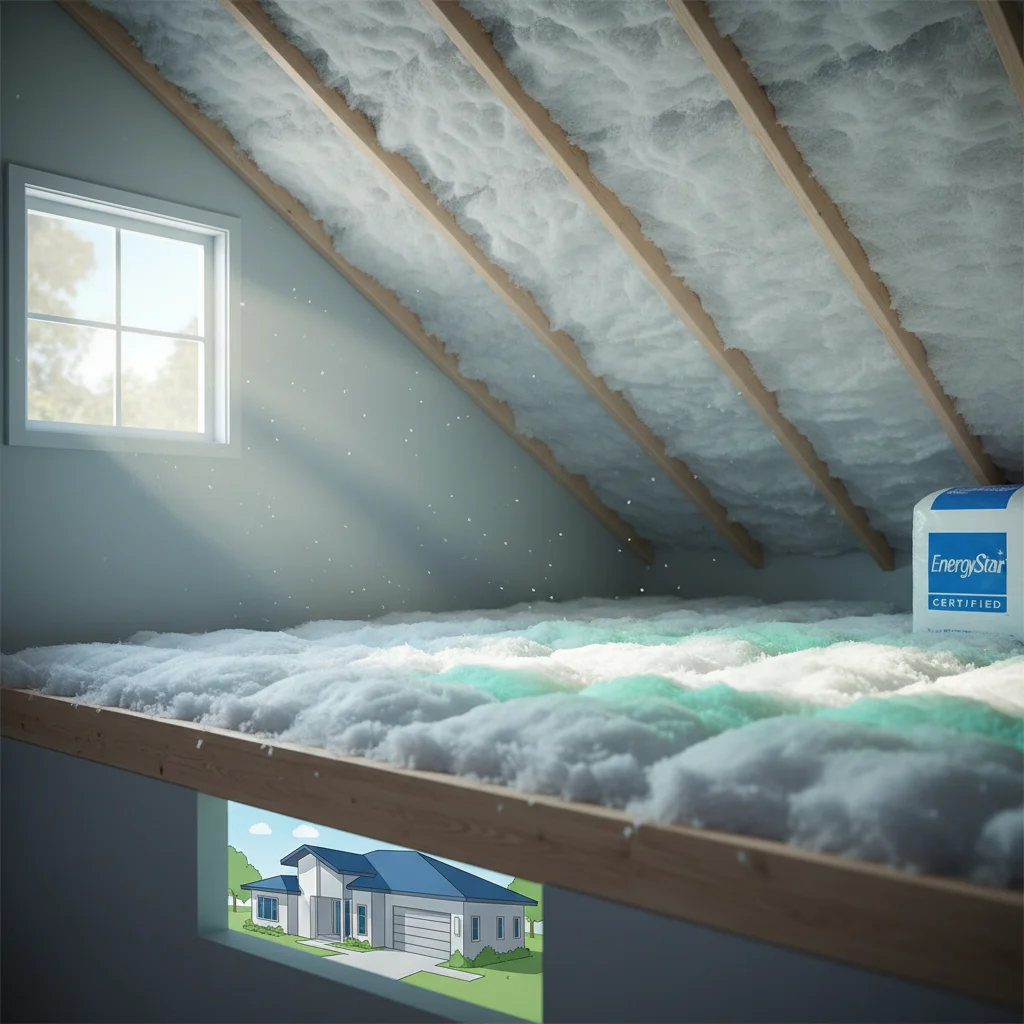
California homeowners waste $300 to $900 annually on heating and cooling bills due to inadequate attic insulation. And attic heat loss accounts for 25-30% of total home energy waste in the state's diverse climate zones, from coastal fog belts to inland desert valleys. The average California home loses 44% of conditioned air through poorly insulated attics, forcing HVAC systems to work overtime and driving up utility costs.
How Much Does Attic Insulation Cost in California?
Attic insulation costs in California range from $1,500 to $3,800 for a 1,200-square-foot attic in 2026, depending on insulation type and R-value. Blown-in fiberglass averages $1.50 to $2.50 per square foot, while spray foam costs $3.00 to $5.00 per square foot. California's Title 24 energy code requires R-38 minimum for attics, though R-49 or R-60 delivers better performance in inland regions.
So why does the same attic insulation project cost $1,800 in Fresno but $3,200 in San Francisco? Labor rates vary 40-60% between California metros, and coastal cities impose stricter permitting requirements that add $200 to $500 to project costs. And material costs fluctuate based on fire-resistant treatments required in wildfire zones, adding 15-20% to baseline pricing in high-risk counties like Butte, Shasta, and El Dorado.
Blown-in cellulose costs $1.20 to $2.00 per square foot and offers the best value for California's mild climate zones. Spray foam delivers superior air sealing but runs $3.00 to $5.00 per square foot, making it cost-effective only in extreme temperature zones like Death Valley or Tahoe. Batt insulation costs $0.80 to $1.50 per square foot but requires more labor for proper installation and leaves gaps that reduce R-value by 20-30% compared to blown-in options.
"Attic insulation upgrades can reduce heating and cooling costs by 15% to 20% annually." — U.S. Department of Energy
California's Building Energy Efficiency Standards require specific R-values based on 16 climate zones. Zone 1 (coastal) requires R-38, while Zone 16 (mountain) mandates R-49. And most contractors charge $150 to $300 for a pre-installation energy audit to determine code-compliant R-value requirements. Use our free rebate calculator to estimate your project cost and available incentives.
What's the ROI and Payback Period for Attic Insulation in California?
Attic insulation delivers 10-22% annual energy savings in California, with payback periods of 4 to 7 years depending on climate zone and current insulation levels. Coastal homes averaging $120 monthly utility bills see $15 to $26 monthly savings, while inland desert homes with $220 monthly bills save $35 to $48 monthly after upgrading from R-19 to R-49.
But ROI varies significantly across California's 16 climate zones. Sacramento homeowners (Zone 12) recoup insulation costs in 4.5 years on average, while San Diego residents (Zone 7) see 6.8-year payback due to milder temperatures and lower baseline energy consumption. And homes with single-pane windows or unsealed ductwork achieve 15-18% better ROI when insulation upgrades combine with air sealing and window replacement.
The California Public Utilities Commission reports that homes upgrading from R-11 to R-38 insulation reduce annual energy costs by $280 to $520. So a $2,400 attic insulation project pays for itself in 4.6 to 8.6 years through utility savings alone. And resale value increases $0.97 to $1.42 per dollar invested in energy efficiency upgrades, according to Lawrence Berkeley National Laboratory studies of California home sales from 2018-2025.
PG&E and SoCal Edison customers qualify for $0.15 to $0.50 per square foot rebates through the Energy Savings Assistance Program in 2026. And California's Residential Energy Efficiency Loan Program offers 0% financing for insulation projects up to $25,000, extending effective payback periods while preserving monthly cash flow. Learn more about energy tax credits available for California homeowners.
How Does Attic Insulation Compare to Other Home Insulation Alternatives?
Attic insulation costs 40-60% less than whole-home spray foam while delivering 70-85% of the total energy savings potential. Wall insulation runs $2.50 to $4.00 per square foot but requires invasive demolition and drywall repair, adding $3,000 to $8,000 to project costs compared to attic-only upgrades.
So where does attic insulation rank against competing efficiency investments? Heat pump upgrades cost $5,500 to $12,000 and reduce HVAC energy use by 30-50%, delivering faster payback than insulation alone in California's mild climate. But combining R-49 attic insulation with a heat pump system reduces total heating and cooling costs by 45-62%, maximizing ROI for both investments. Explore available heat pump rebates to stack savings.
Floor insulation costs $1.50 to $3.00 per square foot and prevents heat loss in raised-foundation homes, but delivers only 8-12% energy savings compared to 15-22% from attic upgrades. And air sealing costs $350 to $1,200 for whole-home treatment and complements insulation by preventing convective heat loss through cracks and gaps. The Building Performance Institute recommends addressing air leaks before installing new insulation to maximize R-value effectiveness.
Radiant barriers cost $0.40 to $0.80 per square foot and reflect 97% of radiant heat in attics, reducing cooling costs by 5-10% in hot inland climates like Bakersfield or Redding. But radiant barriers don't prevent conductive or convective heat loss, making them 60-70% less effective than blown-in insulation for year-round energy savings. And combining radiant barriers with R-49 insulation delivers only 3-5% additional savings beyond insulation alone.
How Long Does Attic Insulation Last and When Will You Need to Replace It?
Attic insulation lasts 80 to 100 years for fiberglass and cellulose products when properly installed and protected from moisture damage. Spray foam insulation maintains R-value for 80 to 100 years without settling or compression, while blown-in fiberglass settles 2-3% annually, losing 15-20% of initial R-value over 20 years.
But California attics face unique degradation risks. Coastal moisture penetration reduces cellulose R-value by 30-40% when wet, requiring replacement every 15 to 25 years in fog-prone zones like San Francisco and Santa Cruz. And rodent damage affects 12-18% of California attics, compressing insulation and creating air gaps that reduce effective R-value by 25-35% before requiring replacement.
So when does insulation need replacement versus top-up treatment? Fiberglass insulation settling below original R-value by 20% or more justifies adding 4 to 8 inches of new material on top of existing insulation. And visible mold, water staining, or pest infestation requires complete removal and replacement to prevent indoor air quality problems and restore thermal performance.
"Properly installed insulation can last the lifetime of your home." — ENERGY STAR
The California Energy Commission recommends attic insulation inspections every 10 to 15 years to assess settling, moisture damage, and R-value degradation. And homes with roof leaks or inadequate attic ventilation require insulation replacement every 12 to 20 years due to accelerated moisture damage and mold growth. Professional energy audits cost $200 to $500 and include thermal imaging to identify insulation gaps and compression zones requiring attention.
What California Rebates and Tax Incentives Can Help Cover Attic Insulation Costs?
California utility rebates cover $0.15 to $2.00 per square foot for attic insulation upgrades in 2026, with low-income households qualifying for up to 100% project cost coverage through the Energy Savings Assistance Program. PG&E customers receive $300 to $1,200 for whole-home insulation projects, while SoCal Edison offers tiered rebates based on pre-upgrade and post-upgrade R-values.
But federal tax credits no longer apply to standalone insulation projects. The federal Energy Efficient Home Improvement Credit (Section 25C) ended for property placed in service after December 31, 2025 (IRS FS-2025-05). Federal tax credits for this work have ended, but state, local and utility rebates may still apply; check what is available at your address with the DuloCore rebate calculator. And California's TECH Clean California initiative provides $500 to $3,000 instant rebates for heat pump installations paired with building envelope improvements including attic insulation.
So how do homeowners stack multiple incentive programs? Bay Area Regional Energy Network customers combine $400 to $800 utility rebates with $0 to $5,000 income-qualified assistance for total project coverage of 40-85%. And Property Assessed Clean Energy (PACE) financing through CaliforniaFIRST allows homeowners to finance insulation costs through property tax bills at 4.9-7.9% APR over 5 to 25 years.
The California Public Utilities Commission's Energy Savings Assistance Program serves households earning less than 250% of federal poverty level, providing free attic insulation upgrades valued at $1,800 to $3,500. And tribal communities qualify for additional Department of Energy Weatherization Assistance Program funding covering up to $8,000 per home for comprehensive efficiency upgrades. Visit DSIRE California for current program details and eligibility requirements.
What's the Timeline and Process for Installing Attic Insulation in California?
Attic insulation installation takes 4 to 8 hours for a 1,200-square-foot attic using blown-in methods, while spray foam requires 6 to 10 hours due to longer curing times. California's Title 24 compliance process adds 1 to 2 weeks for permit approval in most counties, with San Francisco and Los Angeles requiring additional fire safety documentation that extends timelines by 3 to 7 days.
So what's the step-by-step process? Contractors conduct pre-installation energy audits taking 2 to 3 hours to measure existing R-value, identify air leaks, and document attic ventilation. And permit applications require CF-1R compliance forms prepared by certified HERS raters, adding $150 to $400 to project costs and 5 to 10 business days to schedules.
Installation begins with air sealing around electrical fixtures, plumbing penetrations, and attic hatches using caulk and spray foam. And contractors install baffles between rafters to maintain 1 to 2 inches of airspace between insulation and roof decking, preventing moisture buildup and ice dams. Blown-in insulation takes 3 to 5 hours to install, while batt insulation requires 5 to 8 hours for proper fitting and gap prevention.
Post-installation inspections verify R-value using depth gauges and thermal imaging cameras. California's Title 24 compliance requires HERS verification testing within 30 days of project completion, adding $200 to $350 to total costs. And utility rebate applications require contractor-signed completion certificates and pre/post R-value documentation, taking 4 to 8 weeks to process and deliver payment.
Official Sources
- U.S. Department of Energy - Insulation — Federal guidance on insulation types, R-values, and energy savings
- ENERGY STAR Products — Certified insulation products and installation best practices
- DSIRE California — Comprehensive database of California energy rebates and incentives
Related Reading: Learn more about Attic Insulation Cost and Fiberglass Insulation Cost Per Square Foot.
Related Reading: Learn more about Attic Insulation Cost and Insulation Cost Per Square Foot.
Frequently Asked Questions
How much does attic insulation cost in California?
Attic insulation costs $1,500 to $3,800 for a 1,200-square-foot California attic in 2026. Blown-in fiberglass averages $1.50 to $2.50 per square foot, cellulose costs $1.20 to $2.00 per square foot, and spray foam runs $3.00 to $5.00 per square foot. Labor rates vary 40-60% between California metros, with coastal cities charging premium rates. And Title 24 compliance adds $200 to $500 in permit and inspection costs.
What are the eligibility requirements for California attic insulation rebates?
California utility rebates require homeowner-occupied properties with pre-upgrade R-values below Title 24 minimums (R-38 for most zones). And contractors must hold active C-2 or C-61/D64 licenses and complete HERS rater verification within 30 days of installation. Low-income programs through the Energy Savings Assistance Program serve households earning less than 250% of federal poverty level, providing free upgrades worth $1,800 to $3,500 without credit checks or co-payments.
How long does it take to get an attic insulation rebate in California?
California utility rebates process in 4 to 8 weeks after submitting contractor-signed completion certificates and HERS verification forms. PG&E and SoCal Edison require pre-approval for projects exceeding $1,000 in rebate value, adding 1 to 2 weeks to timelines. And income-qualified programs provide instant rebates at project completion, with no waiting period for reimbursement. TECH Clean California heat pump rebates combined with insulation process in 3 to 6 weeks.
Can I claim both state and federal tax credits for attic insulation?
No federal tax credits apply to standalone attic insulation projects in 2026. The IRA framework covers insulation only when bundled with qualifying HVAC upgrades like ENERGY STAR Most Efficient heat pumps or central air conditioners. And California doesn't offer state tax credits for insulation, instead providing utility rebates ranging from $300 to $1,200 for whole-home projects. Low-income households qualify for free installations through the Energy Savings Assistance Program worth up to $3,500.
What's the difference between blown-in and batt insulation for attic cost?
Blown-in insulation costs $1.20 to $2.50 per square foot and fills gaps completely, while batt insulation costs $0.80 to $1.50 per square foot but leaves 15-25% coverage gaps reducing effective R-value. Blown-in cellulose and fiberglass install in 3 to 5 hours for typical attics, while batts require 5 to 8 hours for proper cutting and fitting around obstructions. And blown-in products settle 2-3% annually, while batts maintain consistent thickness but compress under foot traffic and rodent activity.
Ready to cut your energy bills by 15-22%? Use our free rebate calculator to find your exact attic insulation cost, available California rebates, and projected annual savings in under 60 seconds. Get your personalized estimate now and start saving.
Last updated April 14, 2026 — reviewed by DuloCore Editorial. About our authors.
Check your California insulation rebate eligibility — see the programs you qualify for and the dollar amounts on our California insulation rebate finder.