Update (2026): The federal Energy Efficient Home Improvement Credit (Section 25C) expired December 31, 2025, following the passage of the OBBBA. Check state and local programs for current incentives.
A single, unsealed air leak the size of a quarter wastes up to 1,200 kWh of heated air each winter. That's equivalent to leaving a 60-watt lightbulb on for nearly 2.5 years straight. So with heating costs projected to increase by another 8% this winter, pinpointing these hidden energy drains before the first frost isn't just about comfort; it's a direct financial countermeasure. Preparing for a winter energy audit now transforms your home from a liability into a high-performance asset against rising utility bills.
What Financial Incentives Are Available for Winter Energy Audit Recommended Upgrades?
Winter energy audit preparation unlocks access to 2026 financial incentives, including federal tax credits up to $3,200 annually and state-level rebates often exceeding $4,000 for qualifying equipment. These programs target high-efficiency upgrades like heat pumps, insulation, and air sealing identified during the audit.
Following a professional home energy audit, homeowners gain a clear roadmap to the most impactful upgrades. And the Inflation Reduction Act (IRA) provides federal energy tax credits covering 30% of the cost for improvements like insulation and air sealing, capped at $1,200 per year. So for larger projects, the credit covers 30% of heat pump installations up to a $2,000 annual limit. But these federal credits are just the beginning. State energy offices and local utilities offer their own point-of-sale rebates and incentives, which often target specific equipment tailored to regional climate needs. For example, a utility in a cold climate offers an additional $1,500 rebate for installing a cold-climate heat pump, a direct recommendation from a winter audit. These programs are designed to offset the initial investment, reducing the payback period for efficiency upgrades from 10 years to as few as 5.
How Do My State, Utility, and Income Affect My Eligibility for Energy Rebates?
Eligibility for 2026 energy rebates is determined by a homeowner's state, specific utility provider, and household income relative to the Area Median Income (AMI). State programs offer baseline incentives, while utility-specific rebates add another layer of savings, and income-based programs provide the deepest discounts.
The state where a homeowner resides is the primary factor. And each State Energy Office administers its own set of programs with unique funding levels and eligibility criteria. For example, the Home Energy Rebates program, funded by the IRA, provides different rebate amounts based on income. So households earning less than 80% of the Area Median Income (AMI) are eligible for rebates covering up to 100% of project costs, capped at $14,000. But households between 80% and 150% of AMI qualify for rebates covering 50% of costs. Utility providers then offer their own distinct programs. A homeowner served by Con Edison has access to different incentives than one served by PG&E, even if they install identical equipment. Verifying eligibility requires checking program details through both the state's energy office and the local utility's online portal.
What's the Application Process and Key Deadlines for Winter Energy Efficiency Programs?
The 2026 application process for energy rebates typically involves a pre-approval step, installation by a certified contractor, and submission of final documentation before a program's deadline, which is often December 31st. Missing a single step or deadline results in automatic disqualification for rebates.
The process begins before any work starts. So homeowners must first identify a qualifying program and often submit a pre-application for approval, which reserves their rebate funds. And after receiving pre-approval, they hire a program-approved contractor to install the recommended upgrades, such as a new heat pump or attic insulation. The contractor provides a detailed invoice, which is the core of the final application package. But this package also includes the initial energy audit report and proof of project completion. Most state and utility programs for 2026 have a firm application deadline of December 31, 2026, though some high-demand programs run out of funding earlier in the year. Submitting all required documents well before the final deadline is critical, as incomplete applications are universally rejected without appeal.
"Many state and local governments and utilities offer rebates or other incentives for energy-efficient homes and appliances." — U.S. Department of Energy
Can I Stack Rebates, and What's the Current Funding Status for These Programs?
Homeowners can stack federal energy tax credits with state and utility rebates in 2026, but they cannot stack multiple federal credits for the same upgrade. Funding for state-level programs is finite and allocated on a first-come, first-served basis, often depleting before the year-end deadline.
Stacking incentives is a key strategy for maximizing savings. For instance, a homeowner can claim the $2,000 federal tax credit for a new heat pump and simultaneously receive a $1,500 point-of-sale rebate from their local utility for the same equipment. And this combination reduces the out-of-pocket cost by $3,500. But it's critical to understand the funding status of these programs. Federal tax credits under the IRA are available through December 31, 2025. State and utility rebate programs, however, operate on annual budgets. Many popular programs, like those offering generous heat pump rebates, exhaust their 2026 funding by the third quarter. So homeowners planning upgrades must check the real-time funding status on their state's energy office website or the DSIRE database and apply as early in the year as possible to secure their rebate.
What Contractor Requirements Should I Look For When Implementing Audit Recommendations?
To qualify for 2026 energy rebates, homeowners must use licensed and insured contractors who are listed on their state or utility's pre-approved network. Using an uncertified contractor, even for a perfectly executed installation, will void eligibility for financial incentives totaling thousands of dollars.
State and utility programs maintain strict contractor requirements to ensure quality and safety. So the first step is to verify that a potential contractor is not only licensed and insured in your state but also appears on the specific rebate program's list of approved installers. Many programs require contractors to hold certifications from organizations like the Building Performance Institute (BPI). And these certifications guarantee the contractor is trained in the latest energy efficiency installation standards. Before signing a contract, homeowners must get a written quote that explicitly lists the make and model of the equipment to be installed, ensuring it matches the program's eligibility list. Use our free rebate calculator to see what incentives you qualify for before contacting a contractor. Hiring a qualified professional is non-negotiable for securing rebates.
Rebate Program Comparison for 2026
| Incentive Program | Max Amount (2026) | Key Eligibility | Application Deadline |
|---|---|---|---|
| Federal IRA Tax Credit | Ended Dec 31, 2025 | — | Ended Dec 31, 2025 |
| State HEEHRA Rebate | $14,000 (lifetime) | Income <150% of Area Median Income (AMI). | Varies by state; funds are limited. |
| Utility Insulation Rebate | $500 - $1,500 | Must be a customer; specific R-value targets. | Typically Dec. 31, 2026 or when funds run out. |
Official Sources
- DSIRE (Database of State Incentives for Renewables & Efficiency) — The most comprehensive source for up-to-date information on state and utility energy incentive programs.
- ENERGY STAR — A federal tool managed by the EPA to find rebates and special offers for ENERGY STAR certified products in your zip code.
Related Reading: Learn more about Liheap Energy Audit Program and Mini Split Energy Audit Assessment.
Frequently Asked Questions
What steps should I take to prepare my home for a winter energy audit?
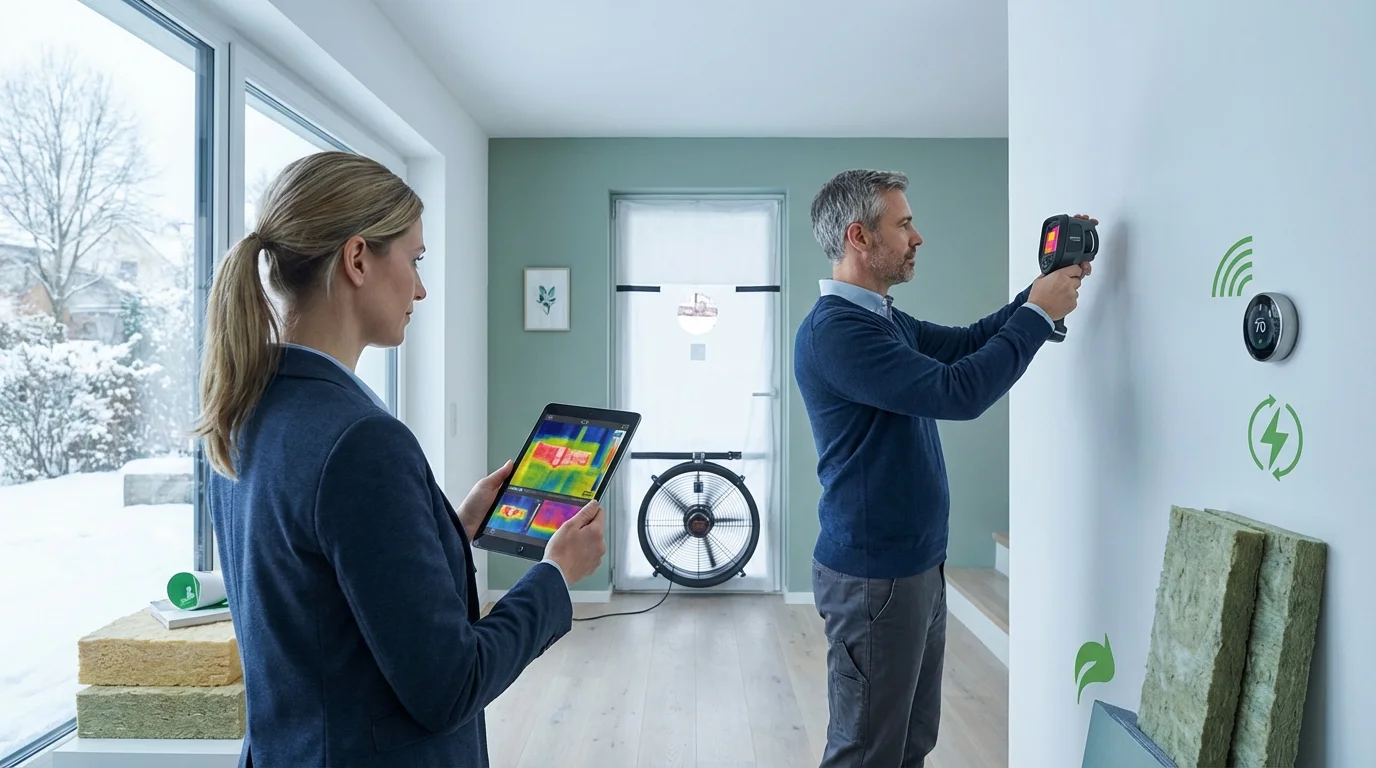
To prepare, first list all known drafts or comfort issues. So then, gather at least 12 months of utility bills to provide the auditor with your energy usage history. And on the day of the audit, ensure clear, safe access to all areas, including the attic, crawlspace, and mechanical room. Finally, close all windows and exterior doors at least 24 hours before the audit to create a stable environment for tests like the blower door test.
How does a winter energy audit differ from one performed in other seasons?
A winter audit provides a more accurate assessment of heat loss because the temperature difference between inside and outside is at its peak. So this allows thermal imaging cameras to more clearly identify insulation gaps and air leaks around windows, doors, and foundations. And auditors can also directly assess the real-world performance of your heating system under load, something not possible during a summer audit.
What information should I have ready for my energy auditor during a winter visit?
Have your last 12-24 months of energy bills (gas and electric) available. And provide information on the age of your home and major appliances like the furnace, water heater, and air conditioner. So if you've done any recent upgrades, such as new windows or insulation, have the details and dates of that work ready. This historical data helps the auditor create a more accurate energy model of your home.
Ready to Find Your Savings?
An energy audit is the first step. The next is cashing in on the upgrades. Use the DuloCore Rebate Calculator to instantly see how much you can save on heat pumps, insulation, and more with 2026 federal, state, and utility incentives.
Updated on April 14, 2026. Fact-checked by DuloCore Editors. About our research team.