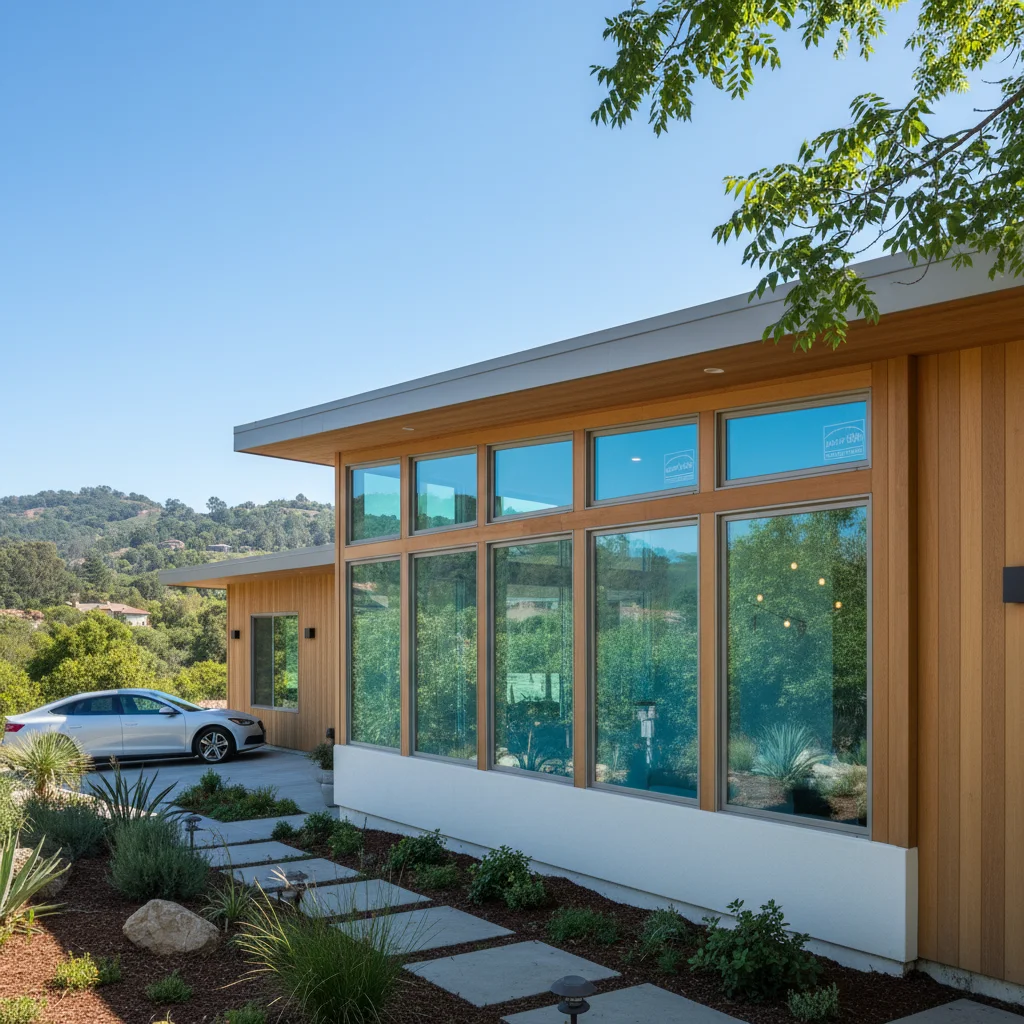
The federal Energy Efficient Home Improvement Credit (Section 25C) ended for property placed in service after December 31, 2025 (IRS FS-2025-05). Federal tax credits for this work have ended, but state, local and utility rebates may still apply; check what is available at your address with the DuloCore rebate calculator. With average replacement costs ranging $500 to $1,200 per window for materials and installation, the combination of energy savings and rebates makes this one of the fastest-payback home upgrades available in the state.
What Are the Current Window Replacement Rebates Available in California?
California window replacement rebates in 2026 include the federal Inflation Reduction Act tax credit covering 30% of qualifying expenses up to $600 annually, California Energy Commission programs offering $100-$300 per window for Energy Star-rated replacements, and utility-specific incentives from PG&E, SoCal Edison, and SDG&E ranging $50-$200 per window depending on climate zone and efficiency ratings.
The federal Energy Efficient Home Improvement Credit (Section 25C) ended for property placed in service after December 31, 2025 (IRS FS-2025-05). But eligibility requires windows to meet Energy Star Most Efficient 2026 certification with U-factors below 0.27 and Solar Heat Gain Coefficients below 0.25 for California's climate zones. So homeowners should verify specifications before purchasing to ensure rebate qualification.
California utilities layer additional rebates on top of federal credits. PG&E offers $75-$200 per window in climate zones 3 and 16, while SoCal Edison provides $50-$150 per window in zones 6 through 10. And San Diego Gas & Electric provides $100-$175 per window for homes in coastal zones 7 and 10. These programs change annually and may have limited funding windows. Use our free rebate calculator to check current program availability and combine federal and utility incentives for maximum savings.
"Energy-efficient windows can reduce household energy bills by an average of 12 percent nationwide." — U.S. Department of Energy
How Do Energy Efficiency Ratings Impact Window Replacement Costs?
Energy Star-rated windows cost $50-$150 more per window than standard double-pane units, but windows with U-factors below 0.20 and triple-pane construction cost $200-$350 more per window — and only the highest-rated windows qualify for California's $300 utility rebates and full federal tax credits totaling $600 per window in combined savings.
U-factor measures heat transfer rate through window assemblies. Windows with U-factors of 0.27 meet minimum Energy Star requirements for California's northern zones. But windows rated 0.20 or lower reduce heat loss by 26% compared to 0.27-rated units. And that translates to $75-$120 additional annual savings in heating costs for homes in climate zones 1, 2, and 16.
Solar Heat Gain Coefficient measures solar radiation transmission. Lower SHGC values reduce cooling loads in California's hot interior valleys. Windows with SHGC below 0.22 cut air conditioning costs by 15-22% compared to standard 0.40 SHGC windows. So homeowners in zones 11 through 15 see faster payback periods of 6-8 years when selecting low-SHGC glass packages despite higher upfront costs. For more on combining window upgrades with other efficiency improvements, see our guide on energy tax credits.
What's the Realistic ROI and Payback Period for Window Replacement in California?
California window replacement projects average 8-12 year payback periods with annual energy savings of $400-$850 and combined federal and utility rebates of $750-$900 per window — and homes in climate zones 11-16 see the fastest returns of 6-9 years due to higher cooling loads and utility rates averaging $0.32 per kWh.
Or homeowners replacing 10 windows at $8,000 total cost receive $6,000-$7,500 in federal credits and utility rebates, reducing net investment to $500-$2,000. And those systems generate $400-$850 annual savings through reduced HVAC runtime. So effective payback periods drop to 0.6-5 years after rebate application.
But resale value increase matters too. Remodeling Magazine's 2026 Cost vs. Value Report shows vinyl window replacement projects recoup 69% of costs at resale in California markets. And premium fiberglass or wood-clad windows recoup 72-75% in coastal markets where energy efficiency commands price premiums. So total economic value combines energy savings, rebates, and property value appreciation into a compelling investment case even before considering comfort improvements and noise reduction benefits.
Which Window Specifications Qualify for California Rebates and Tax Credits?
California rebate-qualifying windows must carry Energy Star Most Efficient 2026 certification with U-factors at or below 0.27, SHGC at or below 0.25, and NFRC-certified performance ratings — and federal IRA tax credits require identical specifications plus professional installation with contractor certification and proper permit documentation submitted with tax returns.
And triple-pane construction with argon or krypton gas fills automatically meets U-factor requirements in most cases. But dual-pane windows with low-emissivity coatings and warm-edge spacers can also qualify if manufacturer ratings document U-factors below 0.27. So homeowners have multiple product pathways to rebate eligibility at different price points.
Frame material affects both performance and cost. Vinyl frames with insulated chambers achieve U-factors of 0.25-0.27 at $500-$700 per window installed. Fiberglass frames reach 0.20-0.24 U-factors at $700-$1,000 per window. And wood-clad frames with foam-filled cavities deliver 0.18-0.22 U-factors at $1,000-$1,400 per window. Or homeowners balance budget constraints against performance goals and rebate thresholds when selecting frame materials. Learn more about related efficiency upgrades in our heat pump rebates article.
"Upgrading to energy-efficient windows can save homeowners between 7 to 15 percent annually on heating and cooling costs." — ENERGY STAR
How Do Climate Zones in California Affect Window Selection and Cost?
California's 16 climate zones require different window specifications — zones 1-5 prioritize low U-factors below 0.24 for heating climates at $700-$1,200 per window, zones 6-10 balance U-factor and SHGC at $600-$900 per window, and zones 11-16 prioritize SHGC below 0.22 for cooling climates at $650-$1,000 per window with tinted or reflective coatings adding $50-$150 per window.
So Sacramento homeowners in zone 12 install windows with SHGC 0.21 and U-factor 0.26 to minimize summer cooling loads averaging 850 hours above 90°F. But Eureka homeowners in zone 1 install windows with U-factor 0.20 and SHGC 0.30 to maximize winter solar heat gain during 4,200 heating degree days annually. And San Francisco homeowners in zone 3 install windows with balanced U-factor 0.24 and SHGC 0.25 for mild Mediterranean climates.
Coastal zones 3, 5, 7, and 10 face additional considerations. Salt air corrosion requires enhanced frame materials and protective coatings adding $75-$150 per window to project costs. But those zones also offer higher utility rebates of $150-$200 per window through coastal climate programs. And milder temperature swings produce longer window lifespans of 25-30 years compared to 20-25 years in extreme interior zones.
Window Replacement vs. Repair: When Is Each Option the Better Investment?
Window replacement costs $500-$1,200 per window and qualifies for $750-$900 in rebates with 8-12 year payback periods — while window repair costs $150-$400 per window but generates zero energy savings and no rebate eligibility, making replacement the better investment when existing windows show condensation between panes, air leakage above 0.3 CFM per square foot, or frames with visible rot or structural damage.
And repair makes economic sense only for windows less than 10 years old with isolated hardware failures, broken sash cords, or damaged weatherstripping. Or homeowners spend $150-$250 replacing balances, locks, and seals on modern double-pane units still delivering U-factors below 0.35. But those repairs don't qualify for rebates and produce minimal energy savings of $25-$50 annually.
So the economic break-even calculation compares $500-$1,200 net replacement cost after rebates against ongoing energy losses of $100-$200 per window annually. Windows older than 15 years or single-pane units lose $150-$300 annually in excess heating and cooling costs. And replacement pays back in 2-4 years after rebate application. But windows 5-10 years old with minor issues justify repair if expected remaining lifespan exceeds 10 years.
How Long Do Replacement Windows Last and What Maintenance Do They Require?
Energy-efficient replacement windows last 20-30 years depending on frame material and climate zone — vinyl frames last 20-25 years with zero maintenance beyond annual cleaning, fiberglass frames last 25-30 years with 5-year seal inspections, and wood-clad frames last 25-35 years with biennial paint or stain reapplication costing $50-$100 per window every 2-3 years in coastal zones.
And seal integrity determines actual lifespan. Triple-pane units with krypton gas fills lose 1-2% insulation value per year if seals fail. But quality manufacturers warrant sealed units for 20 years against gas leakage and condensation between panes. So homeowners verify warranty coverage before purchasing and avoid budget brands with 5-10 year seal warranties.
Or maintenance requirements vary by climate zone. Coastal installations require annual corrosion inspections and protective coating reapplication every 5 years at $25-$50 per window. Desert zones require quarterly cleaning to remove dust buildup affecting solar heat rejection. And mountain zones require snow load inspections and ice dam prevention measures adding $100-$200 annually to maintenance budgets for homes above 5,000 feet elevation.
Official Sources
- U.S. Department of Energy - Energy Saver — Federal energy efficiency guidance and rebate information for residential improvements
- DSIRE - Database of State Incentives for Renewables & Efficiency — Comprehensive state and utility rebate program listings for California window replacements
- ENERGY STAR Windows, Doors & Skylights — Certification requirements and product search for rebate-qualifying window specifications
Related Reading: Learn more about Window Replacement Energy Savings Calculator and Window Replacement Grants For Homeowners.
Related Reading: Learn more about Window Replacement Cost With Rebates.
Related Reading: Learn more about Window Replacement Home Value Increase.
Frequently Asked Questions
How much does window replacement cost in California?
Window replacement costs in California average $500-$1,200 per window installed, with vinyl frames at $500-$700, fiberglass at $700-$1,000, and wood-clad at $1,000-$1,400 per window. Total project costs for 10-window replacements range $5,000-$12,000 before rebates. The federal Energy Efficient Home Improvement Credit (Section 25C) ended for property placed in service after December 31, 2025 (IRS FS-2025-05). Utility rebates add $50-$300 per window depending on climate zone.
What rebates are available for window replacement in California?
California window replacement rebates in 2026 include federal IRA tax credits covering 30% of costs up to $600 annually, California Energy Commission programs offering $100-$300 per window, and utility-specific incentives from PG&E ($75-$200), SoCal Edison ($50-$150), and SDG&E ($100-$175) per window. Combined federal and utility rebates total $750-$900 per qualifying window with Energy Star Most Efficient 2026 certification.
Are there any tax credits for replacing windows in California?
The federal Energy Efficient Home Improvement Credit (Section 25C) ended for property placed in service after December 31, 2025 (IRS FS-2025-05). California offers no state-level tax credits for windows in 2026, but utility rebate programs provide $50-$300 per window in direct incentives. And homeowners combine federal credits with utility rebates for total savings of $750-$900 per window.
How do I qualify for California window replacement rebates?
Qualifying for California window replacement rebates requires Energy Star Most Efficient 2026 certification with U-factors at or below 0.27, SHGC at or below 0.25, NFRC-certified performance ratings, and professional installation with proper permits. And homeowners submit manufacturer specifications, contractor certification, installation invoices, and permit documentation to utility programs within 30-90 days of project completion.
What is the difference between energy-efficient and standard windows in cost?
Energy-efficient windows cost $50-$350 more per window than standard double-pane units — Energy Star-rated windows add $50-$150, while triple-pane units with U-factors below 0.20 add $200-$350 per window. But energy-efficient windows qualify for $750-$900 in combined federal and utility rebates and generate $400-$850 annual energy savings, producing 6-12 year payback periods compared to zero rebates and minimal savings from standard windows.
Ready to calculate your window replacement savings? Use our free rebate calculator to estimate your total federal and utility rebates, annual energy savings, and payback period based on your home's climate zone and window specifications. Get your personalized savings report in under 2 minutes.
Last reviewed: April 14, 2026. Reviewed by DuloCore Energy Specialists. About the team.
Check your California insulation rebate eligibility — see the programs you qualify for and the dollar amounts on our California insulation rebate finder.