Running a central air conditioner for just one hour uses the same amount of electricity as running a modern refrigerator for a full day. With electricity rates climbing an average of 4.3% annually, homeowners are facing cooling bills that consume an ever-larger portion of their monthly budget. So finding a more efficient cooling method isn't just about comfort; it's a direct defense against rising utility costs.
How Much Energy (and Money) Can a Whole House Fan Save Compared to AC?
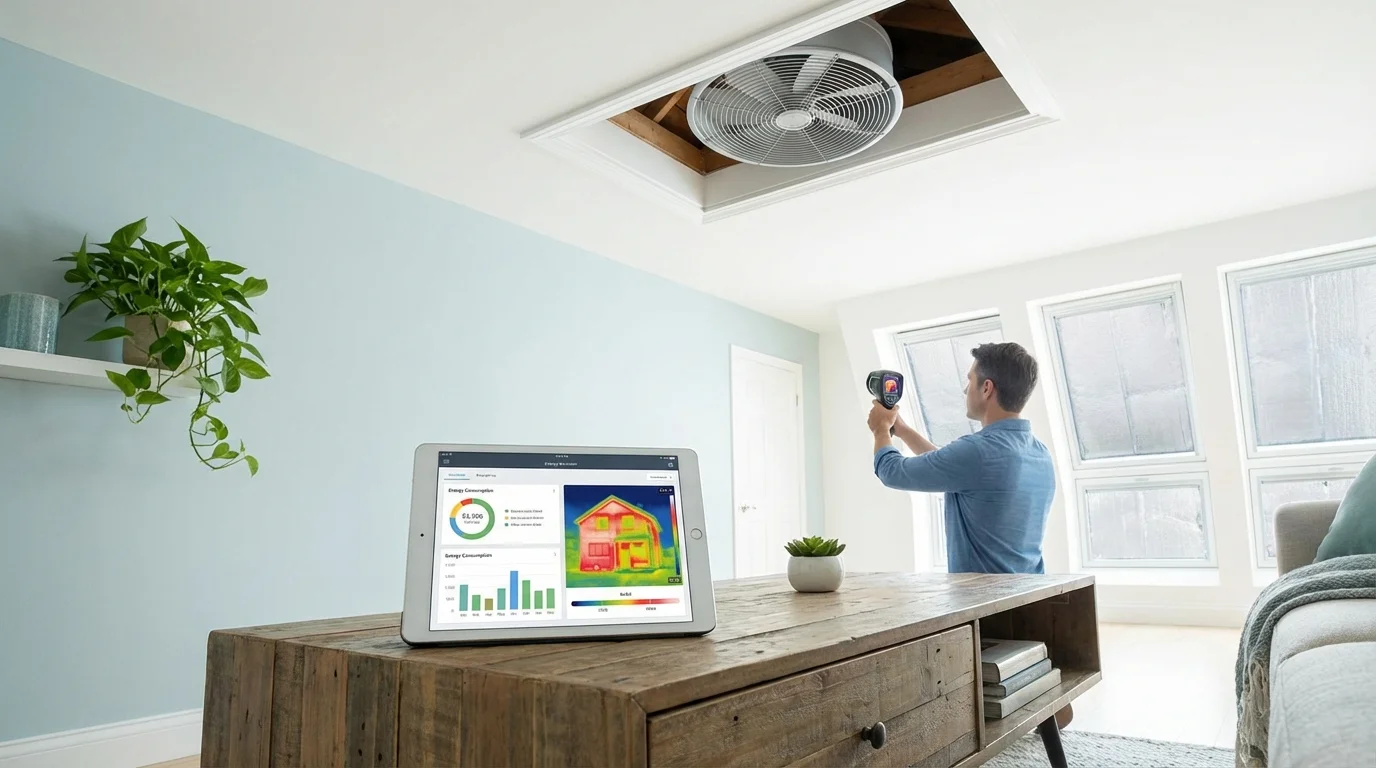
A whole house fan provides a 90% reduction in cooling energy consumption compared to a central air conditioner when used under optimal conditions in 2026. The fan uses between 120 and 700 watts, while a typical central AC unit consumes 3,500 watts, resulting in immediate operational savings.
A whole house fan operates on a simple, efficient principle: it pulls cool, fresh air in through open windows and exhausts hot, stale air out through attic vents. This process creates a refreshing breeze and lowers the indoor temperature by 5-10°F. And the operational cost reflects this efficiency, running for just pennies per hour compared to the several dollars per hour required for central air conditioning. But its effectiveness depends entirely on the outdoor temperature being cooler than the indoor temperature, making it ideal for homes in climates with hot days and cool nights. So for many, it eliminates the need for AC during shoulder seasons and overnight, directly reducing monthly utility bills by $50 to $150. For more detailed savings, use our free rebate calculator.
What Whole House Fan Rebates and Incentives Are Available in My State or From My Utility?
Whole house fan rebates are hyperlocal incentives offered by utility companies and state energy offices, providing homeowners with direct cash back of $50 to $300 for installing qualifying equipment in 2026. These programs are designed to reduce peak energy demand on the grid during warm months.
The availability and value of these incentives vary dramatically by zip code. For instance, a utility in California may offer a $200 prescriptive rebate, while a provider in Colorado offers $150. And these programs are not universal; many states have no active rebates for this specific technology. The Database of State Incentives for Renewables & Efficiency (DSIRE) is a critical resource for identifying local programs.
"Many states and utilities offer rebates or other incentives for purchasing ENERGY STAR certified products. Some offer incentives for recycling old appliances, as well." — U.S. Department of Energy
So homeowners must check with their specific electric utility to confirm 2026 program details, as funding is limited and eligibility rules are strict. Many programs are tied to broader efficiency initiatives, like improving home ventilation or reducing summer energy strain. Discover available heat pump rebates that may also apply.
Am I Eligible for Whole House Fan Rebates Based on Equipment, Income, or Location?
Eligibility for 2026 whole house fan rebates is determined by three primary factors: the fan's energy efficiency rating (CFM/watt), the homeowner's physical address within a utility's service territory, and, in some cases, household income level for enhanced LMI (Low-to-Moderate Income) programs.
To qualify, the installed equipment must meet specific performance standards, such as a minimum airflow-to-power ratio (CFM/watt), which ensures it operates efficiently. And the installation address must fall within the sponsoring utility's designated service area. This is a non-negotiable requirement. Some programs also offer increased rebate amounts, sometimes covering up to 100% of the project cost, for households that meet specific income thresholds defined by the state or utility. But verification requires submitting documentation like tax returns or proof of enrollment in other assistance programs. A comprehensive home energy audit is often a prerequisite for identifying the best efficiency upgrades for a property.
2026 Whole House Fan Rebate Program Comparison
| Program / Utility | Rebate Amount | Key Eligibility Requirement | Application Deadline |
|---|---|---|---|
| SMUD (Sacramento, CA) | Up to $200 | Must be on SMUD's approved product list | December 31, 2026 |
| Xcel Energy (CO) | $150 | Minimum 7.0 CFM/watt efficiency | December 31, 2026 |
| Roseville Electric (CA) | $100 | Must be installed by a licensed contractor | While funds last |
How Do I Apply for Whole House Fan Rebates, What's the Deadline, and Are Funds Still Available?
The application process for whole house fan rebates typically involves submitting an online or mail-in form with proof of purchase and installation by a specific 2026 deadline, usually December 31st. Funds are allocated annually and are distributed on a first-come, first-served basis until depleted.
After purchasing and installing a qualifying fan, homeowners must complete the rebate application provided by their utility. This requires attaching a dated sales receipt or installer invoice and the equipment's specification sheet, which proves it meets efficiency standards. And the deadline is absolute; applications received after the cut-off date, often the last day of the calendar year, are automatically rejected. But because program funding is finite, the money can run out months before the official deadline. So homeowners must check the utility's rebate website for real-time funding status before making a purchase. The application review process takes between 4 to 8 weeks, after which a check is mailed to the applicant.
Can I Stack Whole House Fan Rebates with Other Energy Savings Programs, and Are There Contractor Requirements?
Utility rebates for whole house fans generally stack with federal energy tax credits but cannot be combined with another utility incentive for the same piece of equipment. Many programs also mandate that the fan be installed by a licensed contractor to ensure safety and performance.
Homeowners can often claim both a local utility rebate and any available federal tax credits under the IRA for the same project, as these are separate programs funded by different entities. The rebate reduces the out-of-pocket cost, and the tax credit then applies to the remaining expense. But attempting to claim two utility rebates—for example, from both a city and a county program—for one fan is typically disallowed.
"DSIRE is the most comprehensive source of information on incentives and policies that support renewables and energy efficiency in the United States." — DSIREUSA.org
Additionally, many utilities require the installer to hold a valid state contractor's license to qualify for the rebate. This ensures the installation complies with local building and electrical codes, which is critical for proper and safe operation.
Official Sources
- ENERGY STAR — Official U.S. government resource for identifying energy-efficient products and qualifying for federal tax credits. (note: the federal 25C and 25D credits ended for projects completed after December 31, 2025)
- DSIRE - Database of State Incentives for Renewables & Efficiency — A comprehensive database of state and local energy-related rebates, grants, and tax incentives.
Frequently Asked Questions
How much energy can a whole house fan save on my utility bills?
A whole house fan uses up to 90% less energy than a central air conditioner. For a typical home, this translates to monthly savings of $50 to $150 on electricity bills during cooling seasons, depending on climate and usage patterns. The fan consumes between 120-700 watts, compared to 3,500 watts for a standard AC unit.
What are the eligibility requirements for whole house fan rebates?
Eligibility for 2026 rebates primarily depends on three factors: location within a participating utility's service area, the fan meeting specific energy efficiency ratings (measured in CFM/watt), and purchasing the unit within the program's specified timeframe. Some programs also have income-based requirements for enhanced rebates.
How do whole house fans compare to air conditioning for reducing energy consumption?
Whole house fans offer a dramatic reduction in energy consumption. A fan uses approximately 300 watts on average, while a central AC unit consumes over 10 times that amount at 3,500 watts. By using the fan during cooler evening and morning hours, homeowners displace the need for expensive, energy-intensive air conditioning.
Find Every Rebate You Qualify For
Don't leave money on the table. Use DuloCore's free Rebate Calculator to instantly see how much you can save on a whole house fan and other energy-efficient upgrades in your area.
Calculate Your Savings NowUpdated: April 14, 2026 — fact-checked by DuloCore Research. About our editorial process.