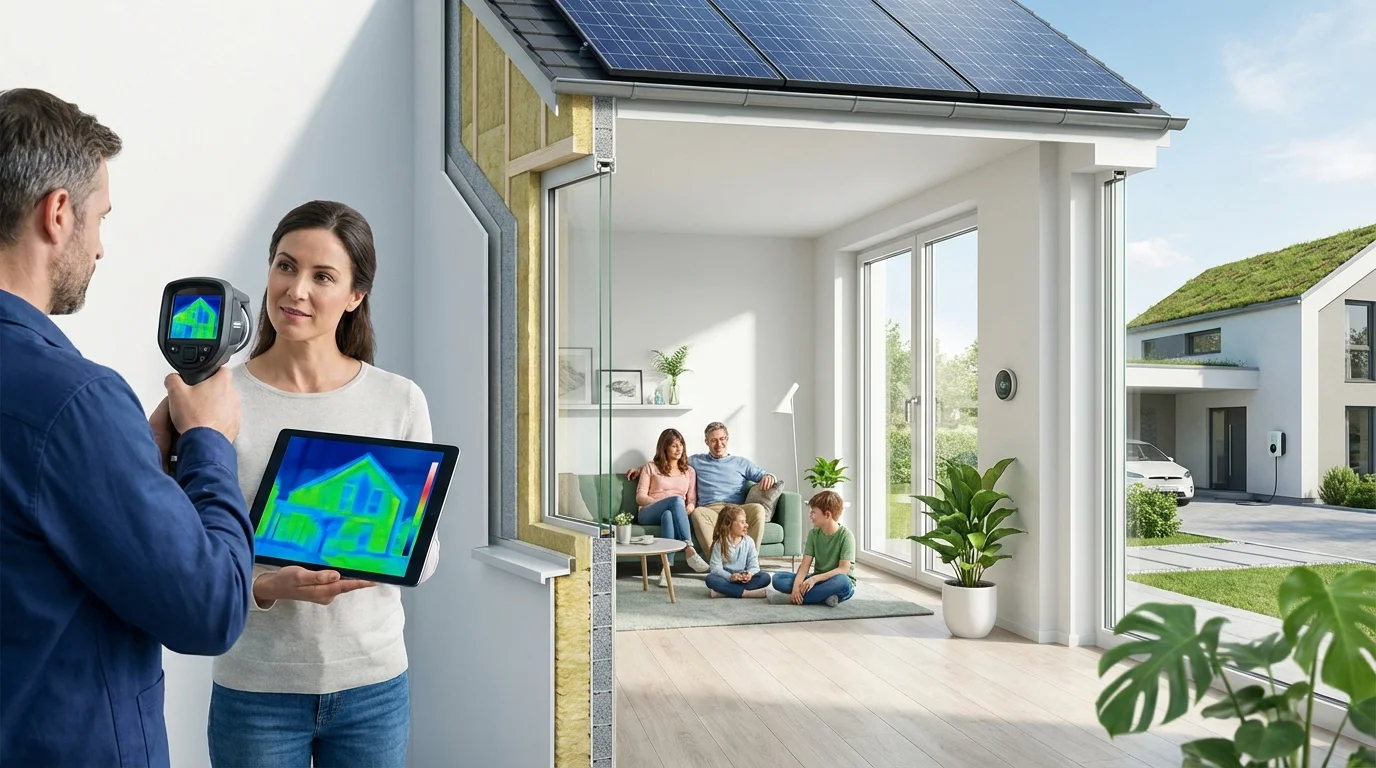
The average American home wastes up to 30% of its heating and cooling energy through air leaks around windows, doors, and ducts. This isn't just about comfort; it's a direct drain on your bank account every single month. So addressing these invisible gaps systematically is the fastest path to lower utility bills and accessing thousands in government incentives designed to pay for the upgrades.
What Whole-House Energy Rebates and Financial Incentives Can I Get in My State?
The Home Electrification and Appliance Rebate (HEEHRA) program offers point-of-sale discounts up to $14,000 for low- and moderate-income households in 2026. And the HOMES Rebate Program provides performance-based rebates from $2,000 to $8,000 for projects that demonstrate specific energy savings across the entire home.
State energy offices administer the federal Inflation Reduction Act (IRA) funds, so specific rebate amounts and availability vary by location. And many states supplement these with their own programs. For example, California's TECH Clean California initiative offers contractor incentives that get passed to homeowners, while New York's NYSERDA programs provide additional grants. So a homeowner in one state gets different funding than one in another. But the core federal programs, HEEHRA and HOMES, establish a nationwide baseline. Homeowners must check their state's energy office website for 2026 funding status and program specifics. The Database of State Incentives for Renewables & Efficiency (DSIRE) is a comprehensive resource for finding local programs. These state-level incentives often work in tandem with federal energy tax credits, creating a layered savings strategy.
What Equipment is Eligible and Are There Income Limits for Whole-House Energy Upgrades?
The HEEHRA program's 2026 income limits are set at 80% of Area Median Income (AMI) for full rebates and up to 150% of AMI for partial rebates. And the HOMES program offers tiered rebates based on measured energy savings, with double the rebate amount for households below 80% AMI.
Eligibility for these programs targets specific high-efficiency electric equipment. So HEEHRA provides up to $8,000 for qualifying heat pumps, $1,750 for a heat pump water heater, and $840 for an electric stove or induction cooktop. And it also covers up to $4,000 for an upgraded electrical panel and $1,600 for insulation and air sealing. The HOMES program is technology-agnostic. But it rewards projects that achieve at least a 20% reduction in home energy use, with rebates doubling from $2,000 to $4,000 for savings over 35%. Many homeowners start with targeted upgrades like heat pump rebates before moving to a full-system approach.
"The Inflation Reduction Act includes several provisions that will help Americans save money on their energy bills... These provisions will make it easier and more affordable for Americans to purchase and install energy-efficient appliances and make other energy-saving improvements to their homes." — U.S. Department of Energy
How Do I Apply for Whole-House Energy Rebates and What Contractor Requirements Apply?
The application process for 2026 whole-house rebates typically requires a pre- and post-upgrade professional energy audit to verify savings. And contractors must often be certified or listed on a state-approved network to perform the work, ensuring quality and program compliance.
To access HOMES rebates, a homeowner first schedules a home energy audit to benchmark current energy usage. After the contractor completes the upgrades—like insulation, air sealing, and new HVAC—a second audit confirms the energy savings percentage, which determines the final rebate of $2,000 to $8,000. HEEHRA rebates are designed as point-of-sale discounts, meaning the retailer or contractor applies the discount directly at the time of purchase. But this requires the contractor to be enrolled in the state's program. So homeowners must verify their contractor’s eligibility before signing a contract. Use our free rebate calculator to estimate your potential savings and find qualified installers.
What Are the Deadlines and Current Funding Status for Whole-House Energy Programs?
The IRA provides funding for whole-house energy programs through September 30, 2031, but state-administered funds for 2026 are limited and available on a first-come, first-served basis. And once a state's annual allocation is exhausted, homeowners must wait for the next funding cycle.
The federal government has allocated $8.8 billion for the HOMES and HEEHRA rebate programs, but each state receives a specific portion of that total. So popular programs in states with high demand will run out of money faster. For 2026, homeowners must monitor their state energy office's website for real-time updates on funding status. Some states have already launched their programs, while others are still in the planning phase. But the key is that funding isn't guaranteed to last all year. So acting early in the calendar year provides the best chance of securing a rebate before the funds are depleted for the cycle.
Can I Stack Multiple Whole-House Energy Rebates and Utility Programs for Maximum Savings?
Homeowners can stack federal energy tax credits with either a HEEHRA or HOMES rebate and often with local utility incentives for the same project. But federal rules prohibit claiming both a HEEHRA and a HOMES rebate for the same individual upgrade, preventing double-dipping on federal funds.
The strategy is to layer different types of incentives. For instance, a homeowner installs a new heat pump. They use a state-administered HEEHRA rebate to reduce the purchase price by up to $8,000. The federal home energy tax credits (Sections 25C and 25D) ended for projects completed after December 31, 2025 (IRS FS-2025-05). Federal tax credits for this work have ended, but state, local and utility rebates may still apply; check what is available at your address with the DuloCore rebate calculator. So their local utility company may offer an additional $500 rebate for installing a qualified high-efficiency model. This stacking transforms a $12,000 project into one with an out-of-pocket cost of just a few thousand dollars. Checking all available programs before starting is critical.
"DSIRE is the most comprehensive source of information on incentives and policies that support renewables and energy efficiency in the United States." — DSIREUSA.org
Whole-House Rebate Program Comparison (2026)
| Feature | HOMES Rebate Program | HEEHRA Program |
|---|---|---|
| Rebate Amount | $2,000–$4,000 (up to $8,000 for LMI) | Up to $14,000 total per household |
| Eligibility | All homeowners; based on % energy saved | Income-based: <150% of Area Median Income |
| Application | Post-project, based on verified savings | Point-of-sale discount at purchase |
| Eligible Upgrades | Any upgrade proving 20%+ energy savings | Specific electric appliances (heat pumps, etc.) |
Official Sources
- ENERGY STAR Rebate Finder — A federal tool from the EPA to find rebates on ENERGY STAR certified products in your zip code.
- IRS Home Energy Tax Credits — Official guidance from the IRS on federal tax credits for energy efficiency upgrades under the IRA. (note: the federal 25C and 25D credits ended for projects completed after December 31, 2025)
- DOE Energy Saver — Comprehensive federal resource for energy efficiency guidance, DIY tips, and information on available rebates.
Related Reading: Learn more about Whole House Fan Energy Savings.
Frequently Asked Questions
Who is eligible for whole house energy rebates?
Eligibility for 2026 whole-house rebates depends on the program. The HOMES Rebate Program is open to all homeowners, with rebate amounts from $2,000 to $8,000 tied to verified energy savings. The HEEHRA program is income-restricted, available to households earning less than 150% of the Area Median Income (AMI), offering point-of-sale rebates up to $14,000.
What is the typical rebate amount for a whole house energy upgrade?
A typical rebate for a whole-house energy upgrade in 2026 ranges from $2,000 to $8,000. The HOMES program provides a base rebate of $2,000 for a 20% energy reduction, increasing to $4,000 for a 35% reduction. These amounts are doubled for low-to-moderate-income households, reaching a maximum of $8,000.
What is the application process for whole house energy rebates?
The application process requires a professional home energy audit before and after the upgrades are completed. For the HOMES program, this verification is submitted to the state energy office to process the rebate. For HEEHRA, the process is simpler; an eligible contractor or retailer applies the rebate as an instant discount at the point of sale, handling the paperwork on the back end.
Are there specific deadlines for whole house energy rebate programs?
Yes, while the federal funding for these IRA programs runs through 2031, each state receives an annual allocation of funds. For 2026, these funds are available on a first-come, first-served basis. Once a state's yearly funding is depleted, no more rebates can be issued until the next funding cycle, making early application critical.
How does a whole house energy approach maximize my rebate savings?
A whole-house approach maximizes savings by treating your home as an integrated system. Instead of a single upgrade, it combines improvements like air sealing, insulation, and a new heat pump. This synergy produces a 20-40% energy savings, qualifying for the highest-tier HOMES rebates of $4,000 to $8,000, which a single upgrade alone typically won't achieve.
Last updated: April 14, 2026. Reviewed by the DuloCore Editorial Team. About our authors.