Update (2026): The federal Energy Efficient Home Improvement Credit (Section 25C) expired December 31, 2025, following the passage of the OBBBA. Check state and local programs for current incentives.
Up to 45% of the energy used in a typical U.S. home is wasted through air leaks, inefficient appliances, and poor insulation. So this isn't just about drafts; it's about hundreds of dollars escaping through your walls and windows each year. A home energy audit is the first step to reclaiming that lost money, identifying exactly where your home is losing efficiency and how to fix it with the help of 2026 rebates.
What Happens Step-by-Step During a Professional Home Energy Audit?
A professional home energy audit is a comprehensive assessment identifying air leaks and insulation gaps using blower door tests and infrared imaging. Auditors provide a detailed report within 5-7 business days, outlining improvements that cut energy bills by up to 30% annually, unlocking access to specific 2026 rebates.
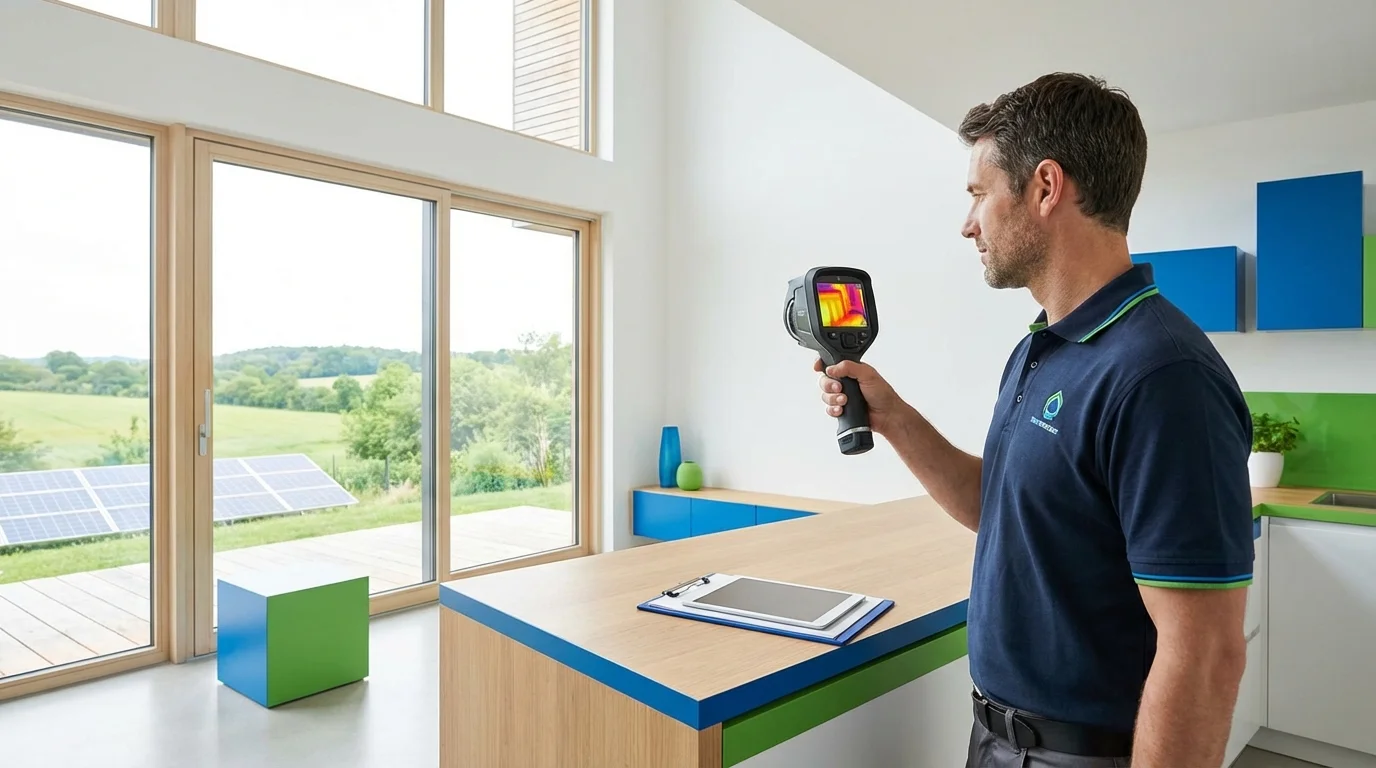
The process begins with a certified auditor examining your past utility bills to understand your home's energy consumption patterns. Next, they perform a room-by-room visual inspection, checking insulation levels in the attic and walls, and assessing the efficiency of your heating, cooling, and water heating systems. But the core of the audit involves diagnostic testing. A blower door test depressurizes your home to pinpoint air leaks around windows, doors, and electrical outlets. So an infrared camera is used to visualize temperature differences, revealing areas where insulation is missing or compromised. The auditor also checks for duct leakage, a common source of energy loss that wastes up to 30% of your heated or cooled air before it ever reaches the registers. The full assessment provides a complete picture of your home’s energy performance. And you can learn more about the benefits in our guide to a home energy audit.
How Much Can You Save? Uncovering Rebate Amounts, Funding Status, and Utility Incentives by State
Home energy audit rebates and related upgrade incentives provide direct financial returns, with 2026 federal programs offering up to $4,000 for efficiency upgrades and state programs adding another $500-$2,500. Utility companies often provide instant rebates of $50-$150 for the audit itself, directly reducing upfront costs.
The amount you save depends on federal, state, and local utility programs, each with its own funding status and deadlines for 2026. The Inflation Reduction Act (IRA) provides federal energy tax credits covering 30% of project costs for qualifying improvements identified in an audit, up to an annual cap. But state energy offices offer their own rebates, which vary by location. For example, California's programs offer up to $3,000 for weatherization, while Massachusetts provides up to $2,000 for similar work. So it's critical to check the funding status, as popular programs often run out of money before the year's end. Many local utilities also offer prescriptive rebates, like $500 for a new heat pump or $100 for a smart thermostat, directly based on an auditor's recommendations.
"Saving money is one of the many benefits of improving your home's energy efficiency. And a home energy assessment, also known as a home energy audit, can help you understand your home's energy use and identify where you are losing energy and money." — U.S. Department of Energy
Are You Eligible? Understanding Income Limits, Equipment Requirements, and Approved Contractors for Energy Programs
Eligibility for 2026 energy rebates is determined by income limits, equipment standards, and contractor qualifications. Federal programs reserve the highest rebate amounts, up to $8,000 for heat pumps, for households earning below 80% of the Area Median Income (AMI), while equipment must meet specific ENERGY STAR or CEE ratings.
To access these incentives, homeowners must navigate a specific set of rules. For income-based rebates, eligibility is often tiered. Households earning between 80% and 150% of AMI qualify for reduced rebate amounts, typically 50% of the project cost. And any equipment installed, such as insulation or new windows, must meet strict efficiency standards set by the Department of Energy. So a critical requirement for most state and utility programs is the use of an approved or certified contractor. These professionals are trained to install equipment according to program specifications, ensuring the upgrades perform as expected and qualify for the rebate. For example, many heat pump rebates require installation by a technician with specific certifications.
What is the Application Process and What Deadlines Should You Know for Energy Audit Rebates?
The 2026 energy rebate application process requires homeowners to submit an audit report, contractor invoices, and proof of purchase before program deadlines, which are often set for December 31st or when funds are depleted. The entire process, from application to receiving a check, typically takes 8-12 weeks.
Applying for rebates is a multi-step process that demands attention to detail. First, homeowners must confirm their eligibility and, in some cases, secure pre-approval before any work begins. After the energy-efficient upgrades are completed by a qualified contractor, the next step is to gather all required documentation. This includes the final paid invoice, equipment model and serial numbers, and the pre- and post-upgrade reports from the energy audit. So these documents are submitted through an online portal or via mail to the state energy office or utility provider. And it's crucial to submit before the deadline, as many 2026 programs operate on a first-come, first-served basis. Use our free rebate calculator to find deadlines in your area.
Rebate Program Comparison for 2026
| Program Type | Typical Rebate Amount | Key Eligibility Requirement | Common Deadline |
|---|---|---|---|
| Federal IRA Credit | Ended Dec 31, 2025 | — | December 31, 2025 |
| State Weatherization | $1,000 - $4,000 | Income-based (e.g., <150% AMI) | Annually, or when funds expire |
| Utility Instant Rebate | $50 - $500 | Must be a customer | Varies; check with utility |
Can You Stack Multiple Rebates? Comparing Program Benefits and Stacking Rules for Maximum Savings
Stacking allows homeowners to combine multiple 2026 rebates from federal, state, and utility sources for a single project, often covering 50-100% of the total cost. Program rules dictate which incentives are stackable; for instance, a federal tax credit can typically be combined with a local utility rebate.
Maximizing savings requires understanding the stacking rules for each program. A homeowner can often combine a federal tax credit with a state-level rebate and a manufacturer's discount. For example, installing a new geothermal system may qualify for the 30% federal geothermal tax credit, a $4,000 state rebate, and a $500 rebate from the local utility company. But some programs have anti-stacking clauses. A state rebate, for instance, won't be combined with another state-funded program for the same piece of equipment. So homeowners must review the terms and conditions for each incentive to create a savings strategy. The final rebate amount cannot exceed the total project cost. (Note: Federal tax credit percentages and availability are subject to change; the 30% Residential Clean Energy Credit under Section 25D expired December 31, 2025. Verify current incentives at energy.gov.)
"DSIRE is the most comprehensive source of information on incentives and policies that support renewables and energy efficiency in the United States." — DSIRE
Official Sources
- ENERGY STAR — A federal tool to find rebates and special offers on ENERGY STAR certified products in your zip code.
- Database of State Incentives for Renewables & Efficiency (DSIRE) — A comprehensive database of state, local, utility, and federal incentives that promote renewable energy and energy efficiency.
Frequently Asked Questions
What specific tests are performed during a professional home energy audit?
A professional audit includes several key diagnostic tests. The blower door test measures a home's airtightness by depressurizing the house to quantify air leakage in cubic feet per minute (CFM). An infrared thermography scan uses a special camera to detect heat loss and missing insulation in walls and ceilings. Auditors also conduct a combustion safety test on appliances like furnaces and water heaters to check for carbon monoxide leaks.
How long can I expect a typical home energy audit to last?
A comprehensive home energy audit typically lasts between 2 to 4 hours. The exact duration depends on the size of your home and the complexity of its systems. A smaller home around 1,500 square feet may take closer to 2 hours, while a larger, multi-story home over 3,000 square feet requires more time for thorough inspection and testing.
What kind of report or recommendations will I receive after an energy audit?
After the audit, you will receive a detailed report, usually within 5-10 business days. This report includes a prioritized list of recommended upgrades, from simple DIY fixes like sealing air leaks to larger projects like adding insulation or replacing your HVAC system. It provides estimated costs for each upgrade, projected energy savings in dollars, and information on available 2026 rebates and tax credits.
What is the average cost of a home energy audit, and are there rebates available?
The average cost of a professional home energy audit ranges from $300 to $600. Many utility companies and state energy programs offer rebates that cover a portion or even the entire cost of the audit. These rebates typically range from $100 to $300, and some utilities offer the audit for free as part of their energy efficiency programs for 2026.
Do I need to do anything to prepare my home before an energy auditor arrives?
To prepare for an audit, ensure the auditor has clear access to the attic, crawl spaces, and mechanical equipment like your furnace and water heater. Have copies of your last 12 months of utility bills available. And for the blower door test, make sure all windows and exterior doors are closed and any fireplaces are cleaned out with the damper closed.
Last reviewed: April 14, 2026. Reviewed by DuloCore Energy Specialists. About the team.