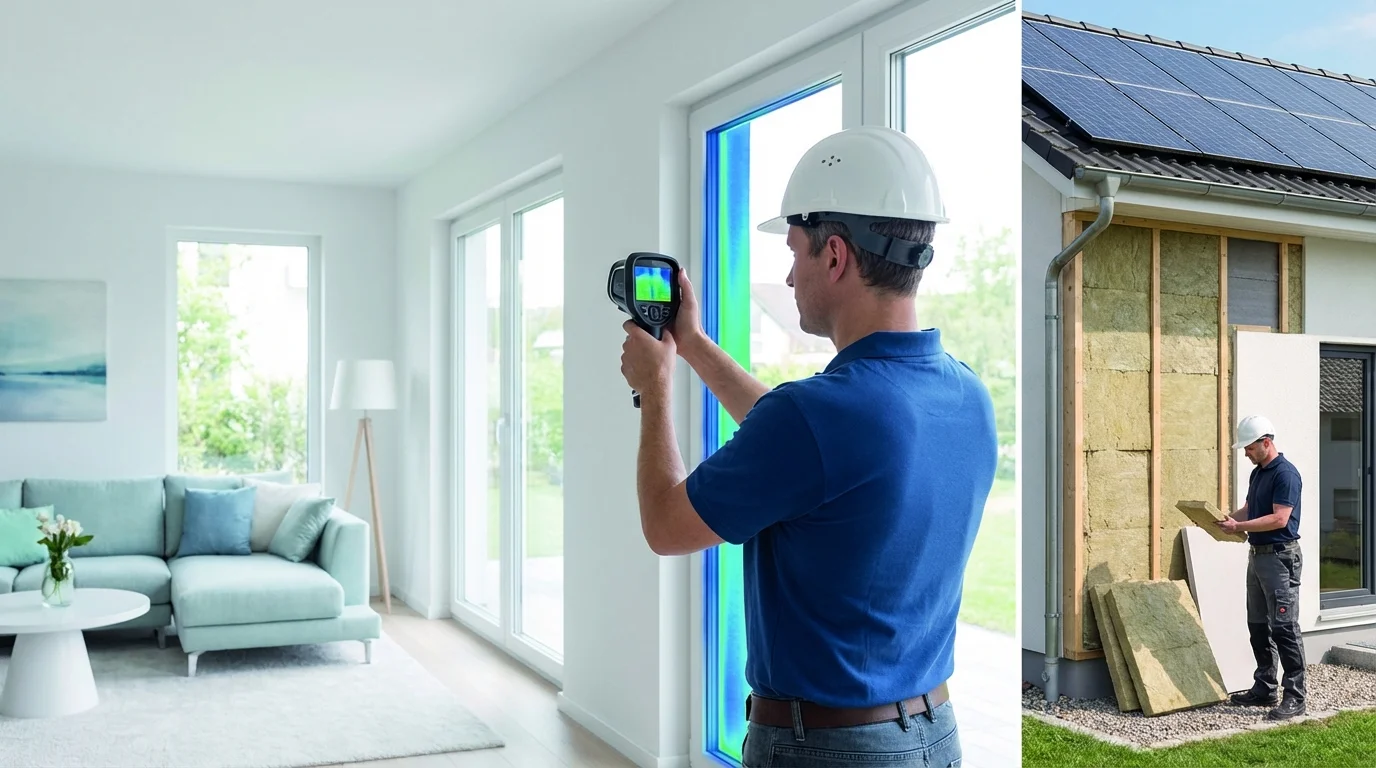
Air leaks in the average American home are equivalent to leaving a window open every day of the year, contributing to 25-40% of heating and cooling costs. This persistent energy waste directly inflates utility bills month after month. So, federal and state governments fund weatherization programs that begin with a professional energy audit to pinpoint and fix these costly inefficiencies, often at no cost to the homeowner.
What are weatherization programs, and how can an energy audit help me save money?
A weatherization program energy audit is a state-administered assessment identifying home energy inefficiencies. For 2026, these audits unlock access to federal and utility rebates covering up to $7,500 for improvements like insulation and air sealing, directly reducing annual utility bills by 10-20% for participants.
Weatherization Assistance Programs (WAP) are federally funded initiatives administered by states to increase the energy efficiency of homes for low-income families. And the process starts with a comprehensive home energy audit that uses diagnostic equipment, like blower doors and infrared cameras, to locate specific areas of energy loss. But this isn't just about finding problems. The audit generates a prioritized list of cost-effective improvements. So, instead of guessing where to add insulation, the audit provides a data-driven roadmap. The U.S. Department of Energy reports that households receiving these services save an average of $372 per year on energy bills. The audit itself is the key that unlocks access to program funds, ensuring that every dollar spent delivers maximum energy savings and home comfort.
Am I eligible for weatherization rebates, and what are the income limits in my state?
Eligibility for 2026 weatherization rebates is primarily determined by household income relative to the state median or federal poverty level. Most state programs set their income limits at or below 200% of the federal poverty guidelines, meaning a family of four qualifies with an annual income under $60,000.
State income thresholds for weatherization programs vary. For example, in 2026, California's Low Income Home Energy Assistance Program (LIHEAP) has different income caps than New York's Weatherization Assistance Program. And families receiving Supplemental Security Income (SSI) or Temporary Assistance for Needy Families (TANF) are often automatically eligible. But homeowners must verify the specific limits for their state, as they are updated annually. So, checking with your local WAP agency is the first step.
"The Weatherization Assistance Program (WAP) reduces energy costs for low-income households by increasing the energy efficiency of their homes, while ensuring their health and safety." — U.S. Department of Energy
These programs prioritize households with elderly members, individuals with disabilities, or young children, as they are most vulnerable to high energy burdens.
Which home improvements and equipment qualify for financial incentives from my utility?
Utility financial incentives in 2026 cover specific, high-impact home improvements identified during a weatherization energy audit. Qualifying equipment includes attic and wall insulation, air sealing, high-efficiency furnaces, water heaters, and heat pump rebates up to $8,000, depending on the provider.
The audit's findings directly dictate which upgrades qualify for funding. So, if the audit reveals 40% of heat loss occurs through an uninsulated attic, insulation becomes an eligible improvement. But cosmetic upgrades or appliance replacements not tied to energy efficiency, like a new refrigerator, don't qualify. Common qualifying measures include sealing air leaks in the building envelope, adding insulation to attics and walls, duct sealing, and tuning or replacing heating and cooling systems. And some programs also cover minor repairs necessary to complete the weatherization work, such as fixing a leaky roof section before adding insulation. The goal is to fund the most cost-effective measures first, ensuring the 15-30% energy savings are realized. Use our free rebate calculator to find savings on specific equipment.
How do I apply for weatherization programs, and what are the key deadlines and funding statuses?
Applying for 2026 weatherization programs involves contacting your local community action agency or state WAP office to submit an application with proof of income. Funding is allocated annually, so applying early in the fiscal year (often starting in July or October) is critical before funds are depleted.
The application process begins with finding your local WAP provider through the Department of Energy's online locator. And you'll need to provide documentation, including recent utility bills, proof of income for all household members (like pay stubs or tax returns), and proof of homeownership. But application processing times vary, often taking 30 to 90 days for approval. So, it’s important to submit a complete application to avoid delays. Deadlines are not always fixed; instead, programs often close once their annual funding allocation is exhausted. In 2026, many states received supplemental funding through federal initiatives, but this status changes, making prompt application essential.
Weatherization Program Comparison (2026)
| Program / Agency | Typical Rebate Amount | Primary Eligibility Requirement | Application Window |
|---|---|---|---|
| Federal WAP | Up to $8,000 (avg.) | Income at/below 200% of FPL | Varies by state; often year-round |
| Utility (e.g., PG&E) | $500 - $5,000 | Utility customer; income-qualified tiers | Typically Jan 1 - Dec 31 |
| State (e.g., NYSERDA) | Up to $10,000 | State resident; program-specific income caps | Varies; check state energy office |
Can I combine weatherization rebates with other incentives, and what are the contractor requirements?
Homeowners can combine or "stack" weatherization program benefits with other incentives like federal energy tax credits and manufacturer rebates in 2026. However, programs require that all work is performed by BPI-certified contractors who are approved and vetted by the local program administrator.
Stacking incentives maximizes your financial return. The federal Energy Efficient Home Improvement Credit (Section 25C) ended for property placed in service after December 31, 2025 (IRS FS-2025-05). Federal tax credits for this work have ended, but state, local and utility rebates may still apply; check what is available at your address with the DuloCore rebate calculator. But you can't double-dip; the tax credit applies only to your out-of-pocket expenses, not the portion covered by a rebate.
"DSIRE is the most comprehensive source of information on incentives and policies that support renewables and energy efficiency in the United States." — DSIRE
And contractor requirements are strict to ensure quality work. Programs maintain a list of approved contractors who are Building Performance Institute (BPI) certified and licensed. So, homeowners don't choose their own contractor; the WAP agency assigns one from their qualified pool to guarantee the upgrades meet specific performance and safety standards.
Official Sources
- Database of State Incentives for Renewables & Efficiency (DSIRE) — A comprehensive database of state, local, utility, and federal incentives for energy efficiency.
- ENERGY STAR Rebate Finder — An EPA-managed tool to find rebates and special offers for ENERGY STAR certified products.
- U.S. Department of Energy (DOE) Weatherization Assistance Program — Official information, eligibility guidelines, and state contacts for the federal WAP.
Related Reading: Learn more about Landlord Energy Audit Requirements and Liheap Energy Audit Program.
Related Reading: Learn more about Weatherization Assistance Program Wap.
Related Reading: Learn more about Utility Rebate Energy Audit Programs.
Frequently Asked Questions
Who is eligible for a weatherization program energy audit?
Eligibility is primarily income-based. For 2026, households with incomes at or below 200% of the federal poverty level generally qualify. This translates to an annual income of approximately $60,000 for a family of four. Priority is often given to households with elderly members (over 60), children, or individuals with disabilities.
What does a weatherization program energy audit involve?
A certified auditor performs a comprehensive home assessment that takes 2-4 hours. This includes a visual inspection of insulation levels, appliance efficiency, and safety checks on combustion appliances. They use specialized tools like a blower door to measure air leakage and an infrared camera to identify areas of heat loss, creating a data-driven improvement plan.
What improvements are recommended after a weatherization energy audit?
The most common recommendations are those with the fastest payback period. These typically include adding attic and wall insulation (up to R-49), comprehensive air sealing around windows and doors, duct sealing to prevent HVAC losses of up to 30%, and tuning or upgrading heating and cooling equipment to modern high-efficiency models.
How long does the weatherization program application process take after an energy audit?
After the audit is complete, the application and approval process typically takes between 30 and 90 days. The timeline depends on the local agency's backlog and the completeness of the submitted paperwork. Once approved, the actual weatherization work is usually scheduled within another 30 days and completed in 1-3 days.
Is a weatherization energy audit the same as a private home energy assessment?
No, they are different. A weatherization program audit is a free service for income-qualified households that directly connects them to program funding for repairs. A private home energy assessment, which costs between $300 and $700, is paid for by the homeowner and provides recommendations but does not automatically grant access to WAP funds.
Unlock Your Home's Savings Potential
Stop overpaying on your energy bills. Use the DuloCore rebate calculator to instantly find out how much you can save on insulation, heat pumps, and other weatherization upgrades in your area.
Calculate Your Savings NowLast reviewed: April 14, 2026. Reviewed by DuloCore Energy Specialists. About the team.