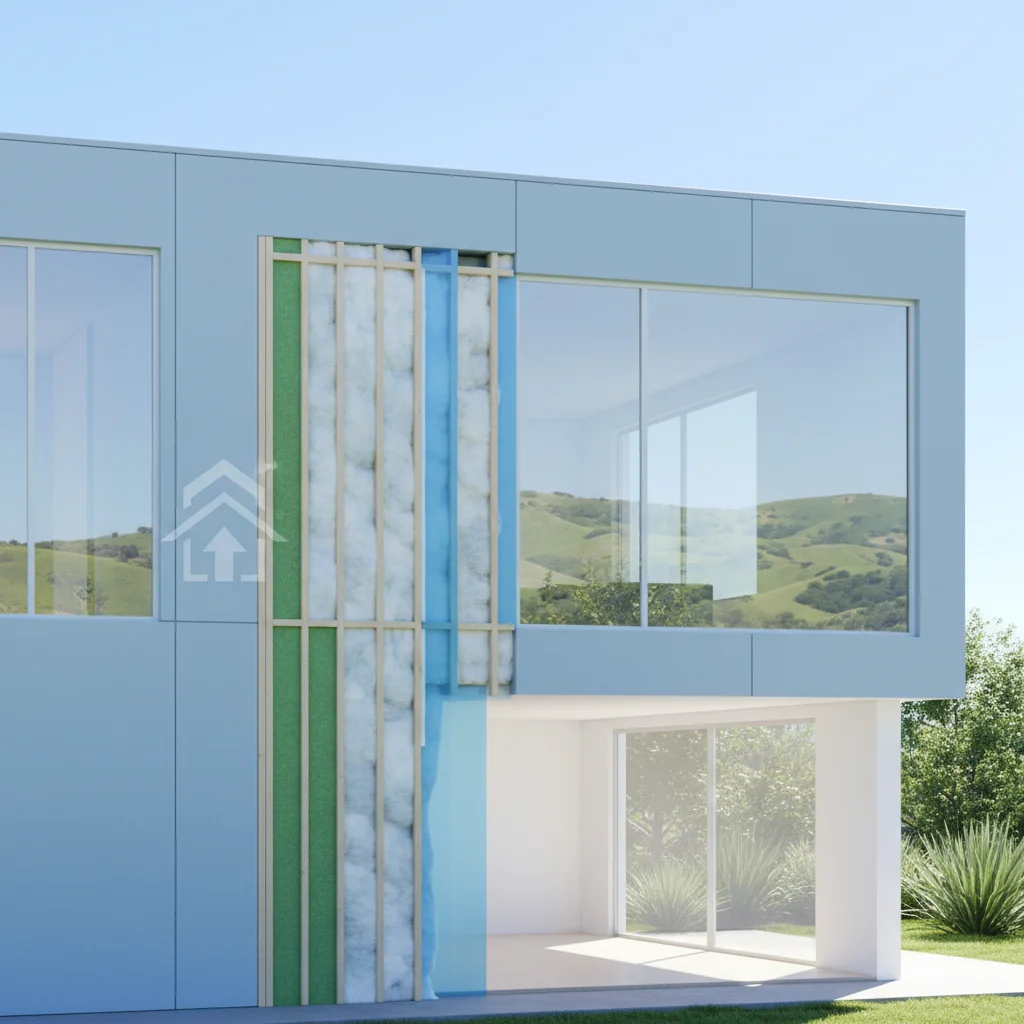
Californians lose an average of $783 per year through poorly insulated walls—and most don't realize until their summer air conditioning bills spike 40% above neighboring homes. In a state where energy costs rank 46% higher than the national average, wall insulation retrofits now qualify for federal tax credits covering up to 30% of installation costs, plus state utility rebates reaching $2,000 per residence. And with California's 2026 Title 24 building standards pushing R-value requirements to R-19 minimum for exterior walls, the gap between code compliance and existing housing stock has never been wider.
How Much Does Wall Insulation Cost in California?
Wall insulation installation in California ranges from $1.50 to $4.50 per square foot in 2026, with blown-in cellulose averaging $2,200 for a 1,500-square-foot home and closed-cell spray foam reaching $6,800 for the same area. Costs vary by insulation type, wall cavity accessibility, labor rates in coastal versus inland regions, and whether the project requires drywall removal. Federal IRA tax credits cover 30% of material and labor costs through 2032, while California utility programs contribute $800 to $2,000 per qualifying installation.
So a typical 1,800-square-foot California home with uninsulated exterior walls faces $3,600 to $8,100 in total costs before incentives. But after applying the 30% federal credit and a $1,200 utility rebate, net costs drop to $1,320 to $4,470—often paid back through energy savings within 4 to 7 years based on Pacific Gas & Electric rate structures.
Material choice drives the widest cost variation. Fiberglass batts cost $0.64 to $1.19 per square foot but require accessible wall cavities. Blown-in cellulose runs $1.50 to $2.30 per square foot and fills irregular spaces without drywall removal. Open-cell spray foam averages $2.20 to $3.80 per square foot with R-3.7 per inch. And closed-cell spray foam peaks at $3.50 to $4.50 per square foot but delivers R-6.5 per inch and air sealing in one application.
Labor rates vary significantly by California region. San Francisco Bay Area installers charge $75 to $110 per hour, while Fresno and Bakersfield contractors bill $45 to $65 per hour for the same work. Coastal projects often include moisture barrier installation adding $0.30 to $0.60 per square foot, while desert climate installations skip this step entirely.
"Homes with wall insulation meeting current R-19 standards use 25% to 30% less energy for heating and cooling compared to uninsulated structures." — U.S. Department of Energy
What Wall Insulation Types Qualify for California Rebates?
Insulation materials meeting ENERGY STAR certification qualify for both federal IRA tax credits and California utility rebates in 2026, including fiberglass batts rated R-13 or higher, blown-in cellulose at R-15 minimum, mineral wool batts at R-15, open-cell spray foam at R-13, and closed-cell spray foam at R-19 or above. The federal credit covers 30% of installed costs with no dollar cap through 2032, while utility programs like PG&E's Energy Upgrade California require R-13 minimum for walls and R-19 for crawlspaces.
California's three major investor-owned utilities—Pacific Gas & Electric, Southern California Edison, and San Diego Gas & Electric—each run separate rebate programs with varying requirements. PG&E's 2026 Energy Upgrade California offers $800 to $1,200 for wall insulation upgrades meeting Title 24 code plus 10% efficiency improvement. SCE's Home Upgrade program pays $1,500 for whole-home retrofits including wall insulation reaching R-19 in existing construction. And SDG&E's prescriptive pathway provides $0.15 per square foot for blown-in wall insulation certified by a HERS rater.
Municipal utility districts operate different incentive structures. Sacramento Municipal Utility District pays $500 for wall insulation installations verified by infrared thermography. Los Angeles Department of Water and Power offers $1.75 per square foot for closed-cell spray foam in Climate Zone 10 applications. But these programs cap annual budgets and close enrollment once funds exhaust—SMUD's 2025 allocation ran out by November 8.
The federal tax credit operates separately from state rebates and stacks with utility incentives. Homeowners claim Form 5695 Energy Efficient Home Improvement Credit for 30% of total installation costs including materials, labor, and permitting fees. So a $6,000 wall insulation project generates a $1,800 federal credit plus potential state rebates of $800 to $2,000, reducing net costs to $2,200 to $3,400.
Check our rebate calculator to find your exact credit amount based on zip code and project scope.
How Long Does Wall Insulation Last in California Homes?
Fiberglass and cellulose wall insulation maintains thermal performance for 80 to 100 years in California's dry inland climates, while coastal installations face 60 to 80-year lifespans due to occasional moisture exposure degrading cellulose materials. Spray foam insulation lasts 80 to 100 years regardless of climate zone, and mineral wool maintains R-value indefinitely barring water damage. The primary failure mode is compression from settling—reducing effective R-value by 15% to 25% in blown-in applications after 40 to 50 years.
California's climate zones create distinct longevity patterns. Homes in Climate Zone 16 (Alpine/Mountain) with freeze-thaw cycles see faster degradation of moisture-exposed insulation compared to Zone 10 (Riverside/San Bernardino) desert installations. But the state's generally dry conditions extend insulation lifespan compared to humid southeastern states where cellulose deteriorates in 40 to 60 years.
Spray foam delivers the longest functional life because it doesn't settle or compress. Closed-cell spray foam installed in 1980s California homes still tests at 98% to 100% of original R-value in HERS verifier assessments. Open-cell foam shows 92% to 96% R-value retention after 35 years. And both types provide permanent air sealing that fiberglass and cellulose can't match.
Installation quality affects longevity more than material choice in many cases. Fiberglass batts compressed during installation lose 50% of rated R-value permanently. Blown-in cellulose installed at incorrect density settles 18% to 22% within the first decade. But proper installation maintains performance for decades—the Lawrence Berkeley National Laboratory found professionally installed cellulose from 1982 retained 94% of R-value when tested in 2019.
"Insulation materials properly installed in dry conditions maintain thermal resistance for the life of the building, often exceeding 80 years without significant degradation." — Oak Ridge National Laboratory
What's the Process to Claim Wall Insulation Rebates in California?
Homeowners claim federal IRA tax credits by filing Form 5695 with their annual tax return and attaching manufacturer certification statements proving ENERGY STAR compliance, while California utility rebates require pre-approval applications submitted before installation begins, followed by post-installation HERS rater verification and inspection documentation within 60 days of project completion. The federal credit processes automatically through IRS returns, but utility rebates involve multi-step workflows with 45 to 90-day payment timelines after final approval.
The utility rebate process starts with program enrollment. PG&E requires online pre-registration at pge.com/energyupgrade with utility account number and planned installation date. SCE uses the scegov.com portal for Home Upgrade program applications with contractor license verification. And SDG&E processes applications through sdge.com/residentialrebates with mandatory pre-inspection scheduling for projects exceeding $2,000 in rebate value.
After enrollment approval, homeowners hire a participating contractor from the utility's approved list. The contractor submits installation plans and material specifications for review—typically 5 to 10 business days for approval. Installation proceeds after plan acceptance, followed by required inspections. PG&E mandates post-installation HERS rating for Energy Upgrade California participants, adding $400 to $600 to project costs. SCE requires infrared thermography verification costing $250 to $400. And SDG&E accepts contractor certification for prescriptive pathway projects under $3,000 in rebate value.
Documentation requirements include manufacturer spec sheets proving R-value ratings, invoices showing material and labor costs separately, photos of completed installation, and utility account numbers for rebate payment. The federal tax credit requires Manufacturer Certification Statement forms—downloadable from manufacturer websites—attached to Form 5695.
Payment timelines vary by program. Federal tax credits arrive as refunds or liability reductions when filing annual returns—typically February through April for prior-year installations. PG&E processes rebate checks 60 to 90 days after final inspection approval. SCE pays within 45 days of documentation submission. But SDG&E's 2026 program shows 75 to 120-day processing times due to increased application volume.
Learn about other eligible upgrades in our guide to energy tax credits.
How Do California Wall Insulation Costs Compare to Other Energy Upgrades?
Wall insulation costs $1.50 to $4.50 per square foot compared to attic insulation at $1.20 to $2.80 per square foot, heat pump installations at $5,500 to $12,000 per system, and solar panel arrays at $2.85 to $3.45 per watt before incentives in California's 2026 market. Wall insulation delivers 15% to 25% energy savings for $3,600 to $8,100 total investment, while heat pumps provide 30% to 40% savings but cost $8,000 to $18,000 after considering ductwork modifications and electrical panel upgrades.
The cost-per-BTU-saved calculation favors attic insulation as the lowest-cost efficiency upgrade at $0.04 to $0.08 per annual BTU reduction. Wall insulation follows at $0.09 to $0.15 per BTU saved. Air sealing costs $0.12 to $0.18 per BTU saved when performed by blower-door-certified contractors. And heat pumps range from $0.22 to $0.38 per BTU saved despite higher absolute savings due to upfront costs.
But rebate availability changes the economics. Heat pumps qualify for $8,000 federal credits plus $3,000 to $4,000 California rebates through programs like TECH Clean California, reducing net costs to $3,000 to $6,000. Wall insulation receives 30% federal credit (currently available through December 2032 under the Inflation Reduction Act)s plus $800 to $2,000 state rebates, dropping net costs to $1,320 to $4,470. So heat pumps deliver faster total savings despite higher initial outlays in many scenarios.
Payback periods vary by climate zone and existing HVAC efficiency. Wall insulation in Climate Zone 13 (San Diego coastal) shows 9 to 12-year payback due to mild temperatures and lower heating loads. The same upgrade in Climate Zone 16 (Mountain regions) pays back in 4 to 6 years with heating degree days exceeding 5,500 annually. Heat pumps show 6 to 10-year payback replacing electric resistance heat, but 12 to 18 years replacing efficient natural gas furnaces in areas with low gas rates.
Compare insulation savings with heat pump rebates for comprehensive home upgrades.
What Are the Deadlines for California Wall Insulation Rebate Programs?
Federal IRA tax credits for wall insulation remain available through December 31, 2032, with installations completed and paid for within the tax year eligible for 30% credits claimed on that year's return, while California utility rebate programs operate on annual budget cycles with 2026 enrollment closing when allocated funds exhaust—typically October through December based on application volume. PG&E's Energy Upgrade California accepts applications through December 15, 2026, for projects completing by February 28, 2027, while SCE's Home Upgrade program shows enrollment paused as of March 2026 due to budget depletion.
The federal credit structure allows multi-year planning. Homeowners can claim credits for qualifying installations from 2022 through 2032 as long as the property serves as their primary residence. And the credit has no annual dollar cap—a $20,000 whole-home insulation project generates a $6,000 credit regardless of income or tax liability, though non-refundable credits can't reduce tax owed below zero.
State programs follow less predictable timelines. California Public Utilities Commission approves utility program budgets in three-year cycles, with current authorization running through 2027. But individual program years close when funds run out. SDG&E's 2025 prescriptive rebate program exhausted $4.2 million in allocated funds by November 2025, suspending new applications until January 2026 budget allocation. SMUD's building efficiency rebates closed September 12, 2025, and reopened January 2, 2026, with $1.8 million available for the new cycle.
Municipal utility deadlines vary independently. LADWP's 2026 insulation rebate enrollment runs through June 30, 2026, for residential customers. Sacramento Municipal Utility District operates rolling enrollment with first-come processing and no published closure date. And Pasadena Water and Power limits rebates to the first 200 applications per calendar year.
Project completion deadlines matter as much as application dates. PG&E requires installation completion within 180 days of initial approval or the application expires. SCE mandates completion within 120 days of contractor enrollment. And federal credits require the installation be "placed in service" during the tax year claimed—December 31 completion deadline for that year's return.
Official Sources
- U.S. Department of Energy - Insulation — Federal guidance on insulation types, R-values, and energy savings calculation methodologies
- Database of State Incentives for Renewables & Efficiency — Comprehensive database of federal, state, and utility energy efficiency rebate programs updated quarterly
- ENERGY STAR Insulation Specification — Product certification requirements and qualified manufacturer lists for federal tax credit eligibility
Related Reading: Learn more about Insulation Cost Per Square Foot and Insulation Cost Vs Savings Analysis.
Frequently Asked Questions
How much does wall insulation cost in California?
Wall insulation costs $1.50 to $4.50 per square foot in California, translating to $2,700 to $8,100 for a typical 1,800-square-foot home depending on material type and regional labor rates. Blown-in cellulose averages $2,200 for standard installations, while closed-cell spray foam reaches $6,800 for the same area. After federal IRA tax credits covering 30% and California utility rebates of $800 to $2,000, net costs drop to $1,320 to $4,470.
What rebates are available for wall insulation in California?
The federal IRA tax credit covers 30% of wall insulation installation costs through 2032 with no dollar cap, while California's three major utilities offer $800 to $2,000 in rebates for projects meeting R-13 minimum requirements and ENERGY STAR certification. PG&E's Energy Upgrade California pays $800 to $1,200, SCE's Home Upgrade program offers $1,500, and SDG&E provides $0.15 per square foot. Municipal utilities like SMUD and LADWP run separate programs with $500 to $1,750 incentives.
Is wall insulation eligible for tax credits in 2026?
Wall insulation installations meeting ENERGY STAR standards qualify for the federal Energy Efficient Home Improvement Credit covering 30% of material and labor costs in 2026, claimed via IRS Form 5695 with no annual dollar limit. The credit applies to primary residences only and requires manufacturer certification statements proving R-value compliance. California doesn't offer state tax credits for insulation, but utility rebates from PG&E, SCE, and SDG&E provide $800 to $2,000 in additional savings.
How long does it take to get a wall insulation rebate?
Federal tax credits arrive as refunds or liability reductions when filing annual tax returns, typically 3 to 8 weeks after IRS submission in February through April. California utility rebates process in 45 to 120 days after final inspection approval—PG&E averages 60 to 90 days, SCE pays within 45 days, and SDG&E shows 75 to 120-day timelines in 2026. Municipal programs like SMUD and LADWP process payments in 30 to 60 days after documentation submission.
What's the difference between spray foam and fiberglass insulation costs in California?
Spray foam costs $2.20 to $4.50 per square foot in California compared to fiberglass batts at $0.64 to $1.19 per square foot, but spray foam delivers R-3.7 to R-6.5 per inch versus R-2.9 to R-3.8 for fiberglass while providing permanent air sealing. A 1,800-square-foot home pays $3,960 to $8,100 for spray foam installation versus $1,152 to $2,142 for fiberglass, though spray foam saves 18% to 25% more on energy costs annually due to superior air barrier performance.
Ready to calculate your wall insulation savings? Use our free rebate calculator to find exact federal credit amounts and California utility rebates based on your zip code, home size, and installation timeline. Get your personalized estimate in under 60 seconds.
(note: the original Section 25C/25D credits expired December 31, 2025; they were replaced by updated credits under the Inflation Reduction Act) - Attic Insulation Cost - Attic Insulation Cost And Savings
Updated on April 14, 2026. Fact-checked by DuloCore Editors. About our research team.
Check your California insulation rebate eligibility — see the programs you qualify for and the dollar amounts on our California insulation rebate finder.