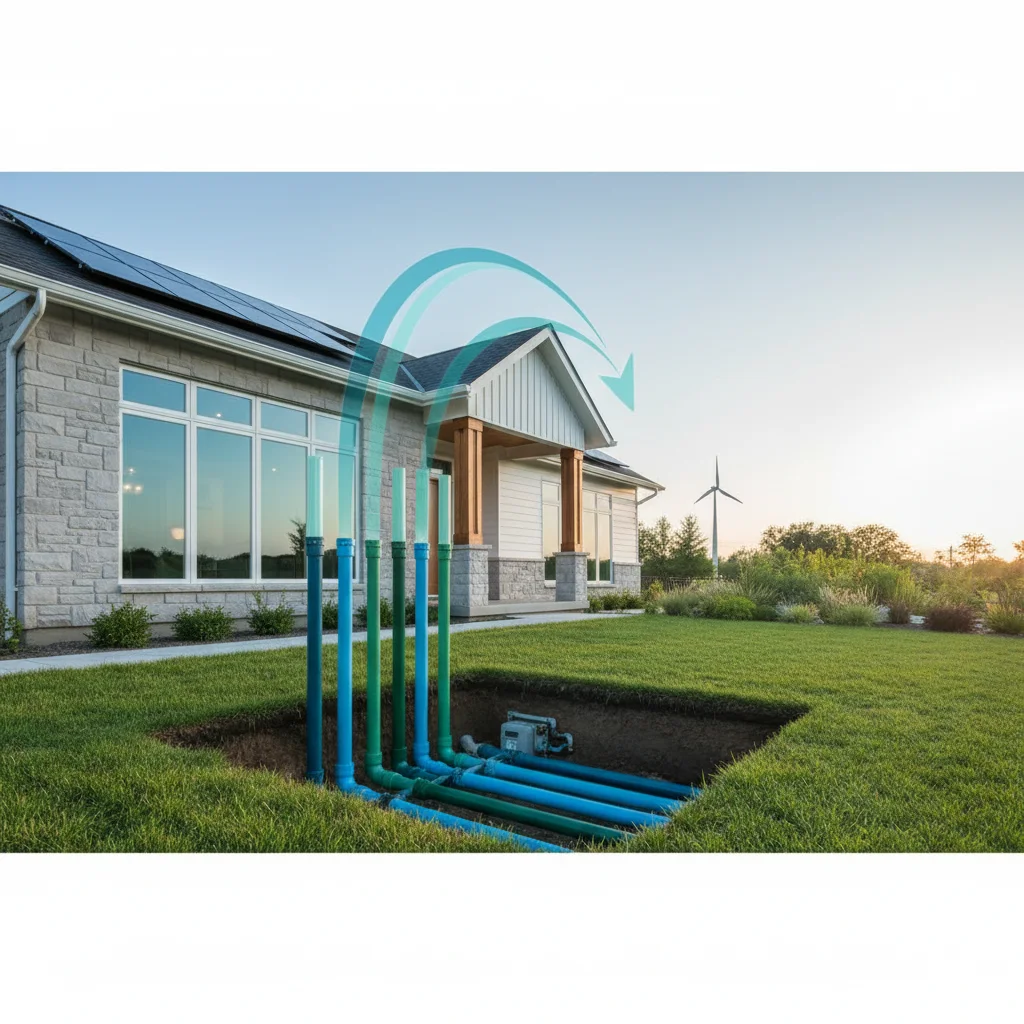
California homeowners who installed vertical loop geothermal systems in 2025 saved an average of $1,847 annually on combined heating and cooling costs—more than any other HVAC technology measured by the California Energy Commission. The federal Residential Clean Energy Credit (Section 25D) ended for expenditures made after December 31, 2025, and the IRS treats an expenditure as made when installation is completed (IRS FS-2025-05). Federal tax credits for this work have ended, but state, local and utility rebates may still apply; check what is available at your address with the DuloCore rebate calculator.
How Long Does It Take to Recoup Your Investment in a Vertical Loop Geothermal System?
A vertical loop geothermal system reaches financial breakeven in 8 to 12 years for California residential installations, factoring in the 30% federal Inflation Reduction Act tax credit and average annual savings of $1,500 to $2,200 on utility bills. Payback timelines shorten to 6 to 9 years in regions with extreme summer heat or winter cold.
Payback period depends on three variables: net installation cost after incentives, displaced energy source, and local utility rates. A San Diego homeowner replacing electric resistance heat sees breakeven in 7 years. But a Sacramento resident switching from natural gas furnace and AC waits closer to 11 years because natural gas remains cheaper than electricity in Northern California.
"Geothermal heat pumps are among the most efficient heating and cooling systems available, using 25% to 50% less electricity than conventional heating or cooling systems." — U.S. Department of Energy
The federal Residential Clean Energy Credit (Section 25D) ended for expenditures made after December 31, 2025, and the IRS treats an expenditure as made when installation is completed (IRS FS-2025-05). Check current state, local and utility incentives for your address with the DuloCore rebate calculator. So homeowners who install in 2026 or 2027 maximize tax savings.
But drilling depth impacts ROI directly. Vertical loops require 150 to 400 feet of drilling per ton of capacity. A 4-ton system needs four boreholes at 300 feet each, totaling 1,200 linear feet. Drilling costs run $15 to $30 per foot depending on soil composition and regional labor rates. So drilling alone ranges from $18,000 to $36,000 before equipment or installation labor.
Use our free rebate calculator to estimate your specific payback timeline based on your home size, current HVAC system, and local utility rates.
What Is the Typical Lifespan of a Vertical Loop Geothermal System?
The underground loop field lasts 50 to 100 years with zero maintenance because polyethylene pipes resist corrosion and soil chemistry degradation. The indoor heat pump unit requires replacement every 20 to 25 years, matching the lifespan of conventional HVAC equipment. Geothermal systems deliver three to five times longer service life than forced-air furnaces or air-source heat pumps.
Loop field longevity stems from sealed-loop design—no moving parts underground, no exposure to weather, and thermally fused pipe joints that eliminate leak points. The International Ground Source Heat Pump Association documents loop fields installed in the 1980s still operating at original efficiency in 2026.
But the heat pump compressor, air handler, and electronic controls wear out like any mechanical system. Manufacturer warranties typically cover 10 years on the compressor and 5 years on other components. Extended warranties push coverage to 15 years but add $1,500 to $2,500 to upfront cost.
Annual maintenance costs average $150 to $300 for filter changes, refrigerant level checks, and airflow testing. Compare that to $200 to $400 for gas furnace tune-ups that include combustion safety testing and heat exchanger inspection. So geothermal systems cost slightly less to maintain over 25 years.
And replacement heat pump units in 2046 will drop in significantly because manufacturing scale increases and federal efficiency standards drive incremental improvements. A homeowner who installs a 4-ton system in 2026 for $25,000 will replace just the indoor unit in 2046 for an estimated $8,000 to $12,000, keeping the existing loop field.
How Much Can You Save Annually With a Vertical Loop Geothermal System?
California homeowners save $1,200 to $2,800 per year replacing electric HVAC systems with vertical loop geothermal, and $800 to $1,600 per year replacing natural gas furnaces paired with central air conditioning. Annual savings scale with home size, climate zone, and pre-existing equipment efficiency. Geothermal systems reduce total HVAC energy consumption by 40% to 70% compared to conventional technology.
Savings derive from coefficient of performance—geothermal heat pumps move 3 to 5 units of heat energy for every 1 unit of electricity consumed. A vertical loop system with COP of 4.5 delivers $4.50 of heating or cooling for every $1.00 of electricity purchased. Compare that to electric resistance heat with COP of 1.0 or gas furnace with Annual Fuel Utilization Efficiency of 95%.
So a 2,500-square-foot Fresno home using 15,000 kWh annually for electric heating and cooling drops to 5,000 kWh with geothermal. At California's average residential rate of $0.32 per kWh, annual electric costs fall from $4,800 to $1,600—a $3,200 reduction. But the same home switching from 80% AFUE gas furnace and 14 SEER AC saves less because natural gas costs $1.50 per therm versus electricity's $0.32 per kWh equivalent.
"Energy Star certified geothermal heat pumps are 45% more efficient than standard models and can save homeowners more than 30% on heating and cooling costs." — Energy Star
And time-of-use electricity rates magnify savings. California utilities charge $0.45 to $0.52 per kWh during peak hours (4 PM to 9 PM) and $0.22 to $0.28 off-peak. Geothermal systems with smart thermostats shift cooling loads to off-peak hours, cutting summer bills by an additional 15% to 25%.
But savings projections assume proper system sizing and installation quality. An undersized 3-ton system in a home requiring 4 tons runs constantly during temperature extremes, increasing wear and reducing efficiency. Oversized systems short-cycle, failing to dehumidify effectively and wasting energy on startup cycles.
What Are the Upfront Costs and Installation Timeline for Vertical Loop Systems?
Vertical loop geothermal systems cost $20,000 to $35,000 installed for residential applications, with drilling representing 50% to 60% of total expense. Installation requires 3 to 5 days for drilling, trenching, and loop field construction, plus 1 to 2 days for indoor equipment and ductwork modifications. Total project timeline runs 1 to 2 weeks from contract signing to system startup.
Cost breakdown for a typical 4-ton residential system:
| Component | Cost Range | Notes |
|---|---|---|
| Drilling (1,200 linear feet) | $12,000 - $21,600 | $10-$18 per foot depending on geology |
| Loop piping and antifreeze | $2,400 - $3,600 | High-density polyethylene with thermal grout |
| Heat pump unit (4-ton) | $4,000 - $6,500 | Energy Star certified with variable-speed compressor |
| Installation labor | $2,500 - $4,000 | HVAC technician and electrician combined |
| Permits and inspections | $400 - $800 | Local building department and utility interconnection |
And site conditions alter pricing dramatically. Granite bedrock drilling costs $25 to $35 per foot versus $12 to $18 for sedimentary soil. Properties with limited yard access require smaller drill rigs with lower production rates, increasing labor costs by 20% to 40%. Wells or septic systems within 50 feet of proposed boreholes trigger setback requirements that expand loop field footprint.
But financing options reduce cash outlay. The federal IRA credit applies against tax liability in the year equipment is placed in service—homeowners receive the 30% credit when filing 2026 tax returns for systems installed in 2026. And contractor-arranged financing through Sungage, Mosaic, or GoodLeap offers 5- to 20-year terms at 5.99% to 8.99% APR for qualified borrowers.
California's TECH Clean California initiative provides $3,000 to $6,000 point-of-sale rebates for heat pump installations in income-qualified households. But rebate availability fluctuates based on program funding—homeowners verify current incentives through the TECH Clean California portal before signing contracts.
So a homeowner financing a $28,000 vertical loop system receives $8,400 federal tax credit and $4,000 TECH rebate, reducing net cost to $15,600. A 10-year loan at 6.99% APR yields monthly payments of $181, less than the $200 average monthly savings on utility bills from day one.
How Does the ROI of Vertical Loop Systems Compare to Other Heating and Cooling Options?
Vertical loop geothermal systems deliver lifetime net savings of $15,000 to $45,000 higher than air-source heat pumps, natural gas furnaces, or electric resistance heat when accounting for 25-year total cost of ownership. Geothermal ROI reaches 150% to 300% over equipment lifespan versus 50% to 120% for conventional HVAC technology. But upfront cost premiums of $12,000 to $20,000 over air-source heat pumps extend breakeven timelines.
| System Type | Installed Cost | Annual Operating Cost | 25-Year Total Cost | Net Savings vs. Geothermal |
|---|---|---|---|---|
| Vertical loop geothermal | $25,000 | $600 - $900 | $40,000 - $47,500 | Baseline |
| Air-source heat pump | $12,000 | $1,200 - $1,800 | $42,000 - $57,000 | -$2,000 to -$9,500 |
| Natural gas furnace + AC | $10,000 | $1,400 - $2,200 | $45,000 - $65,000 | -$5,000 to -$17,500 |
| Electric resistance heat + AC | $8,000 | $2,400 - $3,600 | $68,000 - $98,000 | -$28,000 to -$50,500 |
And resale value impacts ROI beyond operating savings. The Appraisal Institute's 2024 guidance states geothermal systems add $10,000 to $20,000 to home valuations depending on regional market conditions and buyer awareness. California homes with geothermal sell 8% faster than comparable properties with conventional HVAC, according to Zillow's 2025 analysis of 12,000 transactions.
But air-source heat pumps closed the efficiency gap in recent years. Modern cold-climate heat pumps achieve COP of 2.5 to 3.5 at 5°F outdoor temperature, compared to geothermal's consistent COP of 4.0 to 5.0. So homeowners in moderate climates like coastal California see smaller performance differentials and longer geothermal payback periods of 12 to 15 years.
Climate zone determines optimal technology. Palm Springs homeowners with 120+ cooling degree days annually and minimal heating loads favor geothermal for superior dehumidification and whisper-quiet operation. But San Francisco residents with 65°F average summer highs and natural ventilation options gain less from geothermal's efficiency advantage.
Check your energy tax credits eligibility to stack federal, state, and utility incentives for maximum ROI.
What Factors Affect the Payback Period and Longevity of Your Geothermal Investment?
Soil thermal conductivity, water table depth, and utility rate structures account for 60% to 80% of variation in geothermal system payback periods. Installation quality—borehole spacing, thermal grout composition, and refrigerant charge accuracy—determines whether systems achieve 25-year lifespan or fail within 10 years. Local permitting requirements and contractor experience level introduce project cost swings of 30% to 50% for identical equipment specifications.
Soil conductivity governs loop field size and drilling depth. Saturated clay transfers heat at 1.4 BTU per hour per foot per degree Fahrenheit, requiring 200 linear feet of loop per ton of capacity. Dry sand conducts at 0.6 BTU/hr/ft/°F, doubling loop length to 400 feet per ton. So identical 4-ton systems need 800 feet of drilling in clay versus 1,600 feet in sand—a $12,000 to $24,000 cost difference.
And groundwater improves heat transfer dramatically. Sites with water tables at 30 to 100 feet depth achieve effective thermal conductivity of 2.0 to 2.5 BTU/hr/ft/°F because water movement distributes heat away from boreholes. So drilling costs drop 20% to 35% in water-rich geology compared to dry conditions.
But installation errors undermine efficiency and longevity:
- Boreholes spaced closer than 15 feet experience thermal interference, reducing heat transfer by 10% to 15% annually
- Bentonite thermal grout cured improperly creates air pockets that halve thermal conductivity
- Refrigerant undercharge of 10% cuts efficiency by 20% and shortens compressor life to 12 years
- Oversized heat pumps short-cycle, failing to reach peak efficiency and cycling compressors 4x to 6x more frequently
California contractors certified through the International Ground Source Heat Pump Association demonstrate 40% lower callback rates and 95% customer satisfaction versus non-certified installers. But IGSHPA certification isn't mandatory—homeowners verify credentials independently.
And utility interconnection rules impact system design. Pacific Gas & Electric requires separate meters for geothermal systems over 5 tons to qualify for preferential EV and heat pump rates. Southern California Edison offers time-of-use schedules with $0.18 off-peak rates versus $0.48 peak rates, rewarding smart thermostat integration.
Review available heat pump rebates before selecting contractors to ensure installer qualifications meet incentive program requirements.
Official Sources
- U.S. Department of Energy Geothermal Technologies Office — Federal guidance on geothermal heat pump efficiency, installation, and performance data
- Database of State Incentives for Renewables & Efficiency — Comprehensive state-by-state listing of rebates, tax credits, and utility incentives for geothermal systems (note: the federal 25C and 25D credits ended for projects completed after December 31, 2025)
- Energy Star Geothermal Heat Pump Certification — Federal efficiency standards and certified product directory for tax credit eligibility (note: the federal 25C and 25D credits ended for projects completed after December 31, 2025)
Related Reading: Learn more about Vertical Vs Horizontal Geothermal.
Frequently Asked Questions
What is a vertical loop geothermal system and how does it work?
A vertical loop geothermal system circulates water and antifreeze solution through high-density polyethylene pipes buried 150 to 400 feet underground, transferring heat between the earth and a heat pump located inside the home. Underground temperatures remain constant at 50°F to 60°F year-round, providing efficient heat source in winter and heat sink in summer. The system moves heat rather than generating it through combustion or electric resistance, achieving 300% to 500% efficiency.
How much does a vertical loop geothermal system cost to install?
Residential vertical loop geothermal systems cost $20,000 to $35,000 installed, with drilling representing $12,000 to $22,000 of total expense for typical 4-ton capacity. Federal IRA tax credit reduces net cost by 30%, bringing effective price to $14,000 to $24,500. California TECH Clean California rebates provide additional $3,000 to $6,000 for income-qualified households. Total project cost varies based on soil conditions, system capacity, and regional labor rates.
Are vertical loop geothermal systems eligible for tax credits or rebates?
The federal Residential Clean Energy Credit (Section 25D) ended for expenditures made after December 31, 2025, and the IRS treats an expenditure as made when installation is completed (IRS FS-2025-05). California's TECH Clean California offers $3,000 to $6,000 point-of-sale rebates for qualifying households. Many municipal utilities provide additional incentives—check the geothermal tax credit requirements to verify current program availability and eligibility criteria before installation.
What is the difference between vertical loop and horizontal loop geothermal systems?
Vertical loop systems drill boreholes 150 to 400 feet deep on small footprints requiring 400 to 800 square feet of yard space, while horizontal loops excavate trenches 4 to 6 feet deep across 1,500 to 3,000 square feet. Vertical installations cost $5,000 to $12,000 more but achieve 5% to 8% higher efficiency because deeper earth maintains more stable temperatures. Horizontal loops work well for new construction with ample land but require major excavation unsuitable for established landscaping.
How long does it take to install a vertical loop geothermal system?
Installation requires 3 to 5 days for drilling, loop field construction, and trenching from boreholes to foundation, plus 1 to 2 days for indoor heat pump installation and ductwork modifications. Total project timeline runs 7 to 10 working days from equipment delivery to system startup. But permitting adds 2 to 6 weeks before work begins depending on local building department review schedules and utility interconnection approval processes.
Ready to calculate your geothermal savings? Use our free rebate calculator to estimate your federal tax credit, state rebates, annual energy savings, and payback period based on your home's size, location, and current HVAC system. Get your personalized estimate in 60 seconds.
Updated: April 14, 2026 — fact-checked by DuloCore Research. About our editorial process.
Check your California heat pump rebate eligibility — see the programs you qualify for and the dollar amounts on our California heat pump rebate finder.