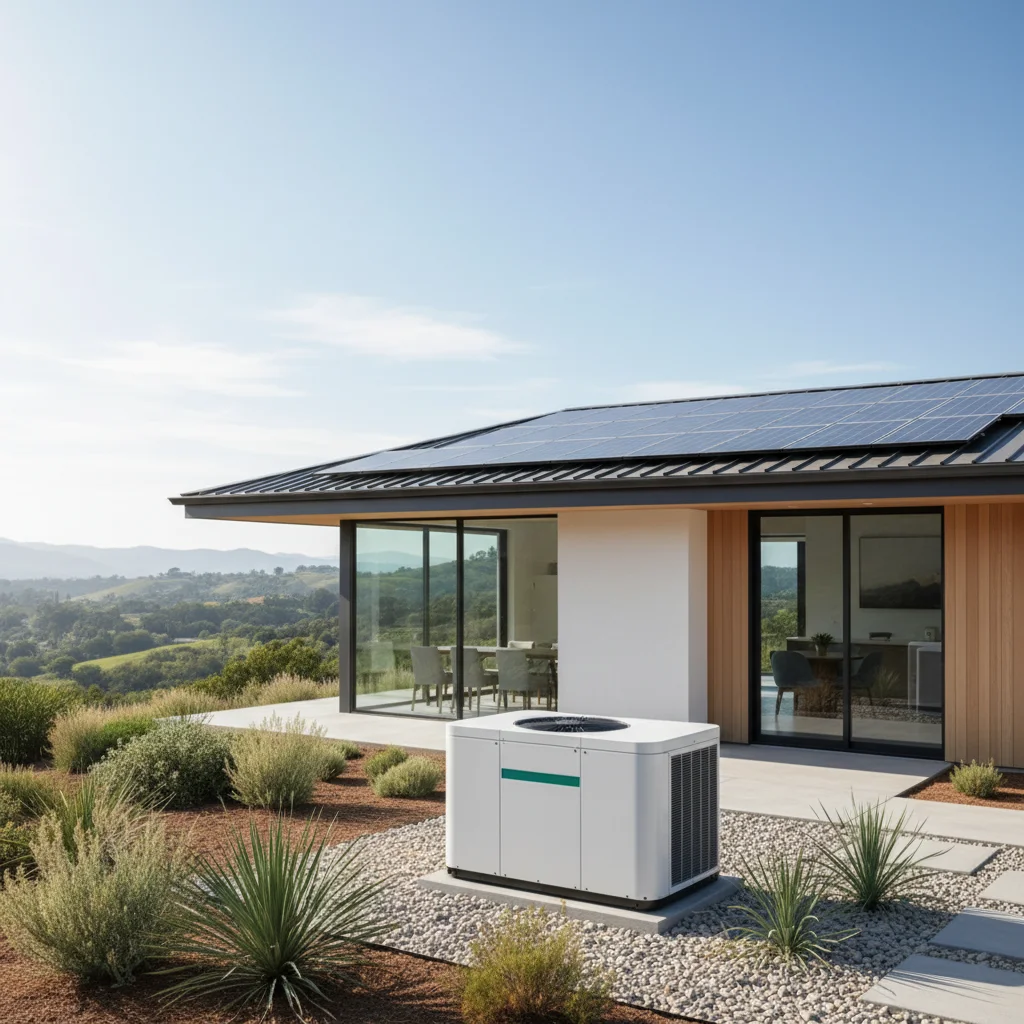
California homeowners waste $600 million annually on HVAC systems that run at full blast even when a fraction of that power would do. Variable speed compressors solve this by adjusting output in 1% increments from 25% to 100% capacity, matching your home's exact heating and cooling demand rather than cycling on and off like a light switch.
What Is Variable Speed HVAC and How Does It Work in California?
Variable speed HVAC systems use inverter-driven compressors that modulate refrigerant flow and fan speed continuously rather than operating in binary on-off cycles. The compressor ramps from 25% capacity during mild weather to 100% during peak summer afternoons or winter cold snaps, maintaining precise indoor temperatures within 0.5°F of the thermostat setting while single-stage units swing 2-4°F above and below target.
And the technology directly addresses California's extreme climate variations. Coastal zones need minimal cooling but consistent dehumidification. Inland valleys hit 110°F summers requiring maximum capacity. Desert regions face 50°F temperature swings between day and night. Variable speed systems adjust motor frequency from 15 Hz to 120 Hz to match these conditions, while single-stage compressors run at fixed 60 Hz regardless of need.
But the real efficiency gain comes from eliminating startup power surges. Single-stage compressors draw 5-7x normal operating amperage every time they cycle on. Variable speed units run continuously at low speeds, avoiding these energy spikes entirely. A 3-ton variable speed system uses 800-1,200 watts during mild weather versus 3,500 watts for a single-stage unit cycling on and off.
So California's Title 24 energy code now awards compliance credits for variable speed systems. New construction using ENERGY STAR certified variable speed equipment earns up to 15% additional margin in whole-house energy budgets. And retrofit installations in Climate Zones 10-16 qualify for expedited permit processing when replacing single-stage systems over 10 years old.
Check heat pump rebates for current incentives on variable speed installations.
How Much Do Variable Speed HVAC Systems Cost in California?
Variable speed HVAC installations in California range from $8,500 to $16,000 for whole-house systems depending on tonnage, efficiency rating, and ductwork requirements. A 3-ton 18 SEER2 variable speed heat pump averages $12,000 installed, compared to $7,500 for an equivalent 14 SEER2 single-stage unit—a $4,500 upfront premium.
Equipment accounts for 60% of total cost. Carrier Infinity or Trane XV series variable speed compressors retail $5,500-$8,500 for the outdoor unit alone. Add $1,800-$2,500 for a compatible variable speed air handler, $800-$1,200 for smart thermostats like Ecobee or Honeywell T10 Pro, and $2,400-$4,800 for labor including refrigerant line sets, electrical upgrades, and startup calibration.
But ductwork modifications add substantial expense. Variable speed systems require tighter duct sealing to prevent air leaks at low fan speeds. Homes with existing duct leakage above 6% of total airflow need professional sealing at $1,200-$2,800 per system. And undersized return ducts that worked adequately with single-stage systems cause restriction at variable speeds, requiring $800-$1,500 in return plenum upgrades.
So financing shifts the math. California's PACE programs offer 20-year property tax assessment financing at 6.5-7.9% APR with no upfront cost. A $12,000 variable speed system financed through PACE costs $95-$105 monthly, often less than the $120-$140 energy savings from replacing a 15-year-old single-stage unit.
Use our free rebate calculator to estimate total installed cost after incentives.
What Are the Energy Savings and Long-Term Financial Benefits?
Variable speed HVAC systems reduce annual cooling and heating costs by 30-50% compared to single-stage units, saving California homeowners $480-$1,200 per year depending on climate zone and runtime hours. A Sacramento household running 2,800 cooling hours annually at $0.28/kWh saves $672 in year one by switching from 14 SEER single-stage to 20 SEER2 variable speed.
And the savings compound over equipment lifespan. Single-stage compressors cycle 6-10 times per hour, accumulating 50,000-80,000 start cycles over 12-15 years before failure. Variable speed compressors run continuously at modulated output, logging under 5,000 start cycles in 18-22 years. Lower mechanical stress extends component life by 40-60%, delaying replacement costs by 5-8 years.
But payback periods vary by usage intensity. High-use scenarios in Climate Zones 13-16 (deserts, Central Valley) recoup the $4,500 premium in 4-6 years. Moderate coastal climates in Zones 6-7 take 7-10 years. So utility rate structures matter—PG&E's tiered pricing penalizes high consumption more severely than SMUD's flat rates, accelerating payback in PG&E territory by 18-24 months.
Or California's SGIP battery storage incentives create additional value. Variable speed HVAC paired with Tesla Powerwall or Enphase storage systems qualifies for $200-$350 per kWh in SGIP rebates. The HVAC's lower peak draw enables smaller battery sizing, reducing storage costs by $2,000-$3,500 while maintaining backup capability.
Variable Speed vs. Single-Stage HVAC: Which System Should You Choose?
Variable speed HVAC delivers 35-45% higher seasonal efficiency than single-stage systems by running continuously at 40-60% capacity instead of full-power on-off cycles, making it cost-effective for California homes with annual cooling costs exceeding $800 or heating bills over $600. Single-stage units remain viable for mild coastal climates where total HVAC runtime stays under 1,000 hours annually.
And climate zone determines ROI. Zone 16 (deserts) experiences 3,500+ cooling hours and 1,200+ heating hours per year. Variable speed systems save $1,100-$1,400 annually in these regions, recovering the $4,500 upfront premium in 3.2-4.1 years. But Zone 3 (coastal San Francisco) logs under 200 cooling hours and 800 heating hours—the same premium takes 12-15 years to recoup.
But home size and insulation quality shift the equation. Homes over 2,500 sq ft with R-38 attic insulation and dual-pane windows maintain stable temperatures longer, allowing variable speed systems to run at 30-50% capacity for extended periods. Smaller homes under 1,500 sq ft in poorly insulated buildings experience rapid temperature swings, forcing even variable speed units to cycle more frequently and reducing efficiency gains to 15-25%.
So existing ductwork condition matters. Variable speed systems require duct leakage under 6% total airflow to achieve rated efficiency. Homes with 10-15% duct leakage must invest $1,200-$2,800 in duct sealing before installation. If ductwork needs full replacement at $4,500-$7,500, the combined cost of $13,000-$18,500 eliminates financial advantage over single-stage in moderate climates.
Compare options using the rebate calculator with your actual utility bills.
How Long Do Variable Speed HVAC Systems Last and What's the Maintenance Cost?
Variable speed HVAC systems last 18-22 years in California installations compared to 12-15 years for single-stage units, with annual maintenance costs of $180-$280 versus $120-$180 for conventional systems. The extended lifespan stems from reduced compressor start cycles—variable speed units log 3,000-5,000 starts over 20 years while single-stage compressors endure 50,000-80,000 cycles before mechanical failure.
And inverter-driven compressors reduce wear on refrigerant circuits. Single-stage systems slam from zero to full pressure 6-10 times hourly, stressing valve seats, expansion valves, and refrigerant lines. Variable speed compressors ramp gradually from 25% to 100% capacity, maintaining consistent pressures that prevent oil slugging and compressor bearing damage. So catastrophic compressor failure occurs in under 2% of variable speed units before year 18 versus 15-20% of single-stage units by year 12.
But maintenance costs run 40-50% higher. Variable speed systems require inverter board diagnostics at $90-$140 per service call compared to $65-$95 for single-stage troubleshooting. And variable frequency drives (VFDs) need capacitor replacement every 8-10 years at $280-$420 versus $120-$180 for single-stage contactors. Or dirty filters restrict airflow more severely on variable speed fans, requiring monthly filter changes at $8-$12 per filter versus quarterly changes on single-stage systems.
So California's Title 24 compliance monitoring adds costs. Systems installed after 2023 require smart thermostats with remote diagnostics that upload performance data to utility portals. The monitoring service costs $0-$8 monthly depending on manufacturer, but non-compliance voids warranty coverage on equipment failures after year 5.
Are You Eligible for California Tax Credits or Rebates on Variable Speed Systems?
The federal Energy Efficient Home Improvement Credit (Section 25C) ended for property placed in service after December 31, 2025 (IRS FS-2025-05). California homeowners installing ENERGY STAR certified variable speed HVAC qualify for utility rebates of $500-$3,000 depending on climate zone and income qualification.
And income-qualified households access higher rebates. California's TECH Clean California program offers $3,000-$4,000 for households under 80% area median income installing ducted variable speed heat pumps. PG&E's Energy Savings Assistance program provides no-cost installations for customers below 200% federal poverty level, covering full $8,500-$12,000 equipment and labor costs.
But utility territory determines incentive stacks. SMUD offers $1,500 for 18+ SEER2 variable speed heat pumps plus $500 for HERS verification, totaling $2,000. SCE's Residential HVAC Program pays $500-$1,200 based on SEER2 rating, with additional $300 for dual-fuel configurations. Or LADWP restricts rebates to homes in Tiers 3-5 of their tiered rate structure, excluding low-usage households.
So application timing matters. Most utility programs operate on annual budgets exhausted by June-August. SCE's 2026 HVAC allocation depleted April 12, reopening January 2027. Form 5695 only covers qualifying work completed by December 31, 2025 and claimed on a 2025 return; the federal 25C and 25D credits ended after that date (IRS FS-2025-05). Federal tax credits for this work have ended, but state, local and utility rebates may still apply; check what is available at your address with the DuloCore rebate calculator.
Check California TECH Clean California for current program availability and income limits.
Official Sources
- U.S. Department of Energy - Energy Saver — Federal guidance on HVAC efficiency standards and tax credits (note: the federal 25C and 25D credits ended for projects completed after December 31, 2025)
- ENERGY STAR Tax Credits — Official federal tax credit amounts and eligibility requirements for variable speed HVAC systems (note: the federal 25C and 25D credits ended for projects completed after December 31, 2025)
- DSIRE California Programs — Comprehensive database of state and utility rebate programs for energy-efficient HVAC installations
Frequently Asked Questions
What is a variable speed HVAC system and how does it work?
Variable speed HVAC systems use inverter-driven compressors that modulate refrigerant flow from 25% to 100% capacity by adjusting motor frequency from 15 Hz to 120 Hz, matching your home's exact heating or cooling demand. Single-stage systems run at fixed 60 Hz full power then shut off completely, cycling 6-10 times hourly. Variable speed units run continuously at lower speeds, maintaining temperature within 0.5°F of thermostat setting while consuming 30-50% less energy than on-off cycling.
How much can I save on my energy bills with a variable speed HVAC system in California?
California homeowners save $480-$1,200 annually by replacing single-stage HVAC with variable speed systems rated 18+ SEER2. A Sacramento home running 2,800 cooling hours at $0.28/kWh saves $672 in year one. Desert regions with 3,500+ cooling hours save $1,100-$1,400 yearly. Coastal climates under 1,000 total HVAC hours save $180-$320 annually. And PACE financing at $95-$105 monthly often costs less than the energy savings, creating immediate positive cash flow.
Am I eligible for California rebates on variable speed HVAC installation?
The federal Energy Efficient Home Improvement Credit (Section 25C) ended for property placed in service after December 31, 2025 (IRS FS-2025-05). California homeowners qualify for utility rebates of $500-$3,000. SMUD pays $1,500 for 18+ SEER2 heat pumps. PG&E's Energy Savings Assistance covers full installation costs for households under 200% federal poverty level. TECH Clean California offers $3,000-$4,000 for income-qualified households below 80% area median income. And most programs require HERS verification at $150-$300 additional cost to confirm rated efficiency.
What is the difference between variable speed and single speed HVAC systems?
Variable speed compressors modulate from 25% to 100% capacity using inverter frequency control, running continuously at adjusted speeds to match demand. Single-stage compressors operate at fixed 100% output until the thermostat setpoint is reached, then shut off completely. Variable speed units log 3,000-5,000 start cycles over 20 years versus 50,000-80,000 for single-stage in 12-15 years. And variable speed systems maintain 0.5°F temperature precision versus 2-4°F swings from on-off cycling, improving comfort while reducing energy use 30-50%.
How long does it take to get approved and receive a variable speed HVAC rebate in California?
Utility rebate applications process in 4-8 weeks after installation and HERS verification submission. SMUD typically pays within 6 weeks of receiving completed forms. PG&E's online portal approves claims in 4-6 weeks with direct deposit. SCE's paper applications take 8-12 weeks. Form 5695 only covers qualifying work completed by December 31, 2025 and claimed on a 2025 return; the federal 25C and 25D credits ended after that date (IRS FS-2025-05). But TECH Clean California income qualification requires 6-8 weeks for document review before installation approval.
Ready to calculate your exact savings? Use our free rebate calculator to estimate annual energy savings, total installation costs after utility rebates, and payback period for variable speed HVAC in your California climate zone. Get personalized recommendations based on your current system age, utility rates, and home size—no signup required.
Updated on April 14, 2026. Fact-checked by DuloCore Editors. About our research team.
Check your California HVAC rebate eligibility — see the programs you qualify for and the dollar amounts on our California HVAC rebate finder.