The average American household spends over $2,000 a year on energy bills, with up to 25% of that energy completely wasted through air leaks, outdated appliances, and poor insulation. So these hidden energy vampires silently drain hundreds of dollars from your bank account each year. But your local utility company offers a direct solution to identify and eliminate this waste, often at no cost to you. And this solution pinpoints exactly where your home is losing money, providing a clear roadmap to lower monthly bills.
What is a Free Utility Energy Audit and How Can It Save Me Money?
A utility-sponsored home energy audit is a professional assessment that identifies how your home uses and loses energy. A certified auditor inspects your property for air leaks, insulation levels, and appliance efficiency. So this service, often provided for free in 2026, generates a report detailing cost-effective upgrades.
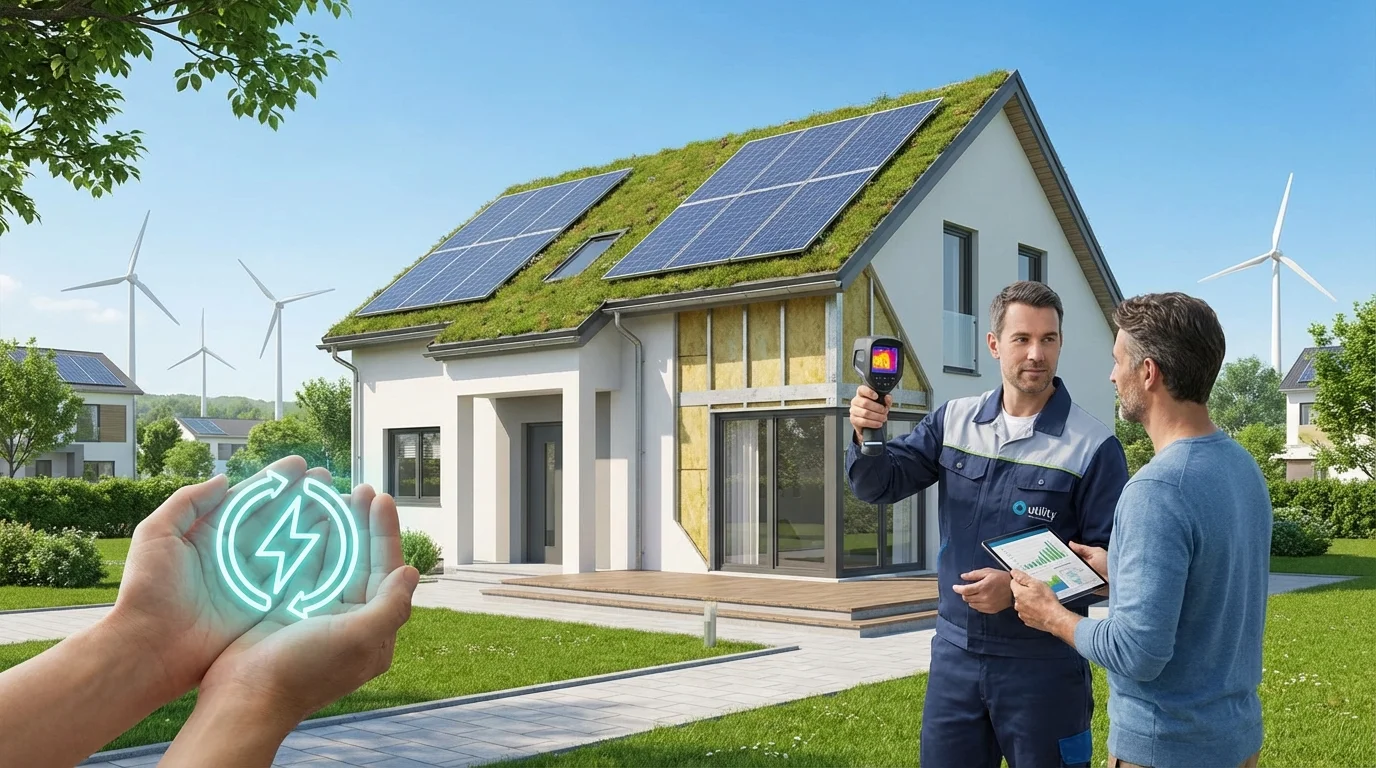
A free utility energy audit is a no-cost home assessment service offered by electric and gas companies to help residential customers identify energy waste. Auditors use tools like blower doors and infrared cameras to pinpoint air leaks and insulation gaps. And the resulting report in 2026 provides a customized plan to reduce energy consumption by up to 30%, directly lowering monthly utility bills. This audit unlocks access to exclusive utility rebates for making recommended upgrades.
So why does this matter? The core tension is the gap between what you pay for energy and what you actually use. The U.S. Department of Energy states that homeowners can trim their annual energy bills by 5% to 30% by making efficiency upgrades identified during an audit. For a household spending $2,200 annually, that’s a direct saving of $110 to $660 every single year. But without a professional home energy audit, you're just guessing where the problems are. An audit replaces guesswork with a data-driven plan, ensuring your investment in upgrades delivers the maximum return. And it’s the first step to accessing thousands in utility rebates.
Who Qualifies for a Free Energy Audit and Related Rebates from My Utility Company?
Utility program eligibility in 2026 depends on location, income, and home type. Most programs require you to be a residential customer of the sponsoring utility. And some offer enhanced, no-cost services for income-qualified households, often defined as being at or below 80% of the area median income.
Utility energy audit eligibility for 2026 programs is primarily determined by your service address and customer status with the specific utility. Homeowners and sometimes renters qualify. And many utilities offer enhanced, no-cost audits and higher rebate amounts for households meeting income-qualified guidelines, typically below 80% of the Area Median Income (AMI).
Qualification criteria are specific to each utility provider. For example, PG&E's 2026 program requires customers to live in a single-family home or a building with 2-4 units. So homeowners must be the primary account holder. Income-qualified programs often have higher incentives; Con Edison's program offers free weatherization services for customers with a household income under 60% of the state median. But even if you don't meet income requirements, most utilities offer a standard audit for free or at a reduced cost of $50-$100. And verifying your status on the utility's website is the necessary first step before scheduling an assessment. It's a simple check that confirms your access to these valuable programs.
How Much Can I Save? Exploring Rebate Amounts and Eligible Energy-Efficient Equipment.
Post-audit upgrades unlock rebates ranging from $100 for a smart thermostat to over $4,000 for a high-efficiency heat pump installation. These 2026 utility incentives are designed to offset the initial cost of energy-saving equipment. So the total savings potential is a combination of upfront rebates and long-term bill reduction.
Utility rebates for 2026 offer direct cash back for energy-efficient equipment, with amounts from $50 for smart thermostats to $4,000 for heat pump systems. Eligible equipment includes ENERGY STAR certified appliances, insulation, air sealing, and high-efficiency HVAC systems. And these incentives reduce the upfront project cost by 20-50%.
The exact rebate amounts vary by utility and equipment. For instance, Duke Energy's 2026 program offers a $750 rebate for attic insulation projects, while Xcel Energy provides up to $1,600 for installing a cold-climate heat pump. Eligible equipment typically includes heat pump water heaters (rebates of $500-$1,000), air sealing ($0.50 per square foot sealed), and ENERGY STAR certified windows (up to $50 per window). And these rebates make substantial home improvements more affordable. Use our free rebate calculator to see the specific incentives available in your zip code. So this tool aggregates local, state, and federal offers to provide a complete picture of your potential savings.
| Program / Utility | Heat Pump Rebate (2026) | Insulation Rebate (2026) | Income-Qualified Eligibility |
|---|---|---|---|
| Con Edison (NY) | Up to $4,000 | $1.00 per sq. ft. | <60% State Median Income |
| PG&E (CA) | Up to $3,100 | $800 | <80% Area Median Income |
| Duke Energy (FL) | Up to $1,200 | $750 | Program Varies |
What is the Step-by-Step Application Process, Including Contractor Requirements, for Utility Energy Audit Programs?
The application process typically involves four steps: scheduling the audit, completing the assessment, receiving the report, and applying for rebates post-upgrade. Most utilities require that any incentivized work be performed by a contractor from their pre-approved network. And this ensures the installations meet specific quality and efficiency standards.
The utility audit application process for 2026 programs begins with an online or phone request to your utility provider. After the audit, homeowners receive a report and must use a program-approved contractor for any upgrades. So the final step is submitting an application with contractor invoices to claim the rebates.
First, you schedule the audit directly through your utility's website or customer service line, a process that takes about 15 minutes. An auditor then visits your home for 1-3 hours. So after the assessment, you receive a detailed report within 7-10 business days outlining recommended upgrades and potential savings. To qualify for rebates, you must hire a contractor from the utility's certified list. This is a critical step; work done by non-approved contractors is ineligible for incentives. Once the work is complete, you or your contractor submits the final invoice and rebate application form online. And reimbursement is typically issued as a check or bill credit within 6-8 weeks.
"A home energy assessment, also known as a home energy audit, is the first step to assess how much energy your home consumes and to evaluate what measures you can take to make your home more energy efficient." — U.S. Department of Energy
Are There Deadlines or Funding Limitations for Utility Energy Audit Programs and Rebates?
Yes, utility energy programs operate on annual budgets and have firm deadlines. Most 2026 programs run from January 1 to December 31, but funding is allocated on a first-come, first-served basis. So popular rebates, like those for heat pump rebates, often run out of funds by the third quarter.
Utility energy rebate programs for 2026 operate with fixed annual budgets and strict deadlines, typically ending on December 31. Funding is limited and distributed on a first-come, first-served basis. So homeowners must apply early in the year, as popular incentive pools are often depleted by Q3 or Q4.
These programs are not open-ended. They are funded by a small surcharge on customer bills, and once the allocated millions are disbursed for the year, the program closes to new applicants until the next funding cycle. For example, a program with a $10 million budget for 2026 will close once that amount is claimed, regardless of the date. And this makes timing crucial. Waiting until fall to start a project is a risk, as the funds for your desired upgrade may already be exhausted. The best practice is to schedule an audit early in the year and complete any upgrade work before summer to ensure you secure your portion of the available rebate funding.
Can I Combine My Utility Rebates with Other State or Federal Energy Incentives?
Homeowners can stack multiple incentives to reduce project costs. Utility rebates are designed to be combined with state-level grants and federal energy tax credits available through the Inflation Reduction Act (IRA). But rules vary, so verifying stacking eligibility is essential for maximizing savings.
Stacking incentives allows homeowners in 2026 to combine utility rebates with state and federal programs, including the IRA tax credits which cover 30% of project costs up to $3,200 annually. So this multi-layered approach significantly reduces the net cost of upgrades like insulation, heat pumps, and solar installations.
For example, a Massachusetts resident installing a $10,000 cold-climate heat pump in 2026 can receive a $2,500 rebate from their utility, a state rebate from the Mass Save program, and a federal tax credit of up to $2,000 under the IRA. So this combination reduces the out-of-pocket cost by more than 50%. The key is to understand the rules. Some programs require the utility rebate to be applied first, reducing the cost basis for the federal tax credit.
"DSIRE is the most comprehensive source of information on incentives and policies that support renewables and energy efficiency in the United States." — DSIRE
Always consult the program guidelines for each incentive to ensure compliance and maximize your total financial benefit.
Official Sources
- U.S. Department of Energy (DOE) Energy Saver — Federal guidance on home energy assessments, efficiency upgrades, and available tax credits. (note: the federal 25C and 25D credits ended for projects completed after December 31, 2025)
- DSIRE - Database of State Incentives for Renewables & Efficiency — A comprehensive database of state, local, utility, and federal incentives for energy efficiency.
Frequently Asked Questions
Who is eligible for a free energy audit from their utility company?
Eligibility for a free 2026 energy audit primarily depends on being a residential customer of the sponsoring utility company. Some programs are restricted to homeowners of single-family properties or small multi-family buildings (2-4 units). And many utilities offer expanded, no-cost audits and direct-install measures for income-qualified households, typically those earning at or below 80% of the Area Median Income. Renters may need landlord permission to participate.
What happens during a utility company's free energy audit?
During a 1- to 3-hour audit, a certified technician inspects your home's energy systems. This includes checking insulation levels in attics and walls, testing for air leaks with a blower door test, and examining HVAC systems, water heaters, and lighting. They often use an infrared camera to visualize heat loss. The auditor provides a detailed report within 10 business days summarizing findings and recommending cost-effective energy-saving upgrades.
Are there any hidden costs associated with a "free" utility energy audit?
Updated on April 14, 2026. Fact-checked by DuloCore Editors. About our research team.