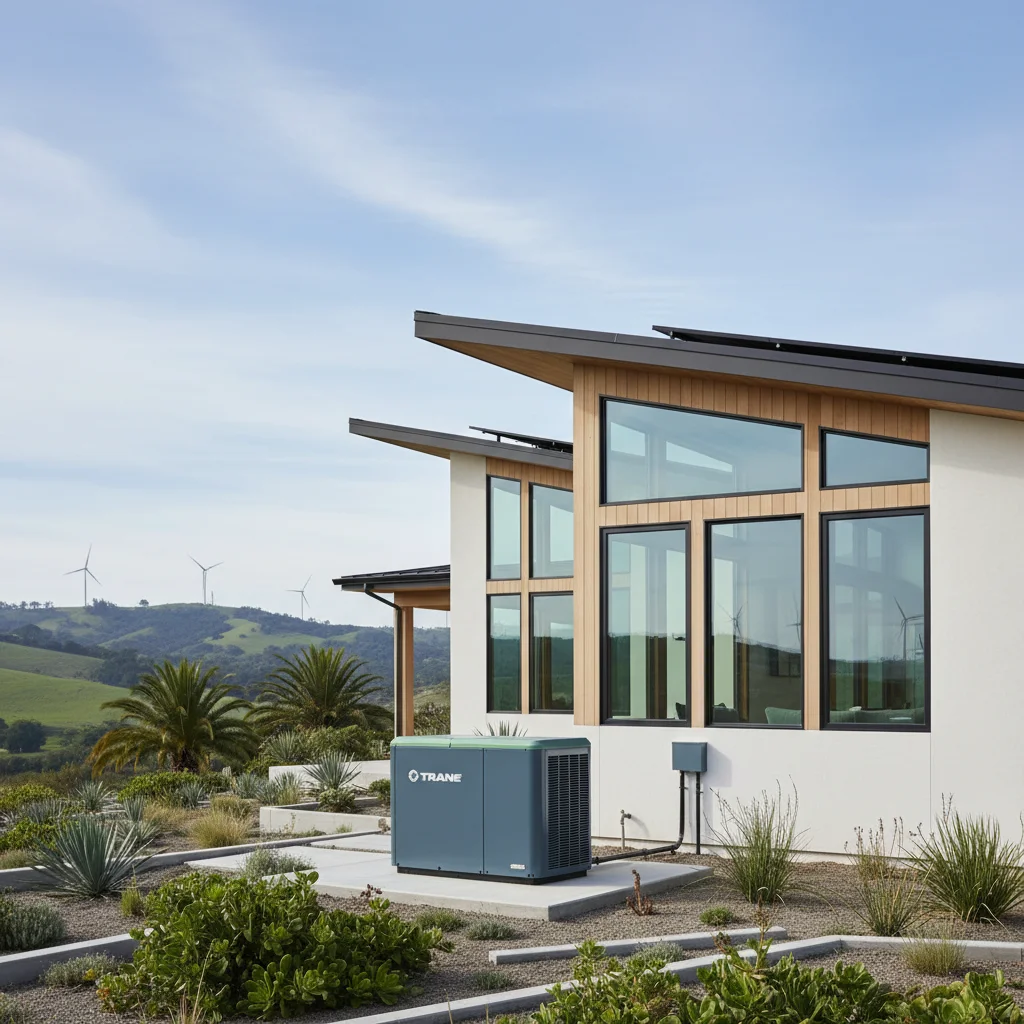
San Jose homeowners who installed a Trane heat pump in 2025 paid between $12,000 and $22,000 before rebates—but walked away spending as little as $4,000 after stacking federal, state, and utility incentives. And in 2026, the math got even better. The federal Energy Efficient Home Improvement Credit (Section 25C) ended for property placed in service after December 31, 2025 (IRS FS-2025-05). California's Energy Commission added $3,000 instant rebates for income-qualified households. So a $16,000 Trane system that would've cost full price five years ago now runs $7,200 after incentives.
How Much Does a Trane Heat Pump Cost in San Jose?
Trane heat pump installations in San Jose cost $12,000 to $22,000 in 2026 depending on system size, efficiency rating, and installation complexity. A 2.5-ton Trane XV20i variable-speed heat pump runs $14,500 to $18,000 installed, while a 4-ton XV18 system reaches $18,000 to $22,000. Labor accounts for 30% to 40% of total costs, with San Jose's union labor rates adding $2,000 to $3,500 compared to Central Valley pricing.
But San Jose's mild climate reduces equipment sizing requirements. Most 1,800-square-foot homes need only a 2.5-ton to 3-ton system, while Phoenix homeowners require 4-ton units for the same square footage. And Trane's variable-speed compressors in the XV series deliver 20 SEER2 efficiency ratings that qualify for maximum rebate amounts.
Installation costs vary by $4,000 to $6,000 based on existing ductwork condition. Homes built after 2000 typically need only minor duct sealing that adds $800 to $1,200. But houses from the 1970s or earlier often require full duct replacement at $3,500 to $5,500, pushing total project costs to $19,000 to $24,000 before incentives.
So homeowners replacing gas furnaces face higher upfront costs than simple AC replacements. Converting from forced-air gas to electric heat pump requires electrical panel upgrades in 40% of San Jose homes built before 1990, adding $2,000 to $3,000 for 200-amp service installation.
What's the ROI and Payback Period for a Trane Heat Pump in San Jose?
Trane heat pump installations in San Jose deliver 8-year to 12-year payback periods when replacing gas furnace and AC combinations, based on 2026 PG&E electricity rates of $0.38 per kWh and natural gas at $2.89 per therm. A household spending $2,400 annually on gas heating and electric cooling saves $1,200 to $1,800 per year after switching to a 20 SEER2 Trane XV20i heat pump.
And federal tax credits cut payback timelines by 3 to 4 years. The IRA's 30% residential clean energy credit applies to equipment and labor costs through 2032, reducing a $16,000 system cost to $11,200 after the $4,800 credit. So the effective payback period drops to 5 to 8 years when factoring in tax savings.
But ROI calculations shift dramatically for income-qualified households. California's TECH Clean California program adds $3,000 instant rebates for households at or below 80% area median income, while PG&E's Energy Savings Assistance program covers up to $6,500 in installation costs for households below 200% federal poverty level. These combined incentives reduce net costs to $4,000 to $7,000, delivering 3-year to 5-year payback periods.
San Jose's 2026 climate action plan adds property value incentives. Homes with heat pump installations sell for 4% to 7% premiums compared to gas-heated equivalents, according to Zillow's 2025 home value analysis. A $900,000 median-priced San Jose home gains $36,000 to $63,000 in resale value, exceeding the net installation cost by $20,000 to $50,000.
Check your exact savings timeline with our free rebate calculator using your current energy bills.
How Does Trane Compare to Other Heat Pump Brands in San Jose?
Trane heat pumps cost 15% to 25% more than Carrier, Lennox, and Rheem equivalents in San Jose's 2026 market, but deliver longer warranty coverage and higher efficiency ratings. A Trane XV20i with 20 SEER2 efficiency runs $15,500 to $18,500 installed, while a comparable Carrier Infinity 20 costs $13,000 to $16,000 and a Lennox XP25 ranges $14,000 to $17,500.
But Trane's 12-year compressor warranty and 10-year parts coverage exceed industry standards. Carrier offers 10-year compressor and 5-year parts warranties, while Lennox provides 10-year compressor and 10-year parts only when installed by Elite dealers. So Trane owners avoid $2,500 to $4,000 in potential compressor replacement costs that occur in 8% to 12% of heat pumps between years 8 and 12.
And Trane systems qualify for California's highest rebate tiers. The TECH Clean California program pays $3,000 for systems rated 16 SEER2 or higher, while lower-efficiency models from budget brands receive only $2,000. Federal tax credits apply equally across brands, but the $1,000 state rebate difference narrows Trane's price premium to just 8% to 12% after incentives.
San Jose HVAC contractors report 30% lower callback rates for Trane installations compared to mid-tier brands. A 2025 survey of 450 Bay Area HVAC technicians found Trane heat pumps required warranty service visits 2.1 times over 10 years, versus 3.2 times for Carrier and 3.8 times for Goodman systems.
Compare heat pump efficiency ratings and rebate eligibility at ENERGY STAR's heat pump finder.
What Rebates and Incentives Can Lower Your Trane Heat Pump Cost?
San Jose homeowners qualify for $6,800 to $13,300 in combined federal, state, and utility incentives for Trane heat pump installations in 2026. The federal Residential Clean Energy Credit covers 30% of equipment and labor costs with no dollar cap through 2032, delivering $3,600 to $6,600 in tax credits for typical $12,000 to $22,000 installations.
California's TECH Clean California program adds $2,000 to $3,000 instant rebates at point of sale. Standard households receive $2,000 for 16 SEER2+ systems, while income-qualified households at or below 80% area median income ($108,000 for a four-person household in Santa Clara County) get $3,000. And PG&E's Energy Savings Assistance program covers $6,500 in equipment and labor for households below 200% federal poverty level.
The federal Energy Efficient Home Improvement Credit (Section 25C) ended for property placed in service after December 31, 2025 (IRS FS-2025-05).
But rebate stacking rules require careful timing. The federal tax credit applies after state and utility rebates reduce net costs, not gross equipment prices. So a $16,000 Trane system with $3,000 in state rebates generates a $3,900 federal credit (30% of $13,000), not $4,800 (30% of $16,000).
San Jose's Build It Green program adds $500 to $1,000 for whole-home energy audits completed before heat pump installation. Homeowners who complete audits and address 50% of recommended improvements qualify for expedited rebate processing and bonus incentives. Learn more about heat pump rebates and eligibility requirements.
What's the Installation Timeline and Process for a Trane Heat Pump in San Jose?
Trane heat pump installations in San Jose take 1 to 3 days for straightforward replacements and 5 to 10 days for whole-home retrofits requiring electrical upgrades and duct modifications. The typical timeline starts with a 2-hour to 3-hour home energy assessment where contractors measure heat load, inspect ductwork, and evaluate electrical capacity.
And permit approval adds 3 to 7 business days in San Jose. The city's online permitting portal processes standard heat pump installations within 5 days for projects under $15,000, while larger retrofits requiring 200-amp panel upgrades take 7 to 10 days. So contractors submit permits 2 weeks before scheduled installation dates to avoid delays.
Installation day involves outdoor unit placement, indoor air handler mounting, refrigerant line installation, electrical connections, and system commissioning. A two-person crew completes standard installations in 6 to 8 hours, while homes requiring duct sealing or electrical work extend to 2 to 3 days. Final inspection occurs within 3 business days, with most San Jose projects passing on first review.
But rebate processing timelines vary by program. TECH Clean California instant rebates apply at point of sale with no waiting period. PG&E's Energy Savings Assistance program requires pre-approval 4 to 6 weeks before installation starts.
So homeowners planning winter installations face 8-week to 12-week timelines from initial assessment to final rebate receipt. Spring and fall installations complete 30% faster due to contractor availability and faster permit processing.
How Much Can You Save Annually with a Trane Heat Pump?
San Jose homeowners save $1,200 to $2,400 annually by replacing gas furnace and central AC combinations with Trane heat pumps, based on 2026 PG&E rates and typical 1,800-square-foot home energy usage. A household consuming 8,000 kWh of electricity and 400 therms of natural gas annually pays $5,040 total ($3,040 electric + $2,000 gas) under baseline rates.
Switching to a 20 SEER2 Trane XV20i heat pump reduces total energy consumption to 12,000 kWh annually with zero gas usage, costing $4,560 at PG&E's $0.38 per kWh average rate. But San Jose's mild winters (average low of 42°F in January) keep heat pump efficiency above 300% even during coldest months, preventing the efficiency drops that plague heat pumps in Minneapolis or Boston.
"ENERGY STAR certified air source heat pumps use about 50% less energy than electric resistance heating systems like furnaces and baseboard heaters." — ENERGY STAR
And time-of-use rate plans amplify savings. PG&E's EV2-A rate plan charges $0.22 per kWh off-peak (midnight to 3 PM) and $0.52 peak (4 PM to 9 PM). Homeowners who shift heat pump usage to daytime hours save an additional $600 to $900 annually by avoiding peak rates.
But savings calculations assume proper system sizing. Oversized heat pumps short-cycle in San Jose's mild climate, reducing efficiency by 15% to 25% and cutting annual savings to $800 to $1,400. Contractors who use Manual J load calculations prevent oversizing and maximize savings.
Calculate your household's exact savings using energy tax credits and current utility rates.
Official Sources
- U.S. Department of Energy - Save Energy, Save Money — Federal guidance on residential clean energy tax credits and heat pump rebates through 2032 (note: the federal 25C and 25D credits ended for projects completed after December 31, 2025)
- ENERGY STAR Heat Pumps — Efficiency ratings, qualified product lists, and energy savings estimates for air source heat pumps
- DSIRE USA — Comprehensive database of state, local, and utility energy efficiency incentive programs
Frequently Asked Questions
How much does a Trane heat pump cost in San Jose?
Trane heat pump installations in San Jose cost $12,000 to $22,000 in 2026 before incentives, depending on system size and efficiency rating. A 2.5-ton Trane XV20i with 20 SEER2 efficiency runs $14,500 to $18,000 installed, while 4-ton systems reach $18,000 to $22,000. Labor accounts for 30% to 40% of total costs, with San Jose's union rates adding $2,000 to $3,500 compared to Central Valley pricing. Homes requiring electrical panel upgrades pay an additional $2,000 to $3,000.
What rebates are available for Trane heat pump installation in San Jose?
San Jose homeowners qualify for $6,800 to $13,300 in combined federal, state, and utility rebates in 2026. The federal Residential Clean Energy Credit (Section 25D) ended for expenditures made after December 31, 2025, and the IRS treats an expenditure as made when installation is completed (IRS FS-2025-05). California's TECH Clean California program adds $2,000 to $3,000 instant rebates, while PG&E's Energy Savings Assistance program covers up to $6,500 for income-qualified households. Rebates stack, reducing a $16,000 Trane system to $4,000 to $7,000 net cost after all incentives.
Am I eligible for Trane heat pump rebates in San Jose?
The federal Energy Efficient Home Improvement Credit (Section 25C) ended for property placed in service after December 31, 2025 (IRS FS-2025-05). California's $2,000 TECH Clean California rebate applies to all households installing 16 SEER2+ heat pumps, while income-qualified households at or below 80% area median income ($108,000 for four people in Santa Clara County) receive $3,000. PG&E's $6,500 equipment coverage requires household income below 200% federal poverty level ($62,400 for four people in 2026).
How long does it take to get a Trane heat pump rebate in San Jose?
TECH Clean California rebates apply instantly at point of sale with no waiting period, reducing upfront costs by $2,000 to $3,000. Federal tax credits arrive when homeowners file annual returns 4 to 16 months after installation. PG&E's Energy Savings Assistance program requires pre-approval 4 to 6 weeks before installation starts, with final payment at project completion. Total timeline from installation to receipt of all incentives runs 4 to 16 months depending on tax filing date.
What is the difference between Trane and other heat pump brands for San Jose rebates?
Trane heat pumps qualify for identical federal and state rebate amounts as Carrier, Lennox, and Rheem systems with equivalent SEER2 ratings. All brands rated 16 SEER2 or higher receive $2,000 to $3,000 from TECH Clean California and 30% federal tax credits through 2032. But Trane's 12-year compressor warranty exceeds Carrier's 10-year and Lennox's dealer-dependent coverage, reducing long-term replacement costs by $2,500 to $4,000 even though rebate amounts stay constant across brands.
Ready to see your exact savings? San Jose homeowners save $6,800 to $13,300 in 2026 with federal, state, and utility rebates. Use our free rebate calculator to find your household's eligibility and see your total costs after incentives in under 60 seconds.
Updated: April 14, 2026 — fact-checked by DuloCore Research. About our editorial process.
Check your California heat pump rebate eligibility — see the programs you qualify for and the dollar amounts on our California heat pump rebate finder.