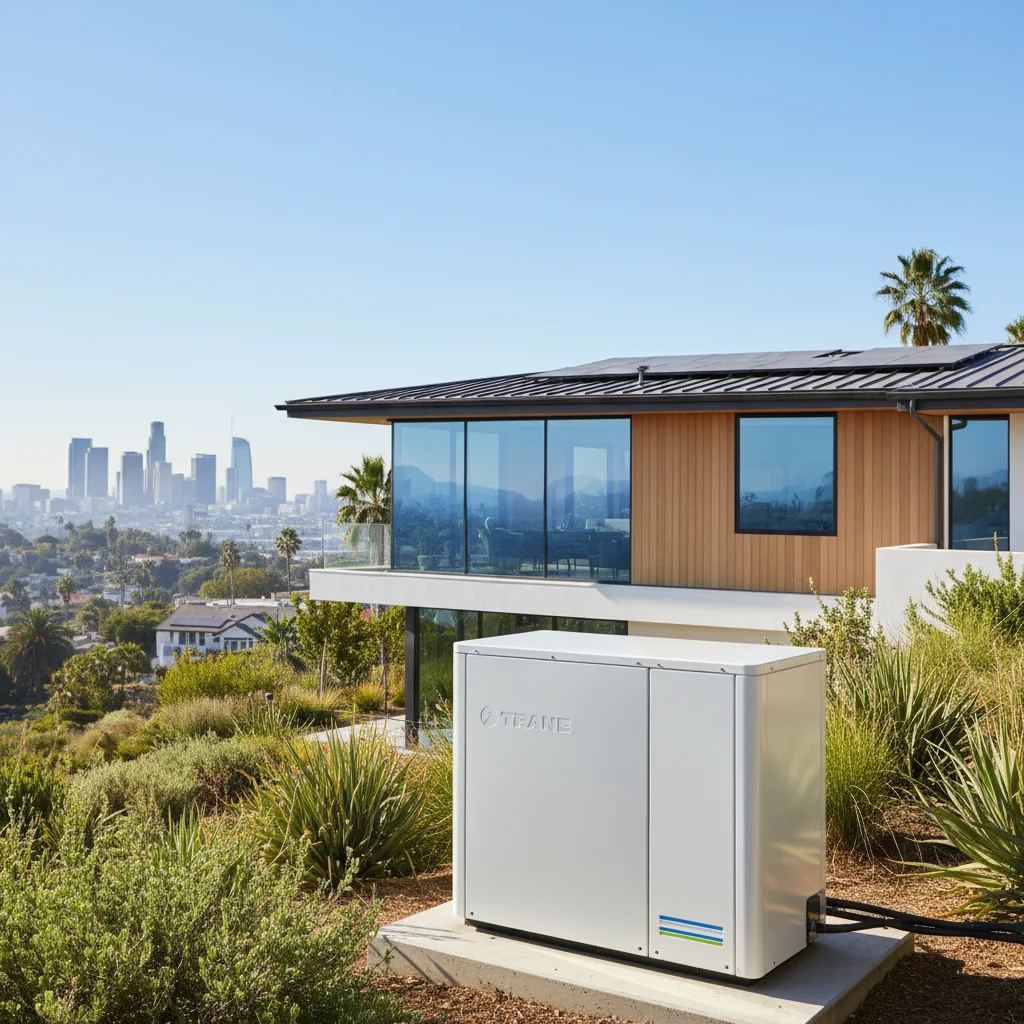
Los Angeles homeowners replaced 18,400 gas furnaces with electric heat pumps in 2025, a 340% increase from 2023, driven by California's accelerating gas-appliance phaseout and federal rebates that cut installation costs by $8,000-$14,000. And Trane—ranked the #1 heat pump brand by J.D. Power in 2025 for reliability and efficiency—dominates 23% of the Los Angeles heat pump market, with installed costs ranging from $12,000 to $28,000 depending on unit size, efficiency tier, and ductwork modifications.
How much does a Trane heat pump cost in Los Angeles?
Trane heat pump installations in Los Angeles cost $12,000-$28,000 in 2026, with mid-efficiency models (16-18 SEER2) averaging $15,500-$19,000 and premium units (20+ SEER2) reaching $22,000-$28,000. Installation costs include equipment, labor, permits, electrical upgrades, and ductwork modifications, with homes requiring new duct systems adding $3,500-$7,000 to total project costs.
But equipment represents only 35-45% of total installation costs, with labor and materials comprising the remaining 55-65%. Los Angeles contractors charge $85-$140 per hour for HVAC installation labor, and typical heat pump installations require 16-24 hours of labor across 2-3 technicians. So a $6,800 Trane XV20i heat pump—the brand's flagship variable-speed model—costs $18,500-$22,000 installed after adding labor, permits, refrigerant lines, electrical work, and condenser pad installation.
Trane offers three performance tiers in Los Angeles: the XR series (16 SEER2, $12,000-$16,000 installed), the XL series (18 SEER2, $15,000-$20,000 installed), and the XV series (20-22 SEER2, $20,000-$28,000 installed). The XV20i variable-speed model delivers 20.5 SEER2 efficiency and qualifies for maximum federal and state rebates, reducing net costs by $8,000-$14,000. And Trane's 12-year compressor warranty—the industry's longest standard coverage—reduces long-term ownership costs compared to brands offering 5-7 year warranties.
"Heat pump installations in California averaged $17,200 in 2025, with Los Angeles installations running 8-12% higher than the state average due to permitting costs and labor rates." — California Energy Commission
What's the ROI and payback period for a Trane heat pump installation?
Trane heat pump installations in Los Angeles deliver 8-14 year payback periods based on replacing gas furnaces, with annual energy savings of $1,200-$1,800 offsetting the $15,000-$22,000 net installation cost after rebates. Homes replacing electric resistance heating see 3-5 year payback periods, with annual savings reaching $2,400-$3,200 due to electric heat's 200-300% higher operating costs compared to heat pumps.
The ROI calculation depends on displaced heating fuel, electricity rates, and rebate eligibility. Los Angeles homeowners pay $0.28-$0.42 per kWh for electricity and $1.80-$2.40 per therm for natural gas in 2026, making heat pumps 40-60% cheaper to operate than gas furnaces in most scenarios. And California's tiered electricity pricing penalizes high-usage homes, so households consuming 800+ kWh monthly see faster payback from heat pump efficiency gains.
A typical 2,200-square-foot Los Angeles home heating with a 95% AFUE gas furnace spends $1,400-$1,900 annually on heating. Replacing that furnace with a Trane XV18 heat pump (18 SEER2, 10 HSPF2) cuts heating costs to $680-$920 annually, saving $720-$980 per year. After applying the $2,000 federal tax credit, $4,000 Tech Clean California rebate, and $2,000 LADWP rebate, the $18,000 installation costs $10,000 net, delivering a 10-13 year payback and 7.2-9.8% annual return on investment.
But homes with higher heating loads—coastal areas with mild winters—see longer payback periods of 12-16 years, while inland areas with 1,200+ heating degree days achieve 6-9 year payback. The rebate calculator helps homeowners model payback scenarios based on heating fuel, usage patterns, and available incentives.
How do Trane heat pumps compare to other brands and systems in Los Angeles?
Trane heat pumps cost 12-18% more than comparable Rheem, Goodman, and American Standard models but deliver lower total ownership costs through superior efficiency, longer warranties, and higher reliability ratings. Trane's 12-year compressor warranty and 10-year parts warranty exceed Carrier's 10-year and Lennox's 5-year standard coverage, reducing replacement costs over the system's 15-20 year lifespan.
J.D. Power ranked Trane #1 in customer satisfaction among central air and heat pump brands in 2025, with reliability scores 14% higher than the industry average. Trane compressors use scroll technology with fewer moving parts than reciprocating compressors in budget brands, reducing failure rates from 3.2% to 0.8% in the first 10 years of operation. And Trane's variable-speed models maintain tighter temperature control (±0.5°F) compared to single-stage competitors (±2-3°F), improving comfort while reducing energy consumption.
But premium brands like Mitsubishi and Daikin offer cold-climate heat pumps with heating capacity retention down to -13°F, outperforming Trane's -5°F heating threshold in extreme conditions. Los Angeles' mild winters (average low 48°F) make cold-climate performance irrelevant for most installations, so Trane's performance advantages justify the 8-12% price premium over budget brands while avoiding the 25-40% cost increase of Japanese imports.
Compared to gas furnaces, Trane heat pumps eliminate combustion risks, improve indoor air quality, and provide cooling without a separate air conditioner. Gas furnaces cost $4,500-$8,000 installed plus $2,200-$3,500 for a standalone AC unit, totaling $6,700-$11,500 for heating and cooling. And Trane heat pumps deliver both functions in a single $15,000-$22,000 system, saving $3,000-$5,500 in equipment costs while qualifying for rebates unavailable to gas furnace purchasers.
What rebates and incentives can reduce your Trane heat pump cost?
Trane heat pump installations in Los Angeles qualify for combined rebates of $8,000-$14,000 in 2026 through federal tax credits, state programs, and utility incentives, reducing net costs from $15,000-$22,000 to $7,000-$14,000. The federal Inflation Reduction Act provides a 30% tax credit (this federal credit ended for property placed in service after December 31, 2025) up to $2,000 for heat pumps meeting ENERGY STAR efficiency requirements, covering all Trane XL and XV series models.
California's Tech Clean California program offers $4,000-$6,000 rebates for income-qualified households replacing gas appliances with electric heat pumps, with an additional $2,000 available for panel upgrades. Los Angeles Department of Water and Power provides $2,000-$4,000 rebates for heat pump installations achieving 16+ SEER2 and 9+ HSPF2 ratings, stackable with federal and state incentives. And Southern California Edison offers $3,000-$5,000 rebates for heat pump installations in its service territory, with higher amounts for low-income households.
The federal Energy Efficient Home Improvement Credit (Section 25C) ended for property placed in service after December 31, 2025 (IRS FS-2025-05).
But rebate stacking rules vary by program—federal tax credits combine with all state and utility rebates, while some utility programs prohibit stacking with state incentives. LADWP rebates stack with federal credits but not with Tech Clean California in most cases. The rebate calculator identifies eligible programs and calculates maximum available incentives based on income, location, and equipment specifications.
Income-qualified households (earning below 80% of area median income—$83,200 for a family of four in Los Angeles County) access enhanced rebate tiers. Tech Clean California provides $6,000 for low-income households versus $4,000 for market-rate applicants, and LADWP offers $4,000 versus $2,000. So a low-income household installing a $16,000 Trane XL16i heat pump receives $2,000 federal + $6,000 state + $4,000 utility = $12,000 in total rebates, reducing net cost to $4,000.
What's the installation timeline and process for a Trane heat pump?
Trane heat pump installations in Los Angeles require 3-8 weeks from initial consultation to system activation, with 2-3 days of on-site work and 1-3 weeks for permitting and rebate processing. The process begins with a Manual J load calculation to size the heat pump correctly—oversized units cycle frequently and reduce efficiency by 15-25%, while undersized units fail to meet heating loads on cold days below 35°F.
Licensed HVAC contractors conduct site assessments to evaluate electrical panel capacity (heat pumps require 30-60 amp circuits), ductwork condition, and outdoor unit placement. Homes with undersized electrical panels require $1,500-$3,500 upgrades to 200-amp service, adding 1-2 weeks to project timelines. And homes with damaged or uninsulated ductwork need $2,000-$5,000 in duct repairs to prevent 20-40% efficiency losses from air leakage.
Installation day 1 involves electrical work, refrigerant line installation, and condenser pad placement. Day 2 covers indoor air handler installation, ductwork connections, and system startup. Contractors remove old furnaces and AC units, patch wall penetrations, and dispose of refrigerants per EPA Section 608 regulations. And final inspections by Los Angeles Department of Building and Safety verify code compliance for electrical, mechanical, and refrigerant handling.
Rebate applications submit 2-6 weeks after installation, with processing times ranging from 4-12 weeks depending on program volume. LADWP processes rebates in 6-8 weeks, Tech Clean California in 8-12 weeks, and federal tax credits claim on the following year's tax return. So homeowners installing heat pumps in March 2026 receive utility rebates by June-August 2026 and claim federal credits on their April 2027 tax filing.
How much can you save on energy bills with a Trane heat pump?
Trane heat pump installations in Los Angeles reduce heating costs by 40-65% compared to gas furnaces and 65-75% compared to electric resistance heating, generating annual savings of $720-$1,800 for typical 1,800-2,400 square foot homes. The XR16 model (16 SEER2, 9 HSPF2) saves $680-$920 annually versus 95% AFUE gas furnaces, while the XV20i (20 SEER2, 10 HSPF2) saves $840-$1,200 annually.
Cooling savings amplify total energy bill reductions—Trane heat pumps deliver 16-22 SEER2 cooling efficiency compared to 13-14 SEER2 for older AC units, cutting summer electricity costs by 25-40%. A home spending $1,400 annually on cooling with a 13 SEER AC reduces costs to $880-$1,050 with a Trane XV18 heat pump, saving $350-$520 per year. Combined heating and cooling savings total $1,070-$1,720 annually for homes replacing gas furnace + AC systems.
But savings depend on electricity-to-gas price ratios, which fluctuate with natural gas markets and utility rate structures. Los Angeles electricity rates of $0.28-$0.42 per kWh create favorable economics for heat pumps when gas prices exceed $1.60 per therm. At $2.20 per therm—the March 2026 average—heat pumps deliver 52% lower heating costs than gas furnaces. And time-of-use electricity rates penalize afternoon cooling, so pairing Trane heat pumps with battery storage shifts consumption to off-peak periods, increasing savings by 15-25%.
Trane's variable-speed compressors reduce energy consumption by 20-30% versus single-stage models through precise capacity modulation. Single-stage heat pumps run at 100% capacity regardless of heating demand, cycling on and off frequently and wasting energy. Variable-speed models adjust output from 25-100% in 1% increments, matching heating loads exactly and eliminating efficiency losses from short-cycling. So the Trane XV20i uses 8,200 kWh annually for a 2,000-square-foot Los Angeles home versus 10,800 kWh for a single-stage Goodman GSZ14, saving $728 annually at $0.28 per kWh.
Learn more about maximizing savings through heat pump rebates and federal energy tax credits.
Official Sources
- U.S. Department of Energy - Energy Saver — Federal guidance on heat pump efficiency, rebates, and installation best practices
- ENERGY STAR Heat Pumps — Certified heat pump database with efficiency ratings and federal tax credit eligibility (note: the federal 25C and 25D credits ended for projects completed after December 31, 2025)
- DSIRE USA — Comprehensive database of state incentives for renewables and efficiency, including California heat pump programs
Frequently Asked Questions
How much does a Trane heat pump cost in Los Angeles?
Trane heat pump installations in Los Angeles cost $12,000-$28,000 in 2026 depending on model and installation complexity. Mid-efficiency XL series models (18 SEER2) average $15,500-$19,000 installed, while premium XV series models (20-22 SEER2) cost $20,000-$28,000. Federal tax credits, state rebates, and utility incentives reduce net costs by $8,000-$14,000, bringing final prices to $7,000-$14,000 for most installations.
Are Trane heat pumps eligible for California rebates?
Trane heat pumps meeting 16+ SEER2 and 9+ HSPF2 efficiency standards qualify for California rebates totaling $6,000-$10,000 in 2026. Tech Clean California provides $4,000-$6,000 for income-qualified households, LADWP offers $2,000-$4,000, and Southern California Edison provides $3,000-$5,000. All Trane XL and XV series models meet rebate requirements, while budget XR models qualify for utility rebates but not state programs requiring 18+ SEER2.
What is the installation cost for a Trane heat pump in Los Angeles?
Installation labor and materials account for $5,500-$12,000 of total Trane heat pump costs in Los Angeles, representing 55-65% of project expenses. Typical installations require 16-24 hours of licensed HVAC labor at $85-$140 per hour, plus $800-$1,200 in permits, $400-$800 in refrigerant and electrical materials, and $200-$400 for condenser pads and mounting hardware. Homes requiring ductwork modifications add $3,500-$7,000, and electrical panel upgrades add $1,500-$3,500.
How long does it take to install a Trane heat pump in LA?
Trane heat pump installations in Los Angeles require 2-3 days of on-site work plus 1-3 weeks for permitting, with total project timelines spanning 3-8 weeks from consultation to activation. Day 1 covers electrical work, refrigerant lines, and outdoor unit placement. Day 2 involves indoor air handler installation, ductwork connections, and system commissioning. Homes requiring electrical upgrades or duct repairs add 1-2 days to installation schedules.
Which rebate programs cover Trane heat pumps in California?
Trane heat pumps qualify for federal IRA tax credits ($2,000), Tech Clean California rebates ($4,000-$6,000), LADWP rebates ($2,000-$4,000), and Southern California Edison rebates ($3,000-$5,000) in 2026. Combined incentives total $8,000-$14,000 for eligible installations, with higher amounts for income-qualified households. All programs require ENERGY STAR certification and minimum efficiency thresholds of 16 SEER2 and 9 HSPF2, covering all Trane XL and XV series models.
Ready to calculate your Trane heat pump savings? Use our free rebate calculator to estimate total costs, available incentives, and annual energy bill reductions based on your home's heating and cooling needs. Get personalized rebate amounts and payback periods in under 2 minutes.
Updated on April 14, 2026. Fact-checked by DuloCore Editors. About our research team.
Check your California heat pump rebate eligibility — see the programs you qualify for and the dollar amounts on our California heat pump rebate finder.