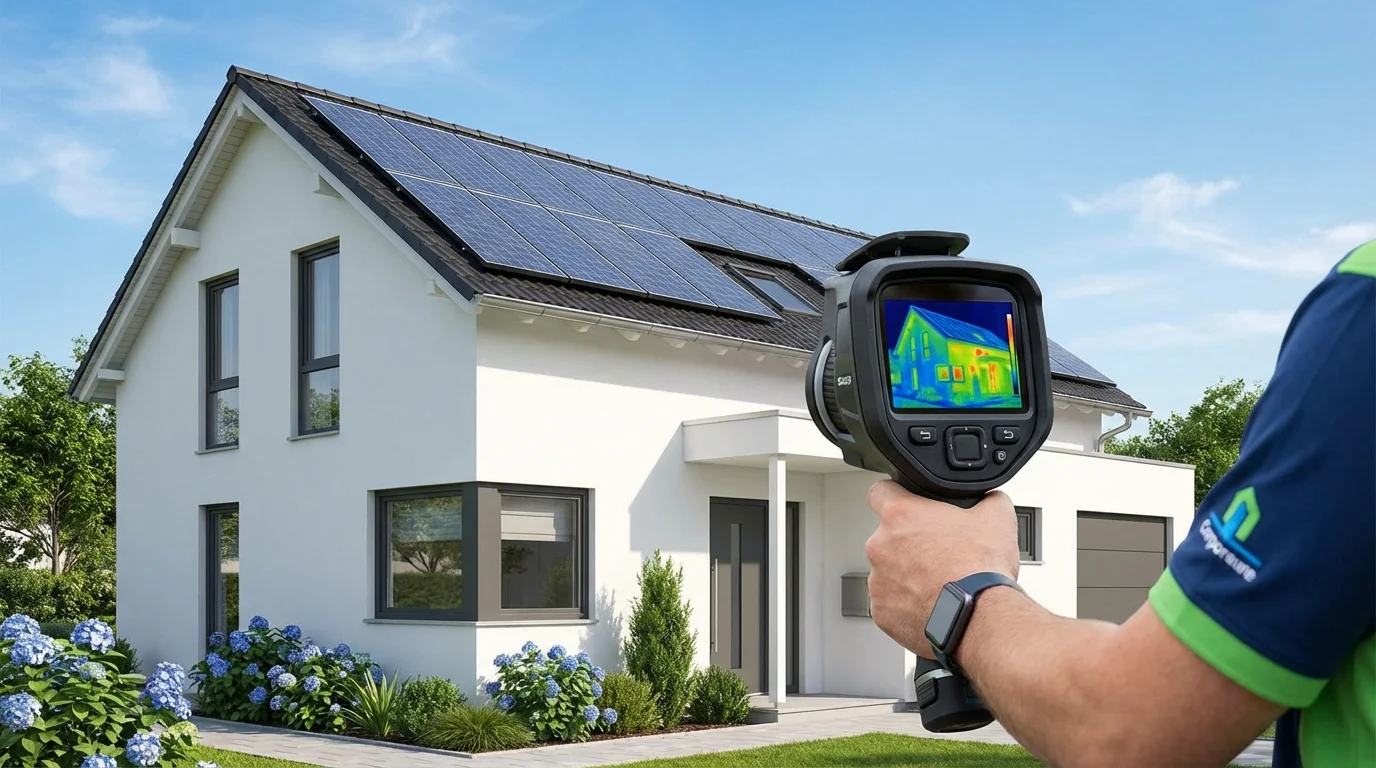
Up to 40% of a home's heating and cooling energy is lost to air leaks through hidden gaps in walls, windows, and ducts. These invisible drafts are a constant drain on your finances, silently driving up utility bills every month. A thermal camera audit makes this invisible energy loss visible, pinpointing the exact locations where conditioned air—and money—is escaping your home.
What Financial Incentives and Rebates Are Available for Thermal Camera Home Energy Audits?
A thermal camera home energy audit is a diagnostic service that often qualifies for local utility rebates up to $150 or state energy program grants covering 50% of the audit cost in 2026. And federal Inflation Reduction Act (IRA) tax credits don't directly cover audits but apply to the high-efficiency upgrades identified by one.
Financial support for the audit itself primarily comes from local and state-level programs. For instance, utilities like Con Edison or PG&E frequently offer rebates between $100 and $150 to incentivize homeowners to identify energy waste. So state agencies such as NYSERDA provide cost-sharing grants that cover up to 50% of the audit's price, capped at around $250. But the real financial benefit comes after the audit. The detailed report serves as a roadmap to qualify for thousands in federal energy tax credits for improvements like new insulation or windows, which can cover 30% of the project cost up to $3,200 annually.
Who Qualifies for Thermal Camera Audit Rebates, and What Equipment is Eligible?
Rebate qualification typically requires the property to be a primary residence within a specific utility service area. And eligible equipment for the audit includes certified infrared cameras meeting RESNET standards. So income is not usually a factor for audit rebates, but it is for subsequent upgrade incentives.
Eligibility for most 2026 utility rebates hinges on being a current customer in good standing and owning a single-family home or a small multi-family building. But renters are generally ineligible. The audit must be performed on the primary residence, not a vacation home. Regarding equipment, the thermal imaging camera used must meet professional standards, typically a resolution of at least 120x120 pixels, to accurately detect temperature differentials. Phone attachments or low-grade cameras don't qualify. So while the audit rebate itself isn't income-restricted, the findings from a comprehensive home energy audit are often a prerequisite for accessing income-based state or federal programs that provide 80-100% of the cost for energy efficiency upgrades.
What's the Application Process and Timeline for Securing Thermal Camera Audit Incentives?
The application process for a thermal audit rebate involves submitting a paid invoice and the audit report to a utility portal within 90 days of completion. But approval and rebate check issuance typically takes 6-8 weeks. So pre-approval is rarely required for audits under $200.
Securing a rebate for a thermal camera audit is a straightforward, post-service process. First, a homeowner hires a certified professional to conduct and pay for the audit, which costs between $300 and $600. After receiving the final report and a paid-in-full invoice, the homeowner submits these documents through their utility's online rebate portal. And most programs, like those managed by Efficiency Vermont, require submission within 60 to 90 days of the service date. The utility then reviews the documentation to ensure the contractor was certified and the report meets standards. So upon approval, a rebate check or bill credit is issued within two months. You can use our free rebate calculator to find savings specific to your location.
"A home energy assessment, also known as a home energy audit, can help you understand the whole picture of your home's energy use, comfort, and safety." — U.S. Department of Energy
What Are the Requirements for Contractors Performing Rebate-Eligible Thermal Audits?
Contractors performing rebate-eligible thermal audits must hold certifications like BPI (Building Performance Institute) or RESNET HERS Rater. And they must use calibrated thermographic equipment with a minimum resolution of 120x120 pixels. So this ensures compliance with utility program standards for 2026.
Utility and state energy programs don't issue rebates for just any thermal scan. They require the audit to be conducted by a credentialed professional to ensure accuracy and standardization. The most common required certifications are the Building Performance Institute (BPI) Building Analyst and the RESNET Home Energy Rater System (HERS) Rater. And these certifications guarantee the auditor is trained to use equipment like a blower door in conjunction with the thermal camera to properly diagnose building envelope issues. So contractors must also carry general liability insurance, often with a minimum coverage of $1 million, to protect the homeowner. These stringent requirements ensure the audit provides actionable, reliable data for pursuing larger heat pump rebates and other incentives.
How Do State and Utility Programs Impact My Thermal Camera Audit Savings?
State and utility programs directly determine thermal audit savings by offering flat rebates, such as $100 from Duke Energy, or percentage-based incentives, like 50% off up to $250 from NYSERDA. So these local programs are the primary source of direct financial aid for the audit itself in 2026.
The value of a thermal camera audit rebate varies dramatically by location. A homeowner in a state with aggressive energy efficiency goals, like Massachusetts or California, will find more generous programs than one in a state with fewer mandates. For example, the Mass Save program often covers up to 75% of the audit cost. But a smaller municipal utility offers a simple $50 bill credit. And some programs bundle the thermal audit into a no-cost energy assessment package. Stacking is also a factor; certain state and utility rebates cannot be combined. A homeowner must check their specific utility's 2026 program rules and the Database of State Incentives for Renewables & Efficiency (DSIRE) for the most accurate local information on potential geothermal tax credit opportunities.
"DSIRE is the most comprehensive source of information on incentives and policies that support renewables and energy efficiency in the United States." — DSIREUSA.org
2026 Thermal Audit Rebate Program Comparison
| Program / Utility | Rebate Amount | Eligibility Requirements | Application Deadline |
|---|---|---|---|
| NYSERDA (NY) | 50% of cost, up to $250 | NY State resident, use BPI-certified auditor | Within 90 days of audit |
| PG&E (CA) | $150 flat rebate | PG&E electric or gas customer, primary residence | Dec. 31, 2026 |
| Mass Save (MA) | 75% of cost, up to $300 | Customer of participating utility | Rolling, funds permitting |
| Duke Energy (NC/SC) | $100 bill credit | Duke Energy customer, single-family home | Within 60 days of audit |
Official Sources
- ENERGY STAR — A U.S. Environmental Protection Agency program providing credible, objective information on energy-efficient products and practices.
- Database of State Incentives for Renewables & Efficiency (DSIRE) — The most comprehensive national database of state and utility incentives for energy efficiency and renewable energy.
- IRS.gov Energy Credits Page — Official guidance from the Internal Revenue Service on federal energy tax credits available under the IRA. (note: the federal 25C and 25D credits ended for projects completed after December 31, 2025)
Related Reading: Learn more about Thermal Bridging Home Audit.
Frequently Asked Questions
What are the steps to get a thermal camera home energy audit?
First, find a BPI or RESNET-certified energy auditor in your area. Second, schedule the audit, which typically requires a blower door test to be run simultaneously for accurate results. Third, the auditor performs the scan and provides a detailed report within 7-10 business days. Finally, use this report to apply for utility rebates and plan for energy efficiency upgrades.
How much does a thermal camera energy audit typically cost?
A professional thermal camera energy audit, often bundled with a blower door test as part of a comprehensive assessment, costs between $300 and $600 in 2026. And the price depends on the home's size and the level of detail in the final report. So many local utility programs offer rebates of $100-$250 that reduce this out-of-pocket expense.
What are the main benefits of a thermal camera energy audit over a standard audit?
A thermal camera audit provides visual, irrefutable evidence of energy loss that a standard visual inspection misses. It can pinpoint missing or settled insulation inside a wall, find small air leaks around fixtures, and detect moisture issues before they cause damage. This precision allows for targeted repairs that deliver a return on investment of 15-30% through energy savings.
Can a thermal camera audit help me qualify for home energy rebates?
Yes, a thermal camera audit is often a required first step to qualify for larger home energy upgrade rebates. Many 2026 state and utility programs, along with federal tax credits under the IRA, require a professional energy assessment to document the home's initial condition before paying for improvements like insulation, air sealing, or new windows. The audit report serves as the necessary proof.
How long does a thermal camera home energy audit take to complete?
A comprehensive thermal camera audit on an average-sized home of 2,000 square feet takes between 2 and 4 hours to complete on-site. This includes setting up the blower door, scanning the entire building envelope from both inside and out, and documenting the findings. The auditor then typically delivers a full written report with images within one to two weeks.
Find and Claim Your Rebates Instantly
Don't leave money on the table.
Last reviewed: April 14, 2026. Reviewed by DuloCore Energy Specialists. About the team.