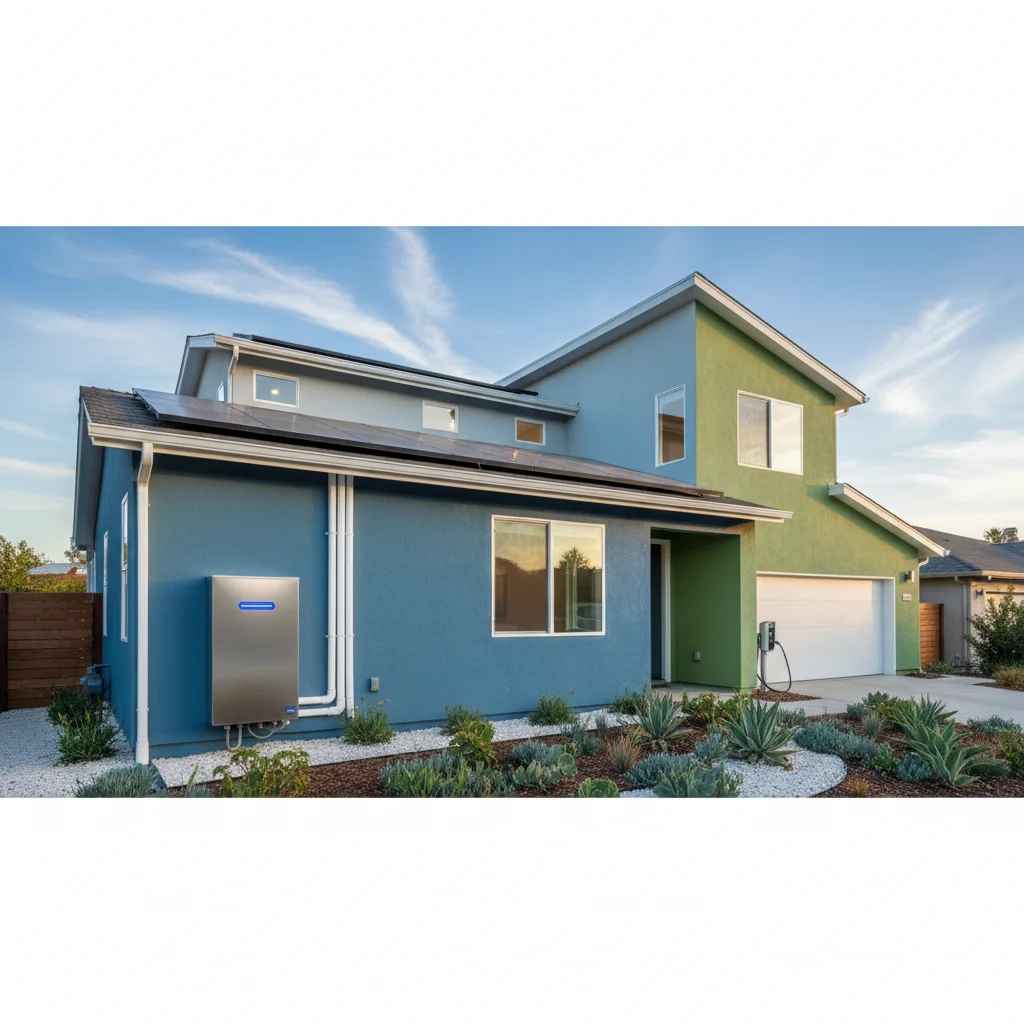
California's grid is buckling under summer AC demand, hitting record peaks of 52,000 megawatts in 2024, and nearly half of that electricity goes to cooling homes with outdated systems. Heat pumps flip that equation, cutting electricity use by 50% or more compared to resistance heating and traditional air conditioning, but the upfront cost of $5,000 to $20,000 keeps most homeowners stuck with inefficient equipment. TECH Clean California changes that math by offering rebates up to $8,000 for income-qualified households, stacking with federal tax credits that cover 30% of project costs through 2032.
How Much Does a TECH Clean California Heat Pump Cost?
TECH Clean California offers heat pump rebates ranging from $3,000 to $8,000 for income-qualified households installing ducted or ductless systems in 2026, with higher amounts for all-electric conversions and moderate-income applicants, stacking with federal IRA tax credits worth 30% of total installation costs.
Total project costs for heat pump installations in California range from $5,000 for basic ductless mini-splits to $20,000 for ducted whole-home systems with upgraded electrical panels. And the TECH Clean California program targets the moderate-income segment, defining eligibility as households earning 80% to 150% of area median income. So a four-person household in Los Angeles County qualifies with income between $76,000 and $142,500 annually.
Equipment costs alone run $3,000 to $10,000 depending on system size, brand, and SEER2/HSPF2 efficiency ratings. Labor adds $2,000 to $6,000 for installation, electrical upgrades, and ductwork modifications. But stacking TECH Clean rebates with the 30% federal IRA tax credit drops net costs to $2,500 to $8,000 for most moderate-income households.
The program prioritizes all-electric conversions, offering the maximum $8,000 rebate when replacing gas furnaces or boilers with heat pumps. Ductless mini-split systems qualify for $3,000 to $5,000 rebates, while ducted heat pumps earn $5,000 to $8,000. Or households can combine TECH Clean with local utility rebates from PG&E, SCE, or SDG&E for an additional $500 to $2,000 in savings.
The federal Energy Efficient Home Improvement Credit (Section 25C) ended for property placed in service after December 31, 2025 (IRS FS-2025-05).
Use our free rebate calculator to stack federal, state, and utility incentives for your specific installation.
What's the ROI and Payback Period for a Heat Pump Installation?
California heat pump installations deliver payback periods of 4 to 8 years for households replacing electric resistance heating or gas furnaces, with annual savings of $800 to $2,200 depending on climate zone, electricity rates, and system efficiency, accelerated by stacked rebates and tax credits.
Households in California's inland valleys and mountain regions see the fastest returns, saving $1,500 to $2,200 annually by replacing propane furnaces or electric baseboards with high-efficiency heat pumps. Coastal areas with milder winters still save $800 to $1,200 per year by eliminating gas heating and reducing AC costs.
Electricity rate tiers matter. And PG&E customers paying $0.35 to $0.50 per kWh in Tier 3 usage cut monthly bills by 40% to 60% when switching from resistance heating to heat pumps with HSPF2 ratings above 10. So a Fresno household spending $280 monthly on winter heating drops to $120 with a ducted heat pump, saving $1,920 annually.
The federal Energy Efficient Home Improvement Credit (Section 25C) ended for property placed in service after December 31, 2025 (IRS FS-2025-05). Federal tax credits for this work have ended, but state, local and utility rebates may still apply; check what is available at your address with the DuloCore rebate calculator. But TECH Clean rebates shorten payback periods by an additional 1 to 2 years for moderate-income households. A $12,000 installation dropping to $4,000 net cost after rebates and credits pays back in 3 to 5 years at California's electricity rates.
System lifespan extends ROI calculations. Heat pumps last 15 to 20 years with proper maintenance, delivering $12,000 to $35,000 in lifetime energy savings compared to gas furnaces or electric resistance systems.
How Does a Heat Pump Compare to Other Heating Alternatives?
Heat pumps deliver 300% to 400% efficiency by moving heat rather than generating it, cutting operating costs 50% to 70% compared to gas furnaces, propane systems, or electric resistance heating, while eliminating combustion risks and indoor air quality impacts from fossil fuel combustion.
Gas furnaces convert 80% to 98% of fuel energy to heat, but natural gas costs $1.80 to $2.40 per therm in California, resulting in monthly heating bills of $150 to $250 for average homes. Or heat pumps extract 3 to 4 units of heat per unit of electricity consumed, cutting costs to $60 to $120 monthly even at California's high electricity rates.
Propane systems cost $3.00 to $4.50 per gallon, pushing winter heating expenses to $300 to $500 monthly in rural areas without natural gas service. So switching to heat pumps saves $2,400 to $4,000 annually in these markets.
Electric resistance heating converts 100% of electricity to heat but consumes 3 to 4 times more kilowatt-hours than heat pumps. And baseboard heaters or furnaces with resistance coils cost $200 to $400 monthly in cold climates, compared to $60 to $100 for heat pumps delivering identical comfort.
| System Type | Efficiency | Monthly Cost (avg) | Annual Savings vs Heat Pump | Combustion Risk |
|---|---|---|---|---|
| Heat Pump | 300%-400% | $60-$120 | Baseline | None |
| Gas Furnace | 80%-98% | $150-$250 | -$1,080 to -$1,560 | CO, NOx |
| Propane | 80%-95% | $300-$500 | -$2,880 to -$4,560 | CO, fire |
| Electric Resistance | 100% | $200-$400 | -$1,680 to -$3,360 | None |
But heat pumps also cool homes, eliminating separate AC systems and cutting summer electricity use by 30% to 50% with inverter-driven compressors. Learn more about energy tax credits available for heat pump (this federal credit ended for property placed in service after December 31, 2025) installations. (Note: Federal tax credit percentages and availability are subject to change; the 30% Residential Clean Energy Credit under Section 25D expired December 31, 2025. Verify current incentives at energy.gov.)
How Long Does a Heat Pump Last and What's the Maintenance?
California heat pumps last 15 to 20 years with annual maintenance costs of $150 to $300 for filter changes, coil cleaning, and refrigerant checks, matching or exceeding gas furnace lifespans while requiring less frequent repairs and no combustion system servicing.
Inverter-driven heat pumps from manufacturers like Mitsubishi, Daikin, and Carrier achieve 18 to 22 years of service life in mild California climates, compared to 12 to 18 years for traditional single-speed systems cycling on and off under heavy loads.
Annual maintenance includes replacing air filters every 3 months ($20 to $60 for MERV 11-13 filters), cleaning outdoor coils ($80 to $150 professionally), and checking refrigerant levels ($100 to $200 if recharge needed). And these costs total $150 to $300 annually, less than gas furnace servicing requiring combustion analysis, heat exchanger inspection, and flue checks.
Major repairs occur every 8 to 12 years. So compressor replacement costs $1,500 to $3,000, while fan motors run $400 to $800. But gas furnaces require heat exchanger replacements at $1,200 to $2,500 and igniter replacements every 5 to 7 years at $300 to $600.
Extended warranties from manufacturers add $300 to $800 upfront but cover compressor failures for 10 to 12 years. Or third-party service plans cost $200 to $400 annually and include preventive maintenance plus parts and labor coverage.
Climate impacts lifespan. Coastal systems avoid extreme temperature cycling and last 20+ years, while inland valley installations running year-round for heating and cooling hit 15 to 18 years.
Are You Eligible for TECH Clean California Rebates and Incentives?
TECH Clean California eligibility requires household income between 80% and 150% of area median income, occupancy in single-family or 2-4 unit multifamily properties, and replacement of existing gas heating with qualifying ENERGY STAR certified heat pumps installed by licensed contractors in 2026.
Income thresholds vary by county and household size. And a three-person household in San Francisco County qualifies with income from $86,000 to $161,000, while the same household in Fresno County qualifies from $58,000 to $109,000. So the program targets California's moderate-income segment priced out of market-rate equipment but earning too much for low-income programs.
Property types include owner-occupied single-family homes, duplexes, triplexes, and fourplexes. But condos and townhomes with shared HVAC systems don't qualify, nor do rental properties unless owners meet income limits and commit to occupancy.
Equipment must meet ENERGY STAR Most Efficient criteria with minimum SEER2 16 and HSPF2 9.0 ratings. Or cold-climate heat pumps maintaining full capacity at 5°F outdoor temperatures earn bonus rebates of $500 to $1,000.
Installation requires licensed California contractors with C-20 HVAC or C-46 Solar licenses. And projects need building permits and final inspections, with rebate applications submitted within 180 days of permit closure.
Stacking rules allow combining TECH Clean rebates with federal IRA tax credits, local utility incentives, and municipal programs. But duplicate rebates for the same equipment component aren't permitted. Explore additional heat pump rebates available in California.
"California's TECH Clean program has distributed $75 million in heat pump rebates since 2022, with average awards of $5,400 per household." — California Energy Commission
What's the Installation Process and Timeline?
California heat pump installations take 2 to 8 weeks from contractor selection to final inspection, involving load calculations, equipment sizing, electrical panel upgrades, refrigerant line installation, and commissioning, with TECH Clean rebate processing adding 4 to 12 weeks after project completion.
Initial steps start with Manual J load calculations determining required heating and cooling capacity in BTUs based on home size, insulation, window area, and climate zone. And undersized systems fail to maintain comfort, while oversized units cycle inefficiently and dehumidify poorly.
Electrical service matters. Heat pumps drawing 30 to 60 amps require 240-volt circuits, often needing panel upgrades costing $1,500 to $3,000 for homes with 100-amp service. So permitting electrical work adds 1 to 2 weeks to project timelines.
Physical installation takes 1 to 3 days for ductless mini-splits and 3 to 5 days for ducted systems. But contractors drill exterior penetrations, mount outdoor condensers, run refrigerant lines, install air handlers or ductwork, wire thermostats, pressure-test refrigerant circuits, and commission controls.
Building inspections occur after rough-in and final installation, adding 3 to 10 business days depending on jurisdiction workload. Or contractors can't apply for rebates until receiving signed-off permits.
TECH Clean rebate applications require uploading permits, invoices, equipment spec sheets, and income verification documents through the online portal. And processing takes 6 to 12 weeks, with funds disbursed as checks or direct deposits to homeowners or assigned to contractors as point-of-sale discounts.
Peak season delays stretch timelines. Summer and fall installations face 4 to 8 week contractor backlogs, while winter and spring projects move faster with 1 to 3 week scheduling.
Official Sources
- ENERGY STAR Heat Pumps — Federal efficiency standards and product finder for qualified equipment
- IRS Energy Incentives — Tax credit details for heat pumps and home energy upgrades (note: the federal 25C credit ended for property placed in service after December 31, 2025)
- DOE Energy Saver — Consumer guidance on heat pump technology, installation, and efficiency
Frequently Asked Questions
Can you get a rebate for a heat pump in California?
California offers TECH Clean rebates of $3,000 to $8,000 for moderate-income households installing heat pumps in 2026, plus local utility rebates from PG&E, SCE, and SDG&E ranging from $500 to $2,000. The federal Energy Efficient Home Improvement Credit (Section 25C) ended for property placed in service after December 31, 2025 (IRS FS-2025-05). But income limits apply, requiring households to earn 80% to 150% of area median income.
How much is the TECH Clean California heat pump rebate?
TECH Clean rebates range from $3,000 for ductless mini-splits to $8,000 for ducted whole-home systems replacing gas heating. And all-electric conversions removing gas furnaces or boilers qualify for maximum amounts, while partial conversions retaining gas service earn reduced rebates. So households at 80% to 120% of area median income receive higher amounts than those at 120% to 150%.
Are heat pumps eligible for California tax credits in 2026?
The federal Energy Efficient Home Improvement Credit (Section 25C) ended for property placed in service after December 31, 2025 (IRS FS-2025-05). Or these federal credits run through 2032 with no income limits, stacking with TECH Clean rebates and utility incentives for combined savings of $5,000 to $12,000 on typical installations.
What's the difference between heat pump rebates and tax credits?
Rebates reduce upfront costs through direct payments or point-of-sale discounts after project completion, while tax credits lower federal income tax liability in the year of installation. And TECH Clean rebates arrive 6 to 12 weeks after permit closure. Form 5695 only covers qualifying work completed by December 31, 2025 and claimed on a 2025 return; the federal 25C and 25D credits ended after that date (IRS FS-2025-05). So rebates improve cash flow immediately, while credits deliver savings at tax time.
How do I apply for TECH Clean California heat pump incentives?
Apply through the TECH Clean online portal within 180 days of final building inspection, uploading signed permits, itemized invoices, equipment specification sheets, and household income verification documents like tax returns or pay stubs. And contractors can submit applications on behalf of homeowners with signed assignment forms, receiving rebate payments as point-of-sale discounts. Or processing takes 6 to 12 weeks with funds disbursed by check or direct deposit.
Ready to calculate your heat pump savings? Use our free rebate calculator to stack TECH Clean rebates, federal tax credits, and utility incentives for your specific installation. Get a personalized estimate in 60 seconds, no signup required.
Last updated April 14, 2026 — reviewed by DuloCore Editorial. About our authors.
Check your California heat pump rebate eligibility — see the programs you qualify for and the dollar amounts on our California heat pump rebate finder.