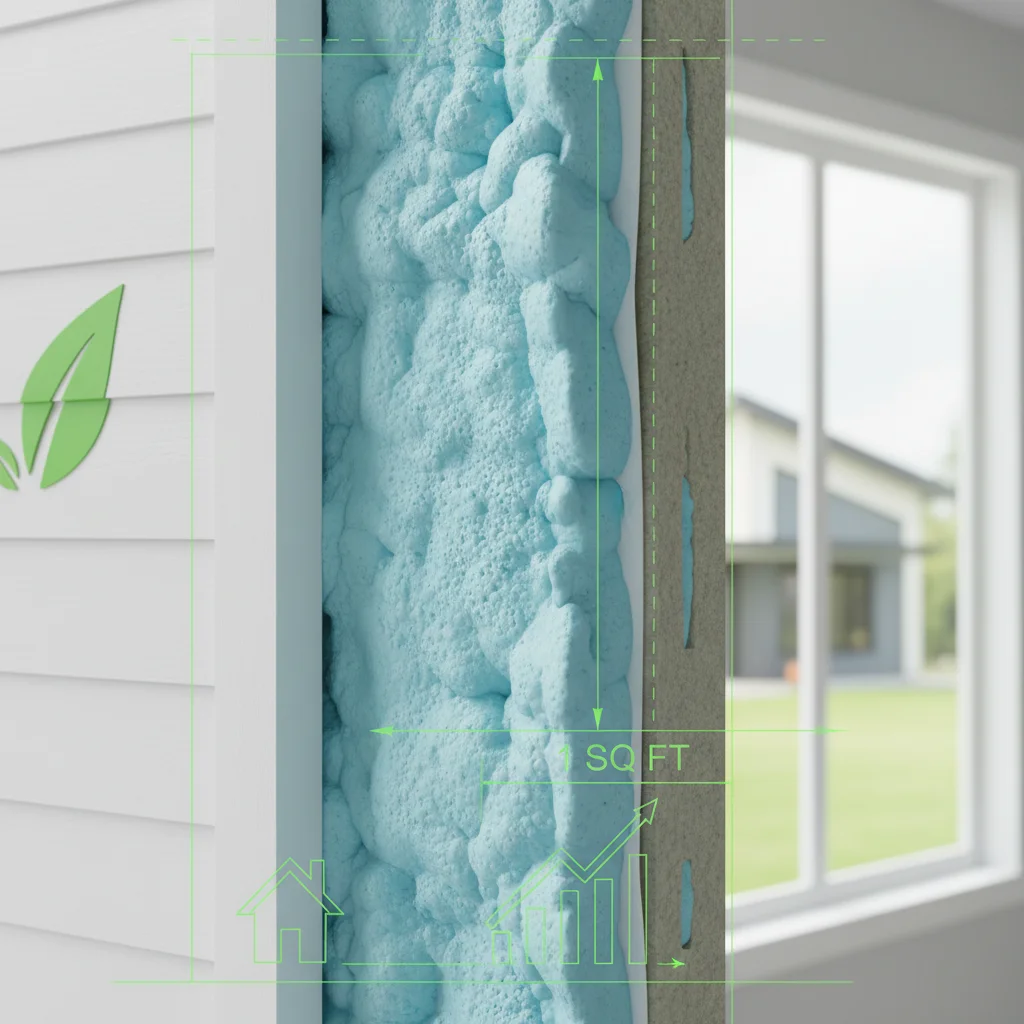
Homeowners who installed spray foam insulation in 2025 paid an average of $1.50 to $3.50 per square foot for open-cell foam and $2.50 to $6.50 per square foot for closed-cell foam, according to energy efficiency contractors across California. And those prices don't include removal of old insulation, air sealing prep work, or vapor barrier installation—costs that routinely add another $0.75 to $2.00 per square foot to the final invoice.
What's the Average Cost of Spray Foam Insulation Per Square Foot?
Spray foam insulation costs $1.50-$3.50 per square foot for open-cell polyurethane foam and $2.50-$6.50 per square foot for closed-cell foam in 2026, depending on project size, foam thickness, and regional labor rates. A typical 1,500-square-foot attic installation runs $2,250-$9,750 including materials and labor.
The price gap between open-cell and closed-cell foam reflects performance differences. Open-cell foam delivers R-3.6 to R-3.9 per inch, while closed-cell foam hits R-6.0 to R-7.0 per inch—nearly double the insulating power in the same thickness. So closed-cell foam costs more upfront but requires less depth to meet building code R-value requirements.
But thickness requirements drive total project costs more than per-foot pricing. California's Title 24 energy code mandates R-38 minimum for attic insulation in most climate zones, meaning open-cell foam needs 10 inches of thickness versus just 6 inches for closed-cell. And thicker applications consume more material and installation time.
Labor accounts for 50-65% of total spray foam costs. Certified installers charge $40-$85 per hour in California, and a typical 1,500-square-foot attic takes 8-12 hours to complete including surface prep, mixing equipment setup, and spray application. Insulation rebates from utilities and state programs offset 15-30% of installation costs for qualifying projects.
How Does Spray Foam Compare to Fiberglass, Cellulose, and Other Insulation Types?
Spray foam costs $1.50-$6.50 per square foot installed versus $0.65-$2.50 for fiberglass batts and $1.25-$3.75 for blown cellulose in 2026. Spray foam delivers superior air sealing with R-values of R-3.6 to R-7.0 per inch, while fiberglass provides R-2.9 to R-3.8 per inch and cellulose offers R-3.2 to R-3.8 per inch.
The cost premium for spray foam buys air infiltration control that fiberglass and cellulose can't match. Spray foam expands on contact to fill gaps, cracks, and irregular cavities, creating an airtight thermal envelope. Fiberglass batts leave air gaps around framing members, and cellulose settles 15-20% over time, creating thermal weak points.
But spray foam's higher upfront cost translates to faster energy savings. Homes insulated with closed-cell spray foam reduce heating and cooling costs by 40-50% compared to 25-35% savings from fiberglass batts, according to Department of Energy testing. And the air sealing eliminates drafts that compromise comfort even when fiberglass meets code R-values.
Mineral wool batts cost $1.85-$4.25 per square foot installed—splitting the difference between fiberglass and spray foam—and deliver R-3.0 to R-3.3 per inch with better fire resistance than organic insulation. Or rigid foam boards run $2.00-$4.50 per square foot and provide continuous insulation without thermal bridging through framing members.
What's the Payback Period and ROI for Spray Foam Insulation?
Spray foam insulation delivers payback periods of 5-9 years and lifetime ROI of 250-400% based on 2026 energy costs and 30-year service life. A $6,000 attic spray foam upgrade saves $850-$1,200 annually on heating and cooling in California's mixed climate zones, recovering installation costs in 5-7 years.
Energy savings compound over spray foam's 30+ year lifespan without performance degradation. A homeowner who spends $6,000 on spray foam installation saves $25,500-$36,000 over 30 years at current California energy rates of $0.28 per kWh for electricity and $2.15 per therm for natural gas. And utility rates historically increase 3-5% annually, accelerating payback periods for insulation installed today.
So closed-cell spray foam delivers faster payback than open-cell despite higher upfront costs. The superior R-value per inch means thinner application depth, lower material volume, and 8-12% greater energy savings. But open-cell foam makes financial sense in moderate climates where code requirements don't exceed R-30.
Home resale value increases $15-$25 for every $1 reduction in annual utility costs according to National Association of Realtors data. A spray foam upgrade that cuts energy bills by $1,000 annually adds $15,000-$25,000 to home value—well above the $5,000-$8,000 typical installation cost for a 1,500-square-foot attic.
Use our free rebate calculator to estimate your spray foam project savings and available incentives.
How Long Does Spray Foam Insulation Last Before Replacement?
Spray foam insulation lasts 80-100 years without performance degradation when properly installed and protected from UV light exposure. Both open-cell and closed-cell polyurethane foam maintain their R-value and structural integrity indefinitely in wall cavities, attics, and crawl spaces, outlasting the building itself in most applications.
Chemical stability makes spray foam the longest-lasting insulation material available. The cured polyurethane polymer resists moisture absorption, doesn't settle or compress over time, and won't support mold growth. And spray foam doesn't degrade from thermal cycling between -40°F and 180°F—the full temperature range for California attics and crawl spaces.
But fiberglass batts settle 2-4% over 20 years and cellulose compresses 15-20% from moisture absorption and gravity, reducing effective R-values by similar percentages. So these materials require replacement or top-up application every 15-25 years to maintain code-required insulation levels.
Closed-cell spray foam adds structural rigidity to wall assemblies, increasing racking strength by 200-300% according to testing by the Spray Polyurethane Foam Alliance. This structural contribution becomes more valuable over decades as building materials age and connections loosen. Or open-cell foam allows vapor transmission while still providing lifetime air sealing.
What Factors Affect the Total Cost of Your Spray Foam Project?
Project size, foam thickness, application location, and surface preparation requirements determine total spray foam costs more than per-square-foot pricing in 2026. Installation in accessible attics costs 35-50% less than crawl space or wall cavity applications requiring confined space equipment and extended labor hours.
Foam thickness compounds material and labor costs faster than linear scaling. A 6-inch closed-cell application uses 80% more material than 4-inch depth but takes 100-120% more installation time due to multiple pass requirements and extended cure intervals between layers. And projects requiring R-49 insulation in California's climate zone 16 need 8 inches of closed-cell foam versus just 5 inches for R-30 requirements.
So existing insulation removal adds $0.50-$1.50 per square foot to project costs. Old fiberglass batts, vermiculite, or cellulose must be cleared before spray foam application, and asbestos testing runs $400-$600 for homes built before 1980. But leaving old insulation in place creates moisture traps and reduces effective R-value.
Surface preparation requirements vary by substrate. New construction with clean lumber accepts spray foam directly, but retrofit applications on dusty attic joists or moisture-damaged crawl space framing need cleaning and sealing before foam application. And electrical junction boxes, recessed lights, and HVAC ducts require protective barriers to prevent foam infiltration, adding 2-4 hours to labor time.
Equipment rental comprises 8-12% of total project costs for DIY installations. Professional spray foam rigs cost $15,000-$45,000, but homeowners rent portable two-component systems for $300-$500 per day. But professional installation includes liability insurance, code compliance verification, and manufacturer warranties that DIY projects lack.
Are There Tax Credits or Rebates Available for Spray Foam Installation?
The federal Energy Efficient Home Improvement Credit (Section 25C) ended for property placed in service after December 31, 2025 (IRS FS-2025-05). Federal tax credits for this work have ended, but state, local and utility rebates may still apply; check what is available at your address with the DuloCore rebate calculator. California's Energy Savings Assistance Program offers free or subsidized insulation upgrades for income-qualified homeowners, and utility companies provide rebates of $0.15-$0.75 per square foot for projects exceeding Title 24 code requirements.
Federal energy tax credits cover spray foam, fiberglass, cellulose, and mineral wool equally when installed in existing homes' attics, walls, or crawl spaces. The $1,200 annual cap applies to combined insulation and air sealing expenses, so a $6,000 spray foam project generates $1,200 in tax credits in year one and carries forward remaining credit to subsequent years.
But the federal credit excludes new construction—only retrofits of existing homes qualify. And rentals don't qualify unless the taxpayer lives in one unit of a multi-family property. So investment properties and vacation homes miss out on federal insulation incentives.
Pacific Gas & Electric pays $0.30-$0.65 per square foot for attic insulation upgrades that increase R-value by at least R-19, while Southern California Edison offers $0.25-$0.55 per square foot. These utility rebates combine with federal tax credits, and income-qualified homeowners access no-cost energy upgrades through the ESA Program covering 100% of installation costs.
Check your eligibility for energy tax credits and utility incentives that reduce spray foam installation costs by 30-50% in 2026.
Official Sources
- U.S. Department of Energy - Save Energy, Save Money — Federal guidance on home energy efficiency improvements, insulation types, and available rebate programs
- DSIRE USA — Comprehensive database of state and utility energy efficiency incentives, rebates, and financing programs
- IRS Energy Incentives — Official tax credit information for residential energy efficiency improvements including insulation (note: the federal 25C and 25D credits ended for projects completed after December 31, 2025)
Related Reading: Learn more about Blown In Insulation Cost Per Square Foot and Cellulose Insulation Cost Per Square Foot.
Frequently Asked Questions
How much does spray foam insulation cost per square foot?
Spray foam insulation costs $1.50-$3.50 per square foot for open-cell foam and $2.50-$6.50 per square foot for closed-cell foam installed in 2026. Total project costs for a 1,500-square-foot attic range from $2,250 to $9,750 including labor, materials, and surface preparation. Closed-cell foam costs more but requires 40% less thickness to achieve the same R-value.
What factors affect the price of spray foam insulation installation?
Project size, foam thickness, application location, and surface preparation drive spray foam costs more than base per-square-foot pricing. Accessible attic installations cost 35-50% less than crawl space applications requiring confined space equipment. And removing old insulation adds $0.50-$1.50 per square foot, while asbestos testing runs $400-$600 for pre-1980 homes.
Is spray foam insulation more expensive than fiberglass or cellulose?
Spray foam costs $1.50-$6.50 per square foot versus $0.65-$2.50 for fiberglass batts and $1.25-$3.75 for blown cellulose. But spray foam reduces energy bills by 40-50% compared to 25-35% savings from fiberglass, delivering payback in 5-9 years. And spray foam lasts 80-100 years without settling while fiberglass and cellulose need replacement every 15-25 years.
Does spray foam insulation qualify for tax credits or rebates?
The federal Energy Efficient Home Improvement Credit (Section 25C) ended for property placed in service after December 31, 2025 (IRS FS-2025-05). California utilities offer $0.15-$0.75 per square foot in rebates for projects exceeding code requirements, and income-qualified homeowners access free installation through the Energy Savings Assistance Program. Combined incentives reduce net costs by 30-50%.
How long does spray foam insulation last compared to its cost?
Spray foam insulation lasts 80-100 years without performance degradation, delivering lifetime ROI of 250-400%. A $6,000 spray foam installation saves $850-$1,200 annually on energy costs, recovering the investment in 5-7 years and generating $25,500-$36,000 in total savings over 30 years at 2026 California energy rates of $0.28 per kWh.
Ready to reduce your energy bills with spray foam insulation? Use our free rebate calculator to find available tax credits, utility rebates, and estimated savings for your home. Get your personalized quote in under 2 minutes.
Updated: April 14, 2026 — fact-checked by DuloCore Research. About our editorial process.
Check your California insulation rebate eligibility — see the programs you qualify for and the dollar amounts on our California insulation rebate finder.