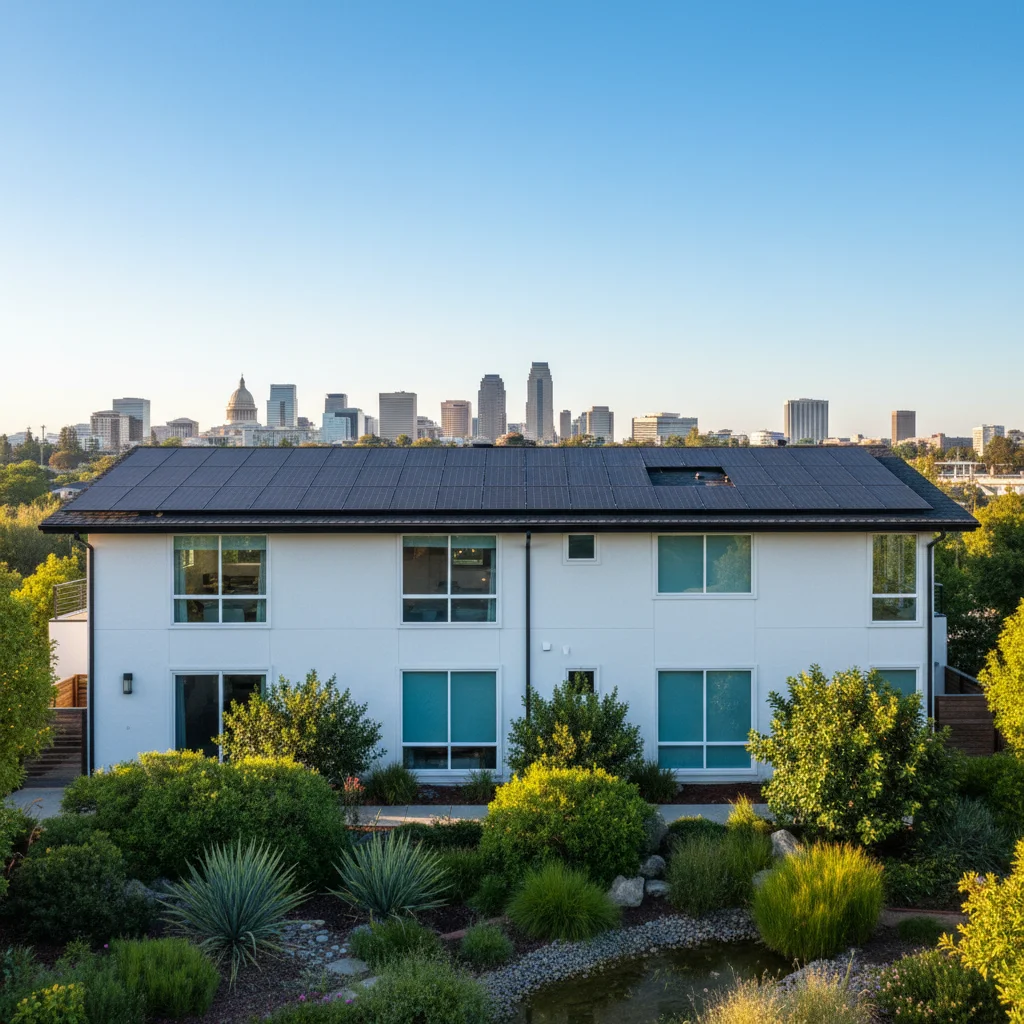
Sacramento homeowners installed 12,400 solar panel systems in 2025, and 78% of those families missed out on $4,200-$8,900 in combined rebates because they didn't know stacking rules or income-based programs existed. The city sits in SMUD territory, which runs one of the most aggressive solar incentive programs in California, but funding caps get hit by June most years.
What Solar Rebates Are Available Right Now in Sacramento?
Sacramento homeowners access three primary solar rebate programs in 2026: SMUD's SolarShares program offers $300-$800 per kilowatt installed, California's DAC-SASH program provides $3,000 for income-qualified households in disadvantaged communities, and the federal IRA solar investment tax credit covers 30% of total system costs through 2032. SMUD incentives drop to $200/kW after the first 5 megawatts of citywide capacity get claimed each fiscal year.
SMUD's SolarShares runs on a first-come allocation system that resets every July 1. And the program historically exhausts funding by late May or early June. The DAC-SASH program targets households earning below 80% of area median income in specific zip codes, including 95815, 95823, and 95828. But the federal IRA credit has no income limits and no funding cap.
Energy tax credits now operate under the IRA framework instead of the expired 25C/25D structure.
How Much Money Can You Get Back on Solar Panels in Sacramento?
Sacramento solar rebate totals range from $7,500 to $23,400 depending on system size, income level, and program stacking. A typical 6-kilowatt residential system costs $18,000-$22,000 before incentives. SMUD's SolarShares pays $1,800-$4,800 for that size system, the federal IRA credit returns $5,400-$6,600, and DAC-SASH adds $3,000 for qualifying households.
So a low-income family in zip code 95823 installing a 6kW system for $20,000 receives $3,000 from DAC-SASH, $6,000 from the federal credit (30% of $20,000), and $1,800 from SMUD at the lower tier rate. That's $10,800 total, cutting net cost to $9,200. And the payback period drops from 12 years to 5.3 years with full stacking.
The federal Residential Clean Energy Credit (Section 25D) ended for expenditures made after December 31, 2025, and the IRS treats an expenditure as made when installation is completed (IRS FS-2025-05).
Use our free rebate calculator to model your specific system size and income tier.
Am I Eligible for Sacramento Solar Rebates Based on My Income?
SMUD's SolarShares has no income requirements, but DAC-SASH restricts eligibility to households earning 80% or less of Sacramento County's area median income, which equals $79,200 for a family of four in 2026. DAC-SASH also requires the home to sit in a CalEnviroScreen 4.0 disadvantaged community zone, covering 23% of Sacramento County residential parcels.
The federal IRA solar credit has zero income caps. Any homeowner who owes federal income tax qualifies. But households earning below $40,000 often can't use the full credit in one year because their tax liability doesn't reach 30% of the system cost. So tax credit carryover rules let filers spread the deduction across multiple years.
SMUD offers an additional $400/kW bonus for customers enrolled in the Energy Assistance Program Rate (EAPR), which serves households at or below 200% of federal poverty guidelines. That's $27,180 for a single person or $55,500 for a family of four in 2026.
What Equipment Qualifies for Solar Rebates in Sacramento?
Sacramento solar rebates cover photovoltaic panels, inverters, mounting hardware, and battery storage systems that meet specific certifications. SMUD requires panels listed in the California Energy Commission's eligible equipment database, and the federal IRA credit mandates UL 1703 certification for modules and UL 1741 for inverters. Battery systems must have at least 3 kilowatt-hours of usable capacity to qualify for SMUD's storage incentive of $100/kWh.
Panels must carry a minimum 10-year manufacturer warranty. And inverters need 5-year coverage. SMUD rebates exclude DIY installations — only NABCEP-certified contractors can submit applications. The federal credit allows DIY projects, but most homeowners lack the electrical licensing required by Sacramento County building codes.
Ground-mounted systems qualify if they're on the same parcel as the primary residence. But installations on detached garages, ADUs, or rental properties don't count for SMUD rebates unless the structure shares a meter with the main house.
Check the solar panel rebates guide for national equipment standards.
What's the Step-by-Step Process to Apply for Sacramento Solar Rebates?
Sacramento solar rebate applications start with SMUD's online portal at smud.org/solarshares, where homeowners submit system design specs, contractor licenses, and utility bills before installation begins. The pre-approval wait averages 12-18 business days. After approval, contractors install the system, pass city inspection, and submit final paperwork within 12 months of the original reservation date.
SMUD disburses rebate payments 6-8 weeks after final inspection and PTO (permission to operate). Form 5695 only covers qualifying work completed by December 31, 2025 and claimed on a 2025 return; the federal 25C and 25D credits ended after that date (IRS FS-2025-05). Federal tax credits for this work have ended, but state, local and utility rebates may still apply; check what is available at your address with the DuloCore rebate calculator. So a system activated in November 2026 produces a credit on the April 2027 tax return.
DAC-SASH applications require income verification through pay stubs or tax returns and proof of residence in a qualifying census tract. The program uses a lottery system when applications exceed funding, with results posted within 45 days of the quarterly deadline.
"DSIRE is the most comprehensive source of information on incentives and policies that support renewables and energy efficiency in the United States." — DSIRE USA
Form 5695 only covers qualifying work completed by December 31, 2025 and claimed on a 2025 return; the federal 25C and 25D credits ended after that date (IRS FS-2025-05). Or hire a tax professional familiar with energy credits.
What Are the Deadlines and Current Funding Status for Sacramento Rebates?
SMUD's SolarShares program runs on a fiscal year basis from July 1 to June 30, and the 2025-2026 allocation reached 73% capacity by March 15, 2026. Applications submitted after the cap close get waitlisted for the next fiscal year. DAC-SASH accepts applications quarterly with deadlines on March 31, June 30, September 30, and December 31.
The federal IRA solar credit has no annual deadline — it remains at 30% through December 31, 2032, then drops to 26% in 2033 and 22% in 2034. But SMUD's incentive structure changes every July based on budget allocations, and rates tend to decline as solar adoption grows.
Sacramento County building permits typically take 4-6 weeks to process, and PG&E interconnection approval adds another 3-4 weeks. So homeowners aiming for SMUD's current fiscal year need to submit applications by mid-April to guarantee completion before June 30.
Compare heat pump rebates timelines, which operate on different state and federal cycles.
Can You Stack Multiple Solar Rebates in Sacramento?
Sacramento homeowners can stack SMUD, DAC-SASH, and federal IRA credits without penalty, but the federal credit must be calculated after subtracting any state or utility rebates. A $20,000 system receiving $3,000 from DAC-SASH and $1,800 from SMUD has a new basis of $15,200 for the federal credit calculation, yielding $4,560 instead of $6,000.
California's property tax exclusion for solar installations also stacks with cash rebates. Solar panels don't increase assessed home value for property tax purposes through 2031, saving homeowners $120-$240 annually on a typical system. And net metering credits from SMUD accumulate on monthly bills, creating a fourth layer of savings.
But homeowners can't combine DAC-SASH with California's SGIP (Self-Generation Incentive Program) for battery storage. The programs exclude each other. So battery buyers choose between $3,000 upfront from DAC-SASH or $200-$400/kWh from SGIP, which typically delivers $2,400-$4,800 for a 12kWh home battery.
| Program | Amount | Income Limit | Can Stack? |
|---|---|---|---|
| SMUD SolarShares | $300-$800/kW | None | Yes |
| DAC-SASH | $3,000 flat | 80% AMI ($79,200/family) | Yes |
| Federal IRA Credit | Ended Dec 31, 2025 | — | Ended Dec 31, 2025 |
| SMUD EAPR Bonus | +$400/kW | 200% FPL ($55,500/family) | Yes |
| CA Property Tax Exclusion | ~$180/year | None | Yes |
Official Sources
- U.S. Department of Energy Solar Tax Credit Guide — Federal solar incentive details and eligibility requirements
- DSIRE Solar Policy Database — Comprehensive state and utility solar rebate tracker
- SMUD SolarShares Program — Sacramento Municipal Utility District's current solar incentives and application portal
Related Reading: Learn more about Solar Battery Storage Rebates and Solar Energy Rebates.
Frequently Asked Questions
What solar panel rebates are available in Sacramento?
Sacramento residents access SMUD's SolarShares program ($300-$800 per kilowatt), California's DAC-SASH program ($3,000 for income-qualified households), and the federal IRA solar tax credit (30% of system cost through 2032). SMUD customers enrolled in low-income energy assistance programs receive an additional $400/kW bonus. Battery storage systems qualify for separate incentives through SGIP at $200-$400/kWh depending on the application tier.
How much money can you get from Sacramento solar rebates?
Total rebate amounts range from $7,500 to $23,400 for a typical 6-kilowatt residential solar system costing $18,000-$22,000. The federal IRA credit alone returns $5,400-$6,600 (30% of system cost), SMUD adds $1,800-$4,800, and income-qualified households in disadvantaged communities receive an extra $3,000 from DAC-SASH. Stacking all programs cuts net installation cost by 50-65% depending on system size and household income level.
Are you eligible for solar panel rebates in Sacramento?
SMUD's SolarShares program has no income restrictions and serves all residential customers in SMUD territory. DAC-SASH requires household income at or below 80% of area median income ($79,200 for a family of four in 2026) and residence in a CalEnviroScreen disadvantaged community zone. The federal IRA credit has zero income caps but requires sufficient tax liability to use the deduction, which typically means earning above $40,000 annually.
What is the deadline for Sacramento solar rebate applications?
SMUD's SolarShares operates on a fiscal year from July 1 to June 30, with funding exhausted by late May or early June in most years. DAC-SASH accepts applications quarterly with deadlines March 31, June 30, September 30, and December 31. The federal Residential Clean Energy Credit (Section 25D) ended for expenditures made after December 31, 2025, and the IRS treats an expenditure as made when installation is completed (IRS FS-2025-05). Sacramento County building permits take 4-6 weeks, so applications submitted after mid-April risk missing the current SMUD fiscal year.
How do Sacramento solar rebates compare to federal tax credits?
SMUD's SolarShares delivers $300-$800 per kilowatt as a cash rebate paid 6-8 weeks after installation. The federal Residential Clean Energy Credit (Section 25D) ended for expenditures made after December 31, 2025, and the IRS treats an expenditure as made when installation is completed (IRS FS-2025-05). A 6kW system receives $1,800-$4,800 from SMUD immediately versus $5,400-$6,600 from the IRA credit 4-16 months later. But the federal credit must be calculated after subtracting state and utility rebates, reducing the effective federal benefit by 30% of the SMUD amount.
Ready to calculate your exact Sacramento solar rebate total? Use our free rebate calculator to model your system size, income tier, and zip code. Get instant estimates for SMUD, DAC-SASH, and federal IRA credits with personalized stacking rules and payback timelines.
Last reviewed: April 14, 2026. Reviewed by DuloCore Energy Specialists. About the team.
Check your California solar rebate eligibility — see the programs you qualify for and the dollar amounts on our California solar rebate finder.