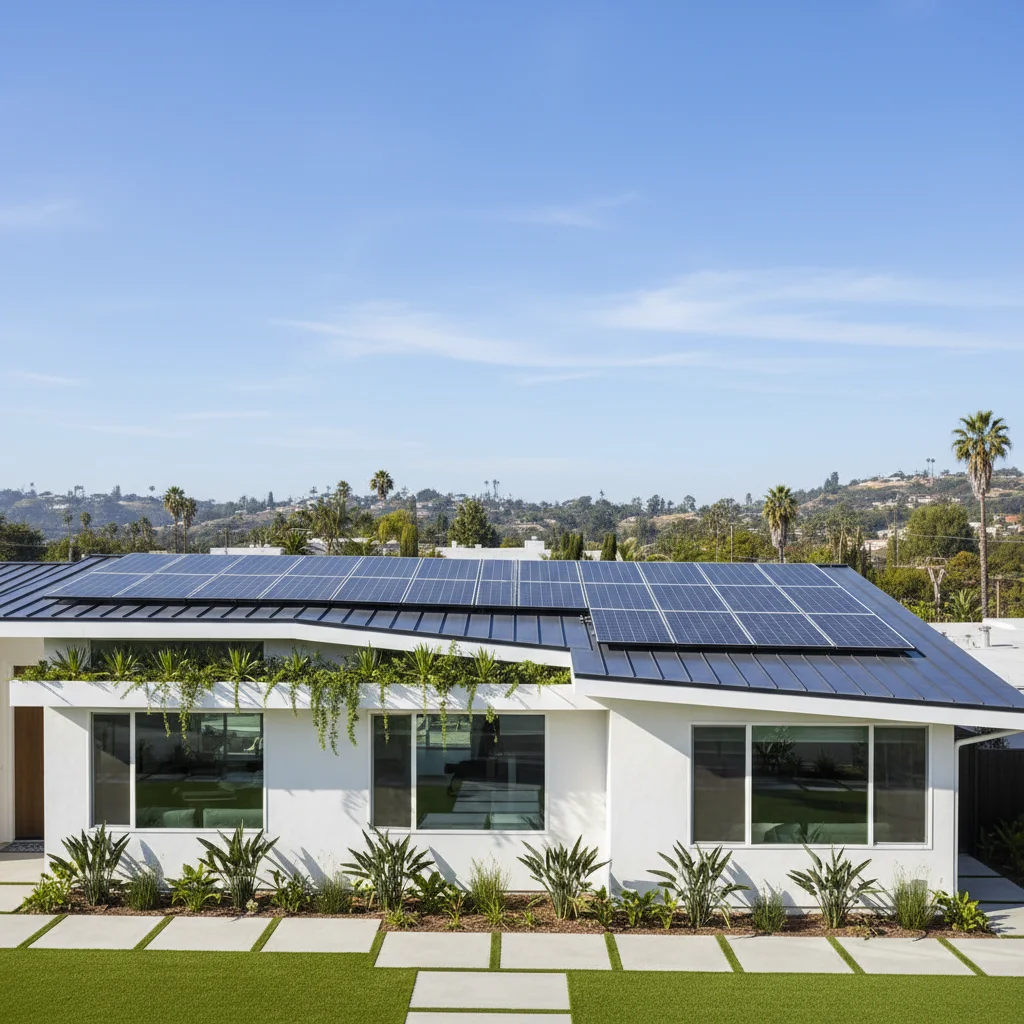
Los Angeles homeowners installed 47% more solar panels in 2025 than the previous year, driven by stacked federal and local rebates that cut installation costs by $15,000 to $22,000. And 2026 brings even more funding opportunities as California utilities restart rebate programs that ran out of money last fall.
What Solar Rebates Are Available in Los Angeles Right Now?
Los Angeles homeowners in 2026 qualify for three stackable solar panel rebate programs: the federal IRA solar tax credit worth 30% of installation costs, the Los Angeles Department of Water and Power (LADWP) Solar Incentive Program offering $0.20 per watt for systems under 30 kW, and the California Self-Generation Incentive Program (SGIP) providing $200 per kilowatt-hour for battery storage paired with solar.
LADWP's solar rebate provides $0.20 per watt for residential installations up to 30 kW, which translates to $1,200 for a typical 6 kW system. But the program operates on a first-come, first-served basis with $8.5 million allocated for fiscal year 2026. And funding depletes within 4-6 months based on prior year data from LADWP's quarterly reports.
The federal Residential Clean Energy Credit (Section 25D) ended for expenditures made after December 31, 2025, and the IRS treats an expenditure as made when installation is completed (IRS FS-2025-05). Federal tax credits for this work have ended, but state, local and utility rebates may still apply; check what is available at your address with the DuloCore rebate calculator. So a $20,000 solar installation generates a $6,000 tax credit that reduces federal income tax liability dollar-for-dollar.
SGIP battery storage incentives start at $200 per kWh for equity budget customers and $150 per kWh for general market applicants. And a 13.5 kWh battery paired with solar qualifies for $2,700 in equity budget areas or $2,025 in general market zones.
How Much Can You Actually Save with LA Solar Rebates in 2026?
Los Angeles homeowners save $15,400 to $22,800 on solar installations by stacking federal, utility, and state incentives in 2026. The breakdown for a standard 7 kW system costing $24,500 includes $7,350 from the federal tax credit, $1,400 from LADWP's solar rebate, and $2,025 to $2,700 from SGIP battery incentives when paired with a 13.5 kWh storage system.
Total out-of-pocket costs drop from $24,500 to $13,025 after all rebates for equity budget customers. But general market applicants pay $13,700 after stacking the same incentives. And both scenarios assume battery storage installation, which qualifies for additional SGIP funding.
Monthly electric bill savings average $145 to $180 for Los Angeles households with solar, based on LADWP's $0.23 per kWh average residential rate in 2026. So annual savings reach $1,740 to $2,160, creating a payback period of 6 to 8 years depending on system size and rebate eligibility tier.
California's net metering 3.0 policy reduces export compensation rates by 75% compared to prior programs. And this change extends payback periods by 18 to 24 months for systems without battery storage. So battery pairing becomes essential for maximizing financial returns in Los Angeles County.
Use our free rebate calculator to calculate exact savings based on your home's energy usage, roof specifications, and rebate eligibility tier.
What Are the Eligibility Requirements and Income Limits?
LADWP solar rebates require Los Angeles Department of Water and Power electric service, system installation by California licensed contractors holding C-46 or C-10 licenses, and completion of all LADWP interconnection requirements before rebate payment. And no income limits apply to the standard LADWP solar program in 2026.
SGIP equity budget qualifications include residence in CARE or FERA low-income assistance programs, location in disadvantaged communities identified by CalEnviroScreen 4.0, or residence in fire-threat districts with two or more Public Safety Power Shutoff events in the prior 3 years. And equity budget applicants receive $200 per kWh compared to $150 per kWh for general market participants.
But the credit carries forward to future tax years if tax liability falls below the credit amount in the installation year.
LADWP's Solar Rooftop Program mandates systems sized to offset 100% or less of annual electricity consumption based on the prior 12 months of usage data. And oversized systems receive reduced or zero rebate payments for capacity exceeding demonstrated consumption needs.
"LADWP customers must have their solar photovoltaic system installed by a California licensed contractor and receive permission to operate from LADWP before submitting a rebate application." — LADWP Solar Incentive Program
What's the Application Deadline and How Do Funding Limits Work?
LADWP's solar rebate program for fiscal year 2026 closes June 30, 2026 or when the $8.5 million budget depletes, whichever occurs first. And historical data shows funding exhaustion within 120 to 180 days of the July 1 program launch based on LADWP's 2024 and 2025 program reports.
Applications require system installation completion, LADWP permission to operate approval, and submission of all required documentation within 90 days of receiving permission to operate. But late submissions forfeit rebate eligibility even if funding remains available.
SGIP operates on a continuous first-come, first-served basis with $295 million in total remaining funding for battery storage statewide as of March 2026. And the program continues until funds deplete, with no annual renewal or fiscal year reset.
The federal Residential Clean Energy Credit (Section 25D) ended for expenditures made after December 31, 2025, and the IRS treats an expenditure as made when installation is completed (IRS FS-2025-05). So homeowners claim credits on the tax return for the year when the system becomes operational.
LADWP processes rebate applications in 45 to 60 business days after complete submission. And payment issues via check or ACH transfer within 15 business days of approval. So total timeline from permission to operate to rebate receipt spans 60 to 75 business days.
Can You Stack Multiple Rebates and What Are the Rules?
Los Angeles homeowners stack federal IRA tax credits, LADWP solar rebates, and SGIP battery storage incentives without reduction or penalty in 2026. And California law explicitly permits combining utility, state, and federal incentives for the same solar installation.
Federal tax credits calculate on gross installation costs before deducting LADWP or SGIP rebates. So a $24,500 system generates a $7,350 federal credit regardless of receiving $1,400 from LADWP or $2,700 from SGIP. But homeowners must report utility rebates as taxable income in the year received if deducted on prior year tax returns.
SGIP battery incentives stack with solar installations but require battery pairing to qualify. And standalone battery systems without solar also qualify for SGIP at the same $150 to $200 per kWh rates depending on equity budget status.
LADWP's solar rebate prohibits combining with other LADWP incentive programs for the same system. But LADWP's feed-in tariff programs and solar rebates operate as mutually exclusive options. So homeowners choose one program or the other based on system size and financial return modeling.
Property tax exclusion for active solar systems under California Revenue and Taxation Code Section 73 stacks with all rebate programs. And this exclusion prevents solar installations from increasing property tax assessments through January 1, 2027.
Check our guide to energy tax credits for details on federal filing requirements when stacking multiple incentive programs.
What Contractor Requirements and Documentation Do You Need?
LADWP requires California licensed contractors holding C-46 Solar or C-10 Electrical licenses to install systems qualifying for rebates. And contractors must register with LADWP's Solar Rooftop Program before installing systems for rebate applicants.
Required documentation includes LADWP's solar rebate application form, copy of the LADWP permission to operate letter, contractor's California license number and classification, itemized invoice showing equipment and labor costs, manufacturer spec sheets for panels and inverters, and proof of system ownership if using third-party financing.
SGIP applications require California Solar Initiative Program Administrator rebate reservation confirmation, energy storage equipment warranty documentation, interconnection agreement with the utility, and single-line electrical diagram showing battery integration with solar and grid connection points.
Form 5695 only covers qualifying work completed by December 31, 2025 and claimed on a 2025 return; the federal 25C and 25D credits ended after that date (IRS FS-2025-05).
LADWP prohibits rebate applications for leased systems or power purchase agreements where third parties retain system ownership. But federal tax credits transfer to system owners, which includes leasing companies and PPA providers rather than homeowners in third-party ownership structures.
For more details on similar rebate programs, see our article on heat pump rebates which follow comparable application processes.
Do You Need Pre-Approval Before Installing Solar Panels?
LADWP requires pre-approval through the interconnection application process before installing solar panels but does not require pre-approval for the solar rebate itself. And the interconnection application review takes 15 to 30 business days depending on system size and complexity.
SGIP requires reservation submission before purchasing battery storage equipment to lock in incentive rates. And reservation applications receive confirmation within 10 business days, securing the applicable incentive level even if rates decline before installation completion.
Federal tax credits require no pre-approval, reservation, or notification before system installation. But homeowners must complete installation and begin operation before claiming credits on tax returns for the operational year.
LADWP's interconnection process requires submission of single-line diagrams, equipment specifications, contractor license verification, and engineering review before issuing permission to operate. And installations beginning before receiving interconnection approval void rebate eligibility and create potential code enforcement issues.
Pre-approval timelines extend project schedules by 20 to 45 days in Los Angeles County when combining LADWP interconnection requirements with building permit processes. So contractors typically initiate interconnection applications 30 to 60 days before planned installation dates to avoid delays.
Official Sources
- IRS Residential Clean Energy Credit — Federal tax credit details for solar installations (note: the federal 25D credit ended for expenditures made after December 31, 2025)
- U.S. Department of Energy Solar Resources — Complete guide to federal solar incentives and technical requirements
- DSIRE Solar Policy Database — State and utility solar incentive program database with California-specific details
Related Reading: Learn more about California Solar Rebates 2026 and Solar Panel Rebates Near Me.
Frequently Asked Questions
What solar panel rebates are available in Los Angeles California?
Los Angeles homeowners access three primary rebates in 2026: the federal IRA solar tax credit providing 30% of installation costs, LADWP's Solar Incentive Program offering $0.20 per watt up to $1,400 for typical residential systems, and California's SGIP battery storage program paying $150 to $200 per kWh for systems paired with solar panels. And these programs stack without reduction for combined savings of $15,400 to $22,800 on installations.
How much money can you get from solar panel rebates in Los Angeles?
Total rebates reach $10,750 to $11,450 for a 7 kW solar system with 13.5 kWh battery storage when stacking federal, LADWP, and SGIP incentives. The breakdown includes $7,350 from the federal tax credit, $1,400 from LADWP, and $2,025 to $2,700 from SGIP depending on equity budget qualification. And these amounts reduce the $24,500 average installation cost to $13,025 to $13,700 after rebates.
Are you eligible for solar panel rebates in Los Angeles California?
Eligibility requires LADWP electric service for the utility rebate, system installation by California licensed contractors, and sufficient federal tax liability for the IRA credit. SGIP equity budget qualification adds $50 per kWh in additional incentives for CARE/FERA program participants, disadvantaged community residents, or homes in fire-threat districts with multiple Public Safety Power Shutoff events. And no income limits apply to LADWP or federal programs in 2026.
What is the process to apply for solar panel rebates in Los Angeles?
Applications start with LADWP interconnection approval before installation, followed by system installation by licensed contractors, obtaining permission to operate from LADWP, and submitting rebate applications within 90 days of operational approval. SGIP requires reservation before equipment purchase, and federal credits claim on IRS Form 5695 filed with annual tax returns. And LADWP processes rebates in 45 to 60 business days with payment within 15 days of approval.
When do solar panel rebates expire in California?
LADWP's fiscal year 2026 program closes June 30, 2026 or when $8.5 million depletes, typically within 120 to 180 days based on prior year data. The federal Residential Clean Energy Credit (Section 25D) ended for expenditures made after December 31, 2025, and the IRS treats an expenditure as made when installation is completed (IRS FS-2025-05). And SGIP operates continuously until the remaining $295 million statewide battery storage budget exhausts, with no specific expiration date set as of April 2026.
Ready to maximize your solar savings? Use our free rebate calculator to get personalized estimates based on your home's energy usage, roof specifications, and eligibility for Los Angeles solar rebate programs. Calculate your total incentives and payback period in under 2 minutes.
Last updated: April 14, 2026. Reviewed by the DuloCore Editorial Team. About our authors.
Check your California solar rebate eligibility — see the programs you qualify for and the dollar amounts on our California solar rebate finder.