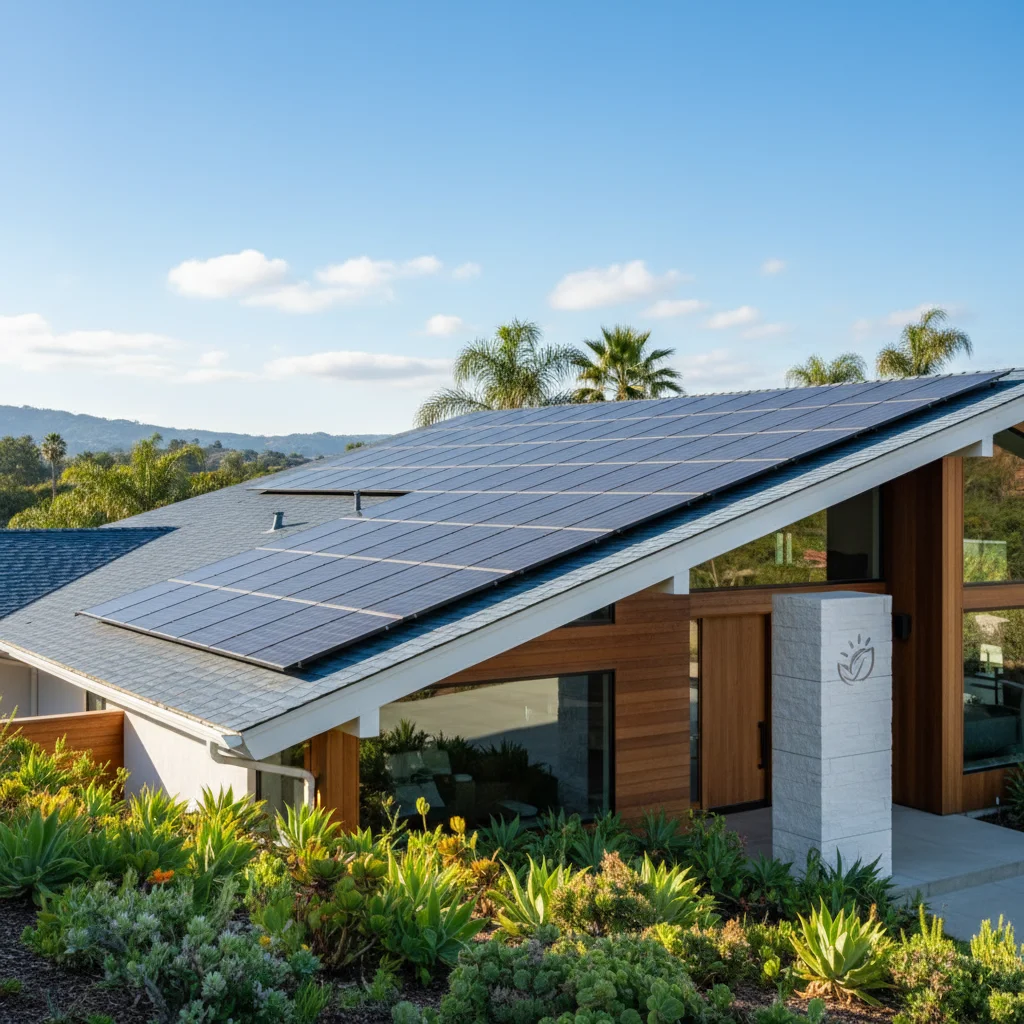
Orange County homeowners installing solar panels in 2026 pay between $12,000 and $28,000 before incentives—but after federal tax credits and local utility rebates, the net cost drops to $6,500 to $18,000. And with electricity rates in Southern California Edison territory hitting $0.52 per kWh during peak hours, the payback period shrinks to 5-7 years for most residential systems.
How Much Does Solar Panel Installation Cost in Orange County in 2026?
Solar panel installation costs in Orange County range from $2.40 to $3.10 per watt in 2026, translating to $12,000 for a 5 kW system or $28,000 for a 10 kW system before incentives, with final pricing dependent on roof complexity, panel efficiency ratings, and inverter technology selected.
The average Orange County home consumes 7,200 kWh annually, requiring a 6-7 kW system to offset 100% of electricity usage. So a typical installation lands at $14,400 to $21,700 before applying the federal Investment Tax Credit. But labor costs in Orange County run 15-20% higher than inland California markets due to permit fees, inspection requirements, and installer demand in coastal zip codes.
Three factors drive the per-watt price: panel tier (economy monocrystalline at $2.40/watt versus premium bifacial at $3.10/watt), inverter type (string inverters cost $0.18/watt less than microinverters), and structural work (tile roof removal adds $1,500-$3,000 to total project cost). And installation timelines stretch 8-12 weeks from contract signing to final inspection, with Southern California Edison interconnection approval adding 4-6 weeks to the schedule.
The federal Residential Clean Energy Credit (Section 25D) ended for expenditures made after December 31, 2025, and the IRS treats an expenditure as made when installation is completed (IRS FS-2025-05). Federal tax credits for this work have ended, but state, local and utility rebates may still apply; check what is available at your address with the DuloCore rebate calculator. The $2,100 difference on a $21,000 system represents 10% of net installation cost. Use our free rebate calculator to model your specific savings timeline.
What Are the Best Alternatives to Solar Panels for Orange County Homeowners?
The federal home energy tax credits (Sections 25C and 25D) ended for projects completed after December 31, 2025 (IRS FS-2025-05).
Tesla Powerwall and Enphase IQ Battery (this federal credit ended for expenditures made after December 31, 2025) systems cost $11,000-$15,000 installed, storing 13.5-10 kWh of electricity to offset peak-rate consumption without requiring roof space or HOA approval. But battery-only systems don't generate electricity—they shift grid consumption from $0.52/kWh peak hours to $0.28/kWh off-peak rates, saving $800-$1,200 annually for homes with time-of-use billing. (Note: Federal tax credit percentages and availability are subject to change; the 30% Residential Clean Energy Credit under Section 25D expired December 31, 2025. Verify current incentives at energy.gov.)
Community solar programs through Clean Power Alliance let Orange County residents subscribe to off-site solar farms without installation costs, delivering 5-15% electricity bill discounts through virtual net metering credits. And the model works for renters, condo owners, and homes with shaded roofs that can't support traditional panels.
Heat pump rebates reach $8,000 under California's 2026 Tech Clean California program when replacing gas furnaces, cutting HVAC energy consumption 40-60% while eliminating natural gas bills averaging $85/month. So the combined savings from heat pump installation plus solar panels accelerate payback periods to 4-5 years versus 6-7 years for solar alone.
How Long Do Solar Panels Last and What's the Warranty Coverage?
Premium solar panels installed in Orange County in 2026 carry 25-year performance warranties guaranteeing 85-92% output at year 25, with actual panel lifespan extending 30-35 years before degradation requires replacement, though inverter components need replacement at 10-15 years.
Tier 1 manufacturers including Qcells, REC Solar, and Silfab offer 25-year product warranties covering defects plus separate performance guarantees ensuring panels produce at least 85% of rated capacity after 25 years. But the performance warranty matters more than product warranty—degradation rates of 0.3-0.5% annually mean a 400-watt panel outputs 340-368 watts at year 25.
Inverter warranties run 10-25 years depending on technology, with string inverters (10-12 year warranties) requiring $1,500-$2,500 replacement at year 10-12, while microinverters (25-year warranties) eliminate mid-life replacement costs but add $0.18/watt to upfront installation. So total system lifetime costs favor microinverters for homeowners planning 20+ year ownership.
Orange County's coastal climate accelerates corrosion on mounting hardware and electrical connections compared to desert installations, making annual inspections critical for maintaining warranty coverage. And most manufacturers void warranties if unauthorized contractors perform repairs or modifications.
What Federal and State Incentives Can Reduce Your Installation Costs?
The federal Investment Tax Credit delivers a 30% reduction on total solar installation costs through 2032 for Orange County homeowners, stacking with California's Disadvantaged Communities Single-Family Solar Homes (DAC-SASH) program offering $3,000 rebates and Southern California Edison's Self-Generation Incentive Program providing $200-$250 per kWh for battery storage.
The ITC applies to complete system costs including panels, inverters, batteries charged by solar, mounting hardware, permits, and installation labor. So a $21,000 system generates a $6,300 federal tax credit claimed on 2026 or 2027 tax returns—but the credit can't exceed total tax liability, making it less valuable for retirees or low-income households with minimal tax burdens.
"California's DAC-SASH program provides upfront rebates of up to $3,000 for income-qualified solar installations in disadvantaged communities, with no tax liability requirements." — California Public Utilities Commission
DAC-SASH targets households earning below 80% of area median income ($89,600 for Orange County four-person households in 2026) located in CalEnviroScreen-designated disadvantaged communities including parts of Santa Ana, Anaheim, and Fullerton. And the program delivers cash rebates at installation rather than tax credits, eliminating the tax liability barrier.
Southern California Edison's SGIP battery incentive pays $200/kWh for equity-eligible customers and $250/kWh for equity-resiliency customers in high fire-threat districts, covering $2,000-$2,500 of a 10 kWh battery system. But SGIP funds deplete annually, with 2026 reservations opening January 2 and typically exhausting within 8-12 weeks.
How Does the Solar Installation Process Work in Orange County?
Orange County solar installations follow a five-phase process spanning 8-12 weeks: site assessment and proposal (week 1), permit submission and approval (weeks 2-4), installation and inspection (weeks 5-7), utility interconnection approval (weeks 8-11), and permission to operate granted by Southern California Edison (week 12).
Site assessments evaluate roof condition, electrical panel capacity (200-amp service required for most systems), shading analysis using tools like Aurora Solar, and structural load calculations for tile or composite roofing. So installers identify deal-breakers early—roofs requiring replacement within 5 years, electrical panels needing $2,500 upgrades to 200-amp service, or HOA restrictions prohibiting visible installations.
Orange County requires separate building permits and electrical permits, with fees ranging $450-$850 depending on city jurisdiction and system size. And permit processing times vary dramatically: Irvine approves within 5-7 business days, while Laguna Beach stretches to 3-4 weeks for Coastal Commission review in certain zones.
Installation takes 1-3 days for residential systems, but utility interconnection adds the longest delay—Southern California Edison's approval process runs 30-45 days as engineers verify grid compatibility and update net metering agreements. Check solar panel rebates for current utility incentive timelines that may accelerate interconnection.
Are There Financing Options Available for Solar Panel Installation?
Orange County homeowners access solar financing through cash purchases, solar loans (4.99-8.99% APR), Property Assessed Clean Energy (PACE) loans tied to property tax bills, and power purchase agreements (PPAs) requiring zero upfront payment but forfeiting federal tax credits to third-party owners.
The federal Residential Clean Energy Credit (Section 25D) ended for expenditures made after December 31, 2025, and the IRS treats an expenditure as made when installation is completed (IRS FS-2025-05). Solar (this federal credit ended for expenditures made after December 31, 2025) loans preserve tax credit eligibility while spreading payments over 10-25 years, though 6.99% APR on a $21,000 loan adds $7,800 in interest over 20 years, reducing net savings versus cash purchase.
PACE financing through Ygrene or Renew Financial attaches loan payments to property tax bills, offering 20-year terms at 6.5-8.5% APR with no credit score requirements and transferring to new owners upon home sale. But PACE loans take priority over mortgage liens, complicating refinancing and home sales—some buyers refuse properties with PACE obligations.
PPAs let homeowners install solar with $0 down, paying only for electricity generated at rates 10-20% below utility rates. The federal Residential Clean Energy Credit (Section 25D) ended for expenditures made after December 31, 2025, and the IRS treats an expenditure as made when installation is completed (IRS FS-2025-05). So PPAs deliver immediate savings without upfront costs but sacrifice long-term wealth building—ownership transfers to the homeowner after year 20-25 for $0-$1,500 buyout.
Explore current energy tax credits to understand how financing structures interact with federal and state incentive programs.
Official Sources
- U.S. Department of Energy Solar Guide — Federal tax credit details and eligibility requirements for residential solar installations (note: the federal 25C and 25D credits ended for projects completed after December 31, 2025)
- DSIRE Database — Comprehensive database of state, local, and utility solar incentives updated monthly
- California Solar Initiative — State solar programs, rebates, and interconnection procedures for California utilities
Frequently Asked Questions
How much does solar panel installation cost in Orange County?
Solar panel installation in Orange County costs $12,000-$28,000 before incentives ($2.40-$3.10 per watt) depending on system size and panel quality. After the 30% federal tax credit, net costs drop to $8,400-$19,600. The average 6.5 kW system for Orange County homes runs $15,600-$20,150 before credits, or $10,920-$14,105 after federal incentives.
What rebates and tax credits are available for solar panels in Orange County?
The federal Residential Clean Energy Credit (Section 25D) ended for expenditures made after December 31, 2025, and the IRS treats an expenditure as made when installation is completed (IRS FS-2025-05). Southern California Edison's SGIP offers $200-$250/kWh for battery storage. DAC-SASH delivers $3,000 rebates for income-qualified households in disadvantaged communities. Combined incentives reduce a $21,000 system to $11,700-$14,700 net cost depending on eligibility.
How long does it take to install solar panels in Orange County?
Physical installation takes 1-3 days, but the complete process spans 8-12 weeks. Permit approval requires 1-4 weeks, installation and inspection take 2-3 weeks, and Southern California Edison interconnection approval adds 4-6 weeks. Coastal Commission review in certain Orange County zones extends timelines an additional 2-3 weeks.
Are solar panels worth the cost in Orange County?
Solar panels deliver 8-12% annual returns for Orange County homeowners based on $0.28-$0.52/kWh electricity rates and 5-7 year payback periods. A $21,000 system generating $2,800-$3,400 annually in savings pays for itself in 6.2-7.5 years, then produces free electricity for 20+ additional years, creating $56,000-$84,000 in lifetime value.
What is the process for applying for solar rebates in Orange County?
Form 5695 only covers qualifying work completed by December 31, 2025 and claimed on a 2025 return; the federal 25C and 25D credits ended after that date (IRS FS-2025-05). SGIP battery rebates need reservation submissions at energycenter.org/sgip within 10 days of installation contract signing. DAC-SASH applications go through approved installers who verify income eligibility and submit paperwork to utilities before installation begins.
Ready to Calculate Your Solar Savings?
Orange County's combination of high electricity rates, strong solar exposure, and stacked federal and state incentives creates one of California's best solar markets. Use our free rebate calculator to model your specific installation costs, available incentives, and payback timeline based on your home's energy consumption and roof characteristics. Get your personalized solar savings estimate in under 60 seconds.
Last updated April 14, 2026 — reviewed by DuloCore Editorial. About our authors.
Check your California solar rebate eligibility — see the programs you qualify for and the dollar amounts on our California solar rebate finder.