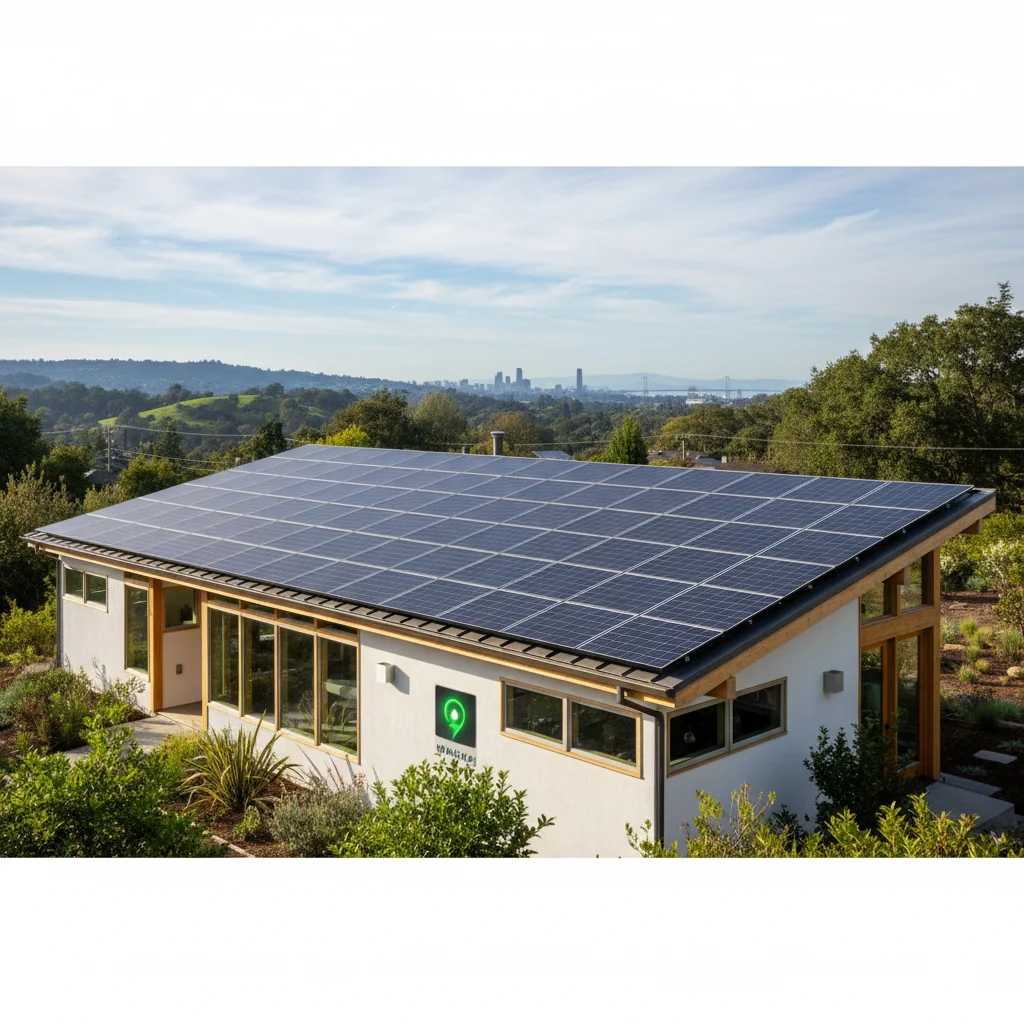
Oakland homeowners paid an average of $18,200 for residential solar installations in 2025, but new federal tax credit changes and California's NEM 3.0 policy shift mean those economics just changed dramatically. And the sticker price tells only part of the story—financing costs, interconnection fees, and post-incentive net costs create a $12,000 spread between what neighbors pay for identical systems.
How Much Does Solar Panel Installation Cost in Oakland?
Oakland residential solar installations cost $2.85 to $3.45 per watt before incentives in 2026, translating to $17,100-$20,700 for a typical 6-kilowatt system. The federal Residential Clean Energy Credit (Section 25D) ended for expenditures made after December 31, 2025, and the IRS treats an expenditure as made when installation is completed (IRS FS-2025-05). Check current state, local and utility incentives for your address with the DuloCore rebate calculator. Labor accounts for 25-30% of total project costs, while equipment (panels, inverters, racking) represents 55-60%, and permitting and interconnection fees add $800-$1,500.
So what drives the $3,600 price variance between Oakland installers? Panel tier selection creates a $0.15-$0.30 per watt spread—premium Tier 1 panels from manufacturers like LG and SunPower cost more upfront but deliver 22-23% efficiency versus 18-19% for budget alternatives. And roof complexity matters: single-plane asphalt installations cost 15-20% less than multi-plane tile or metal roofs requiring custom flashing and additional structural work.
Oakland's permitting costs run $400-$800 depending on system size, while PG&E interconnection applications add another $400-$700 in utility processing fees. But installation timelines contracted from 3-4 months in 2024 to 6-8 weeks in 2026 as Oakland streamlined its solar permitting to comply with California's Solar Rights Act AB 2188.
"The average cost of a residential solar energy system has dropped by more than 60% over the last decade, from $7.34 per watt in 2010 to $2.77 per watt in 2020." — U.S. Department of Energy Solar Energy Technologies Office
Three cost tiers dominate Oakland's market: budget systems at $2.50-$2.85/watt using Tier 2 panels with string inverters, mid-tier installations at $2.85-$3.15/watt with Tier 1 panels and microinverters, and premium builds at $3.15-$3.45/watt featuring high-efficiency panels with integrated battery storage. Battery additions increase upfront costs by $8,000-$15,000 but qualify for the same 30% federal credit (this federal credit ended for expenditures made after December 31, 2025).
What Are the Main Alternatives to Solar Panels for Energy in Oakland?
Community solar programs allow Oakland renters and homeowners without suitable roofs to access solar power at $0.10-$0.15 per kilowatt-hour, typically 10-15% below standard PG&E residential rates of $0.38-$0.42/kWh. Participants subscribe to a portion of a shared solar array and receive monthly bill credits proportional to their subscription size, with no upfront installation costs and cancellation terms of 30-90 days.
Geothermal heat pump systems cost $18,000-$35,000 installed in Oakland but address heating and cooling rather than electricity generation, making direct comparison difficult. Or homeowners targeting electricity independence might combine rooftop solar with whole-home battery systems like Tesla Powerwall 3 ($11,500-$14,000 installed) to store excess daytime generation for evening use.
Wind turbines remain impractical for Oakland's urban density and wind patterns—residential installations require sustained winds of 10+ mph and setbacks of 150+ feet from property lines. And grid-tied solar with net metering still offers the fastest payback among Oakland-viable renewable options: 7-9 years versus 12-15 years for standalone battery systems or 15-20 years for geothermal installations.
Check the solar panel rebates page for current California incentive programs that further reduce net costs versus alternative renewable systems.
How Long Do Solar Panels Last and What's the Total Cost of Ownership?
Oakland solar installations carry 25-30 year panel performance warranties guaranteeing 80-85% of rated output at year 25, but actual system lifespans reach 30-35 years with proper maintenance. Inverter replacement represents the largest maintenance cost—string inverters last 10-15 years and cost $1,200-$2,500 to replace, while microinverters carry 20-25 year warranties that often exceed panel lifespans.
Annual maintenance costs run $150-$300 for professional panel cleaning and electrical inspections, though many Oakland homeowners skip professional cleaning given the Bay Area's winter rain naturally removes dust accumulation. But bird deterrent installation ($800-$1,500) prevents nesting under panels, which creates fire hazards and voids some warranties.
Total 30-year cost of ownership for a $17,100 system breaks down to: $11,970 net installation cost after federal credit, $2,000-$3,500 inverter replacement at year 12-15, $4,500-$9,000 in maintenance ($150-$300 annually), and potential battery replacement of $8,000-$12,000 if battery backup was included initially. So total 30-year ownership costs reach $18,470-$34,470 depending on maintenance choices and battery inclusion.
"Solar panels typically come with 25-year performance warranties guaranteeing they'll still produce at least 80% of their rated output after that time, but many continue operating for 30-40 years." — National Renewable Energy Laboratory Solar Research
Oakland's climate extends panel longevity versus desert or coastal salt-spray environments—moderate temperatures of 50-75°F and low humidity reduce thermal cycling stress that degrades silicon cells. And PG&E's NEM 3.0 policy shift in April 2023 reduced export credit rates by 75%, making system sizing for self-consumption rather than grid export critical to maximizing lifetime returns.
What Financing Options and Incentives Are Available for Oakland Solar Installation?
Form 5695 only covers qualifying work completed by December 31, 2025 and claimed on a 2025 return; the federal 25C and 25D credits ended after that date (IRS FS-2025-05). Federal tax credits for this work have ended, but state, local and utility rebates may still apply; check what is available at your address with the DuloCore rebate calculator.
Cash purchases deliver the lowest total cost of ownership and fastest payback periods of 7-9 years for Oakland installations, but solar loans and PACE financing (Property Assessed Clean Energy) spread costs over 10-25 years at 4.99-8.99% APR. And PACE programs like Renew Financial attach repayment obligations to property tax bills, surviving home sales but potentially complicating refinancing.
California's SGIP (Self-Generation Incentive Program) offers $200-$250 per kilowatt-hour for battery storage systems installed with solar, though funding depleted rapidly in 2025 and currently operates with a 6-12 month waitlist for equity budget allocations. Or income-qualified homeowners earning below 80% of area median income access SGIP equity budgets offering $850-$1,000/kWh for batteries—a $8,500-$10,000 incentive for a 10 kWh system.
Use the rebate calculator to estimate your combined federal and state incentive values based on system size and household income.
PG&E's Net Energy Metering 3.0 policy pays $0.05-$0.09 per kWh for excess generation exported to the grid, down from $0.25-$0.35 under the previous NEM 2.0 framework grandfathered through April 2023. So installations completed under NEM 2.0 enjoy 20-year rate locks at higher export values, while new 2026 installations face lower export economics that favor battery storage and self-consumption.
Oakland's Property Tax Exclusion for Solar Energy Systems prevents solar installations from increasing assessed home values for property tax purposes, saving homeowners $150-$300 annually on tax bills. And the exclusion extends for the life of the system or until property transfer, whichever comes first.
What Is the Process and Timeline for Getting Solar Panels Installed in Oakland?
Oakland solar installations follow a five-stage process spanning 6-8 weeks from contract signing to system activation: site assessment and design (1-2 weeks), permitting with Oakland's Building Services (2-3 weeks), physical installation (2-3 days), electrical inspection (1 week), and PG&E interconnection approval (1-2 weeks). Delays most commonly occur during PG&E's interconnection review when applications contain errors or require utility infrastructure upgrades.
Site assessment includes roof measurements, shading analysis using tools like Aurora Solar or Helioscope, and electrical panel evaluation to confirm 200-amp service capacity. Or homes with 100-amp panels require $1,200-$2,500 panel upgrades before solar installation, adding 1-2 weeks to project timelines and disqualifying systems from some zero-down financing programs.
Oakland requires building permits for all solar installations, with fees calculated at $0.07-$0.12 per watt depending on system size—a 6 kW system pays $420-$720. But Oakland adopted SolarAPP+ automated permitting in January 2025, reducing approval times from 2-3 weeks to same-day or next-day for qualifying residential installations.
"The typical timeline for a residential solar installation from contract to activation is 45-90 days, with permitting and utility interconnection representing the longest phases." — EnergySage Solar Installation Process Guide
Physical installation takes 1-3 days depending on system size and roof complexity—crews mount racking, install panels, run conduit and wiring, and connect the inverter and electrical panel. And Oakland requires electrical inspections within 3-5 business days of installation completion, with inspectors verifying proper grounding, conduit installation, and panel labeling.
PG&E interconnection applications trigger meter replacement from analog to bi-directional digital meters that track both consumption and generation. Or homeowners maintain existing net metering agreements through property ownership, but agreements don't transfer to new owners who must reapply under current NEM 3.0 terms at sale.
How Does the Cost of Solar Installation in Oakland Compare to Other Renewable Energy Options?
Solar photovoltaic installations at $2.85-$3.45 per watt deliver Oakland's lowest cost per kilowatt-hour among residential renewable options at $0.12-$0.18/kWh levelized over 25 years. Geothermal heat pumps generate $0.25-$0.35/kWh equivalent when accounting for heating and cooling offsets, while community solar subscriptions run $0.32-$0.38/kWh including administrative fees and profit margins.
Small wind turbines cost $3,000-$8,000 per kilowatt installed but require sustained wind speeds of 10+ mph and property setbacks Oakland's R-1 and R-2 zoning districts don't accommodate. And Oakland's average annual wind speed of 6.2 mph delivers capacity factors below 15%, making wind economically nonviable versus solar's 18-22% capacity factors.
Battery storage systems without solar generation cost $800-$1,200 per kWh of capacity but provide backup power rather than energy generation, serving different use cases than solar installations. So optimal economics often combine solar generation with battery storage—a 6 kW solar array with 10 kWh battery costs $25,000-$30,000 but qualifies for 30% federal credit (this federal credit ended for expenditures made after December 31, 2025)s on both components.
Explore energy tax credits for comprehensive comparisons of federal incentives across solar, geothermal, and battery storage technologies.
Oakland's electricity rates create favorable solar economics versus most California markets—PG&E's tiered residential rates peak at $0.42/kWh for usage above baseline allowances, while solar levelized costs remain flat at $0.12-$0.18/kWh regardless of consumption patterns. And time-of-use rate structures penalize evening consumption when solar doesn't generate, making battery storage increasingly attractive despite higher upfront costs.
Official Sources
- U.S. Department of Energy Solar Energy Technologies Office — Federal solar research, cost data, and consumer guidance
- DSIRE USA Solar Programs Database — Comprehensive state and federal solar incentive tracking
- IRS Form 5695 Instructions — Residential energy credit claiming procedures and eligibility
Related Reading: Learn more about Solar Panel Installation Cost Breakdown and Solar Rebates.
Frequently Asked Questions
How much does solar panel installation cost in Oakland?
Oakland solar installations cost $17,100-$20,700 for a typical 6-kilowatt residential system before incentives in 2026, or $2.85-$3.45 per watt. The 30% federal IRA tax credit reduces net costs to $11,970-$14,490. Final costs vary based on roof complexity, panel tier selection, and whether battery storage is included, which adds $8,000-$15,000 to upfront expenses.
What rebates and incentives are available for solar panels in Oakland?
The federal Residential Clean Energy Credit (Section 25D) ended for expenditures made after December 31, 2025, and the IRS treats an expenditure as made when installation is completed (IRS FS-2025-05). California's SGIP program offers $200-$250 per kWh for battery storage, with equity budgets providing $850-$1,000/kWh for income-qualified homeowners below 80% area median income. Oakland's Property Tax Exclusion prevents solar systems from increasing assessed home values for tax purposes, saving $150-$300 annually.
Are solar panels worth the cost in Oakland?
Oakland solar installations deliver 7-9 year payback periods with cash purchases when factoring in PG&E's $0.38-$0.42/kWh residential rates and the 30% federal tax credit. Systems generate 25-30 years of electricity production against total 30-year ownership costs of $18,470-$34,470 including inverter replacement and maintenance. Or NEM 3.0's reduced export rates of $0.05-$0.09/kWh favor battery storage additions to maximize self-consumption economics versus grid export.
How long does it take to install solar panels in Oakland?
Oakland solar installations span 6-8 weeks from contract signing to system activation: site assessment (1-2 weeks), permitting (2-3 weeks with SolarAPP+ automation), physical installation (2-3 days), electrical inspection (1 week), and PG&E interconnection (1-2 weeks). Delays most commonly occur during PG&E interconnection reviews or when homes require electrical panel upgrades from 100-amp to 200-amp service, adding 1-2 weeks to timelines.
What is the payback period for solar panels in Oakland?
Cash-purchased Oakland solar systems achieve 7-9 year payback periods based on PG&E's $0.38-$0.42/kWh residential rates, 30% federal tax credit, and average household consumption of 500-700 kWh monthly. Financed systems at 5.99-7.99% APR extend payback to 10-14 years depending on loan terms. Or battery storage additions increase payback periods by 2-4 years but provide backup power during PG&E's public safety power shutoffs affecting Oakland 1-3 times annually.
Ready to see how much you'll save with solar? Use our free rebate calculator to get a personalized estimate of your federal tax credit, state incentives, and long-term electricity savings based on your Oakland home's roof size and energy usage. Calculate your savings in under 60 seconds.
Updated on April 14, 2026. Fact-checked by DuloCore Editors. About our research team.
Check your California solar rebate eligibility — see the programs you qualify for and the dollar amounts on our California solar rebate finder.