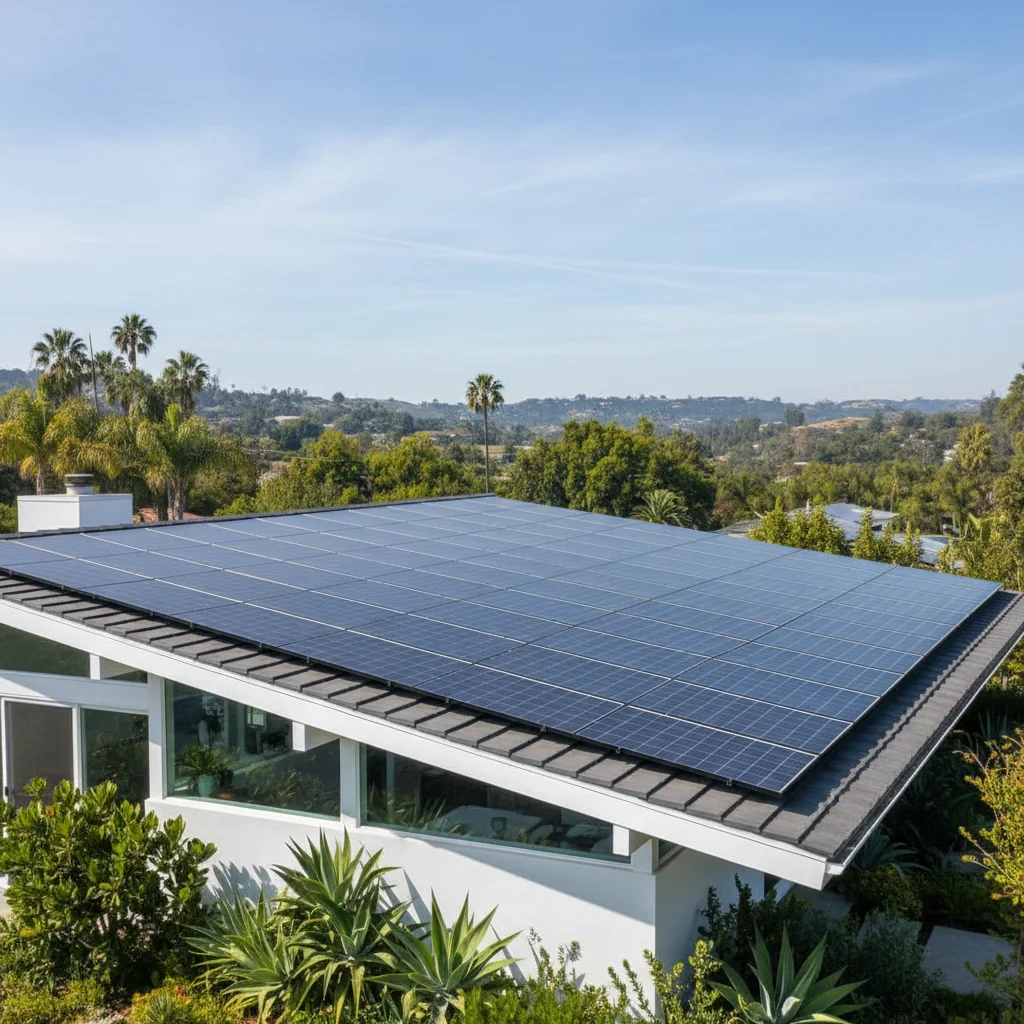
Los Angeles homeowners paid between $12,000 and $28,000 for residential solar panel installations in 2026, with the average 6-kilowatt system costing $16,200 after federal tax credits. And that number keeps dropping as panel efficiency improves and labor costs stabilize across Southern California's competitive solar market.
How Much Does Solar Panel Installation Cost in Los Angeles Right Now?
Solar panel installation costs in Los Angeles range from $2.50 to $3.50 per watt in 2026, with most residential systems between 5 and 8 kilowatts. A typical 6-kilowatt system costs $18,000 before incentives, or $12,600 after the 30% federal IRA tax credit through 2032.
Los Angeles sits in California's Climate Zone 9, where 300 days of annual sunshine make solar particularly effective. The city's Mediterranean climate delivers 5.6 peak sun hours daily on average, meaning a 6-kilowatt system generates approximately 9,500 kilowatt-hours annually. But installation costs vary by neighborhood—homes in hillier areas like Silver Lake or Echo Park pay 15-20% more for mounting equipment and structural reinforcement compared to flat-roof installations in the San Fernando Valley.
Equipment accounts for 60% of total costs, with labor, permits, and interconnection fees making up the remaining 40%. And soft costs like permitting have dropped 25% since 2024 as Los Angeles streamlined its solar approval process to same-day electronic permits for standard residential installations.
Labor rates range from $0.75 to $1.25 per watt depending on roof complexity, panel type, and contractor experience. So a simple south-facing composition shingle roof costs significantly less to outfit than a Spanish tile roof requiring custom mounting hardware and reinforcement.
What Solar Incentives and Tax Credits Are Available in Los Angeles in 2026?
Los Angeles homeowners qualify for the 30% federal IRA residential clean energy credit through 2032, worth $5,400 on an $18,000 system. California's Self-Generation Incentive Program offers $0.85 per watt-hour for solar-plus-storage installations, adding $7,200 to a typical 8-kilowatt-hour battery system.
The federal Residential Clean Energy Credit (Section 25D) ended for expenditures made after December 31, 2025, and the IRS treats an expenditure as made when installation is completed (IRS FS-2025-05).
The Los Angeles Department of Water and Power (LADWP) discontinued its Solar Incentive Program in 2024, but Southern California Edison (SCE) customers still qualify for net metering 3.0, crediting excess generation at retail rates minus non-bypassable charges of $0.02-$0.04 per kilowatt-hour. And low-income households earning below 80% of area median income ($77,300 for a family of four in Los Angeles County) qualify for the SOMAH program, which covers up to 100% of installation costs for multifamily properties.
The federal credit applies to solar panels, inverters, mounting equipment, labor, permitting, inspection fees, and energy storage devices charged exclusively by solar panels. Or homeowners can stack the federal credit with California's Property Tax Exclusion for Active Solar Energy Systems, which prevents solar installations from increasing property tax assessments through 2026.
Calculate your exact rebate amount using our free rebate calculator to see combined federal, state, and utility incentives.
Is Your Los Angeles Home's Climate Zone Suitable for Solar Panels?
Los Angeles spans California Climate Zones 6 through 10, with most residential areas in Zones 9 and 10 receiving 5.2 to 5.8 peak sun hours daily—among the highest solar potential in the continental United States. Coastal neighborhoods from Santa Monica to San Pedro receive 10-15% less solar radiation than inland areas due to marine layer fog, but still generate enough electricity to offset 85-95% of typical household consumption.
Zone 9 covers downtown Los Angeles, Hollywood, and most of the San Fernando Valley, where summer temperatures reach 95-105°F and panel efficiency drops 0.5% for every degree above 77°F. But modern monocrystalline panels with temperature coefficients of -0.35%/°C maintain 88% efficiency even during peak heat, outperforming older polycrystalline technology by 12%.
Zone 10 includes inland areas like Pasadena and Glendale, where higher summer temperatures reduce panel output by 8-10% compared to coastal installations. So a 6-kilowatt system in Pasadena generates approximately 9,200 kilowatt-hours annually versus 9,800 kilowatt-hours for the same system in Culver City, a difference of $90-$120 in annual electricity savings at current LADWP rates of $0.15 per kilowatt-hour.
South-facing roofs with 15-40 degree pitch deliver optimal performance, but east-west configurations still capture 85% of south-facing output. And Los Angeles's building codes require 3 feet of clearance around roof edges, reducing usable installation area by 20-30% on smaller homes.
How Long Will Your Solar Panels Last and What's the Warranty Coverage?
Residential solar panels installed in Los Angeles carry 25-year performance warranties guaranteeing 80-85% of original output after 25 years, with actual lifespan extending 30-35 years before requiring replacement. Inverters last 10-15 years and carry separate 10-year warranties, with replacement costs of $1,200-$2,500 for string inverters or $200-$300 per microinverter.
"Most solar panel manufacturers guarantee their panels will produce at least 80% of their rated power output after 25 years of use." — Department of Energy Solar Guide
Los Angeles's climate accelerates panel degradation by 0.5-0.7% annually compared to 0.5% in cooler climates, primarily due to thermal cycling and UV exposure. But premium panels from manufacturers like SunPower and LG degrade at 0.25-0.35% annually, maintaining 92% output after 25 years versus 80% for budget panels.
Workmanship warranties cover installation defects for 10-25 years, protecting against roof penetration leaks, wiring failures, and mounting system failures. And most installers offer production guarantees ensuring systems generate within 10% of projected output, with free troubleshooting and repairs if performance falls short.
Panel manufacturers replace defective units within the warranty period, but homeowners pay labor costs of $500-$1,200 for panel removal and reinstallation. So choosing installers with 10+ year track records reduces the risk of companies folding before warranty claims arise.
What's the Complete Installation Process and Timeline in Los Angeles?
Solar panel installation in Los Angeles takes 30-90 days from contract signing to final inspection, with physical installation completed in 1-3 days for standard residential systems. Permitting through the Los Angeles Department of Building and Safety now processes electronically within 24-48 hours for standard installations, down from 2-4 weeks in 2024.
The process starts with a site assessment where installers evaluate roof condition, electrical panel capacity, shading analysis, and structural load requirements. And most Los Angeles homes built before 1980 require electrical panel upgrades costing $1,500-$3,000 to handle solar system interconnection, adding 3-5 days to the timeline.
After permitting, crews install racking systems, mount panels, run conduit and wiring, install inverters, and connect to the electrical panel in 8-12 hours for a 6-kilowatt system. Or complex installations with tile roofs, multiple roof planes, or ground-mounted arrays take 2-3 days.
Utility interconnection adds 15-45 days as LADWP or SCE review applications, install new meters, and authorize permission to operate (PTO). But LADWP's streamlined process for systems under 10 kilowatts now averages 21 days compared to SCE's 35-day timeline.
Final city inspection occurs within 5-7 days of installation completion, with inspectors verifying electrical connections, grounding, structural attachments, and code compliance. So total timeline from contract to PTO averages 45 days for LADWP customers and 65 days for SCE customers in 2026.
How Do Solar Installation Costs Compare Between Los Angeles and Other California Cities?
Los Angeles solar installation costs average $2.85 per watt in 2026, falling between San Francisco's $3.20 per watt and San Diego's $2.75 per watt. The city's competitive installer market with 200+ licensed contractors drives prices 8% below San Francisco but 4% above San Diego's even more saturated market.
San Francisco installations cost more due to complex roof types, stricter permitting requirements, and 15% higher labor rates at $95-$125 per hour versus Los Angeles's $75-$95 per hour. And San Francisco's fog belt reduces solar production by 20-25% compared to Los Angeles, extending payback periods from 6-7 years to 8-9 years.
San Diego matches Los Angeles's solar potential with 5.7 peak sun hours daily but benefits from SDG&E's higher electricity rates of $0.32 per kilowatt-hour versus LADWP's $0.15 per kilowatt-hour. So San Diego homeowners save $1,450 annually from a 6-kilowatt system compared to $1,140 for Los Angeles LADWP customers, reducing payback periods to 5-6 years.
Sacramento installations cost $2.65 per watt with SMUD's aggressive solar incentives, but the city receives only 5.1 peak sun hours daily compared to Los Angeles's 5.6 hours. Or Fresno offers the lowest costs at $2.50 per watt with 5.9 peak sun hours, but PG&E's net metering 3.0 rates reduce savings by 20-30% compared to LADWP's retail rate credits.
Los Angeles homeowners benefit from the combination of high solar potential, competitive installer pricing, and LADWP's favorable net metering structure, making the city one of California's most attractive solar markets alongside San Diego and parts of the Inland Empire.
Official Sources
- IRS Residential Clean Energy Credit — Federal tax credit details for solar installations (note: the federal 25D credit ended for expenditures made after December 31, 2025)
- Department of Energy Solar Homeowner's Guide — Comprehensive federal solar incentive information and technical guidance
- DSIRE Solar Programs Database — Detailed database of state, local, and utility solar incentive programs
Frequently Asked Questions
How much does solar panel installation cost in Los Angeles?
Solar panel installation in Los Angeles costs $12,000-$28,000 for residential systems in 2026, with the average 6-kilowatt system priced at $18,000 before incentives or $12,600 after the 30% federal IRA tax credit. Installation costs average $2.85 per watt, including panels, inverters, mounting equipment, labor, permits, and interconnection fees. Or homeowners adding battery storage pay an additional $8,000-$15,000 for 10-15 kilowatt-hour systems.
What rebates and tax credits are available for solar panels in Los Angeles?
Los Angeles homeowners qualify for the 30% federal IRA residential clean energy credit through 2032, worth $5,400 on an $18,000 system. California's Self-Generation Incentive Program offers $0.85 per watt-hour for solar-plus-storage, adding $7,200 for typical 8-kilowatt-hour batteries. And low-income households qualify for SOMAH program coverage of up to 100% of installation costs for multifamily properties. Learn more about available solar panel rebates and energy tax credits.
Do I qualify for solar rebates in Los Angeles?
The federal Residential Clean Energy Credit (Section 25D) ended for expenditures made after December 31, 2025, and the IRS treats an expenditure as made when installation is completed (IRS FS-2025-05). California's SGIP battery storage incentive requires enrollment before funds expire, with current waitlist times of 2-4 weeks. Low-income households earning below 80% of area median income ($77,300 for a family of four) qualify for SOMAH program incentives covering 50-100% of installation costs. Or LADWP and SCE customers automatically qualify for net metering 3.0. (Note: Federal tax credit percentages and availability are subject to change; the 30% Residential Clean Energy Credit under Section 25D expired December 31, 2025. Verify current incentives at energy.gov.)
What is the timeline for solar panel installation and rebate approval?
Solar panel installation in Los Angeles takes 30-90 days from contract signing to utility permission to operate, with physical installation completed in 1-3 days. Permitting processes electronically within 24-48 hours, while utility interconnection averages 21 days for LADWP and 35 days for SCE. And California SGIP rebates reserve funds immediately upon application submission but disburse payments 30-60 days after final inspection.
How do Los Angeles solar costs compare to other California cities?
Los Angeles solar installations average $2.85 per watt in 2026, falling between San Francisco's $3.20 per watt and San Diego's $2.75 per watt. The city's solar potential of 5.6 peak sun hours daily matches San Diego but exceeds San Francisco by 20% and Sacramento by 10%. Or Los Angeles LADWP customers face lower electricity rates at $0.15 per kilowatt-hour versus SCE's $0.27 per kilowatt-hour, extending payback periods by 1-2 years compared to SCE territory but reducing long-term savings potential.
Ready to go solar? Use our free rebate calculator to calculate your exact solar savings, federal tax credits, and California incentives based on your Los Angeles home's roof size, electricity usage, and utility provider. Get your personalized solar cost breakdown in 60 seconds.
Last reviewed: April 14, 2026. Reviewed by DuloCore Energy Specialists. About the team.
Check your California solar rebate eligibility — see the programs you qualify for and the dollar amounts on our California solar rebate finder.