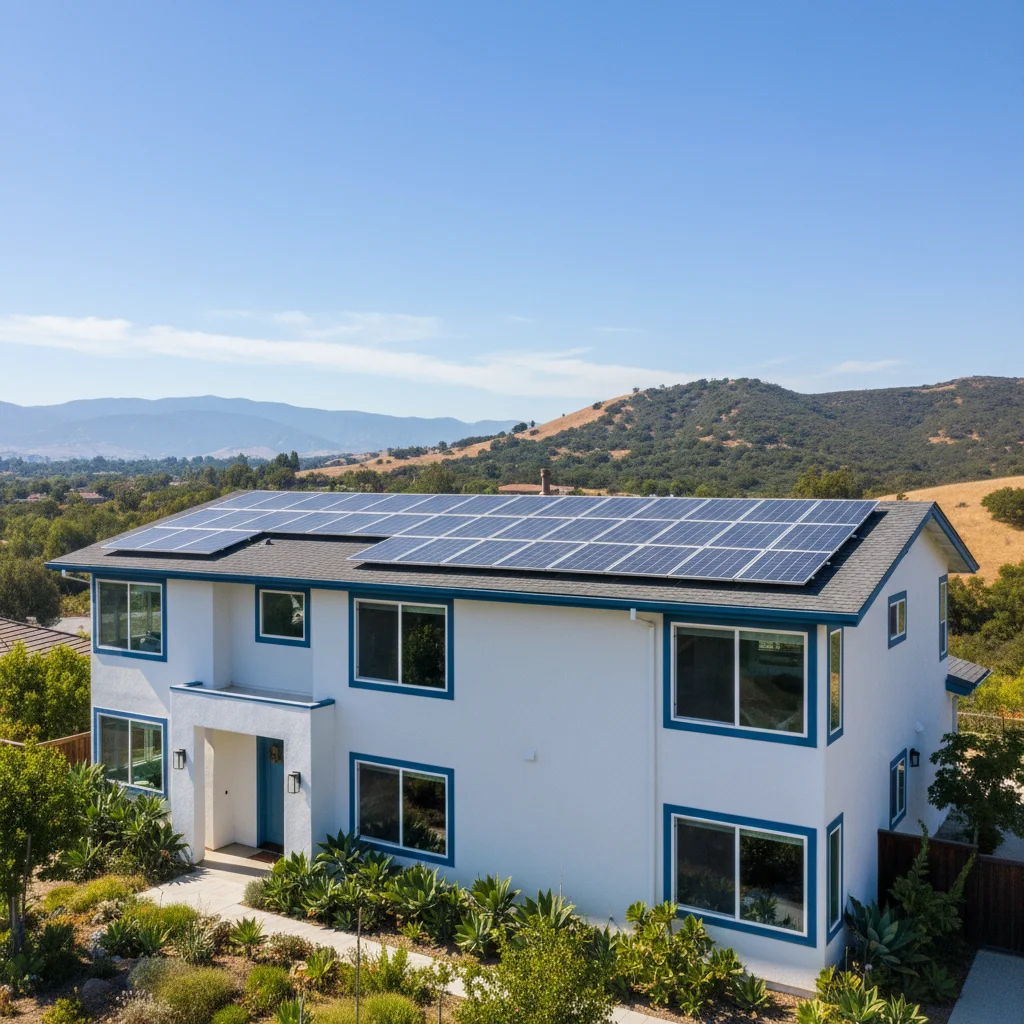
Inland Empire homeowners paid an average of $18,640 for a 6-kilowatt solar system in early 2026—down 23% from 2024 levels. And that's before applying the 30% federal tax credit and California's Net Energy Metering 3.0 structure, which together can cut first-year costs below $11,000 for qualified households.
How much does solar panel installation cost in the Inland Empire in 2026?
Residential solar installations in the Inland Empire range from $2.75 to $3.45 per watt in 2026, resulting in total system costs of $16,500 to $27,600 for typical 6-8 kilowatt arrays. These figures reflect equipment, labor, permitting, and grid interconnection fees across Riverside and San Bernardino counties.
So why does the Inland Empire see lower solar costs than coastal California? Lower permitting fees, faster inspection timelines, and higher competition among regional installers drive the 12-18% price advantage compared to Los Angeles or Orange County markets. And that cost gap matters—Inland Empire households using 900-1,100 kWh monthly see complete system payback in 7-9 years versus 10-12 years in coastal areas.
Average system size in the Inland Empire runs 6.2 kilowatts, which generates approximately 9,300 kWh annually under typical Riverside-San Bernardino irradiance levels of 5.8-6.1 peak sun hours per day. Southern California Edison and Imperial Irrigation District customers in this region face average electricity rates of $0.31-$0.38 per kWh as of March 2026, making solar breakeven accelerate compared to lower-rate utility territories.
But equipment selection creates 40-50% price variation even within the same ZIP code. Tier-1 monocrystalline panels with 22% efficiency ratings and 25-year production warranties cost $0.85-$1.10 per watt, while budget polycrystalline options run $0.55-$0.70 per watt with 18-19% efficiency. Microinverter systems add $0.30-$0.45 per watt compared to string inverter configurations but deliver 8-12% higher energy harvest in partial-shade conditions common across Inland Empire neighborhoods with mature tree coverage.
Labor accounts for 18-24% of total installed cost in Riverside and San Bernardino markets. Permitting and inspection fees range from $450 to $780 depending on jurisdiction, with cities like Riverside and Ontario charging flat fees while unincorporated county areas use percentage-based structures.
What factors affect solar installation pricing for Inland Empire homeowners?
Roof complexity, shading patterns, electrical panel capacity, and permitting jurisdiction create the widest cost variance among Inland Empire installations. Homes with multi-plane roofs, tile or shake materials, or steep pitches (8:12 or greater) see 18-35% higher installation labor compared to simple single-plane composition shingle installations.
Electrical panel upgrades represent the largest potential adder beyond baseline system cost. 32% of Inland Empire homes built before 1995 require 200-amp service upgrades to accommodate solar interconnection, adding $1,800-$2,600 to project totals. And properties with buried utility service or complex meter configurations face additional grid interconnection costs of $650-$1,200.
Shading analysis determines system sizing and layout optimization. Properties with south-facing roof planes experiencing less than 15% annual shading achieve 92-96% of theoretical maximum production. But homes with significant afternoon shading from trees, adjacent structures, or terrain lose 20-35% of potential generation, requiring larger arrays or microinverter technology to recover lost production.
HOA approval processes in planned communities like Dos Lagos, Sundance, or Corona Hills add 3-8 weeks to project timelines but don't typically increase hard costs. However, architectural review requirements for equipment visibility or mounting methods occasionally mandate more expensive low-profile racking or black-on-black panel upgrades adding $800-$1,400 to standard pricing.
Financing structure affects net cost through interest expenses and origination fees. Solar loans carry 4.99-8.99% APR in 2026 markets with 12-25 year terms, while home equity products offer 7.25-9.75% rates. Lease and power purchase agreement structures eliminate upfront costs but transfer tax credit and energy tax credits benefits to the financing entity, reducing lifetime savings by 25-40% compared to owned systems.
Are you eligible for California solar rebates and tax credits in the Inland Empire?
The federal Residential Clean Energy Credit (Section 25D) ended for expenditures made after December 31, 2025, and the IRS treats an expenditure as made when installation is completed (IRS FS-2025-05). Federal tax credits for this work have ended, but state, local and utility rebates may still apply; check what is available at your address with the DuloCore rebate calculator. This Inflation Reduction Act provision replaced the expired Section 25D credit and covers equipment, labor, permitting, and interconnection fees without dollar caps.
But California eliminated its statewide solar rebate programs in 2024 after reaching grid capacity targets set in the California Solar Initiative framework. Current financial incentives center on the federal tax credit, accelerated depreciation for business installations, and utility-specific programs for income-qualified households.
CARE and FERA program participants—households at or below 200% of federal poverty guidelines—qualify for upfront capacity incentives through the DAC-SASH and SOMAH programs administered by GRID Alternatives and participating contractors. These programs provide $3.00-$3.20 per watt in direct rebates, effectively covering 65-75% of system costs for qualified Inland Empire residents in designated disadvantaged communities.
Net Energy Metering 3.0, implemented statewide in April 2023, remains the primary ongoing incentive mechanism for Inland Empire solar adopters. NEM 3.0 systems receive export compensation rates of $0.05-$0.09 per kWh depending on time-of-day and season, compared to $0.08-$0.12 under legacy NEM 2.0 structures. And that 30-40% reduction in export value extends system payback periods by 14-22 months unless paired with battery storage qualifying for separate federal tax credit treatment.
Property tax exclusion under California Revenue and Taxation Code Section 73 exempts solar installations from property value reassessment through 2026, though this provision faces 2027 sunset without legislative extension. Use our free rebate calculator to estimate your exact federal tax credit amount and monthly savings.
"California's Net Energy Metering 3.0 tariff reduced solar export compensation rates by approximately 75% compared to retail electricity rates, emphasizing the value of battery storage pairing." — California Public Utilities Commission NEM 3.0 Decision
What is the typical timeline and process for installing solar panels in the Inland Empire?
Solar installations in Riverside and San Bernardino counties follow a 6-12 week timeline from contract signature to system activation. Initial site assessment and system design require 5-10 business days, followed by permitting submission and approval spanning 2-5 weeks depending on jurisdiction workload.
Permitting timelines vary significantly across Inland Empire municipalities. Cities like Rancho Cucamonga and Murrieta operate expedited solar permit programs with 3-5 day over-the-counter approvals for standard residential installations. But unincorporated San Bernardino County areas and cities without dedicated solar review staff see 3-6 week permit processing windows.
Physical installation takes 1-3 days for typical 6-8 kilowatt residential systems once permits clear. Two-to-four-person crews complete roof mounting, electrical interconnection, and inverter commissioning in a single mobilization for straightforward projects. But tile roof removals, electrical panel upgrades, or complex multi-plane layouts extend field work to 3-5 days.
Utility interconnection represents the longest timeline variable. Southern California Edison processes Permission to Operate applications in 10-25 business days, while Imperial Irrigation District averages 15-30 days for final inspection coordination and meter programming. And municipal utilities like Riverside Public Utilities complete interconnection reviews in 7-14 days.
Final inspection by the local Authority Having Jurisdiction occurs after installation completion and before utility interconnection. Inspectors verify electrical code compliance, structural attachment adequacy, and equipment labeling. Correction notices extend timelines by 5-10 days but occur in less than 8% of properly designed and installed systems across the region.
HOA approval adds front-end timeline extensions of 15-45 days in planned communities with architectural review requirements. And properties requiring electrical service upgrades face additional utility coordination of 3-6 weeks before solar installation can proceed.
How do Inland Empire solar costs compare to other Southern California regions?
Inland Empire residential solar averages $2.95 per watt installed in 2026, representing a 14% discount compared to Los Angeles County's $3.43 per watt and an 18% savings versus Orange County's $3.60 per watt. Lower labor rates, reduced permitting costs, and higher installer competition drive the regional pricing advantage.
But San Diego County edges the Inland Empire with $2.88 per watt averages due to the region's mature solar market and streamlined municipal permitting infrastructure. And high-desert communities in northern San Bernardino County see prices as low as $2.65 per watt in areas with limited installer presence but lower operational overhead.
Permitting fees account for significant cost variance across Southern California markets. Inland Empire jurisdictions charge $450-$780 for typical residential solar permits compared to $800-$1,400 in coastal Los Angeles and Orange County cities. And inspection timelines running 40-60% shorter in Riverside and San Bernardino counties reduce installer carrying costs passed to homeowners.
Labor rate differentials contribute $0.18-$0.25 per watt to the Inland Empire cost advantage. Licensed electricians in Riverside-San Bernardino markets earn $38-$52 per hour versus $48-$68 in coastal counties, though productivity and quality standards remain comparable across regions.
Energy production value amplifies cost-per-watt comparisons. The Inland Empire's 5.8-6.1 peak sun hours daily generate 8-11% more annual kWh than coastal regions averaging 5.2-5.5 sun hours. So a $17,700 Inland Empire system producing 9,300 kWh annually delivers better $/kWh economics than an $18,900 Los Angeles system generating 8,500 kWh despite similar rated capacity.
Electricity rate structures affect payback calculations independent of installation costs. Southern California Edison territories see 7-9 year paybacks while San Diego Gas & Electric customers with $0.44-$0.52 per kWh tier-3 rates achieve 5-7 year paybacks despite higher system costs. Check our solar panel rebates guide for detailed regional incentive comparisons.
What financing options are available for solar installation in the Inland Empire?
Cash purchases eliminate interest costs and maximize lifetime savings by preserving full federal tax credit value and avoiding loan fees. Inland Empire homeowners paying $18,640 upfront for a 6-kilowatt system capture the full $5,592 federal credit and achieve 8.5-year simple payback at current electricity rates.
Solar loans from specialized lenders like Goodleap, Sunlight Financial, and Dividend Finance offer 4.99-8.99% APR with 12-25 year terms and no down payment requirements. And dealer fees of 10-20% paid by installers get rolled into loan principal, effectively increasing system cost by $1,800-$3,600 but eliminating out-of-pocket expenses at closing.
Home equity loans and HELOCs provide alternative financing with 7.25-9.75% rates in 2026 markets. These products offer tax-deductible interest for borrowers itemizing deductions but require existing home equity and may complicate future refinancing or home sale transactions.
PACE financing through Property Assessed Clean Energy programs remains available in select Inland Empire jurisdictions. PACE loans attach to property tax bills with 5-25 year terms and 6.5-9.5% effective rates. But PACE assessment priority ahead of mortgage holders creates complications for refinancing and may require payoff at property sale.
Solar leases and power purchase agreements eliminate upfront costs through 20-25 year contracts. Homeowners pay fixed monthly lease fees or per-kWh PPA rates of $0.14-$0.19 initially, typically escalating 2.9% annually. But third-party ownership structures transfer federal tax credits and depreciation benefits to investors, reducing total lifetime savings by $8,000-$14,000 compared to purchased systems.
Income-qualified programs through GRID Alternatives provide no-cost installations for households meeting CARE or FERA eligibility thresholds at or below 200% of federal poverty level. These programs deliver immediate energy savings without financing obligations or credit requirements across designated disadvantaged communities in Riverside and San Bernardino counties.
Official Sources
- U.S. Department of Energy Solar Energy Technologies Office — Federal solar research, data, and homeowner guidance
- IRS Residential Clean Energy Credit — Official federal solar tax credit documentation and eligibility rules (note: the federal 25C and 25D credits ended for projects completed after December 31, 2025)
- DSIRE California Solar Incentives Database — Comprehensive state and utility solar program tracking
Frequently Asked Questions
How much does solar panel installation cost in Inland Empire?
Residential solar systems in the Inland Empire cost $16,500-$27,600 for typical 6-8 kilowatt installations in 2026, averaging $2.75-$3.45 per watt. After applying the 30% federal tax credit, net costs drop to $11,550-$19,320. Monthly loan payments run $95-$165 for financed systems with 20-year terms at 6.5% APR.
What rebates and incentives are available for solar panels in Inland Empire?
The federal Residential Clean Energy Credit (Section 25D) ended for expenditures made after December 31, 2025, and the IRS treats an expenditure as made when installation is completed (IRS FS-2025-05). Income-qualified households at or below 200% federal poverty level access DAC-SASH and SOMAH programs providing $3.00-$3.20 per watt upfront rebates covering 65-75% of system costs through GRID Alternatives and participating contractors.
How long does it take to install solar panels in Inland Empire?
Complete solar installation timelines span 6-12 weeks from contract to system activation. Physical installation takes 1-3 days. Permitting requires 2-5 weeks depending on jurisdiction. Utility interconnection adds 10-30 days. HOA approval processes in planned communities extend front-end timelines by 15-45 days where applicable.
What are the eligibility requirements for solar rebates in Inland Empire?
Income-qualified programs require CARE or FERA enrollment demonstrating household income at or below 200% federal poverty guidelines and property location in designated disadvantaged communities mapped by CalEnviroScreen 4.0 scoring.
How much can you save with solar panels in Inland Empire?
Inland Empire homeowners using 900 kWh monthly save $210-$265 monthly on electricity bills with properly sized solar systems. Annual savings of $2,520-$3,180 deliver 7-9 year payback periods accounting for $18,640 average system cost minus $5,592 federal credit. Lifetime savings over 25 years reach $48,000-$67,000 assuming 2.9% annual electricity rate escalation.
Ready to calculate your exact solar savings? Use our rebate calculator to get personalized federal tax credit amounts, monthly payment estimates, and payback projections based on your Inland Empire property's roof characteristics and current electricity usage.
Updated: April 14, 2026 — fact-checked by DuloCore Research. About our editorial process.
Check your California solar rebate eligibility — see the programs you qualify for and the dollar amounts on our California solar rebate finder.