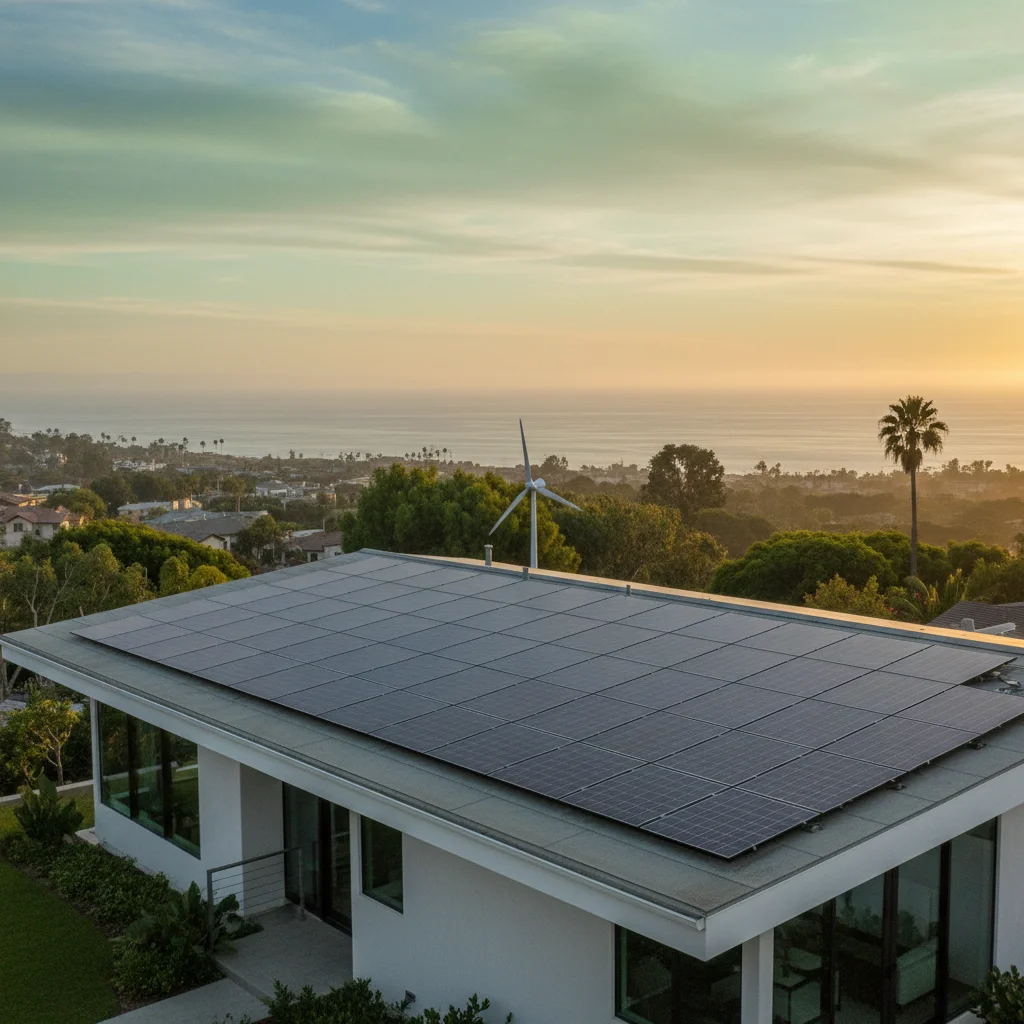
San Diego homeowners paid an average of $2.85 per watt for residential solar installations in 2025, down 18% from $3.48 per watt in 2020. But 2026 brought new federal tax credit rules and a surge in Chinese polysilicon production that dropped panel costs another 12% by February. The timing's never been better for a city that gets 266 sunny days annually.
How Much Does Solar Cost Per Watt in San Diego Right Now?
Residential solar installations in San Diego cost $2.51 to $2.89 per watt as of March 2026, with average system sizes of 6-8 kilowatts totaling $15,060 to $23,120 before incentives. Premium tier-1 panels with 25-year warranties run $2.75-$2.89 per watt, while mid-tier options start at $2.51 per watt.
And the range depends on installer overhead, panel efficiency ratings, and whether the homeowner chooses microinverters or string inverters. Tesla Solar quotes systems at $2.01 per watt installed, but excludes microinverters and premium racking. Local installers like Sullivan Solar Power and Baker Electric Solar quote $2.65-$2.89 per watt with full-service warranties and monitoring.
So what drives the gap? National installers cut costs through bulk purchasing and streamlined permitting, but local companies include design customization for San Diego's coastal microclimates and Torrey pine canopy shading. Labor accounts for 23% of total cost, permitting and inspection another 8%, and customer acquisition 11%. The panels themselves? Just 31% of the final bill.
But here's the tension: San Diego's electricity rates hit $0.47 per kWh during summer peak hours under SDG&E's TOU-DR1 plan, the highest in California. A 7-kilowatt system producing 10,500 kWh annually saves $4,935 at those rates, recovering the $17,570 upfront cost in 3.6 years after federal credits. Use our free rebate calculator to model your exact payback timeline.
"The average cost of a residential solar energy system decreased by more than 50% over the last decade." — U.S. Department of Energy
What's Your Real ROI and Payback Period with San Diego Solar Prices?
A 7-kilowatt system costing $17,570 after federal tax credits generates $4,935 annually in electricity savings at San Diego's $0.47 peak rates, achieving payback in 3.6 years. Over 25 years, the system produces $123,375 in total savings with 3% annual utility rate inflation factored in.
And that's the baseline. Homeowners who pair solar with battery storage capture additional value through SDG&E's Net Energy Metering 3.0 program, which pays $0.04-$0.09 per kWh for exports during afternoon hours but $0.47 for self-consumed power during evening peaks. A Tesla Powerwall 3 adds $11,500 upfront but unlocks $1,800 annually in time-shifted savings, cutting payback to 6.4 years for the combined system.
So California's property tax exclusion for solar installations means the $17,570 system adds zero to annual property tax bills, unlike a kitchen remodel. And home sale data from Zillow shows San Diego properties with solar panels sell for 4.1% more than comparable homes, adding $24,600 to a $600,000 home's value immediately.
But ROI calculations hinge on staying in the home long enough to hit breakeven. Homeowners who sell within three years lose money compared to monthly utility bills, while those who stay 10+ years see 600%+ returns on the net investment after credits.
Is San Diego's Climate Right for Solar Panels?
San Diego delivers 2,630 annual peak sun hours, ranking third among major California cities behind only Palm Springs and Fresno. The coastal Mediterranean climate with mild temperatures of 57-77°F year-round maximizes panel efficiency, as photovoltaic cells lose 0.5% output per degree above 77°F.
And marine layer fog covering inland valleys until 11 AM from May through August cuts morning production by 18%, but crystalline silicon panels still generate 85-92% of rated capacity on overcast days. East-facing roofs capture that first wave of post-fog sun, while west-facing arrays peak during SDG&E's 4-9 PM super-peak pricing window when rates hit $0.47 per kWh.
So compare that to Phoenix, where 115°F summer days drop panel efficiency 19% below rated specs despite higher annual sunshine. San Diego's temperate coastal climate means a 7-kilowatt system produces 10,200-10,800 kWh annually versus 9,400 kWh for an identical Phoenix installation once heat losses factor in.
But coastal homeowners within two miles of the ocean face salt spray corrosion requiring marine-grade aluminum racking and higher IP67-rated junction boxes, adding $0.12 per watt to installation costs. And that $840 premium pays off in extended 30-year system life versus 25 years for standard inland installations. Learn more about how location affects energy tax credits eligibility and system sizing.
"Solar panels work in a wide range of climates, and contrary to popular belief, don't require hot temperatures to be effective." — ENERGY STAR
How Do Solar Costs Compare to Other Renewable Energy Options in San Diego?
Rooftop solar at $2.51-$2.89 per watt delivers electricity at $0.06-$0.08 per kWh levelized cost over 25 years, beating residential wind turbines at $0.18 per kWh and small-scale geothermal at $0.22 per kWh for San Diego County installations.
And wind makes zero economic sense in coastal San Diego, where average wind speeds hit just 7.2 mph versus the 13+ mph needed for residential turbine efficiency. The one 10-kilowatt Skystream turbine installed in Ramona in 2019 generates 3,200 kWh annually, just 23% of rated capacity, at a total installed cost of $48,000 or $15 per watt.
So geothermal heat pumps work for heating and cooling, not electricity generation. A WaterFurnace 5-ton geothermal HVAC system costs $32,000 installed, saves $2,100 annually versus conventional AC, and pays back in 15.2 years. But San Diego's mild winters mean heating demand stays low, cutting geothermal's advantage over air-source heat pumps by 40% compared to Denver or Minneapolis. Explore current heat pump rebates for 2026 programs.
But community solar programs like Clean Energy Alliance's Shared Solar let renters and condo owners buy panels installed on municipal buildings at $1.89 per watt, receiving credits on electricity bills at $0.11 per kWh. That's 58% higher than rooftop solar's levelized cost but accessible to the 47% of San Diego households who can't install roof panels.
How Long Will Your Solar Panels Last and What's the Long-Term Value?
Tier-1 monocrystalline panels from manufacturers like REC, Panasonic, and LG degrade 0.3-0.4% annually, retaining 90-92% output after 25 years under San Diego's coastal climate. Premium warranties guarantee 90% production at year 25, with actual field data showing 88-94% retention for installations from 2000-2005.
And microinverters from Enphase and SolarEdge carry 25-year warranties matching panel lifespans, while string inverters last 12-15 years and require $2,200 replacement at year 13. That one-time cost eats 8.9% of lifetime savings for systems using string inverters, tilting economics toward microinverter designs despite $0.18 per watt higher upfront costs.
So aluminum racking and mounting hardware last 30+ years with zero maintenance, but coastal installations within two miles of the ocean need annual freshwater rinses to prevent salt buildup on panel surfaces. Ignoring that $120 annual cleaning drops output 2.1% per year versus the baseline 0.3% degradation rate, cutting 25-year production by 14,200 kWh worth $5,680 at current rates.
But extended warranties from installers like Sullivan Solar Power cover parts, labor, and roof penetration leaks for 25 years at $1,890 upfront, while standard workmanship warranties end at 10 years. That premium insurance pays for itself if a single roof leak repair at year 18 runs $3,200, plus it transfers to new homeowners and adds $4,100 to resale value according to 2024 Zillow data.
What Federal and State Tax Credits Can You Claim in 2026?
The federal Residential Clean Energy Credit (Section 25D) ended for expenditures made after December 31, 2025, and the IRS treats an expenditure as made when installation is completed (IRS FS-2025-05). Check current state, local and utility incentives for your address with the DuloCore rebate calculator.
And California's SGIP (Self-Generation Incentive Program) pays $200 per kWh for battery storage, delivering $2,700 for a 13.5 kWh Tesla Powerwall 3 paired with solar. Low-income households earning below $50,000 annually qualify for SGIP Equity Resiliency incentives at $850 per kWh, or $11,475 for the same battery, plus an additional $1,000 for solar panel installations.
So SDG&E retired its legacy net metering 2.0 program in April 2023, replacing it with NEM 3.0 that pays $0.04-$0.09 per kWh for solar exports versus the old retail rate credit of $0.35 per kWh. Homeowners who grandfathered into NEM 2.0 before the cutoff see $1,840 higher annual savings on identical systems, recovering installation costs 2.1 years faster.
But the federal credit applies to both panels and batteries installed together, covering 30% of a $29,070 combined system for $8,721 in tax liability reduction. And credits roll forward if annual tax liability is less than the credit amount, so retirees with $4,200 tax bills claim $4,200 in 2026 and the remaining $4,521 in 2027. Calculate your exact incentive stack with our rebate calculator.
Official Sources
- U.S. Department of Energy: Solar Tax Credit Guide — Federal tax credit eligibility, rates, and claiming procedures for residential solar installations. (note: the federal 25C and 25D credits ended for projects completed after December 31, 2025)
- ENERGY STAR Solar Information — Climate performance data and efficiency ratings for photovoltaic systems.
- DSIRE USA: California Solar Incentives — Database of state, local, and utility solar rebate programs updated monthly.
Related Reading: Learn more about Solar Panel Cost Per Watt After Rebates.
Frequently Asked Questions
What is the average cost per watt for solar panels in San Diego?
Residential solar installations in San Diego average $2.51 to $2.89 per watt as of March 2026, with premium tier-1 systems at the high end and mid-tier options starting at $2.51. National installers like Tesla quote $2.01 per watt but exclude microinverters and premium warranties. A typical 7-kilowatt system costs $17,570 to $20,230 before federal tax credits.
How do solar rebates affect the final cost per watt in San Diego?
The federal Residential Clean Energy Credit (Section 25D) ended for expenditures made after December 31, 2025, and the IRS treats an expenditure as made when installation is completed (IRS FS-2025-05). California's SGIP battery incentives add $200-$850 per kWh for energy storage paired with solar.
Are solar panels cheaper per watt in San Diego compared to other California cities?
San Diego's $2.51-$2.89 per watt pricing sits 7% below Los Angeles averages of $2.69-$3.12 per watt and 14% below San Francisco's $2.92-$3.38 per watt range as of March 2026. Higher installer competition in San Diego County and lower permitting costs in unincorporated areas drive the gap. But coastal installations add $0.12 per watt for marine-grade corrosion protection.
What factors influence the cost per watt of solar installation in San Diego?
Panel efficiency ratings account for 31% of system cost, with 21%+ efficient monocrystalline cells at $2.75-$2.89 per watt versus 19% polycrystalline at $2.51 per watt. Labor costs add 23%, permitting and inspection 8%, and customer acquisition 11%. Microinverters increase cost $0.18 per watt over string inverters but eliminate single-point failure risk and extend warranties from 12 to 25 years.
Do solar panel costs per watt in San Diego qualify for federal tax credits?
The federal Residential Clean Energy Credit (Section 25D) ended for expenditures made after December 31, 2025, and the IRS treats an expenditure as made when installation is completed (IRS FS-2025-05). Battery storage paired with solar also qualifies. A $20,230 system generates $6,069 in tax credits, reducing net cost to $14,161 or $2.02 per watt. Credits apply to tax liability for the installation year.
Ready to see your exact savings? Use our free rebate calculator to get a personalized cost breakdown with all 2026 federal and California incentives applied. Enter your address, roof details, and current electric bill to see payback timelines and 25-year ROI for your specific San Diego location.
Last updated April 14, 2026 — reviewed by DuloCore Editorial. About our authors.
Check your California solar rebate eligibility — see the programs you qualify for and the dollar amounts on our California solar rebate finder.