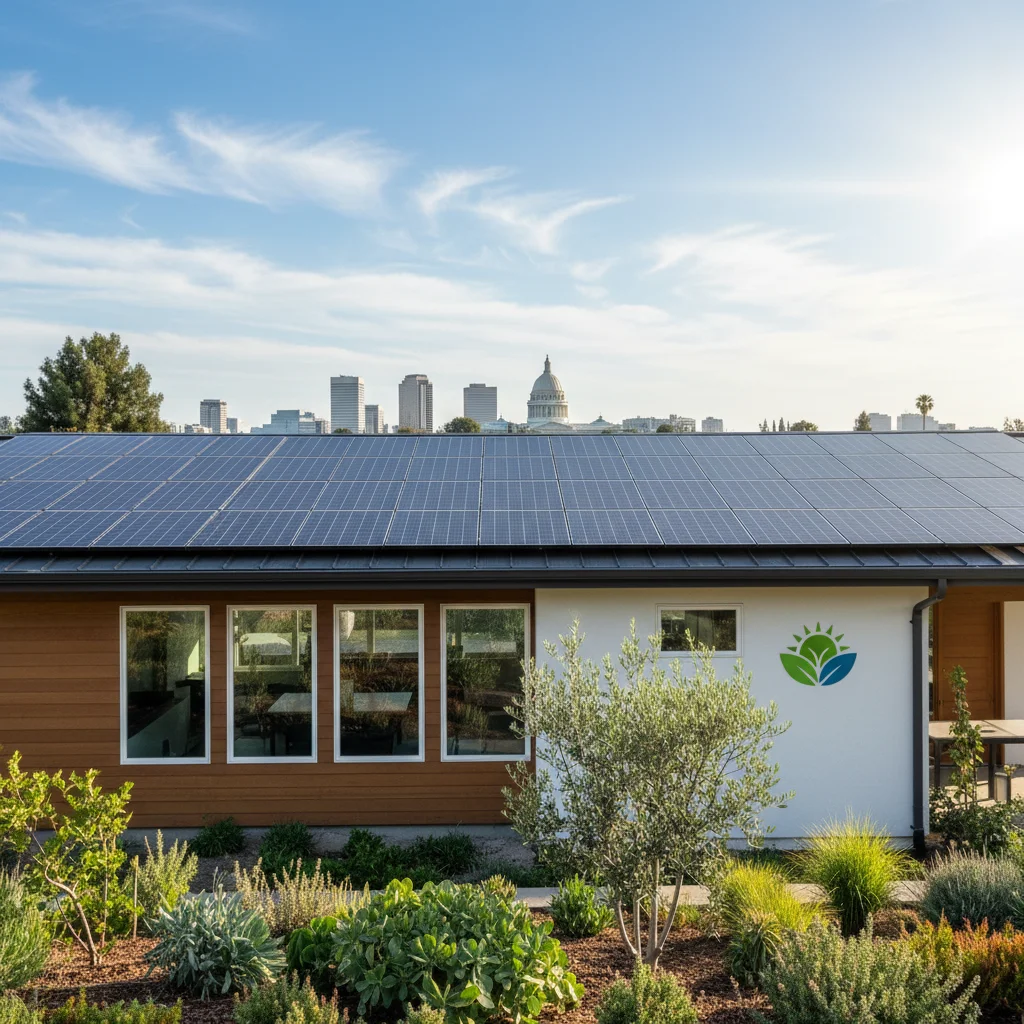
Sacramento homeowners paid between $2.50 and $3.20 per watt for solar panel installations in early 2026, according to EnergySage marketplace data. And that price range translates to $15,000 to $19,200 for a typical 6-kilowatt residential system before incentives. But the final cost per watt depends on panel efficiency, roof complexity, and installer markup—variables that can swing your total investment by $4,000 or more.
What Is the Average Solar Panel Cost Per Watt in Sacramento Right Now?
Sacramento's average solar panel cost sits at $2.85 per watt as of April 2026. Tier-1 panel installations from certified contractors range from $2.50 to $3.20 per watt depending on equipment quality and installer volume. Premium monocrystalline panels command $3.00 to $3.20 per watt, while polycrystalline options start at $2.50 per watt with lower efficiency ratings.
So a 6-kilowatt system averaging $2.85 per watt costs $17,100 before incentives. The federal Inflation Reduction Act (IRA) solar tax credit covers 30% of installation costs through 2032, reducing that $17,100 system to $11,970 after the credit. And Sacramento Municipal Utility District (SMUD) offers a $300 per kilowatt rebate for residential solar, adding another $1,800 in savings for the same 6-kilowatt installation.
Installer overhead accounts for 15% to 25% of per-watt pricing in Sacramento. Companies processing 50+ installations annually charge $2.50 to $2.70 per watt, while smaller contractors average $2.90 to $3.20 per watt. But larger installers sometimes cut corners on roof assessments or use lower-tier inverters to maintain volume pricing.
"The average cost of solar panels in the United States is $2.66 per watt as of 2026, with regional variation based on labor costs and permitting complexity." — National Renewable Energy Laboratory
Panel degradation rates factor into long-term cost analysis. Tier-1 panels degrade 0.3% to 0.5% annually, maintaining 85% to 90% output after 25 years. Cheaper panels degrade 0.8% to 1.2% per year, dropping to 70% to 75% efficiency by year 25—a difference that costs Sacramento homeowners $2,400 to $3,800 in lost production over system lifespan.
How Does Sacramento's Climate Zone Affect Your Solar Panel Costs and Performance?
Sacramento sits in California Climate Zone 12, characterized by hot-dry summers and mild winters. This zone delivers 5.4 to 5.8 peak sun hours daily year-round, ranking among the top 15% of U.S. metro areas for solar production. And that translates to 1,970 to 2,120 kilowatt-hours per installed kilowatt annually—20% higher than the national average of 1,640 kWh per kW.
Climate Zone 12's heat affects panel efficiency. Monocrystalline panels lose 0.3% to 0.4% efficiency per degree Celsius above 25°C. Sacramento's average summer roof temperature hits 65°C to 70°C during July and August, reducing panel output by 12% to 16% during peak heat. But annual production still exceeds cooler regions due to 280+ sunny days per year.
Roof mounting costs vary with climate zone requirements. Sacramento's dry climate eliminates the need for advanced waterproofing systems required in wetter zones, saving $300 to $500 per installation. But fire safety regulations in Urban Wildland Interface zones add $400 to $800 for setbacks and rapid shutdown equipment mandated by California's Title 24 building code.
Panel orientation matters less in Climate Zone 12 than in northern latitudes. South-facing arrays generate 100% of optimal production, but southwest-facing roofs still achieve 90% to 95% output due to extended afternoon sun. East-facing installations produce 75% to 80% of south-facing equivalents—a 20% reduction that adds $0.50 to $0.70 per watt to payback calculations.
Temperature coefficients determine Sacramento-specific panel selection. Premium panels with -0.29%/°C coefficients lose 11.6% output at 65°C roof temperature, while budget panels at -0.45%/°C drop 18% under identical conditions. That 6.4 percentage point difference costs $720 to $960 annually on a 6-kilowatt system with SMUD's $0.16 per kWh residential rate.
What's the Expected Lifespan of Solar Panels in Sacramento's Environment?
Tier-1 solar panels installed in Sacramento maintain 85% to 90% output after 25 years based on manufacturer testing data. Premium manufacturers like SunPower and LG guarantee 92% output at year 25, while mid-tier brands guarantee 80% to 85%. And the 7 to 12 percentage point difference in guaranteed output translates to $3,200 to $5,400 in lost production value over panel lifespan.
Sacramento's hot-dry climate accelerates thermal cycling—the expansion and contraction that stresses solder bonds and lamination. Panels in Climate Zone 12 experience 40% more thermal cycles than coastal California zones, increasing failure rates from 0.5% annually to 0.7% to 0.9% for mid-tier equipment. But the region's low humidity reduces corrosion risk that plagues coastal installations.
Inverter lifespan limits system longevity more than panel degradation. String inverters last 10 to 15 years in Sacramento's heat, requiring $1,200 to $2,000 replacement costs. Microinverters handle heat better, lasting 20 to 25 years but costing $0.20 to $0.35 more per watt upfront. So the $1,200 to $2,100 additional cost for microinverters on a 6-kilowatt system eliminates one inverter replacement cycle.
Warranty coverage varies significantly between installers. Premium contractors include 25-year workmanship warranties covering mounting hardware and electrical connections. Budget installers offer 5 to 10 years, leaving homeowners liable for $800 to $1,500 in repair costs if racking systems corrode or electrical terminations fail after warranty expiration.
"Solar panel degradation rates have improved from 1% annually in early systems to 0.3% to 0.5% for modern Tier-1 panels, extending effective lifespan beyond 30 years." — National Renewable Energy Laboratory
Hail and wind damage occur infrequently in Sacramento compared to Midwest and Gulf Coast regions. Climate Zone 12 averages 0.2 hail events per year with stones exceeding 1 inch diameter, versus 3 to 7 events annually in Colorado and Texas markets. And that reduces insurance claims by 85% to 90%, keeping homeowner premiums stable after solar installation.
How Do Installation Costs Break Down for Sacramento Solar Systems?
Equipment costs represent 45% to 55% of total per-watt pricing in Sacramento. Panels account for $0.60 to $0.85 per watt, inverters add $0.25 to $0.40 per watt, and racking plus electrical components contribute $0.30 to $0.45 per watt. So a $2.85 per watt system allocates $1.28 to $1.54 per watt to hardware before labor and overhead.
Labor costs range from $0.65 to $0.95 per watt depending on roof complexity. Single-story composition shingle roofs average $0.65 to $0.75 per watt for installation, while two-story tile or metal roofs cost $0.85 to $0.95 per watt due to safety equipment and slower work pace. And OSHA-compliant fall protection adds $200 to $400 per installation regardless of system size.
Permitting and inspection fees in Sacramento total $400 to $650 for residential systems. The city charges $0.065 per watt for electrical permits, adding $390 for a 6-kilowatt installation. SMUD interconnection fees run $75 to $150 depending on service panel upgrades. And Title 24 compliance documentation adds $100 to $200 in architectural stamping costs for systems exceeding 10 kilowatts.
Installer markup covers overhead, insurance, and profit margins. High-volume contractors operate on 12% to 18% margins, while boutique installers charge 25% to 35% markup. But higher margins don't guarantee superior quality—warranty strength and installer longevity matter more than price for long-term system performance.
Service panel upgrades affect 30% to 40% of Sacramento solar installations. Homes built before 2000 often require 200-amp panel upgrades costing $1,800 to $2,800. And homes with aluminum wiring need complete electrical remediation adding $3,500 to $6,500 before solar installation can proceed. Use our free rebate calculator to estimate total project costs including necessary electrical work.
What Federal and State Incentives Can Lower Your Solar Panel Costs in Sacramento?
The federal Residential Clean Energy Credit (Section 25D) ended for expenditures made after December 31, 2025, and the IRS treats an expenditure as made when installation is completed (IRS FS-2025-05). Federal tax credits for this work have ended, but state, local and utility rebates may still apply; check what is available at your address with the DuloCore rebate calculator. A $17,100 system qualifies for a $5,130 credit claimed on 2026 tax returns. And the credit covers equipment, labor, permitting, and sales tax—everything except financing costs or post-installation monitoring systems.
SMUD's SolarShares program pays $300 per kilowatt for residential installations, capping at $3,000 per household. A 6-kilowatt system earns $1,800 from SolarShares, stacking with the federal ITC for combined savings of $6,930. But SolarShares funding depletes by mid-year most cycles, requiring early application to secure rebates.
California's Self-Generation Incentive Program (SGIP) covers battery storage paired with solar. Residential lithium-ion batteries qualify for $200 to $250 per kilowatt-hour depending on equity program eligibility. A 13.5-kilowatt-hour battery earns $2,700 to $3,375 through SGIP, reducing effective storage costs by 35% to 45%.
The federal Residential Clean Energy Credit (Section 25D) ended for expenditures made after December 31, 2025, and the IRS treats an expenditure as made when installation is completed (IRS FS-2025-05).
Property tax exemptions protect Sacramento homeowners from assessment increases. California excludes solar installations from property tax valuations through 2026 under Revenue and Taxation Code Section 73. And a $20,000 system adding $18,000 in post-incentive home value generates $0 in additional property taxes, saving $180 to $240 annually compared to other home improvements.
Net metering through SMUD credits excess solar production at retail rates. Homeowners banking 1,000 kilowatt-hours during summer receive $160 in credits applied to winter bills when production drops. But NEM 3.0 reforms reduced export credits to $0.08 to $0.10 per kWh for new interconnections after April 2023, cutting annual savings by 40% to 50% compared to legacy NEM 2.0 customers.
How Do Sacramento Solar Quotes Compare to Other California Cities?
Sacramento's $2.85 per watt average sits 8% below San Francisco's $3.10 per watt and 12% below Los Angeles's $3.25 per watt. And the gap widens for premium installations—Sacramento's $3.20 high end compares to $3.60 in Bay Area markets and $3.75 in Southern California coastal cities. Labor costs drive most of the difference, with Sacramento electricians earning 15% to 20% less than coastal counterparts.
Fresno and Bakersfield quote $2.60 to $2.90 per watt, matching or slightly undercutting Sacramento pricing. But Central Valley installers average 20% fewer installations annually than Sacramento companies, suggesting lower market maturity and potentially less competitive pricing pressure. And permit fees run $100 to $200 lower in Fresno and Bakersfield compared to Sacramento's municipal requirements.
San Diego installations average $3.15 to $3.50 per watt due to complex permitting and higher labor rates. San Diego County requires additional fire marshal inspections adding $150 to $300 per installation, while union labor requirements in some jurisdictions push wages 25% to 30% above Sacramento levels. So a system costing $17,100 in Sacramento runs $18,900 to $21,000 in San Diego before incentives.
Equipment costs remain consistent across California metros—$1.30 to $1.55 per watt regardless of location. Panel manufacturers don't adjust pricing by region, and inverter costs vary less than 5% statewide. But soft costs—labor, permitting, insurance, overhead—swing total pricing by $0.40 to $0.90 per watt between markets based on local regulatory complexity and contractor competition.
Sacramento's faster permitting process reduces installer carrying costs. The city issues permits within 7 to 10 business days versus 15 to 25 days in Los Angeles and San Francisco. And shorter permit timelines save installers $200 to $400 in project management overhead, allowing slightly lower per-watt pricing while maintaining equivalent margins.
Official Sources
- U.S. Department of Energy Solar Tax Credit Guide — Federal solar tax credit details and claiming instructions (note: the federal 25C and 25D credits ended for projects completed after December 31, 2025)
- National Renewable Energy Laboratory Solar Research — Solar panel performance data and cost analysis
- Database of State Incentives for Renewables & Efficiency — Comprehensive database of federal and state solar incentives
Related Reading: Learn more about Solar Panel Cost Per Watt After Rebates.
Frequently Asked Questions
How much do solar panels cost per watt in Sacramento?
Sacramento solar panels cost $2.50 to $3.20 per watt as of April 2026, with the average installation running $2.85 per watt. Premium monocrystalline panels reach $3.00 to $3.20 per watt, while polycrystalline options start at $2.50 per watt. A typical 6-kilowatt residential system costs $17,100 before federal and state incentives.
What factors affect the cost per watt for solar panels in Sacramento?
Panel efficiency, roof complexity, installer volume, and equipment tier drive per-watt pricing. Premium panels with -0.29%/°C temperature coefficients cost $0.40 to $0.50 more per watt than budget options. Two-story or tile roofs add $0.20 to $0.30 per watt in labor costs. High-volume installers charge $2.50 to $2.70 per watt versus $2.90 to $3.20 for boutique contractors.
Are there rebates or incentives that reduce solar panel costs in Sacramento?
The federal Residential Clean Energy Credit (Section 25D) ended for expenditures made after December 31, 2025, and the IRS treats an expenditure as made when installation is completed (IRS FS-2025-05). SMUD's SolarShares program pays $300 per kilowatt up to $3,000 per household. Combined, these incentives reduce a $17,100 system to $10,170 after the $5,130 federal credit and $1,800 SMUD rebate. California's SGIP program covers battery storage at $200 to $250 per kilowatt-hour.
How does Sacramento's solar panel cost per watt compare to other California cities?
Sacramento's $2.85 average sits 8% below San Francisco ($3.10) and 12% below Los Angeles ($3.25). San Diego averages $3.15 to $3.50 per watt due to complex permitting. Fresno and Bakersfield match Sacramento at $2.60 to $2.90 per watt. Labor costs account for most variation, with Sacramento electricians earning 15% to 20% less than coastal markets.
What is the typical payback period for solar panels in Sacramento based on cost per watt?
Sacramento solar systems achieve 6 to 9 year payback periods with current $2.85 per watt pricing and incentives. A $17,100 system drops to $10,170 after federal and SMUD incentives, generating $1,280 to $1,440 annually with SMUD's $0.16 per kWh rates and 5.6 peak sun hours daily. Homes with higher electricity usage see 5 to 7 year paybacks, while modest users extend to 8 to 10 years.
Ready to calculate your solar savings? Use our free rebate calculator to estimate costs, incentives, and payback periods for your Sacramento home. Get instant quotes from certified installers and maximize your 2026 tax credits.
Last updated April 14, 2026 — reviewed by DuloCore Editorial. About our authors.
Check your California solar rebate eligibility — see the programs you qualify for and the dollar amounts on our California solar rebate finder.