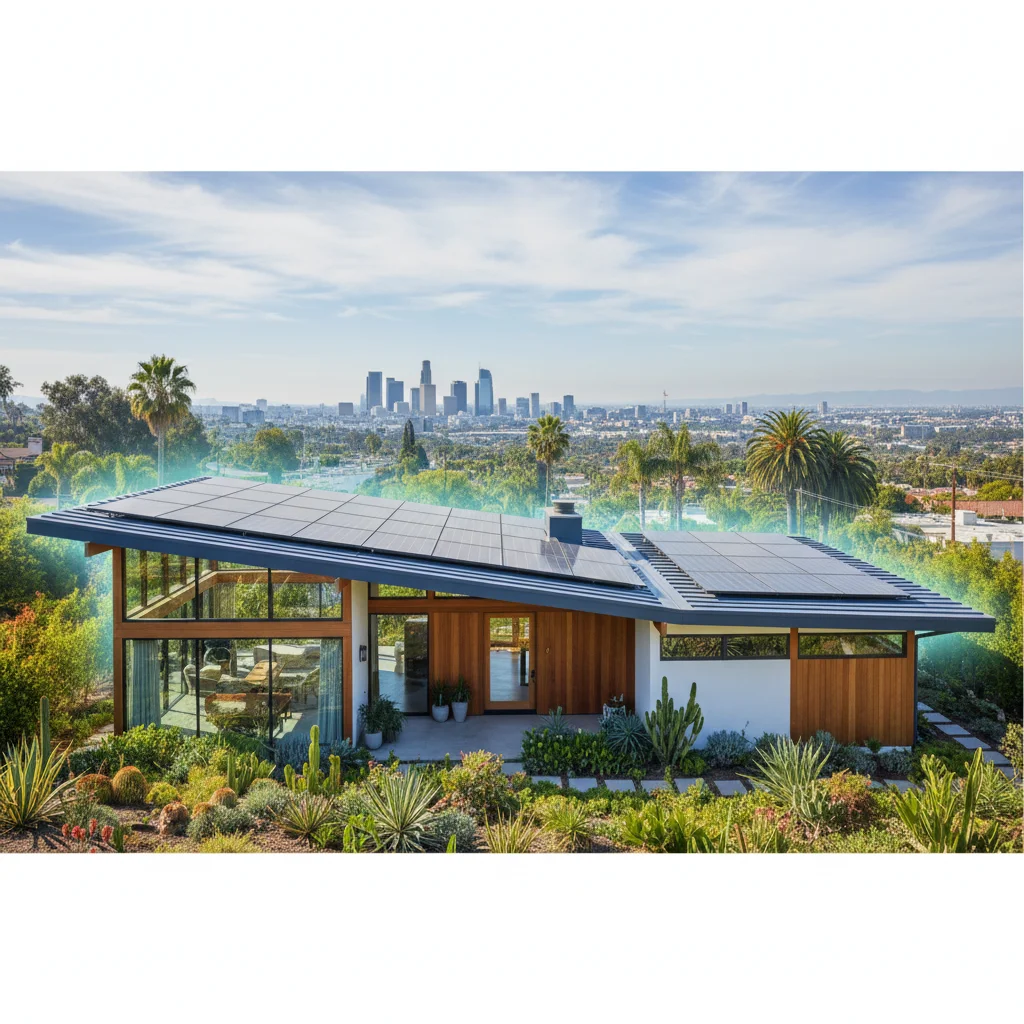
Los Angeles homeowners paid an average of $2.89 per watt for solar panel installations in 2026, down from $3.12 per watt in 2023. That 7.4% price drop reflects intensifying competition among installers, improved panel efficiency, and streamlined permitting in LA County. For a typical 6-kilowatt residential system, that translates to $17,340 before incentives—or $12,138 after the federal tax credit.
What Is the Average Cost Per Watt for Solar Panels in Los Angeles in 2026?
Los Angeles residential solar installations in 2026 cost $2.89 per watt on average, with system prices ranging from $2.62 to $3.18 per watt depending on equipment quality, installer overhead, and roof complexity. This reflects a 7.4% decline from 2023 pricing due to panel manufacturing scale and regional installer competition.
The cost per watt metric measures the total installed system price divided by nameplate capacity in watts. A 6-kilowatt system at $2.89 per watt costs $17,340 before incentives. And that price includes panels, inverters, mounting hardware, labor, permitting, and interconnection fees. But roof obstructions like skylights or multiple roof planes can add $0.18 to $0.35 per watt in labor costs. So homeowners with complex roof geometries often see quotes closer to $3.10 per watt.
Premium equipment like microinverters or bifacial panels typically adds $0.22 to $0.40 per watt compared to string inverter systems with monocrystalline panels. Los Angeles Department of Water and Power (LADWP) territory installations average $2.94 per watt, slightly higher than Southern California Edison (SCE) service areas at $2.86 per watt, reflecting differences in interconnection requirements.
"The average cost of a residential solar installation in California is $2.85 per watt before incentives." — National Renewable Energy Laboratory
How Does Los Angeles Solar Panel Cost Per Watt Compare to National Averages?
Los Angeles solar costs in 2026 run 6.3% higher than the national average of $2.72 per watt but 3.8% lower than the California statewide average of $3.01 per watt. Dense installer competition in LA County drives prices below San Francisco ($3.18 per watt) and San Diego ($2.97 per watt) while permitting complexity keeps them above Phoenix ($2.48 per watt).
Labor costs account for the primary regional variation. LA County requires both building permits and electrical permits for rooftop solar, adding $450 to $720 in permitting fees compared to $280 to $450 in Riverside County. And union labor prevails in 62% of Los Angeles installations versus 34% statewide, adding $0.14 to $0.21 per watt in labor costs.
But high electricity rates justify the premium. LADWP residential customers pay $0.28 per kilowatt-hour on average, and SCE tiered rates reach $0.42 per kilowatt-hour for heavy users. So a $17,340 system in Los Angeles generates $2,420 in annual electricity savings compared to $1,680 for the same system in Phoenix, where rates average $0.13 per kilowatt-hour. Check our rebate calculator to estimate your specific savings based on current utility rates.
Texas installations average $2.51 per watt, and Florida runs $2.64 per watt. New York leads at $3.28 per watt due to union labor requirements and cold-weather installation challenges.
What Factors Affect Solar Panel Pricing Per Watt in the Los Angeles Area?
Five cost drivers determine per-watt pricing in Los Angeles: equipment quality ($0.45 to $0.72 per watt), installer overhead and profit margin ($0.38 to $0.54 per watt), roof characteristics ($0.12 to $0.38 per watt), permitting complexity ($0.08 to $0.12 per watt), and system size economies of scale.
Panel efficiency directly impacts cost per watt. Tier 1 monocrystalline panels rated at 400 watts cost installers $0.48 to $0.62 per watt wholesale, while 350-watt polycrystalline panels run $0.34 to $0.44 per watt. And microinverters add $0.28 to $0.35 per watt compared to string inverters with power optimizers at $0.18 to $0.24 per watt.
Roof pitch, orientation, and material alter installation complexity. Composite shingle roofs on 4/12 to 6/12 pitch allow standard racking at baseline cost. But tile roofs add $0.18 to $0.28 per watt for tile removal and flashing, and flat roofs require ballasted racking at $0.22 to $0.32 per watt premium. So a 6-kilowatt system on a Spanish tile roof costs $1,080 to $1,680 more than the same system on composition shingles.
System size drives per-watt economies. A 4-kilowatt system averages $3.12 per watt due to fixed permitting and interconnection costs, while a 10-kilowatt system drops to $2.68 per watt. Installer overhead—sales commissions, showroom costs, marketing—typically represents $0.42 to $0.58 per watt of the total price.
LADWP interconnection requires separate electrical and fire department plan reviews adding 14 to 21 days to permitting timelines compared to 7 to 12 days in unincorporated LA County areas.
How Long Do Solar Panels Last and What Does That Mean for Your Cost Per Watt Investment?
Solar panels manufactured in 2026 carry 25-year performance warranties guaranteeing 85% to 88% of nameplate capacity after 25 years, with actual operational lifespans reaching 30 to 35 years before efficiency degradation necessitates replacement. Tier 1 manufacturers warrant 92% output at year 10 and 85% at year 25, translating to 0.45% to 0.55% annual degradation rates.
A $17,340 system generating 9,240 kilowatt-hours annually at LA's average irradiance saves $2,587 per year at $0.28 per kilowatt-hour. And that yields a 6.7-year simple payback period before incentives, or 4.8 years after the 30% federal tax credit. Over 25 years, accounting for 0.5% annual degradation and 3.2% average annual electricity rate increases, the system generates $89,460 in electricity savings against the $17,340 upfront cost.
Inverters represent the primary maintenance expense. String inverters last 10 to 15 years and cost $1,200 to $2,200 to replace for a 6-kilowatt system. Microinverters carry 25-year warranties but cost $2,400 to $3,600 to replace an entire array. So total 25-year ownership costs including one inverter replacement run $18,540 to $19,740 for string inverter systems versus $17,340 for microinverter systems with no mid-life replacement.
Panel degradation means year-25 output drops to 7,854 kilowatt-hours for a system initially producing 9,240 kilowatt-hours. But compounding electricity rate increases offset degradation—$0.28 per kilowatt-hour in 2026 becomes $0.62 per kilowatt-hour by 2051 at 3.2% annual growth.
"Modern solar panels degrade at approximately 0.5% per year, retaining 87.5% of original capacity after 25 years." — National Renewable Energy Laboratory
What Tax Credits and Rebates Can Reduce Your Effective Cost Per Watt in Los Angeles?
The federal Residential Clean Energy Credit covers 30% of installed solar costs through 2032, reducing effective Los Angeles pricing from $2.89 per watt to $2.02 per watt after the credit. A $17,340 system generates a $5,202 federal tax credit claimed on Form 5695 for the tax year of installation.
California's Solar on Multifamily Affordable Housing (SOMAH) program provides upfront incentives for qualifying low-income multifamily properties but doesn't apply to single-family homes. And the state's Self-Generation Incentive Program (SGIP) covers battery storage at $200 to $850 per kilowatt-hour but excludes standalone solar. So most Los Angeles homeowners rely solely on the federal credit.
LADWP's Solar Incentive Program expired in 2024. But SCE's Net Energy Metering 3.0 (NEM 3.0) tariff allows solar exports at $0.05 to $0.09 per kilowatt-hour during off-peak hours and $0.18 to $0.31 per kilowatt-hour during peak summer afternoons. Net metering doesn't reduce upfront costs but improves 25-year return on investment by $8,200 to $14,600 for a typical 6-kilowatt system.
Property tax exclusion under California's AB 1451 prevents solar installations from increasing assessed property value through 2027, saving $140 to $220 annually on a $17,340 system. And solar equipment qualifies for the federal tax credit even when financed—the credit applies in the year of installation regardless of payment method.
Low-income homeowners in CARE or FERA utility discount programs don't receive additional solar incentives but benefit from higher baseline electricity rates, improving payback economics. Use our energy tax credits guide to understand combined federal incentives.
What Is the Typical Installation Timeline and Process for Solar in Los Angeles?
Los Angeles residential solar installations take 45 to 75 days from contract signing to permission-to-operate, with permitting consuming 21 to 35 days, equipment procurement requiring 7 to 14 days, and physical installation spanning 1 to 3 days. LADWP interconnection adds 7 to 12 days post-installation compared to 3 to 7 days in SCE territory.
The process follows six phases. Initial site assessment and system design take 3 to 7 days, including roof measurements, shade analysis, and electrical panel evaluation. Contract execution and financing approval require 2 to 5 days. Building and electrical permit applications submitted to LA County or city building departments take 18 to 28 days for approval, with LADWP Fire Department review adding 5 to 9 days for rooftop access compliance.
Equipment orders ship within 7 to 14 days for in-stock panels and inverters. Installation crews complete mounting, panel placement, inverter installation, and electrical connections in 6 to 18 hours for systems under 8 kilowatts. And inspections occur 3 to 7 days after installation, covering structural, electrical, and fire safety compliance.
Utility interconnection applications to LADWP or SCE require meter replacement and final approval. LADWP issues permission-to-operate in 7 to 12 days after passing inspection. SCE completes interconnection in 3 to 7 days. But HOA approval can add 14 to 45 days in master-planned communities, though California's Solar Rights Act limits HOA authority to deny installations.
Seasonal factors affect timelines. June through August installations face 8 to 12 day permitting delays due to peak volume. December installations encounter holiday processing slowdowns adding 5 to 9 days. So contracts signed in March typically achieve permission-to-operate by mid-May, while November contracts may extend into February.
Official Sources
- DOE Solar Energy Technologies Office — Federal solar research, data, and homeowner resources including cost trends
- Federal Solar Tax Credit Guide — Complete IRS Form 5695 instructions and credit eligibility requirements (note: the federal 25C and 25D credits ended for projects completed after December 31, 2025)
- DSIRE California Solar Incentives — Database of state and utility solar rebates, net metering policies, and financing programs
Related Reading: Learn more about Solar Panel Cost Per Watt After Rebates.
Frequently Asked Questions
How much does solar cost per watt in Los Angeles?
Los Angeles solar installations in 2026 average $2.89 per watt, with typical range from $2.62 to $3.18 per watt depending on equipment quality, roof complexity, and installer. A 6-kilowatt system costs $17,340 before the 30% federal tax credit, or $12,138 after the credit. Premium equipment like microinverters adds $0.22 to $0.40 per watt, and tile roofs increase costs by $0.18 to $0.28 per watt.
What factors affect solar panel pricing in Los Angeles?
Five factors drive Los Angeles solar pricing: equipment quality ($0.45 to $0.72 per watt), installer overhead and margin ($0.38 to $0.54 per watt), roof characteristics ($0.12 to $0.38 per watt), permitting complexity ($0.08 to $0.12 per watt), and system size. Tile roofs add $1,080 to $1,680 for 6-kilowatt systems compared to composition shingles. LADWP interconnection requires additional fire department review adding 5 to 9 days and $120 to $180 in fees.
Are there federal tax credits available for solar in Los Angeles?
The federal Residential Clean Energy Credit (Section 25D) ended for expenditures made after December 31, 2025, and the IRS treats an expenditure as made when installation is completed (IRS FS-2025-05). A $17,340 system generates a $5,202 tax credit, reducing effective cost to $12,138. The credit applies to equipment, labor, permitting, and interconnection fees. And California's property tax exclusion prevents solar from increasing assessed value through 2027.
How do Los Angeles solar costs compare to other states?
Los Angeles pricing at $2.89 per watt runs 6.3% above the national average of $2.72 per watt but 3.8% below California's statewide average of $3.01 per watt. Texas averages $2.51 per watt, Florida $2.64 per watt, and New York $3.28 per watt. But Los Angeles electricity rates at $0.28 per kilowatt-hour for LADWP customers justify the premium—annual savings reach $2,420 compared to $1,680 for identical systems in Phoenix.
What is the typical payback period for solar panels in Los Angeles?
Los Angeles solar systems achieve 4.8-year payback periods after the 30% federal tax credit, or 6.7 years before incentives, based on $0.28 per kilowatt-hour LADWP rates and 9,240 kilowatt-hours annual production for 6-kilowatt systems. SCE territory customers on upper-tier rates see 4.2 to 4.6 year paybacks due to $0.42 per kilowatt-hour peak pricing. Over 25 years, accounting for 0.5% annual degradation and 3.2% electricity rate inflation, systems generate $89,460 in savings against $17,340 upfront cost. Explore additional savings with heat pump rebates when upgrading multiple home systems.
Ready to see how much you'll save with solar? Use our free rebate calculator to get a personalized estimate of your solar costs, federal tax credits, and 25-year savings based on your roof size, utility rates, and electricity usage. Get your custom solar analysis in 60 seconds.
Last reviewed: April 14, 2026. Reviewed by DuloCore Energy Specialists. About the team.
Check your California solar rebate eligibility — see the programs you qualify for and the dollar amounts on our California solar rebate finder.