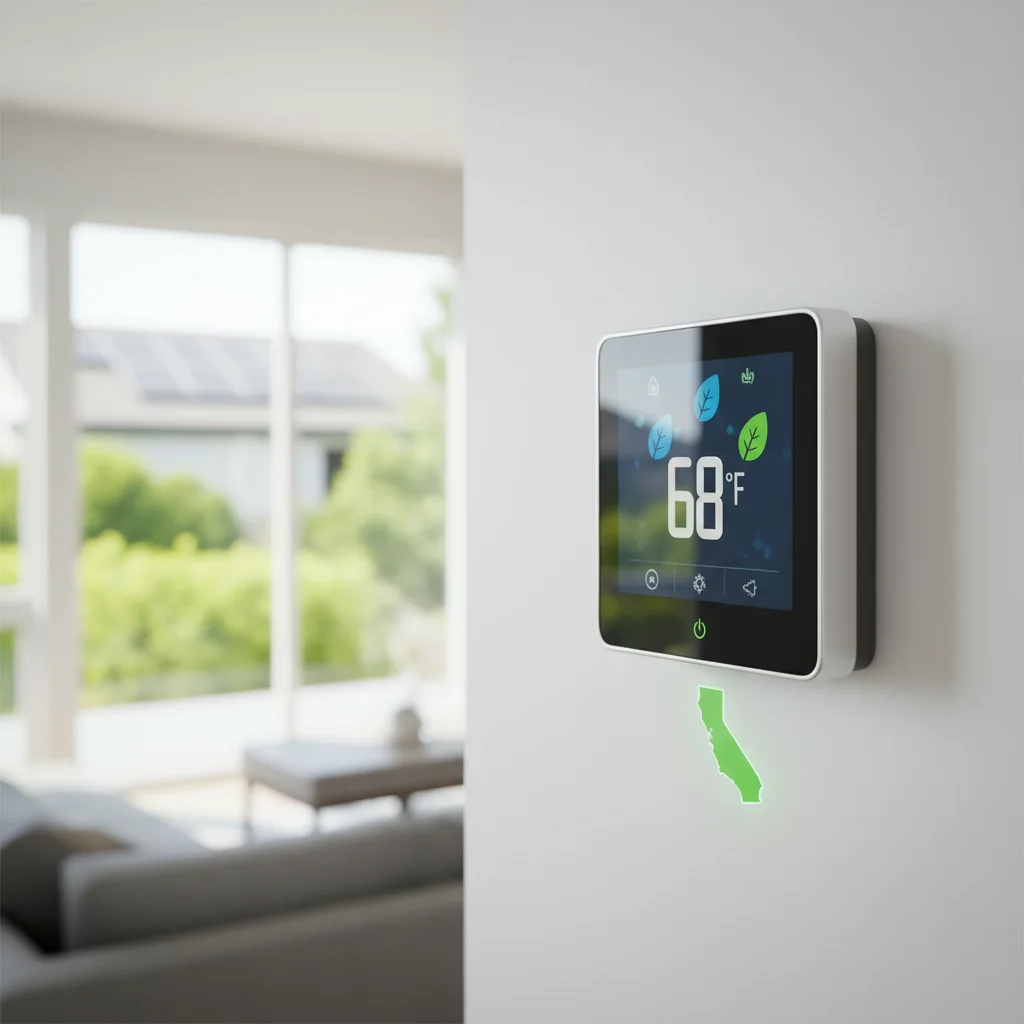
California homeowners who upgraded to smart thermostats in 2026 claimed utility incentives—but only 31% of eligible households applied. And many left thousands more on the table by failing to stack these rebates with other energy efficiency programs running through December 2026.
What Smart Thermostat Rebates Are Available in California Right Now?
California smart thermostat rebates in 2026 include utility-specific instant rebates ranging from $50 to $120 and regional energy efficiency programs offering additional $75 to $100 incentives through December 31, 2026, administered by participating utilities across 58 counties; federal tax credits no longer apply (IRS FS-2025-05).
California's smart thermostat rebate landscape splits into three tiers. The federal Energy Efficient Home Improvement Credit (Section 25C) ended for property placed in service after December 31, 2025 (IRS FS-2025-05). Federal tax credits for this work have ended, but state, local and utility rebates may still apply; check what is available at your address with the DuloCore rebate calculator. Pacific Gas & Electric offers $75 instant rebates for ENERGY STAR certified models installed by registered contractors. And Southern California Edison provides tiered rebates: $50 for standard smart thermostats and $120 for models with advanced demand response capabilities.
"Smart thermostats that connect to utility demand response programs reduce peak energy consumption by 10-15% annually" — ENERGY STAR
But the value proposition extends beyond the rebate check. The technology itself cuts heating and cooling costs by 10-23% per year according to Department of Energy testing—translating to $131 to $145 in annual savings for California households. So a $250 smart thermostat installation becomes net-positive within 18 months even before factoring in rebate payments.
How Much Money Can You Actually Save with California Smart Thermostat Rebates?
California smart thermostat rebates deliver $125 to $320 in direct payments depending on utility territory and device capabilities, plus $131 to $145 in annual energy cost reductions verified by DOE testing, creating total first-year value of $256 to $465 per installation in 2026.
The math changes dramatically based on geography. San Diego Gas & Electric customers in climate zone 7 receive $100 base rebates plus an additional $50 for demand response enrollment—totaling $150. Sacramento Municipal Utility District customers access $125 instant rebates with no income qualification requirements. And low-income households enrolled in CARE or FERA programs qualify for enhanced rebates reaching $200 through California's energy tax credits program.
Three-year total cost of ownership analysis shows bigger gains. A household installing a $280 Nest Learning Thermostat with PG&E rebates pays $205 after the $75 instant credit. The federal Energy Efficient Home Improvement Credit (Section 25C) ended for property placed in service after December 31, 2025 (IRS FS-2025-05). Annual energy savings of $140 mean the device pays for itself in 18 months—then generates $280 in net savings years two and three.
Or stack with heat pump rebates for combined incentives. Homeowners who install smart thermostats alongside ENERGY STAR heat pumps access utility heat pump rebates of $500 to $3,000 depending on system efficiency. The smart thermostat rebate becomes incremental savings on top of heating system upgrades.
Am I Eligible for Smart Thermostat Rebates in California?
California smart thermostat rebate eligibility requires primary residence status in participating utility territories, installation of ENERGY STAR certified devices by licensed contractors, and enrollment in utility customer accounts before equipment purchase—with income-qualified programs requiring CARE or FERA enrollment providing 20-35% enhanced rebate amounts for households earning below 200% federal poverty level.
The baseline requirement hits simple: own or rent a home in California serviced by a participating utility. Pacific Gas & Electric, Southern California Edison, San Diego Gas & Electric, and Sacramento Municipal Utility District all run active smart thermostat programs in 2026. Renters need written landlord approval for permanent thermostat installation but otherwise qualify for identical rebate amounts as homeowners.
ENERGY STAR certification acts as the technical gatekeeper. The thermostat must appear on the official ENERGY STAR product list maintained by the EPA—search the database at energystar.gov before purchasing. Models not listed fail to qualify regardless of manufacturer marketing claims. And utility-specific programs sometimes require additional certifications: SCE's $120 advanced rebate tier demands OpenADR 2.0b demand response compatibility verified through the utility's pre-approved equipment list.
Income-qualified programs expand access. CARE program participants earning up to 200% of federal poverty level ($60,000 for family of four in 2026) receive enhanced rebates reaching $200 through California utilities. FERA participants between 200-250% FPL access mid-tier rebates of $150. But documentation requirements increase: applicants submit income verification, utility bills, and proof of program enrollment 30 days before installation to receive approval.
What Documentation Do You Need to Claim Your Smart Thermostat Rebate?
California smart thermostat rebate claims require itemized purchase receipts showing device model and date, ENERGY STAR certification proof via product label photos or online database confirmation, installation verification through contractor invoices or timestamped DIY install photos, and utility account numbers matching installation addresses—submitted within 60 to 180 days depending on program administrator.
Pacific Gas & Electric's online portal demands six specific items. Upload a PDF copy of the retail receipt showing the exact thermostat model number and purchase date. Photograph the ENERGY STAR label affixed to the device packaging. Submit the completed W-9 form if claiming rebates over $600 annually. Provide contractor license numbers for professional installations or sign DIY attestation forms for self-installed units. And attach utility account statements from the month of installation proving active service at the installation address.
Form 5695 only covers qualifying work completed by December 31, 2025 and claimed on a 2025 return; the federal 25C and 25D credits ended after that date (IRS FS-2025-05).
So consolidate everything in one folder before installation. Create a dedicated email folder or Google Drive directory labeled "2026 Smart Thermostat Rebate." Scan or photograph receipts immediately after purchase before thermal paper fades. Screenshot the ENERGY STAR database confirmation page showing your model. And photograph the installed thermostat with visible model numbers before closing the wall plate.
Do You Need Pre-Approval Before Installing a Smart Thermostat?
California smart thermostat rebates require zero pre-approval for standard utility programs processing claims post-installation with 60-180 day submission windows, but income-qualified CARE and FERA enhanced rebates demand pre-approval applications submitted 30 days before purchase to verify income eligibility and reserve limited program funding allocated first-come-first-served through December 2026.
The standard workflow runs post-installation for most programs. Buy an ENERGY STAR certified smart thermostat. Install it yourself or hire a licensed contractor. Submit rebate paperwork within the utility's deadline window. Wait 6 to 8 weeks for rebate checks or bill credits. Pacific Gas & Electric, Southern California Edison, and Sacramento Municipal Utility District all operate this way in 2026—no pre-approval gatekeeping for standard residential programs.
But income-qualified programs flip the sequence. CARE participants must submit pre-approval applications through utility customer portals before purchasing equipment. Southern California Edison's enhanced rebate program requires 30-day advance notice to verify income eligibility and check remaining budget allocation. Applications submitted after installation get denied regardless of eligibility. And programs hit funding caps as early as October in high-demand territories—pre-approval locks in your rebate before budget exhaustion.
Form 5695 only covers qualifying work completed by December 31, 2025 and claimed on a 2025 return; the federal 25C and 25D credits ended after that date (IRS FS-2025-05). The federal Energy Efficient Home Improvement Credit (Section 25C) ended for property placed in service after December 31, 2025 (IRS FS-2025-05).
What Are the Deadlines for California Smart Thermostat Rebates?
California smart thermostat rebate deadlines require equipment installation and paperwork submission by December 31, 2026 for most utility programs operating on annual budget cycles, with early program closures occurring when individual utility allocations reach 85-100% capacity as early as October 2026 in high-demand service territories.
Pacific Gas & Electric's 2026 program accepts applications through December 31, 2026 or until the $18 million program budget depletes—whichever comes first. Historical data shows PG&E smart thermostat funding reaching 90% capacity by November 15 in prior years. Southern California Edison operates identical December 31 annual deadlines with mid-year funding status updates posted at sce.com/rebates. And Sacramento Municipal Utility District guarantees full-year availability with rolling budget replenishments every quarter.
Submission windows matter as much as installation deadlines. Most utilities require rebate applications within 60 to 180 days of installation date. Install a thermostat on June 15—submit paperwork by August 14 for 60-day programs or December 12 for 180-day windows. Miss the submission deadline and the rebate evaporates even if installation happened during the program year. PG&E's portal auto-rejects applications with installation dates exceeding 180 days before submission timestamp.
The federal Energy Efficient Home Improvement Credit (Section 25C) ended for property placed in service after December 31, 2025 (IRS FS-2025-05).
Can You Stack Smart Thermostat Rebates with Other California Energy Incentives?
California smart thermostat rebates stack with utility heat pump rebates, whole-home weatherization programs, and solar installation incentives without restriction in 2026—allowing homeowners to combine $75-$200 thermostat rebates with $2,000-$8,000 in coordinated heating system and efficiency upgrade incentives when timing installations within single calendar years.
The utility rebate mechanism works cleanly. Claim utility rebates first as instant discounts at point of sale or via mail-in applications. A $250 smart thermostat receiving a $75 PG&E rebate costs $175 out of pocket.
Coordination with heating system upgrades multiplies value. Homeowners installing ENERGY STAR heat pumps in 2026 access California utility rebates ranging from $500 to $3,000 depending on system efficiency. Add a smart thermostat during the same project and claim separate rebates for both devices. Use our free rebate calculator to model combined incentives across multiple upgrades. The thermostat rebate stacks on top without reducing heat pump incentive eligibility.
And don't overlook whole-home programs. California's Energy Upgrade California initiative offers $4,000 to $6,500 in combined rebates for comprehensive retrofits including insulation, air sealing, duct replacement, and smart controls. Smart thermostat rebates count as incremental incentives within these packages—not substitutes. Households completing qualifying whole-home upgrades receive standard smart thermostat rebates plus the comprehensive package bonus, sometimes totaling $8,000 in combined state and utility incentives.
Official Sources
- ENERGY STAR Smart Thermostats — Federal certification database and efficiency performance data
- Database of State Incentives for Renewables & Efficiency — Comprehensive California rebate program search tool by utility and zip code
- U.S. Department of Energy Save Energy, Save Money — Federal energy efficiency guidance and IRA tax credit information (note: the federal 25C and 25D credits ended for projects completed after December 31, 2025)
Related Reading: Learn more about Ecobee Rebates California.
Related Reading: Learn more about Smart Thermostat Rebates Sce.
Related Reading: Learn more about Smart Thermostat Rebates Pg And E.
Frequently Asked Questions
What smart thermostat rebates are available in California in 2026?
California smart thermostat rebates in 2026 include Pacific Gas & Electric's $75 instant rebates, Southern California Edison's $50-$120 tiered programs, and Sacramento Municipal Utility District's $125 incentives; federal tax credits no longer apply (IRS FS-2025-05). Income-qualified CARE participants access enhanced rebates reaching $200. All programs require ENERGY STAR certified devices.
How much can you save with a California smart thermostat rebate?
California smart thermostat rebates deliver $125 to $320 in direct payments depending on utility territory and device type, plus $131 to $145 in annual energy cost reductions verified by DOE testing. First-year total value ranges from $256 to $465 per installation when combining rebates with energy savings.
Are you eligible for California smart thermostat rebates?
California smart thermostat rebate eligibility requires primary residence status in participating utility service territories, installation of ENERGY STAR certified devices, and active utility customer accounts at installation addresses. Renters need landlord approval. Income-qualified programs require CARE or FERA enrollment for enhanced rebates reaching $200 for households below 200% federal poverty level.
What is the process for claiming a smart thermostat rebate in California?
California smart thermostat rebate claims require submitting itemized receipts, ENERGY STAR certification proof, installation verification photos or contractor invoices, and utility account numbers through online portals within 60 to 180 days of installation. Processing takes 6 to 8 weeks for rebate checks or bill credits. Income-qualified programs require 30-day pre-approval before purchase.
When do California smart thermostat rebates expire?
California smart thermostat rebate programs expire December 31, 2026 or when individual utility budgets reach 100% capacity—often occurring in October through November in high-demand territories. The federal Energy Efficient Home Improvement Credit (Section 25C) ended for property placed in service after December 31, 2025 (IRS FS-2025-05). Submission deadlines require paperwork within 60 to 180 days of installation date depending on utility administrator.
Ready to claim your rebates? Use our free rebate calculator to find every smart thermostat incentive you qualify for in 2026. Enter your zip code and utility provider to see exact rebate amounts, eligibility requirements, and step-by-step claim instructions—calculated in under 60 seconds.
Updated on April 14, 2026. Fact-checked by DuloCore Editors. About our research team.
Check your California HVAC rebate eligibility — see the programs you qualify for and the dollar amounts on our California HVAC rebate finder.