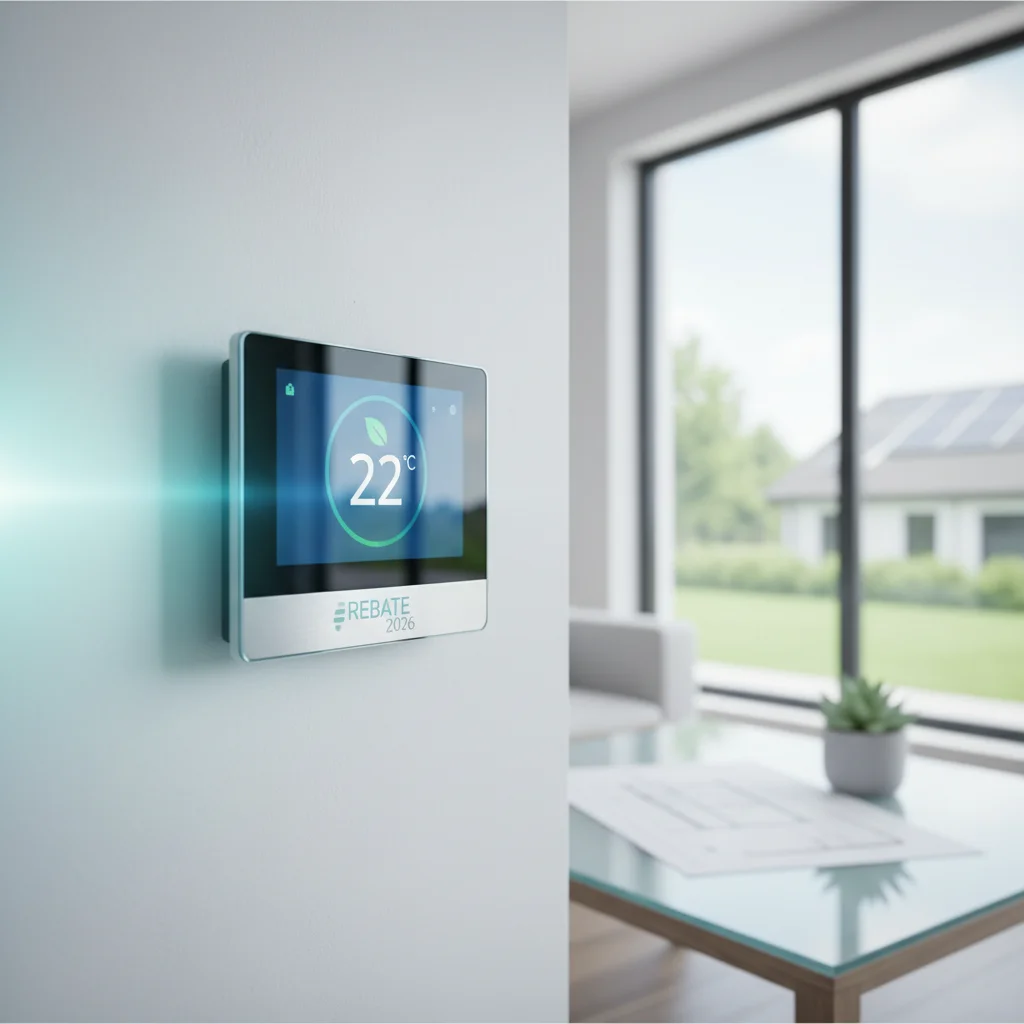
In 2026, a smart thermostat can cost a homeowner nothing out of pocket. And in some California service territories, the utility company pays you to install one—rebates reach $150 per device, with federal tax credits covering an additional 30% of installation costs under IRA provisions that extend through 2032. But most homeowners leave this money on the table because they don't know which programs stack, which utilities offer instant rebates at checkout, and which applications require a licensed HVAC contractor signature versus a simple online form.
What smart thermostat rebates are available in 2026?
California utilities offer direct cash rebates ranging from $50 to $150 per qualifying smart thermostat, with Pacific Gas & Electric, Southern California Edison, and San Diego Gas & Electric each running their own programs under the California Public Utilities Commission's 2026 energy efficiency portfolio. So a PG&E residential customer installing a Wi-Fi-enabled ENERGY STAR certified thermostat receives $85 through the utility's online marketplace, while SCE customers receive $75 for the same device. And Sacramento Municipal Utility District pays $125 for thermostats purchased through participating retailers like Home Depot and Lowe's, processed as instant point-of-sale discounts rather than mail-in forms.
The federal Energy Efficient Home Improvement Credit (Section 25C) ended for property placed in service after December 31, 2025 (IRS FS-2025-05). Federal tax credits for this work have ended, but state, local and utility rebates may still apply; check what is available at your address with the DuloCore rebate calculator. But the thermostat alone doesn't qualify for the federal credit—it must be installed alongside qualifying equipment like a heat pump or central air conditioner to meet IRS documentation requirements.
How much money can you save with smart thermostat rebates?
A homeowner installing a $250 Ecobee SmartThermostat Premium in PG&E territory saves $85 immediately through the utility rebate, reducing the net cost to $165 before any federal tax benefits. And ENERGY STAR data shows smart thermostats reduce heating and cooling costs by 8% annually, translating to $95 per year for the average California household with $1,187 in annual HVAC energy costs. So the device pays for itself in 1.7 years through energy savings alone, with the utility rebate shortening the payback period to 0.9 years.
Stacking utility rebates with federal tax credits multiplies the savings. But only installations that include qualifying HVAC equipment upgrades beyond the thermostat qualify for the 30% federal credit (this federal credit ended for property placed in service after December 31, 2025). A homeowner installing both a $250 smart thermostat and a $6,500 heat pump receives the $85 PG&E rebate on the thermostat, a separate $3,000 heat pump rebate from California's TECH Clean California program, and a federal tax credit of $2,025 (30% of the combined $6,750 equipment and installation cost). The total incentive package reaches $5,110, reducing the net cost from $6,750 to $1,640.
"Smart thermostats that have earned the ENERGY STAR label have been independently certified to save energy, saving you money on your utility bills and helping to protect the environment." — ENERGY STAR Certified Smart Thermostats
What are the eligibility requirements for smart thermostat rebates?
California utility rebates require ENERGY STAR certification, Wi-Fi connectivity, and enrollment in a demand response program that allows the utility to adjust temperature settings during peak electricity demand events. And PG&E's SmartRate and Peak Day Pricing programs offer an additional $50 annual incentive for customers who allow remote thermostat adjustments during the 12-15 highest-demand days each summer, bringing total first-year savings to $135 in rebates plus $95 in reduced energy bills.
Device compatibility matters. So thermostats must support 24-volt HVAC systems common in California single-family homes, integrate with the utility's OpenADR 2.0b demand response protocol, and maintain a customer override function that allows manual temperature control during demand response events. But not all smart thermostats meet these technical requirements—Nest Learning Thermostat, Ecobee SmartThermostat, and Honeywell T9 appear on most utility pre-qualified product lists, while budget models from Amazon Basics and Wyze don't support the required demand response integrations.
Income-qualified customers receive enhanced rebates. And California's Energy Savings Assistance Program provides free smart thermostat installation for households earning up to 250% of the federal poverty level, with no out-of-pocket cost and no application fee.
What's the deadline for claiming smart thermostat rebates in 2026?
PG&E's current smart thermostat rebate program expires December 31, 2026, with applications accepted through 11:59 PM Pacific on that date or until allocated funds run out. And SCE's program operates on a rolling quarterly budget—once the $2.4 million allocation for Q1 2026 depletes, applications go on a waitlist until Q2 funding releases on April 1. So homeowners who wait until late December risk missing the window entirely if budget caps are reached in November.
Form 5695 only covers qualifying work completed by December 31, 2025 and claimed on a 2025 return; the federal 25C and 25D credits ended after that date (IRS FS-2025-05). And installations completed in December 2026 with contractor invoices dated January 2027 don't qualify for the 2026 tax year, pushing the credit claim to the 2027 return filed in 2028.
SMUD offers year-round rebates with no hard deadline, processing applications within 6-8 weeks of submission. But the utility reserves the right to modify or terminate the program with 30 days' notice posted on smud.org/rebates.
Can you stack smart thermostat rebates with other energy incentives?
California explicitly allows stacking of utility rebates, state incentives, and federal tax credits for the same device as long as no two programs come from the same funding source. So a homeowner can combine PG&E's $85 utility rebate (funded by ratepayer surcharges), the federal 30% tax credit (this federal credit ended for property placed in service after December 31, 2025) (funded by IRS), and Bay Area Air Quality Management District's $150 Clean Air Incentive (funded by state AB 617 grants) for a single qualifying installation, totaling $310 in incentives on a $250 device.
But double-dipping within the same program category is prohibited. And customers who receive a free smart thermostat through the Energy Savings Assistance Program can't also claim the standard utility rebate for the same device, because both programs draw from CPUC-mandated energy efficiency portfolios. The ESA program functions as a 100% rebate, so no additional utility incentive applies.
Local municipalities layer additional incentives on top of state and federal programs. And the City of San Francisco offers a $200 Home Energy Score incentive for residents who complete a whole-home energy assessment that includes smart thermostat installation, bringing the total available incentive stack to $510 when combined with PG&E and federal programs. Use our free rebate calculator to find your total savings across all available programs.
What's the process for applying for and receiving your smart thermostat rebate?
PG&E customers start at pge.com/marketplace, create an account using their utility account number, select a pre-qualified smart thermostat from the online catalog, and receive the $85 rebate as an instant discount at checkout—no forms, no waiting. And thermostats ship within 3-5 business days with free installation guides, though professional HVAC contractor installation costs $150-$300 and qualifies for the federal tax credit when combined with other qualifying equipment upgrades.
SCE and SDG&E use a traditional mail-in rebate process. So customers purchase any ENERGY STAR certified smart thermostat from any retailer, complete the online application at sce.com/rebates within 180 days of purchase, upload a copy of the dated receipt showing the device make and model number, and receive a check mailed to the service address within 6-8 weeks. But applications missing required documentation or showing non-qualifying products are rejected with no appeal process.
Federal tax credits require keeping detailed records. Form 5695 only covers qualifying work completed by December 31, 2025 and claimed on a 2025 return; the federal 25C and 25D credits ended after that date (IRS FS-2025-05). Homeowners must retain all receipts and contractor invoices for three years after filing in case of IRS audit, with original documents required—photocopies aren't accepted as proof during examinations.
"Taxpayers who make qualified energy-efficient improvements to their home after Dec. 31, 2021, may qualify for a tax credit up to $3,200." — IRS Energy Incentives for Individuals
How do smart thermostat rebates compare across different utility companies?
California's three major investor-owned utilities offer different rebate structures, payment timelines, and device requirements that affect total savings by $75 or more depending on service territory. And PG&E provides the highest base rebate at $85 with instant point-of-sale discount for marketplace purchases, while SCE pays $75 through mail-in rebate processed in 6-8 weeks, and SDG&E offers $85 with a hybrid model allowing online applications for purchases made at any retailer.
Municipal utilities set their own programs independent of CPUC oversight. So SMUD pays $125 per qualifying thermostat with no demand response enrollment requirement, making it the highest cash rebate in California but available only to the 600,000 customers in Sacramento County. And Los Angeles Department of Water & Power offers $75 for ENERGY STAR thermostats plus an additional $100 for customers who enroll in the Smart Energy Program that allows utility-controlled temperature adjustments during 15-20 peak events per year.
Income-qualified programs vary by utility but generally provide better value than standard rebates. And PG&E's Energy Savings Assistance Program installs smart thermostats at zero cost for eligible households, effectively a $250-$300 rebate when including the device and installation labor, compared to the $85 standard rebate that still requires the homeowner to purchase the device.
For more information on federal energy tax credits that can be combined with utility rebates, see IRS Publication 5695.
Official Sources
- ENERGY STAR Smart Thermostats — Federal certification requirements and qualified product database
- Database of State Incentives for Renewables & Efficiency — Comprehensive directory of California utility rebate programs
- IRS Residential Energy Credits — Federal tax credit guidance for home energy improvements (note: the federal 25C and 25D credits ended for projects completed after December 31, 2025)
Related Reading: Learn more about What Is the Best Smart Thermostat for a Heat Pump in 2026? and Best Smart Thermostat Under 200 Dollars 2026.
Related Reading: Learn more about Smart Thermostat Rebates Pg And E.
Frequently Asked Questions
What smart thermostats qualify for federal rebates in 2026?
Federal tax credits don't apply to smart thermostats alone—the device must be installed as part of a qualifying HVAC system upgrade including heat pumps, central air conditioners, or furnaces exceeding $150 in total cost. Form 5695 only covers qualifying work completed by December 31, 2025 and claimed on a 2025 return; the federal 25C and 25D credits ended after that date (IRS FS-2025-05). Popular qualifying models include Ecobee SmartThermostat Premium ($249), Nest Learning Thermostat 4th Gen ($279), and Honeywell T9 ($199).
How much can you save with a smart thermostat rebate?
California homeowners save between $50 and $150 in immediate utility rebates depending on service territory, with SMUD offering the highest cash incentive at $125. The federal Energy Efficient Home Improvement Credit (Section 25C) ended for property placed in service after December 31, 2025 (IRS FS-2025-05). Total first-year value including energy bill reductions reaches $300-$400 for the average household when combining all available incentives.
Are smart thermostat rebates the same in every state?
No—California utilities operate their own rebate programs under CPUC oversight, while other states follow different structures. And federal tax credits apply nationwide but require the thermostat to be part of a larger HVAC upgrade, not a standalone purchase. California's combination of high utility rebates, stacking rules that allow federal and local incentives, and robust municipal programs creates better total savings than most other states where utility rebates average $25-$50.
What documentation do you need to claim a smart thermostat rebate?
Utility rebates require a dated sales receipt showing the device make, model number, purchase price, and retailer name, submitted through the utility's online portal within 180 days of purchase. Form 5695 only covers qualifying work completed by December 31, 2025 and claimed on a 2025 return; the federal 25C and 25D credits ended after that date (IRS FS-2025-05). Keep all original documents for three years after filing in case of IRS audit or utility verification requests.
Do smart thermostats have an expiration date for rebate eligibility in 2026?
Most California utility programs expire December 31, 2026, with applications accepted until that date or until allocated program budgets are fully claimed. And PG&E's marketplace rebates apply instantly at checkout with no post-purchase deadline, while SCE and SDG&E mail-in rebates require submission within 180 days of the purchase date shown on the receipt. The federal Energy Efficient Home Improvement Credit (Section 25C) ended for property placed in service after December 31, 2025 (IRS FS-2025-05).
Ready to find out exactly how much you can save? Use our free rebate calculator to calculate your total incentives across utility rebates, federal tax credits, and local programs. Get your personalized estimate in under 60 seconds—no email required.
Last reviewed: April 14, 2026. Reviewed by DuloCore Energy Specialists. About the team.
Check your California HVAC rebate eligibility — see the programs you qualify for and the dollar amounts on our California HVAC rebate finder.