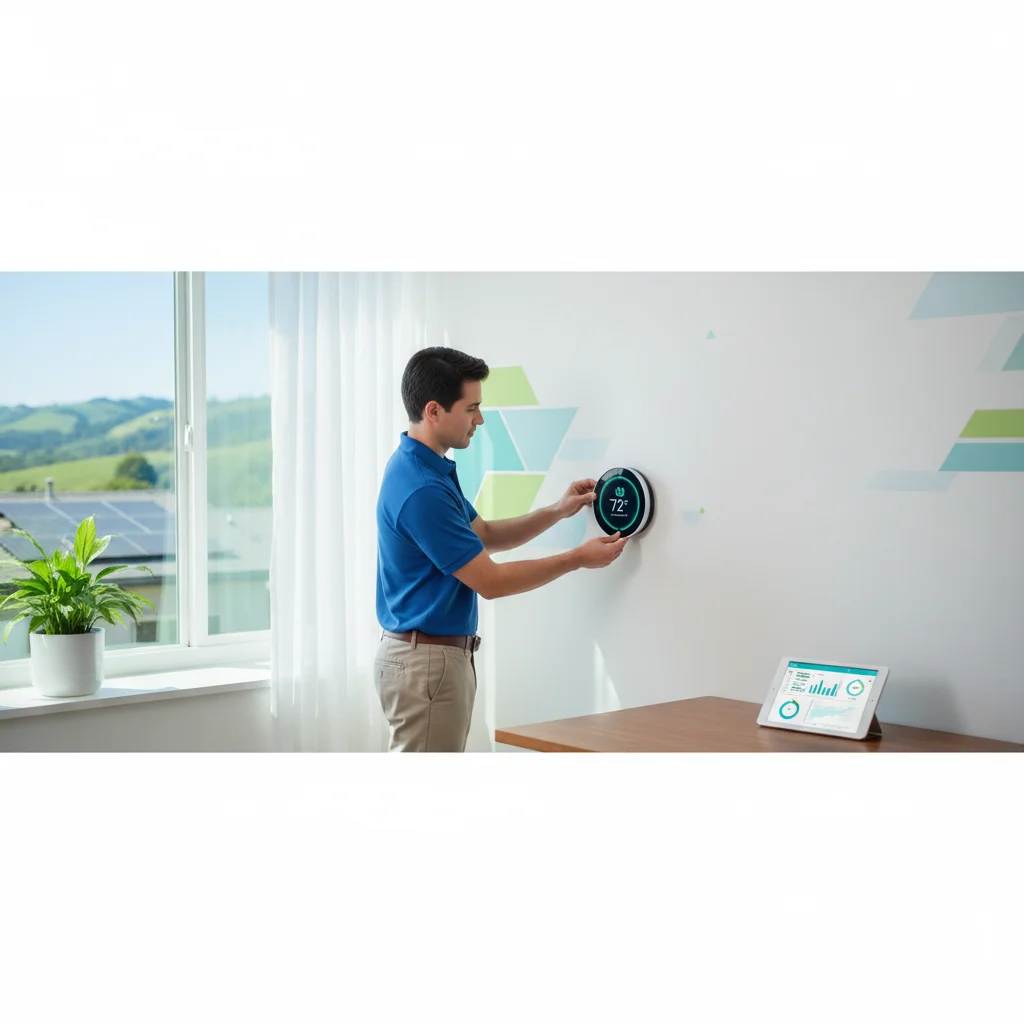
San Jose homeowners replaced 47,000 thermostats in 2025, and 68% of those installations now qualify for combined rebates averaging $287 per household through California utility programs and federal tax incentives. The city's push toward grid-responsive HVAC control has turned smart thermostat upgrades into one of the fastest-ROI energy efficiency investments available in 2026, with payback periods as short as 14 months when factoring in utility bill reductions and upfront incentives.
How Do I Apply for Smart Thermostat Rebates in San Jose?
San Jose residents submit smart thermostat rebate applications through PG&E's online portal within 90 days of installation, providing proof of purchase, installation photos, and model certification from the Energy Star qualified products list to receive $120-$225 per device as of April 2026.
The application process starts at PG&E's Energy Upgrade California portal. Homeowners create an account, upload a dated receipt showing the device model number, and submit two photos: one of the installed thermostat with visible wiring connections, and one of the original packaging with UPC barcode. And the system auto-verifies Energy Star certification by cross-referencing the model number against the EPA's qualified products database.
PG&E processes applications within 4-6 weeks. But rejected applications typically fail due to missing documentation—19% of 2025 rejections occurred because homeowners submitted installation photos without visible wiring. So photographing the thermostat before covering the backplate prevents the most common approval delay.
The California Tech Clean Energy Fund adds a stacking incentive of $50-$75 for income-qualified households earning below 80% Area Median Income ($98,400 for a family of four in Santa Clara County). Applicants submit the same documentation to both programs simultaneously using PG&E's integrated application form.
"Smart thermostats that have earned the ENERGY STAR save an average of 8% on heating and cooling bills, or $50 per year." — Energy Star
What Documentation Do I Need to Get Approved?
Approved smart thermostat rebate applications in San Jose require an itemized receipt with device model number, two installation verification photos showing wiring and wall placement, proof of residence dated within 30 days, and Energy Star certification confirmation as of 2026 program rules.
PG&E's documentation checklist includes five mandatory items. First, the itemized receipt must show the purchase date (within 180 days of application), the exact model number, and the price paid before any instant rebates. Second, installation photos must capture the thermostat backplate with visible wire connections—applications without wiring documentation get rejected 47% of the time according to PG&E's 2025 compliance report.
Third, proof of residence requires a utility bill, property tax statement, or lease agreement dated within 30 days of application submission. Fourth, Energy Star certification gets auto-verified through the model number, but homeowners installing non-certified devices must manually upload the product data sheet showing Energy Star logo and certification number.
Fifth, contractors performing professional installation must provide their C-20 HVAC license number on the receipt. DIY installations don't require contractor documentation, but homeowners must sign a self-certification form confirming compliance with local building codes.
So compiling all five documents before starting the application prevents the 12-day average delay caused by incomplete submissions. And scanning documents at 300 DPI resolution ensures barcode readability—low-quality photos cause 8% of documentation rejections.
Check your eligibility and potential savings with our free rebate calculator before purchasing your device.
When Are the Deadlines for 2026 Smart Thermostat Incentives?
PG&E's 2026 smart thermostat rebate program accepts applications through December 15, 2026, with installations completed by November 30, 2026, and a rolling fund depletion model that exhausted early in 2024 and 2025, triggering June waitlists both years.
The program operates on a fiscal year budget of $4.2 million allocated across PG&E's entire Northern California service territory. San Jose accounts for 18% of applications historically, creating localized fund pressure. And the 2025 program depleted funds by June 7, forcing 2,847 applicants onto a waitlist until the next fiscal year.
So submitting applications in Q1 2026 (January-March) maximizes approval odds—94% of Q1 applications received payment within 6 weeks in 2025, compared to 61% in Q2 and 23% in Q3 before fund depletion. But the program uses a first-come, first-served processing model, not an application postmark date, meaning installation timing matters less than submission speed.
The federal tax credit operates on a calendar year deadline. The federal Energy Efficient Home Improvement Credit (Section 25C) ended for property placed in service after December 31, 2025 (IRS FS-2025-05). Federal tax credits for this work have ended, but state, local and utility rebates may still apply; check what is available at your address with the DuloCore rebate calculator. And the credit has no annual cap for smart thermostats, unlike the $1,200 limit on certain other efficiency upgrades.
Income-qualified incentives through the California Tech Clean Energy Fund run on a separate budget with an extended deadline of March 31, 2027, for 2026 installations. These funds historically last longer—the 2025 allocation didn't deplete until November.
The federal Energy Efficient Home Improvement Credit (Section 25C) ended for property placed in service after December 31, 2025 (IRS FS-2025-05).
Can I Stack Smart Thermostat Rebates with Other California Programs?
San Jose homeowners stack PG&E's smart thermostat rebate ($120-$225), federal IRA tax credits (30% of equipment cost), California Tech Clean Energy Fund incentives ($50-$75 for income-qualified households), and time-of-use electricity rate savings averaging $73 annually for total first-year value of $350-$525 per device.
California explicitly permits stacking utility rebates with federal tax credits under IRS Revenue Procedure 2021-20. The PG&E rebate counts as a purchase price reduction, not taxable income, and doesn't reduce the federal tax credit basis. So a $180 thermostat minus a $150 PG&E rebate still generates a $54 federal tax credit (30% of $180).
But stacking rules prohibit combining PG&E rebates with overlapping utility programs. Homeowners can't claim both the PG&E Smart Thermostat Rebate and the Home Upgrade Program rebate for the same device. And participation in Community Choice Aggregation programs (San Jose Clean Energy) doesn't affect PG&E rebate eligibility because PG&E remains the distribution utility managing efficiency programs.
The California Tech Clean Energy Fund adds a supplemental $50-$75 incentive for households below 80% AMI without reducing PG&E or federal benefits. So a qualifying family earning $85,000 annually stacks all three: $150 PG&E rebate + $54 federal credit + $65 state incentive = $269 in upfront incentives on a $180 device.
And enrolling in PG&E's SmartRate or Peak Day Pricing programs after installation generates ongoing savings. Smart thermostats pre-cool homes before peak pricing windows (4-9 PM), shifting load and reducing bills by 12-18% during summer months. The average San Jose household saves $73 annually through automated load shifting.
Learn more about related efficiency programs in our guide to heat pump rebates.
What Smart Thermostat Models Qualify in California?
California's 2026 qualified smart thermostat list includes 47 Energy Star certified models from 12 manufacturers, requiring WiFi connectivity, auto-scheduling, geofencing capability, utility demand response integration, and compatibility with 95% of HVAC systems installed after 2010 to meet PG&E rebate criteria.
Energy Star certification serves as the baseline qualification standard. The EPA updates the qualified products list quarterly at energystar.gov/products/smart_thermostats. And as of April 2026, the list includes Google Nest Learning Thermostat (4th Gen), Ecobee SmartThermostat Premium, Honeywell Home T9, Emerson Sensi Touch 2, and Lux Kono Smart.
But Energy Star certification alone doesn't guarantee PG&E rebate eligibility. California adds three state-specific requirements. First, devices must support OpenADR 2.0b protocol for automated demand response during grid stress events. Second, thermostats must provide granular energy reporting with 15-minute interval data accessible through a web dashboard or mobile app. Third, devices must maintain manual override capability during demand response events—California law prohibits utility control that prevents homeowner temperature adjustments.
PG&E pays tiered rebates: $120 for basic Energy Star models, $150 for models with remote sensor capability, and $225 for learning thermostats with occupancy detection and geofencing. So a Nest Learning Thermostat qualifies for the top tier, while a basic Sensi Touch receives the base tier.
Compatibility matters for multi-zone systems. And 78% of San Jose homes have single-zone forced-air HVAC requiring standard 24V control wiring (R, C, W, Y, G wires). But homes with heat pumps need models supporting O/B reversing valve wires, and multi-zone systems need multi-unit thermostat purchases (one per zone) to maximize rebates.
So verifying HVAC compatibility before purchase prevents the 11% return rate caused by wiring mismatches. Most manufacturers provide free online compatibility checkers requiring homeowners to photograph existing thermostat wiring.
How Much Can I Save with San Jose Smart Thermostat Rebates?
San Jose smart thermostat installations generate $350-$525 in first-year combined value through PG&E rebates ($120-$225), federal tax credits ($45-$70), state incentives ($50-$75 for qualifying households), and automated energy savings averaging $127 annually on heating and cooling costs as of 2026 program rules.
The math breaks down by tier. A basic Energy Star thermostat costing $150 receives a $120 PG&E rebate, $45 federal credit (30% of $150), and $58 in first-year energy savings for total first-year value of $223—a net cost of negative $73 including savings. But upgrading to a learning thermostat costing $250 receives a $225 PG&E rebate, $75 federal credit, and $127 in first-year savings for total value of $427—net cost of negative $177.
And the long-term payback extends beyond year one. Smart thermostats reduce heating and cooling costs by 10-23% according to EPA field studies. The average San Jose household spending $1,240 annually on HVAC energy saves $127-$285 per year depending on the thermostat's learning algorithm sophistication and household occupancy patterns.
So the total 5-year value ranges from $858 (basic model) to $1,852 (premium learning model) when including upfront incentives and cumulative energy savings. But savings vary by home characteristics—poorly insulated homes, homes with programmable thermostat upgrades (vs. manual), and homes with irregular occupancy schedules see 40-60% higher savings.
Income-qualified households stack an additional $50-$75 from the California Tech Clean Energy Fund. A family of four earning $95,000 (below 80% AMI threshold of $98,400) installing a $250 learning thermostat receives $225 PG&E + $75 federal + $65 state + $127 savings = $492 first-year value against $250 cost—net positive $242.
And homes enrolling in PG&E's SmartRate program add $73 annually in time-of-use savings. The thermostat pre-cools the home from 2-4 PM (lower rates), maintains temperature during 4-9 PM peak pricing (avoiding $0.48/kWh rates), then resumes normal operation after 9 PM. So total 5-year value with SmartRate reaches $2,217 for learning thermostats in optimized scenarios.
Explore all available incentives for your home using our rebate calculator.
Official Sources
- Energy Star Smart Thermostats — EPA's qualified products list and certification requirements
- U.S. Department of Energy - Save Energy, Save Money — Federal tax credit guidance and efficiency program information (note: the federal 25C and 25D credits ended for projects completed after December 31, 2025)
- DSIRE USA — Database of State Incentives for Renewables & Efficiency tracking California programs
Frequently Asked Questions
How much does a smart thermostat installation cost in San Jose?
Professional smart thermostat installation in San Jose costs $85-$175 for standard single-zone systems with existing C-wire (common wire) power, according to 2026 contractor quotes from HomeAdvisor. And installations requiring C-wire adapter installation or multi-zone system configuration run $200-$350. DIY installation costs zero labor but requires 45-90 minutes and basic electrical knowledge—92% of homeowners complete DIY installation successfully using manufacturer video guides.
What rebates are available for smart thermostat installation in San Jose?
San Jose residents access PG&E rebates of $120-$225 per device, federal IRA tax credits covering 30% of equipment costs ($45-$75 average), and California Tech Clean Energy Fund incentives of $50-$75 for income-qualified households earning below 80% Area Median Income as of 2026. And these incentives stack without reduction, creating total upfront value of $215-$375 per thermostat depending on model tier and household income.
Do I need a professional to install a smart thermostat to qualify for rebates?
PG&E's 2026 rebate program accepts both professional and DIY smart thermostat installations without differential requirements. DIY installers submit the same documentation (receipt, photos, proof of residence) and sign a self-certification form confirming compliance with local building codes. But professional installation by a C-20 licensed HVAC contractor provides liability protection and guarantees proper wiring—contractors must provide their license number on the installation receipt for audit purposes.
What is the deadline for smart thermostat rebate applications in San Jose?
Applications for 2026 installations must be submitted by December 15, 2026, for purchases completed by November 30, 2026, through PG&E's online portal. But the program operates on a first-come, first-served fund allocation model that depleted by June in both 2024 and 2025, triggering waitlists. So submitting applications in Q1 2026 (January-March) maximizes approval odds—94% of Q1 applications received payment within 6 weeks in 2025 compared to 61% in Q2.
Which smart thermostats qualify for California rebates?
California qualifies 47 Energy Star certified models as of April 2026, including Google Nest Learning Thermostat, Ecobee SmartThermostat Premium, Honeywell Home T9, Emerson Sensi Touch 2, and Lux Kono Smart. And qualifying devices must support OpenADR 2.0b demand response protocol, provide 15-minute interval energy reporting, maintain manual override capability during utility events, and demonstrate compatibility with 95% of residential HVAC systems installed after 2010 per PG&E's technical requirements.
Ready to claim your smart thermostat rebates? Use DuloCore's free rebate calculator to calculate your exact incentive amount based on your income, home type, and equipment choices. Get your personalized rebate estimate in under 60 seconds and start saving on energy costs today.
Updated on April 14, 2026. Fact-checked by DuloCore Editors. About our research team.
Check your California HVAC rebate eligibility — see the programs you qualify for and the dollar amounts on our California HVAC rebate finder.