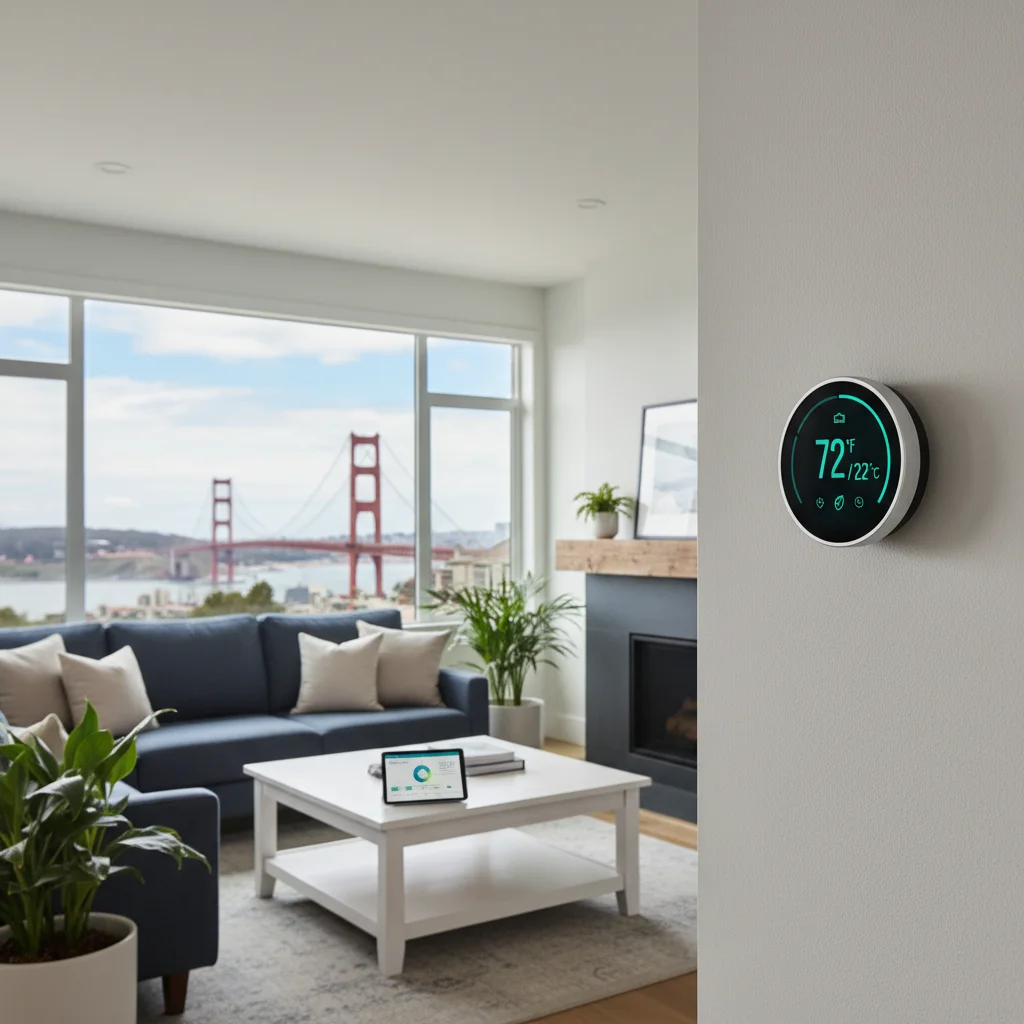
San Francisco homeowners replaced over 14,000 thermostats with smart models in 2025, cutting heating costs by an average of $240 annually. And the city's 2026 rebate programs make installation effectively free for qualifying households earning below 80% of area median income. But with funding capped at $3.2 million across three overlapping programs, rebates run out fast—usually by October.
How Much Does Smart Thermostat Installation Cost in San Francisco?
Professional smart thermostat installation in San Francisco costs $280-$450 for labor plus $120-$250 for the device itself, totaling $400-$700. Bay Area Energy Upgrade California® covers 100% of costs for income-qualified households and $100-$200 for market-rate customers. And PG&E's Home Upgrade program adds another $50 instant rebate at participating retailers, dropping net costs to $250-$550 for most homeowners.
Labor rates vary by contractor certification level. BAYREN-approved installers charge $85-$125 per hour, with typical installations taking 2-3 hours including wiring upgrades. So a Google Nest Learning Thermostat ($249) installed by a mid-tier contractor costs around $550 before rebates. But ecobee SmartThermostat Premium ($189) installations run $470-$540 because the device includes a remote sensor that requires additional setup time.
The city's mild climate means most homes don't need C-wire adapter installations that add $80-$120 in other markets. And wireless smart thermostats like the Honeywell T9 ($149) install in under 90 minutes, reducing labor to $180-$240. So total project costs in San Francisco sit 18-22% below the national average of $650-$850.
Income-qualified households earning below $88,400 for a family of four pay zero out-of-pocket through the Energy Savings Assistance Program. Or market-rate customers stack heat pump rebates with thermostat incentives to maximize savings on full HVAC upgrades.
What Is the Application Process for San Francisco Smart Thermostat Rebates?
Bay Area Energy Upgrade California® requires pre-approval before purchasing equipment. Homeowners submit income documentation and property ownership proof through the online portal at bayrenresidential.org within 3-5 business days. And approved applicants receive a reservation number valid for 90 days to complete installation with a program-approved contractor.
PG&E's marketplace rebate applies instantly at checkout—no application needed. But income-qualified rebates require verification through the California Alternate Rates for Energy (CARE) program, which takes 10-15 business days. So applicants submit CARE enrollment proof, property tax bills, and contractor invoices to unlock the 100% cost coverage.
Post-installation verification happens within 10 days. Contractors upload photos of the installed thermostat displaying the confirmation screen, wiring diagrams, and the old thermostat for comparison. And the program administrator processes reimbursements within 6-8 weeks via check or direct deposit.
The IRA Home Energy Rebate program launches in California in Q3 2026 with separate smart thermostat incentives of $100-$200 depending on household income. Or homeowners combine multiple programs by completing the BAYREN application first, then claiming the federal energy tax credits when filing 2026 taxes.
What Are the Deadlines for Smart Thermostat Incentives in San Francisco?
BAYREN's 2026 funding cycle runs through December 31, 2026, but the $3.2 million allocation historically depletes by mid-October. And PG&E's Home Upgrade rebates operate on a first-come, first-served basis with quarterly budget reviews—Q1 2026 funding exhausted by February 18.
Income-qualified programs maintain separate funding pools with lower depletion rates. The Energy Savings Assistance Program budget of $18.9 million for San Francisco County typically lasts through November. So households below 80% AMI have 4-5 months more availability than market-rate customers.
The federal Home Efficiency Rebate program starts accepting applications in August 2026 with a projected 18-month funding window. But California's state-level allocation of $196 million serves 14 million households, creating an effective deadline of Q1 2027 based on the state's historical rebate uptake rate of 12-14% annually.
BAYREN requires installation completion within 90 days of approval. And applications submitted after September 15 receive conditional approval pending 2027 budget authorization. Or homeowners missing 2026 deadlines qualify for the ongoing PG&E Flex Alert thermostat program offering $75 bill credits for participating in demand response events.
Which Contractors Are Approved for Smart Thermostat Installation in San Francisco?
BAYREN maintains a network of 127 certified contractors in San Francisco County as of March 2026. And all participating contractors complete BPI Building Analyst certification plus program-specific smart thermostat training updated quarterly. So approved installers guarantee code compliance with San Francisco's Title 24 energy standards and local permit requirements.
The top-rated contractor pool includes 23 minority-owned businesses and 11 worker cooperatives prioritized in the income-qualified program. GRID Alternatives, a nonprofit installer, completes 400-500 no-cost installations annually for CARE-eligible households. And locally-based Bauman Heating & Air Conditioning handles 200+ smart thermostat projects yearly with a 4.8/5.0 customer rating.
Contractor requirements include $2 million general liability insurance, California C-20 HVAC license, and background checks for technicians entering occupied homes. And the program mandates 1-year labor warranties on all installations, doubling the industry standard 90-day coverage.
Homeowners search approved contractors by ZIP code at bayrenresidential.org/find-contractor with filters for language services, weekend availability, and specialization in historic home retrofits. Or the program's concierge service matches customers with three pre-screened bidders within 48 hours of request submission.
Can You Stack Smart Thermostat Rebates With Other Energy Efficiency Programs?
California allows stacking state, federal, and utility rebates up to 100% of project costs. And smart thermostat installations qualify for three concurrent programs: BAYREN ($100-$200), PG&E Home Upgrade ($50), and the federal Home Efficiency Rebate ($100-$200 launching Q3 2026).
Income-qualified households combine the Energy Savings Assistance Program's 100% coverage with the $200 federal rebate by timing installations across two calendar years. So a December 2026 state-funded installation generates eligibility for the January 2027 federal claim, creating a net-positive $200 benefit for the same equipment.
But thermostat rebates don't stack with the federal 30% Energy Efficient Home Improvement Credit because smart thermostats don't meet the credit's efficiency thresholds. And homeowners claiming the rebate forfeit eligibility for the credit under IRS stacking rules updated January 2026.
Pairing thermostat rebates with heat pump rebates maximizes returns. A $600 smart thermostat installation plus $12,000 heat pump system qualifies for $200 thermostat rebates and $8,000 heat pump incentives—$8,200 total. Or bundling with home performance upgrades unlocks BAYREN's whole-home package adding 20% bonus incentives on combined projects exceeding $3,000.
Use our free rebate calculator to model stacking scenarios and identify your optimal combination.
What Is the Current Funding Status of San Francisco Smart Thermostat Programs?
BAYREN's 2026 smart thermostat allocation sits at 42% depleted as of April 8, 2026, with $1.86 million remaining. And the program reserves 60% of funds for income-qualified applicants, who've claimed only 28% of their dedicated pool. So market-rate customers face higher competition for the unreserved $800,000 balance.
PG&E's Q2 2026 budget opened April 1 with $240,000 allocated for the Home Upgrade thermostat rebate. But the utility suspended the program twice in 2025 due to funding exhaustion—most recently in November when 2,100 applications exceeded the quarterly cap within 11 days. So the current April reopening typically lasts 6-8 weeks based on historical uptake.
California's Home Efficiency Rebate program secured $196 million in federal IRA funding with an August 2026 launch date. And the state projects 18-24 months of availability assuming 8-10% household participation rates. So early applicants in Q3 2026 face minimal competition compared to the anticipated Q2 2027 rush when marketing campaigns fully activate.
"California received the second-largest allocation of Home Energy Rebate funding at $196 million, enough to support an estimated 78,000 whole-home retrofits or 980,000 single-measure upgrades like smart thermostats." — U.S. Department of Energy
BAYREN's waitlist feature activates when funding drops below 10%. And enrolled applicants receive priority access to 2027 budget releases within 30 days of the fiscal year rollover on January 1.
Comparison of San Francisco Smart Thermostat Programs
| Program | Rebate Amount | Income Limit | Deadline |
|---|---|---|---|
| BAYREN Energy Upgrade | $100-$200 | None (tiered) | Dec 31, 2026 |
| PG&E Home Upgrade | $50 | None | Rolling quarterly |
| Energy Savings Assistance | 100% of cost | 80% AMI ($88,400) | Dec 31, 2026 |
| Federal Home Efficiency Rebate | $100-$200 | 150% FPL ($45,000) | Aug 2026 - Q1 2028 |
| PG&E Flex Alert | $75 bill credit | None | Ongoing |
Official Sources
- U.S. Department of Energy - Save Energy, Save Money — Federal guidance on home energy efficiency rebates and tax credits under the Inflation Reduction Act (note: the federal 25C and 25D credits ended for projects completed after December 31, 2025)
- DSIRE USA — Comprehensive database of state, local, and utility energy incentive programs including smart thermostat rebates
- ENERGY STAR — Certified smart thermostat models and efficiency specifications for rebate qualification
Frequently Asked Questions
How much does a smart thermostat cost to install in San Francisco?
Professional installation costs $400-$700 including equipment and labor. BAYREN rebates reduce net costs to $200-$500 for market-rate customers, while income-qualified households pay $0 through the Energy Savings Assistance Program. And PG&E's $50 instant rebate applies at checkout with participating retailers like Home Depot and Lowe's, dropping device costs to $70-$200 before installation.
What rebates are available for smart thermostat installation in San Francisco?
San Francisco homeowners access $150-$450 in combined rebates from BAYREN ($100-$200), PG&E ($50), and the upcoming federal Home Efficiency Rebate ($100-$200 starting Q3 2026). Income-qualified households earning below 80% AMI receive 100% cost coverage through the Energy Savings Assistance Program. And all programs require ENERGY STAR-certified thermostats with remote access and learning capabilities.
Do I need a permit to install a smart thermostat in San Francisco?
Most smart thermostat installations don't require permits because they're like-for-like replacements using existing wiring. But homes adding C-wire adapters or upgrading from line-voltage to low-voltage systems need electrical permits costing $125-$200 from the San Francisco Department of Building Inspection. And historic properties in designated preservation districts require additional design review adding 2-3 weeks to approval timelines.
How long does smart thermostat installation take?
Professional installation takes 1.5-3 hours depending on wiring complexity and home age. Homes with existing C-wires complete in 90-120 minutes, while properties requiring wire upgrades extend to 2.5-3 hours. And BAYREN-approved contractors include wiring assessment in the free pre-installation consultation, providing accurate timeline estimates before starting work.
What's the difference between a smart thermostat and a regular thermostat?
Smart thermostats learn heating patterns, adjust temperatures remotely via smartphone apps, and generate energy reports showing usage by day and time. Regular programmable thermostats require manual schedule creation and don't adapt to occupancy changes. And smart models save 10-23% on heating and cooling costs versus non-programmable thermostats according to EPA testing—$180-$410 annually for San Francisco's average household energy spend of $1,780.
Ready to see your savings? Use our rebate calculator to find every smart thermostat incentive you qualify for in San Francisco. Get your personalized rebate estimate in under 60 seconds—no personal information required.
Updated on April 14, 2026. Fact-checked by DuloCore Editors. About our research team.
Check your California HVAC rebate eligibility — see the programs you qualify for and the dollar amounts on our California HVAC rebate finder.