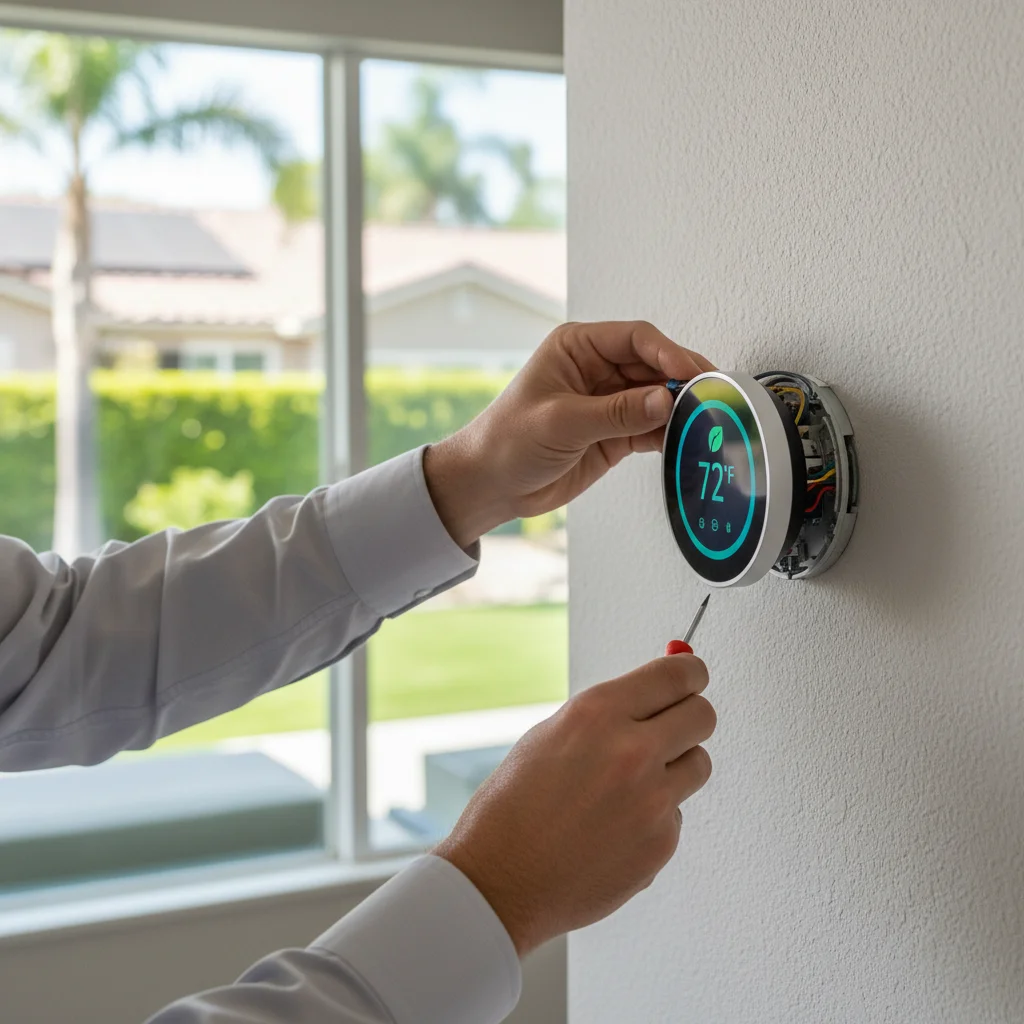
Riverside homeowners waste an average of $274 annually on heating and cooling costs due to inefficient temperature control. And that number climbs higher every year as California utility rates increase. Smart thermostats cut HVAC energy use by 10-23% through automated scheduling, remote access, and real-time energy monitoring.
How Much Does Smart Thermostat Installation Cost in Riverside in 2026?
Smart thermostat installation in Riverside costs $250-$550 total in 2026, including the device ($130-$300) and professional installation ($120-$250). Labor rates vary based on existing wiring compatibility, HVAC system type, and whether electrical panel upgrades are needed.
Professional installation takes 1-2 hours for most homes. Basic installations with compatible C-wire wiring cost $120-$150 in labor. But homes lacking a common wire require additional wiring or a power adapter, adding $50-$100 to the final bill. And older HVAC systems without digital controls sometimes need compatibility modules costing $40-$80.
Popular smart thermostat models in Riverside include the Nest Learning Thermostat ($249), Ecobee SmartThermostat ($249), and Honeywell Home T9 ($199). Entry-level models like the Google Nest Thermostat start at $130 but lack advanced features like room sensors and voice control.
So homeowners considering DIY installation save $120-$250 in labor costs. But incorrect wiring damages HVAC systems and voids manufacturer warranties, creating potential repair bills exceeding $500.
What Funding and Rebates Are Available for Smart Thermostats in Riverside?
Riverside homeowners access $50-$200 in combined rebates for smart thermostat installation through Southern California Edison, the IRA Home Efficiency Rebates program, and manufacturer incentives in 2026.
Southern California Edison (SCE) offers $50-$75 rebates for qualifying ENERGY STAR-certified smart thermostats installed by May 31, 2026. The SCE program requires enrollment in a demand response program where the utility adjusts temperature settings during peak energy events, saving homeowners an additional $20-$40 annually through bill credits.
And the federal IRA Home Efficiency Rebates program provides $100-$200 for smart thermostats when installed as part of a whole-home energy upgrade that reduces energy consumption by at least 20%. California's Home Upgrade (CalHUG) program administers these federal funds with applications opening in Q3 2026.
"The Home Efficiency Rebates program provides point-of-sale discounts for energy-efficient home improvements, including smart thermostats as part of comprehensive retrofits." — U.S. Department of Energy
Manufacturer rebates from Google Nest ($20-$50) and Ecobee ($25-$75) apply at purchase when buying through participating retailers like Home Depot and Lowe's.
Looking to maximize your savings? Use our free rebate calculator to estimate your total eligible rebates based on your home's energy profile.
What Are the Contractor Requirements and Certification Standards in California?
California requires smart thermostat installers to hold an active C-20 Warm-Air Heating, Ventilation, and Air-Conditioning (HVAC) contractor license for installations involving electrical modifications or HVAC system integration in 2026.
The California Contractors State License Board (CSLB) mandates that any work connecting smart thermostats to forced-air systems, heat pumps, or boilers requires a licensed C-20 contractor. And violations result in fines of $200-$15,000 per offense. Homeowners hiring unlicensed contractors forfeit rebate eligibility and warranty coverage.
But simple thermostat replacements on existing wiring without HVAC modifications don't require contractor licensing under California law. So DIY installations qualify for manufacturer warranties and utility rebates if the homeowner follows installation instructions and local building codes.
To verify contractor credentials, search the CSLB database at cslb.ca.gov using the contractor's license number. Active licenses display current bond and insurance status, complaint history, and disciplinary actions.
For rebate program compliance, keep detailed installation records including contractor license numbers, permit documentation, and dated photographs of the completed installation.
What Are the Deadlines for 2026 Tax Credits and Rebate Programs?
Southern California Edison's smart thermostat rebate program deadline is May 31, 2026, with a funding cap of $4.8 million allocated on a first-come, first-served basis across their service territory.
The federal IRA Home Efficiency Rebates program operates through December 31, 2031, but California's CalHUG implementation uses annual funding cycles. And the 2026 allocation of $180 million for California homeowners becomes available in September 2026 with applications processed until funds are exhausted.
SCE notifies customers when rebate funding reaches 75% capacity, typically 2-4 weeks before the deadline. So homeowners planning installations should submit applications 30-60 days before stated deadlines to ensure processing time.
Manufacturer rebates from Google Nest and Ecobee vary by promotion, typically running 60-90 day cycles tied to seasonal HVAC demand. Check manufacturer websites monthly for current offers, as rebate amounts fluctuate between $0-$75 based on inventory and competition.
Can You Stack Multiple Rebates and Tax Credits for One Installation?
Riverside homeowners stack Southern California Edison utility rebates ($50-$75) with manufacturer rebates ($20-$75) and federal IRA Home Efficiency Rebates ($100-$200) for total potential savings of $170-$350 on a single smart thermostat installation in 2026.
California law permits combining utility rebates with federal incentive programs without penalty or offset. And manufacturer point-of-sale rebates apply independently of government programs, reducing the upfront purchase price before installation.
But the IRA Home Efficiency Rebates require the smart thermostat to be part of a larger home energy retrofit project reducing consumption by 20% or more. So standalone thermostat installations don't qualify for the federal rebate without additional upgrades like insulation, air sealing, or heat pump installation.
| Program | Amount | Eligibility | Deadline |
|---|---|---|---|
| SCE Utility Rebate | $50-$75 | ENERGY STAR certified, demand response enrollment | May 31, 2026 |
| IRA Home Efficiency Rebates | $100-$200 | Part of 20%+ energy reduction project | Dec 31, 2031 (annual funding cycles) |
| Manufacturer Rebates | $20-$75 | Purchase through participating retailers | Varies by promotion |
Stacking rules prohibit double-dipping from overlapping programs. So homeowners can't claim both state and federal versions of the same incentive category. But combining different incentive types (utility + federal + manufacturer) remains fully compliant.
Learn more about maximizing rebate combinations through our guide to energy tax credits.
Do You Need Pre-Approval Before Installing a Smart Thermostat?
Southern California Edison requires pre-enrollment in their demand response program before installation to qualify for the $50-$75 smart thermostat rebate, but approval typically takes 1-3 business days online at sce.com.
The IRA Home Efficiency Rebates program requires pre-approval through California's CalHUG portal before starting any work. And installations completed before application approval forfeit all rebate eligibility, creating potential losses of $100-$200.
Pre-approval timelines vary by program complexity. SCE's online enrollment processes within 72 hours for standard residential accounts. But CalHUG pre-approvals take 15-45 days due to energy modeling requirements and contractor verification steps.
So homeowners planning installations should submit pre-approval applications 45-60 days before their target installation date to account for processing delays and potential information requests from program administrators.
Manufacturer rebates don't require pre-approval. Purchase receipts and model numbers submitted within 30-90 days of installation satisfy most manufacturer rebate claims.
Official Sources
- U.S. Department of Energy - Save Energy, Save Money — Federal guidance on energy efficiency rebates and home improvement incentives
- DSIRE USA — Comprehensive database of state and federal energy incentives, rebates, and tax credits (note: the federal 25C and 25D credits ended for projects completed after December 31, 2025)
- California Contractors State License Board — Contractor licensing verification and consumer protection resources
Frequently Asked Questions
How much does a smart thermostat installation cost in Riverside?
Smart thermostat installation in Riverside costs $250-$550 total in 2026, including the device ($130-$300) and professional installation ($120-$250). Basic installations with compatible wiring cost less, while homes needing additional wiring or compatibility modules pay $50-$100 more. DIY installation eliminates labor costs but risks voiding warranties.
What rebates are available for smart thermostat installation in Riverside?
Riverside homeowners access $50-$75 from Southern California Edison, $100-$200 from federal IRA Home Efficiency Rebates (as part of whole-home retrofits), and $20-$75 in manufacturer rebates in 2026. Total potential savings reach $170-$350 when stacking all eligible programs. SCE rebates require demand response program enrollment by May 31, 2026.
Do I need a professional to install a smart thermostat to qualify for rebates?
California doesn't require professional installation for smart thermostat rebates if the work doesn't modify HVAC systems or electrical wiring. But installations involving forced-air systems, heat pumps, or electrical panel work require a licensed C-20 HVAC contractor to maintain rebate eligibility and warranty coverage. And program administrators may request proof of licensed installation during audits.
What is the deadline for smart thermostat rebate applications in Riverside?
Southern California Edison's smart thermostat rebate program closes May 31, 2026, or when the $4.8 million funding allocation is exhausted. California's IRA Home Efficiency Rebates program operates through December 31, 2031, but uses annual funding cycles with 2026 applications opening in September. Manufacturer rebates vary by promotion, typically running 60-90 day cycles.
Are smart thermostats eligible for California energy efficiency tax credits?
Smart thermostats don't qualify for standalone federal tax credits in 2026, but qualify for the IRA Home Efficiency Rebates program ($100-$200) when installed as part of comprehensive home energy retrofits reducing consumption by 20% or more. California offers no state-level tax credits for smart thermostats, but utility rebates through SCE and other providers reduce upfront costs by $50-$75.
Ready to find your exact rebate amount? Use our rebate calculator to get a personalized estimate based on your home's location, utility provider, and planned improvements. Get your free calculation in under 60 seconds.
Last updated April 14, 2026 — reviewed by DuloCore Editorial. About our authors.
Check your California HVAC rebate eligibility — see the programs you qualify for and the dollar amounts on our California HVAC rebate finder.