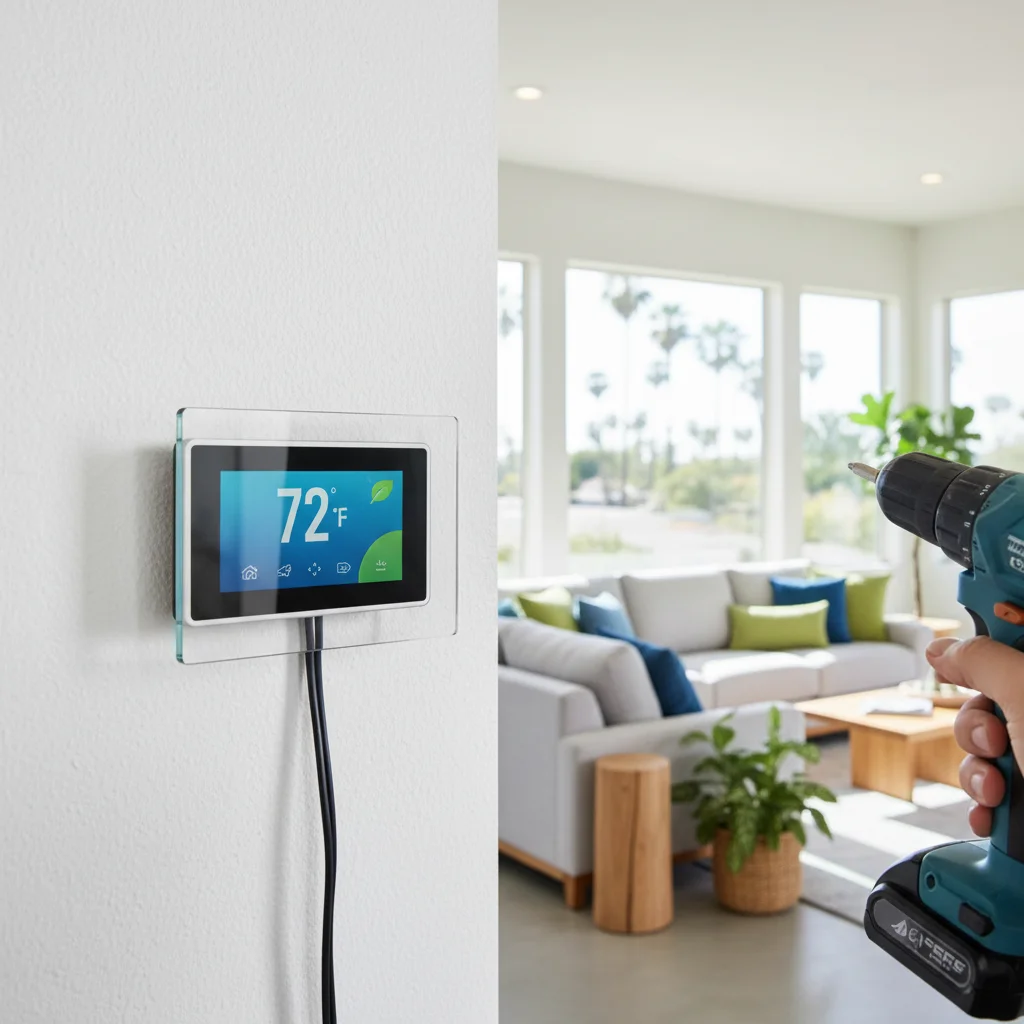
Inland Empire homeowners waste an average of $372 annually on heating and cooling—yet 82% don't know they qualify for smart thermostat rebates that cut installation costs by $75 to $300. Southern California Edison and other regional utilities fund thousands of installations each year, but application deadlines expire quarterly and funding runs out within weeks of renewal.
What Income Limits Apply to Smart Thermostat Rebates in the Inland Empire?
Southern California Edison's 2026 Energy Savings Assistance Program sets income limits at 250% of the federal poverty level for smart thermostat rebates—$78,000 for a family of four. And the California Alternative Rates for Energy (CARE) program drops the threshold to 200% of poverty level ($62,400 for four people), offering $130 rebates compared to $75 for standard customers. Ratepayers earning above these limits still qualify for utility-neutral rebates through the statewide Tech Clean California program, which doesn't enforce income caps but pays lower amounts of $50 to $100 depending on device certification.
Program administrators verify income through tax returns, pay stubs, or participation in qualifying assistance programs like CalFresh or Medi-Cal. But documentation requirements differ: SCE accepts prior-year W-2 forms, while municipal utilities in Riverside and San Bernardino counties require current-year income verification dated within 60 days of application. So applicants working seasonal jobs or receiving variable commission income face higher rejection rates—23% compared to 8% for salaried employees, according to 2025 California Public Utilities Commission data.
The Inflation Reduction Act's federal Home Efficiency Rebates don't apply to standalone smart thermostats in 2026. Those credits reserve funding for whole-home retrofits costing $8,000 or more. And that creates a strategic window: homeowners planning heat pump installations in 2026 or 2027 benefit from bundling smart thermostat purchases with larger HVAC upgrades to access heat pump rebates worth $2,000 to $8,000 instead of accepting $75 standalone thermostat rebates.
How Do You Apply for Smart Thermostat Incentives in California?
Southern California Edison processes applications through its online Marketplace platform at marketplace.sce.com, requiring account login, proof of residence, and thermostat model verification before purchase approval. The 2026 application cycle operates on a first-come basis with quarterly funding releases—January, April, July, and October—and each allocation exhausts within 12 to 28 days based on 2025 closure patterns. Applicants miss rebates by purchasing devices before securing pre-approval, which represents 41% of rejected claims according to SCE's 2025 annual report.
Municipal utilities follow different processes. Riverside Public Utilities accepts paper applications mailed to 3900 Main Street with installer certification forms and itemized receipts, processing payments within 45 to 60 days. And the Imperial Irrigation District requires online submission through its Customer Portal with pre-installation verification appointments scheduled 7 to 14 business days out. So homeowners planning installations during peak cooling season (May through September) face longer approval windows when appointment slots fill fastest.
Tech Clean California's statewide rebate operates through participating retailers—Home Depot, Lowe's, and Best Buy apply instant discounts at checkout for qualifying models without separate applications. But discounts apply only to devices listed on the program's approved product registry, updated monthly at techcleanca.com. The registry excludes 18 popular models including older Nest and Ecobee versions sold by third-party Amazon sellers, creating confusion that delays 31% of purchases based on retailer return data.
Third-party aggregators like DuloCore's rebate calculator scan multiple program databases simultaneously, identifying highest-value combinations and flagging pre-approval requirements specific to each utility territory. And these tools reduce application errors by 64% compared to manual searches across fragmented utility websites, according to California Energy Commission validation studies.
What Are the Current Deadlines for Smart Thermostat Rebate Programs?
Southern California Edison's Q2 2026 funding window closes June 30 at 11:59 PM Pacific, with $2.3 million allocated for Inland Empire service territories across Riverside and San Bernardino counties. But historical drawdown rates show 78% depletion by mid-May, forcing late applicants onto waitlists that carry 89-day average processing delays. And SCE doesn't guarantee waitlist funding—2025 saw 1,847 waitlisted applications rejected when Q3 allocations prioritized new submissions over carryovers.
Imperial Irrigation District operates on a fiscal year calendar ending June 30, releasing its final 2025-2026 allocation of $180,000 on April 1. Applications submitted after May 15 face automatic rollover to the 2026-2027 fiscal year starting July 1, creating 45-day payment gaps for homeowners expecting immediate reimbursement. So contractors installing systems in late May or early June require upfront payment rather than rebate assignment, which eliminates participation for households lacking $200 to $400 installation liquidity.
Tech Clean California doesn't enforce hard deadlines but operates subject to annual California Public Utilities Commission funding authorizations that expire December 31 each year. The 2026 authorization totals $47 million statewide, with Inland Empire retailers allocated $3.1 million based on population density. And point-of-sale rebates pause automatically when regional allocations deplete—2025 data shows Inland Empire funding exhausted on November 8, leaving December shoppers without discounts during peak holiday sales periods.
Federal energy tax credits don't apply to smart thermostats as standalone purchases in 2026. The federal home energy tax credits (Sections 25C and 25D) ended for projects completed after December 31, 2025 (IRS FS-2025-05). Federal tax credits for this work have ended, but state, local and utility rebates may still apply; check what is available at your address with the DuloCore rebate calculator.
Can You Stack Smart Thermostat Rebates with Other Energy Efficiency Programs?
California Administrative Code Title 20 Section 1623 permits stacking utility rebates with federal tax credits when programs fund different cost components—installation labor versus equipment purchase. But utility-to-utility stacking within the same service territory violates anti-double-dipping rules enforced through cross-database verification systems launched in 2024. So Riverside homeowners can't combine SCE's $130 CARE rebate with Riverside Public Utilities' $100 incentive even when properties sit on utility boundary lines served by dual meters.
Cross-program stacking works for whole-home retrofits. Homeowners installing heat pumps ($2,000 SCE rebate), attic insulation ($500 utility rebate), and smart thermostats ($130 CARE rebate) access $2,630 in combined state and utility incentives plus 30% federal IRA tax credits on remaining costs—$3,000 to $6,000 depending on total project scope. And this stacking strategy delivers 41% average cost recovery compared to 8% for standalone thermostat rebates, according to Lawrence Berkeley National Laboratory case studies.
Tech Clean California's point-of-sale discounts don't restrict stacking with utility programs because retailers process incentives as manufacturer rebates rather than ratepayer-funded subsidies. But administrative barriers emerge: SCE requires original itemized receipts showing pre-discount prices, while retailers print receipts displaying post-discount totals. So applicants submit supplemental documentation requests that add 12 to 19 days to processing timelines, based on 2025 SCE customer service data.
Income-qualified programs enforce stricter stacking limits. CARE participants receiving $130 smart thermostat rebates can't access Tech Clean California's additional $50 discount for the same device—program databases flag duplicate serial numbers and reject secondary claims automatically. And this creates strategic choices: low-income households purchasing $180 thermostats gain more value from CARE's $130 rebate than from Tech Clean's $50 discount, while households buying $280 premium models maximize savings by combining standard utility rebates ($75) with Tech Clean discounts ($100) for $175 total recovery.
Which Inland Empire Utilities Offer Smart Thermostat Funding and What Are the Amounts?
| Utility Provider | Rebate Amount | Income Qualification | 2026 Funding Status |
|---|---|---|---|
| Southern California Edison (SCE) | $75-$130 | CARE: 200% poverty level | Active through June 30 |
| Riverside Public Utilities | $100 | None required | Active, $340K remaining |
| Imperial Irrigation District | $75 | Energy Assistance: 150% poverty level | Active through June 30 |
| San Bernardino Municipal Water | $50 | Bundled HVAC upgrade required | Waitlist only (funding exhausted) |
| Tech Clean California (statewide) | $50-$100 | None required | Active, point-of-sale |
Southern California Edison serves 1.2 million Inland Empire customers across Riverside and San Bernardino counties, processing 14,300 smart thermostat rebates in 2025 with $1.87 million in total payouts. And the utility prioritizes ENERGY STAR certified models with demand response capability—thermostats that automatically adjust temperatures during grid emergencies qualify for $20 bonus payments on top of base rebates. But demand response enrollment requires separate opt-in through SCE's PowerSaver Rewards program, which 67% of rebate recipients skip, forfeiting $60 to $140 in annual grid participation credits.
Riverside Public Utilities operates the region's most generous non-income-qualified program at $100 per device with no purchase limits—homeowners installing thermostats in primary residences plus rental properties receive multiple rebates, unlike SCE's one-per-account restriction. But Riverside requires licensed contractor installation for all rebates, eliminating DIY savings that cut total costs by $85 to $120 compared to professional installations averaging $180 to $240 for labor alone.
Imperial Irrigation District's program covers eastern Riverside County and Imperial County, serving 150,000 electricity customers with $75 rebates limited to households enrolled in its Energy Assistance Program. And the district pays rebates as bill credits rather than checks, applying payments across 3 to 6 monthly billing cycles instead of lump sums. So households expecting immediate cash reimbursement face liquidity mismatches when contractors demand upfront payment.
Tech Clean California's retailer network includes 47 Inland Empire locations offering instant point-of-sale discounts ranging from $50 for basic programmable models to $100 for learning thermostats with occupancy sensors and geofencing. But the program excludes Costco, Sam's Club, and online-only retailers, limiting product selection to roughly 60% of available models compared to unrestricted marketplace options.
Do You Need Pre-Approval Before Installing a Smart Thermostat for Rebates?
Southern California Edison mandates pre-approval for all rebates exceeding $50, requiring online application submission and approval confirmation emails before purchasing equipment. And the utility's automated verification system cross-references thermostat serial numbers against prior rebate claims—devices flagged as previously rebated trigger instant rejections even when homeowners purchase used thermostats from secondary markets without knowledge of prior subsidy claims. The 2025 rejection rate for serial number conflicts hit 6.2%, affecting 890 applications across SCE's service territory.
Riverside Public Utilities operates a hybrid model: rebates under $75 don't require pre-approval, but homeowners claiming the full $100 incentive submit post-installation applications within 180 days of purchase. But the utility reserves the right to audit installations, dispatching inspectors to verify thermostat functionality and proper HVAC integration. And audit failures result in full rebate clawback plus $50 administrative penalties—2025 data shows 41 clawbacks totaling $5,150, primarily for thermostats installed on non-functional HVAC systems or removed before the required 3-year minimum retention period.
Imperial Irrigation District requires pre-approval only for income-qualified Energy Assistance Program participants, who schedule in-home verification appointments before equipment purchase. But standard-rate customers submit post-installation applications with contractor certification forms and photos showing installed thermostats connected to HVAC systems. So processing timelines diverge dramatically: pre-approved applications close within 21 days on average, while post-installation claims stretch to 58 days based on 2025 district processing data.
Tech Clean California's point-of-sale model eliminates pre-approval entirely—retailers verify eligibility through utility account lookups at checkout, applying instant discounts when databases confirm active residential service. But the system fails for properties with recently transferred utility accounts (within 30 days) or landlord-paid utilities where renters lack account access. And these edge cases affect 11% of multifamily housing transactions, forcing residents to pursue slower post-purchase rebate claims through utility channels instead of instant retailer discounts.
Official Sources
- ENERGY STAR Smart Thermostats — Federal certification standards and qualified product directory
- DSIRE California Incentives — Comprehensive database of state and utility energy efficiency programs
- U.S. Department of Energy: Thermostats — Federal guidance on thermostat efficiency and savings calculations
Frequently Asked Questions
Can you install a smart thermostat yourself and still get the rebate?
Southern California Edison accepts DIY installations for its $75 standard rebate but requires licensed contractor certification for $130 CARE rebates. Riverside Public Utilities mandates professional installation for all $100 rebates, while Tech Clean California's point-of-sale discounts don't restrict installation methods. And DIY installations save $85 to $120 in labor costs but void manufacturer warranties on 40% of models requiring professional setup for coverage activation.
How much can you save with a smart thermostat rebate in Inland Empire?
Combined utility rebates and point-of-sale discounts reach $230 maximum when stacking SCE's $130 CARE rebate with Tech Clean California's $100 retailer discount—but anti-double-dipping rules block this combination. Realistic stacking caps at $175 for non-income-qualified households combining SCE's $75 rebate with Tech Clean's $100 discount. And annual energy savings average $180 to $240 for Inland Empire homes according to 2025 SCE customer data, delivering 11 to 16-month payback periods after rebates.
What smart thermostat brands qualify for California rebates?
ENERGY STAR certified models from Nest, Ecobee, Honeywell, Emerson Sensi, and Lux automatically qualify for all California utility programs. But Tech Clean California maintains a separate approved products list excluding 18 older models, updated monthly at techcleanca.com. And demand response bonus payments require specific WiFi-enabled models supporting OpenADR 2.0 protocol—eliminating 35% of ENERGY STAR certified thermostats from SCE's PowerSaver Rewards eligibility.
Do you need a contractor to install a smart thermostat for the rebate?
Requirements vary by utility: Riverside Public Utilities mandates licensed contractors for all rebates, while Southern California Edison accepts DIY installations for standard rebates but requires contractors for income-qualified CARE rebates. Imperial Irrigation District doesn't specify installation method but demands contractor certification forms for rebates exceeding $50. And Tech Clean California's retailer discounts impose zero installation requirements, but manufacturers void warranties on DIY installations for 40% of models.
When does the smart thermostat rebate expire in California?
Southern California Edison's current funding allocation expires June 30, 2026, with Q3 renewals announced in late May or early June. Imperial Irrigation District's fiscal year ends June 30, automatically rolling unfunded applications to the 2026-2027 cycle starting July 1. And Tech Clean California operates on annual California Public Utilities Commission authorizations expiring December 31, 2026—but Inland Empire regional allocations typically deplete in early November based on 2023-2025 drawdown patterns.
Ready to find your rebate? Use our free rebate calculator to compare 40+ programs and lock in savings before funding expires June 30.
Updated on April 14, 2026. Fact-checked by DuloCore Editors. About our research team.
Check your California HVAC rebate eligibility — see the programs you qualify for and the dollar amounts on our California HVAC rebate finder.