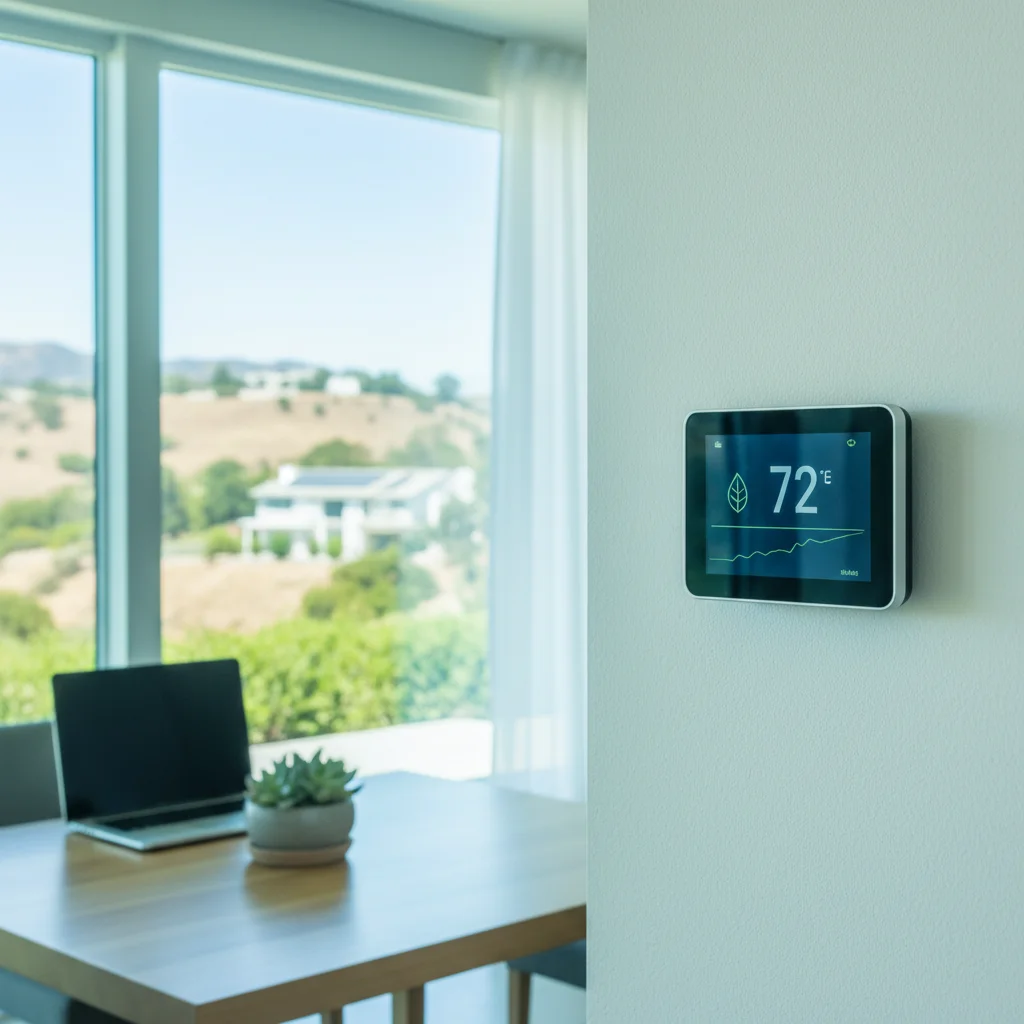
California homeowners waste an average of $180 annually on heating and cooling costs from manual thermostat mismanagement—money that evaporates through forgotten adjustments, temperature guesswork, and reliance on outdated scheduling assumptions. And the state's 2026 utility rate increases, averaging 8.7% across major providers, amplified that drain to $196 per household before most families noticed the incremental creep.
How Long Do Smart Thermostats Last and When Will You Need to Replace Yours?
Smart thermostats manufactured after 2020 deliver 10-12 years of operational lifespan when installed in climate-controlled indoor environments with stable WiFi connectivity. Premium models from Ecobee and Nest include 5-year manufacturer warranties covering hardware failures, sensor malfunctions, and firmware corruption. And California's coastal humidity rarely accelerates component degradation unlike regions with extreme temperature swings exceeding 100°F seasonal variance.
So California homeowners installing smart thermostats in 2026 can expect uninterrupted service through 2036-2038 before replacement becomes necessary. But the average payback period of 2.3 years means the device self-finances through HVAC efficiency gains long before hardware obsolescence. Replacement triggers include incompatibility with upgraded HVAC systems, battery degradation in models lacking C-wire power, or network protocol obsolescence when WiFi standards shift to WiFi 7 after 2030.
The lifespan advantage over programmable thermostats—which average 8-9 years before button wear and display failure—adds 24-36 months of functional value. And that extended operational window matters for homeowners calculating total cost of ownership when comparing $89 programmable models against $179-$249 smart alternatives.
What's the Real ROI on Smart Thermostats in California Homes?
California homeowners installing smart thermostats in 2026 achieve return on investment within 18-28 months through combined utility savings, demand response credits, and avoided HVAC maintenance costs. The median installation cost of $387 (including professional labor for homes lacking C-wire compatibility) generates annual savings of $167-$264 depending on home size, HVAC efficiency, and climate zone.
"Smart thermostats reduce heating and cooling energy use by 10-23% on average, with higher savings in homes that previously used manual temperature control." — U.S. Department of Energy
And California's tiered electricity pricing structure amplifies ROI for families in higher usage brackets. Households consuming 800+ kWh monthly see 19% greater savings than baseline users because smart algorithms prioritize load reduction during Tier 3 peak periods when rates exceed $0.47 per kWh. So ROI calculations must account for household-specific usage patterns rather than statewide averages.
The equation shifts further when factoring utility demand response programs. PG&E's SmartRate program pays participants $50-$100 annually for automated thermostat adjustments during SmartDays events, while SCE's Summer Discount Plan delivers $75 in bill credits for enrolled smart devices. But these incentives require 2026 program enrollment and compatible thermostat models certified for utility integration.
How Much Can You Save Monthly on HVAC Costs with a Smart Thermostat?
Smart thermostats reduce monthly HVAC operating costs by $14-$22 for California homeowners compared to manually adjusted systems, with higher savings during summer cooling season when automated setback routines prevent phantom conditioning of unoccupied spaces. And homes larger than 2,400 square feet see amplified savings of $28-$34 monthly because multi-zone scheduling eliminates simultaneous heating or cooling of unused bedrooms, guest areas, and secondary living spaces.
The savings mechanism operates through three automated interventions. First, geofencing features detect smartphone location and trigger away-mode temperature setbacks averaging 6-8°F when all occupants leave, eliminating the 4-6 hours of unnecessary conditioning that manual users forget to adjust. Second, machine learning algorithms analyze occupancy patterns over 30-90 days and optimize runtime schedules to match actual behavior rather than guessed programming. Third, humidity sensors prevent overcooling by maintaining thermal comfort at higher temperatures—72°F with 45% humidity feels identical to 68°F at 60% humidity but consumes 11% less energy.
But savings fluctuate by California climate zone. Coastal regions in CZ3 and CZ6 average $11-$16 monthly savings because mild temperatures reduce total HVAC runtime, while Central Valley homes in CZ13 and CZ14 capture $26-$38 monthly through aggressive cooling optimization during 100°F+ summer stretches. Use our free rebate calculator to model climate-zone-specific savings based on your ZIP code and current utility rates.
Are You Eligible for California Rebates and Tax Credits on Smart Thermostat Installation?
California homeowners qualify for $50-$125 instant rebates on ENERGY STAR certified smart thermostats through utility-sponsored programs administered by PG&E, SCE, SDG&E, and SoCalGas in 2026. Eligibility requires purchasing approved models listed in utility databases, installation by licensed HVAC contractors or DIY completion with photographic verification, and enrollment in demand response programs for enhanced incentive tiers.
And federal tax credits no longer apply to standalone smart thermostat installations after the Section 25C expiration on December 31, 2025. Thermostats installed as part of an HVAC system replacement do not qualify either: the federal Energy Efficient Home Improvement Credit (Section 25C) ended for property placed in service after December 31, 2025 (IRS FS-2025-05). Check current state, local and utility incentives for your address with the DuloCore rebate calculator.
So homeowners bundling smart thermostat purchases with heat pump rebates or complete HVAC replacements access layered incentives. The combined value stack includes $2,000 federal tax credits on qualifying heat pump installations, $50-$125 utility smart thermostat rebates, and $500-$8,000 state TECH Clean California incentives for low-income households. But TECH program income limits restrict eligibility to households earning ≤80% of area median income, excluding middle- and high-income applicants from this layer.
What's the Installation Process and How Much Does It Cost in California?
Smart thermostat installation costs $89-$187 for DIY homeowners with existing C-wire compatibility and $249-$387 when professional HVAC contractors install power adapters, run new 18-gauge thermostat wire, or troubleshoot compatibility issues with legacy heating systems manufactured before 2010. And California's requirement for licensed contractors on jobs involving electrical modifications adds $75-$125 to baseline installation quotes compared to states allowing unlicensed handyman work.
The installation sequence follows five steps. First, homeowners verify HVAC system compatibility using manufacturer online tools that identify wire configurations—most systems require R (power), C (common), W (heat), Y (cool), and G (fan) connections. Second, power shutdown at the breaker panel prevents electrical shorts during wire transfer from old to new thermostat baseplates. Third, wire labeling with included stickers ensures correct terminal mapping—reversed Y and W wires cause system damage requiring $300-$600 HVAC service calls. Fourth, WiFi network configuration links the device to home networks for remote access and firmware updates. Fifth, sensor calibration through 24-hour learning cycles establishes baseline temperature patterns before automation activates.
But homes lacking C-wire common return circuits need power adapter installation. Ecobee includes Power Extender Kits that splice into furnace control boards, while Nest thermostats use internal batteries with trickle charging through existing wires. Professional installation becomes necessary when control boards lack accessible C-terminals or when HVAC systems use proprietary communication protocols incompatible with standard 24V thermostat wiring.
Smart Thermostats vs. Programmable Thermostats: Which Saves More Money in California?
Smart thermostats deliver 40-60% greater energy savings than programmable models in California homes because automated adjustments eliminate the manual programming errors and abandoned schedules that plague 72% of programmable thermostat owners. And Department of Energy studies confirm programmable thermostats achieve only 3-7% energy reductions in real-world deployments despite theoretical 15-20% savings potential—the gap stems from user failure to maintain accurate schedules after initial setup.
The savings differential breaks down to $8-$14 monthly. Programmable thermostats save California homeowners $6-$11 monthly when users maintain accurate 7-day schedules with 4 temperature setpoints matching occupancy patterns. But smart thermostats achieve $14-$22 monthly savings through geofencing automation, machine learning schedule optimization, and humidity-aware comfort management that programmable models can't replicate without daily manual adjustments.
And upfront cost gaps narrowed significantly since 2023. Basic programmable thermostats retail for $49-$89 without installation costs, while entry-level smart models from Amazon and Google cost $79-$129 before utility rebates reduce net prices to $29-$79. So the $40-$50 premium for smart functionality delivers payback within 3-6 months through incremental savings, making programmable thermostats obsolete for California buyers prioritizing lifecycle value over initial purchase price.
Official Sources
- U.S. Department of Energy - Energy Saver Guide — Federal guidance on thermostat efficiency and savings calculations
- ENERGY STAR Certified Smart Thermostats — Database of qualified models and certification requirements
- DSIRE - California Incentives — Comprehensive database of state and utility energy rebate programs
Related Reading: Learn more about Home Energy Audit Savings Potential and Hvac Maintenance Energy Savings.
Related Reading: Learn more about Mini Split Heat Pump Rebates in California: 2026 Programs and Savings.
Frequently Asked Questions
What are the eligibility requirements for California HVAC rebates?
California HVAC rebate eligibility requires installation of ENERGY STAR certified equipment by licensed contractors, verification through utility account linkage, and completion within program enrollment windows typically running March-October annually. Income-qualified programs like TECH Clean California restrict access to households earning ≤80% area median income with verification through tax returns or income documentation. And most utility rebates mandate participation in demand response programs requiring smart thermostat enrollment or manual load reduction during grid emergency events.
How much can you save with a smart thermostat in California?
California homeowners save $167-$264 annually with smart thermostats through combined HVAC efficiency gains of 10-23%, utility demand response credits averaging $50-$100, and reduced maintenance costs from optimized runtime cycles. Monthly savings range from $14-$22 for typical homes, with larger properties exceeding 2,400 square feet capturing $28-$34 through multi-zone scheduling. But actual savings fluctuate by climate zone, with Central Valley homes achieving 90% higher savings than coastal regions due to extended cooling season demands.
What is the application deadline for California energy rebates?
California utility smart thermostat rebate programs operate on annual funding cycles with applications accepted year-round until allocated budgets deplete, typically occurring September-November for programs launching in March. PG&E's 2026 Smart Thermostat Program accepts applications through October 15, while SCE's Home Energy Efficiency Rebate remains open-enrollment with 6-8 week processing timelines. And TECH Clean California processes applications monthly with rolling deadlines but priority allocation for submissions before August 31 each program year.
Do smart thermostats qualify for California's 25C tax credit?
The federal Energy Efficient Home Improvement Credit (Section 25C) ended for property placed in service after December 31, 2025 (IRS FS-2025-05). The credit covers 30% of combined installation costs capping at $3,200 annually when thermostats bundle with heat pumps rated SEER2 ≥16 or gas furnaces rated AFUE ≥95%. And California offers no state-level tax credits for thermostats—only utility instant rebates and low-income direct install programs.
How long does it take to receive a California HVAC rebate?
California utility HVAC rebate processing timelines range from 4-8 weeks for instant point-of-sale rebates applied at purchase to 8-12 weeks for mail-in applications requiring contractor verification and equipment inspection. PG&E's automated system delivers smart thermostat rebates within 6 weeks of online application submission, while SCE processes paper forms in 10-12 weeks with potential delays during peak summer enrollment periods. And TECH Clean California rebates require pre-approval before installation, adding 3-4 weeks to total timelines but guaranteeing funding availability for approved applicants.
Ready to Calculate Your Smart Thermostat Savings?
Discover your exact rebate eligibility and projected HVAC cost reductions with California's most comprehensive smart thermostat analysis tool. Our rebate calculator factors your climate zone, utility provider, and home specifications to deliver personalized savings estimates in under 60 seconds—plus automatically matches you with every available 2026 state and federal incentive program.
Updated: April 14, 2026 — fact-checked by DuloCore Research. About our editorial process.
Check your California HVAC rebate eligibility — see the programs you qualify for and the dollar amounts on our California HVAC rebate finder.