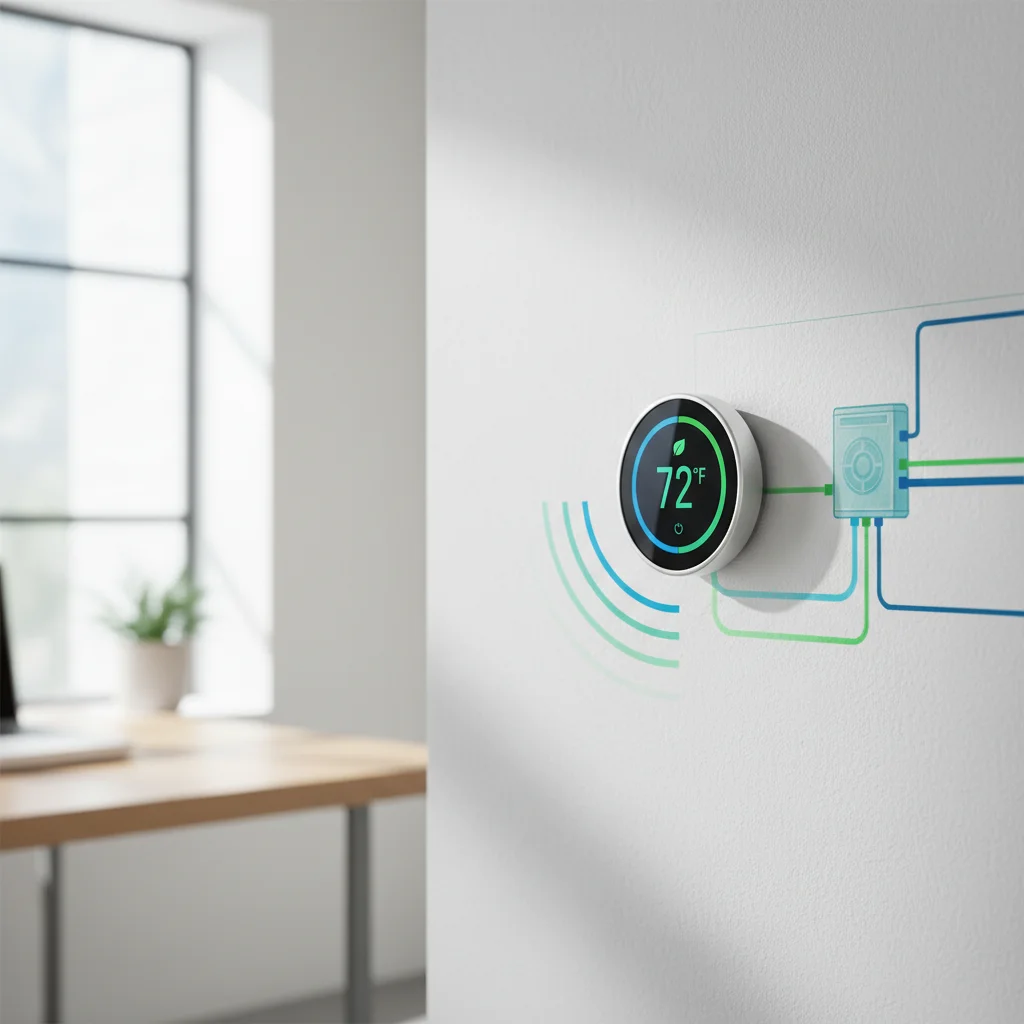
Nearly 40% of homeowners who purchase a smart thermostat never install it because they discover too late their HVAC system isn't compatible—wasting $200-$300 and missing out on $200-$400 in annual energy savings. And with 2026 utility rebates covering up to $500 of installation costs for compatible systems, understanding which smart thermostats work with your heating and cooling equipment determines whether you access those incentives or leave money on the table.
What Smart Thermostat Systems Are Compatible With My HVAC Equipment?
Smart thermostats in 2026 work with gas furnaces, electric furnaces, heat pumps, boiler systems, dual-fuel setups, and central air conditioning units that use low-voltage (24V) C-wire power and conventional HVAC wiring with 4-8 wires. Nest, Ecobee, and Honeywell models support 95% of residential HVAC configurations including single-stage, multi-stage, and variable-speed systems installed after 1990.
Most forced-air systems with central thermostats qualify for smart thermostat upgrades. But high-voltage systems (110V/240V baseboard heaters, wall heaters), proprietary HVAC brands (some Carrier Infinity, Lennox iComfort), and systems lacking a C-wire (common wire) require adapters or professional installation to ensure compatibility.
And heat pump systems installed through 2026 utility programs typically include C-wire adapters bundled with the equipment, solving the most common compatibility barrier for $0 additional cost. The federal HOMES rebate program allocates $8,000 for heat pump installations that include smart thermostat integration when both devices meet ENERGY STAR certification.
So check your existing thermostat's wiring before purchasing. Look for color-coded wires labeled R (power), W (heat), Y (cooling), G (fan), and C (common). Systems with R, W, Y, and G but no C-wire need a $30-$50 adapter or require running new wire from the furnace—adding $150-$250 to professional installation costs.
"Smart thermostats reduce heating and cooling energy use by 10-23% when properly configured for the specific HVAC system type." — U.S. Department of Energy
How Much Can You Save With a Smart Thermostat on Your Energy Bills?
Homeowners save $180-$400 annually on heating and cooling costs by replacing manual thermostats with ENERGY STAR-certified smart models that automatically adjust temperatures based on occupancy patterns and weather forecasts. The exact savings depend on climate zone, existing HVAC efficiency, and how aggressively the old thermostat was programmed—homes in extreme climates (zones 1-2 and 6-7) see the highest dollar amounts.
But the savings multiply when smart thermostats connect to qualifying HVAC upgrades. A 2026 heat pump installation paired with a learning thermostat saves $600-$900 per year compared to an oil furnace with a manual thermostat, because the smart controls optimize the heat pump's variable-speed compressor to run at lower power levels for longer periods instead of cycling on and off.
California's 2026 Tech Clean California program provides $500 rebates for smart thermostats installed alongside heat pumps or central AC units with SEER2 ratings above 16. And utility companies including PG&E, SCE, and SDG&E offer instant rebates of $75-$120 at checkout when purchasing qualifying smart thermostats through their online marketplaces.
Renters save less—typically $80-$150 annually—because landlords control HVAC equipment upgrades. So tenant-installed smart thermostats only optimize existing (often older, less efficient) systems without accessing rebate programs that require property owner applications.
What's the ROI and Payback Period for Installing a Smart Thermostat?
The payback period for a $200-$300 smart thermostat ranges from 6-18 months when accounting for $180-$400 in annual energy savings, plus $75-$500 in upfront rebates from utilities and state programs. Homeowners who install smart thermostats during HVAC system replacements see payback in under 12 months because rebate stacking (federal tax credits + state rebates + utility incentives) covers 40-70% of total upgrade costs.
ROI exceeds 300% over the typical 10-year lifespan of a smart thermostat. A $250 Ecobee or Nest device saves $2,800-$4,000 in energy costs over a decade, delivering $2,550-$3,750 in net value before accounting for home resale premiums—smart thermostats add $500-$1,200 to home valuations in competitive markets.
And professional installation ($150-$300) pays for itself within the first year when it qualifies the system for utility rebates that require certified installer participation. DIY installation costs $0 in labor but disqualifies some rebate programs and voids HVAC warranties if wiring errors damage equipment.
Calculate your specific savings using our free rebate calculator that factors in your climate zone, current HVAC type, and local utility programs. The tool identifies stackable incentives worth $275-$8,500 for combined thermostat and HVAC upgrades in 2026.
So the fastest ROI comes from timing smart thermostat installation with energy tax credits for HVAC replacements—bundling a $300 thermostat with a $15,000 heat pump installation qualifies for $4,500 in federal credits plus $2,000-$4,000 in state rebates, reducing effective thermostat cost to $50-$100 after incentives.
How Do Smart Thermostats Compare to Traditional Programmable Thermostats?
Smart thermostats save 15-30% more energy than programmable thermostats because they use occupancy sensors, weather forecasts, and machine learning to adjust temperatures automatically instead of following fixed schedules that waste energy when routines change. Programmable models require manual schedule updates every season and don't adapt when homeowners leave for vacation or work from home unexpectedly.
But programmable thermostats cost $50-$120 compared to $200-$300 for smart models, making them better choices for rental properties, vacation homes, or budgets under $150. And older adults or technologically hesitant homeowners prefer the simpler interfaces—programmable thermostats don't require smartphone apps, Wi-Fi passwords, or software updates.
Smart thermostats qualify for 2026 utility rebates ($75-$500) that programmable models don't access. California's TECH Clean California program, Bay Area Regional Energy Network (BayREN), and Southern California Edison's Smart Thermostat Program all require Wi-Fi connectivity and ENERGY STAR certification—features only smart thermostats provide.
So the total cost difference narrows to $25-$125 after rebates, making smart thermostats the economically rational choice for owner-occupied homes with stable Wi-Fi. Programmable thermostats remain competitive only in off-grid cabins, properties without internet access, or situations where rebates aren't available.
What Are the Best Alternatives to Smart Thermostats for HVAC Control?
Zoned HVAC systems with damper controls save 20-35% on heating and cooling by conditioning only occupied rooms instead of the entire house, delivering higher energy savings than smart thermostats alone for homes over 2,500 square feet with multiple floors or unused guest rooms. But zoning costs $2,500-$4,500 installed compared to $200-$450 for a smart thermostat.
Programmable thermostats ($50-$120) work for homeowners with predictable schedules who don't need remote control or automatic adjustments. And manual thermostats with seasonal temperature guidelines cost $15-$40 but require disciplined daily adjustments to capture any savings.
Smart HVAC controllers like Flair Smart Vents ($80 each, 6-12 vents needed) or Cielo Breez Mini ($100-$150) add smart features to existing thermostats by controlling individual room vents or ductless mini-split systems. These work better than whole-house smart thermostats for homes with zone-specific comfort needs but don't qualify for California's 2026 smart thermostat rebate programs.
So the best alternative depends on home size and goals. Homes under 1,800 square feet get maximum ROI from a single $200-$300 smart thermostat. Larger homes (2,500+ square feet) benefit more from $2,500-$4,500 zoned systems that qualify for California's multifamily building upgrade incentives worth $800-$1,500 per zone.
What Installation and Compatibility Requirements Should You Know?
Smart thermostats require a C-wire (24V common wire) for continuous power, Wi-Fi connectivity with 2.4GHz network access, and HVAC systems using low-voltage (24V) controls with conventional wiring—high-voltage systems (110V/240V baseboard heaters, electric radiant) aren't compatible without $200-$400 transformer installations. Check your existing thermostat's wire bundle before purchasing any smart model.
Most homes built after 2000 have C-wires pre-installed. Homes from 1980-1999 have 50/50 odds. And pre-1980 homes rarely include C-wires, requiring either a $30-$50 add-a-wire adapter (Venstar ACC0410) or professional rewiring ($150-$300) to run new 18/8 thermostat cable from the furnace to the wall location.
And some HVAC brands use proprietary communication protocols that block third-party thermostats. Carrier Infinity systems, Lennox iComfort S30, and Bryant Evolution connex require manufacturer-specific smart thermostats ($400-$600) instead of standard Nest or Ecobee models ($200-$300). So verify compatibility using the manufacturer's online tool before purchasing.
California utility rebate programs require ENERGY STAR certification and professional installation by licensed HVAC contractors (HVAC-C20 or C-61/D-07 licenses) to qualify for $75-$500 rebates. DIY installation costs $0 but forfeits rebates worth 25-100% of the device cost.
"Thermostats must be installed according to local electrical codes and HVAC manufacturer specifications to maintain equipment warranties and qualify for utility incentive programs." — Database of State Incentives for Renewables & Efficiency
Official Sources
- U.S. Department of Energy ENERGY SAVER — Federal guidance on thermostat efficiency and savings calculations
- ENERGY STAR Certified Smart Thermostats — Database of qualifying models for federal and state rebate programs
- Database of State Incentives for Renewables & Efficiency — Comprehensive directory of California utility rebates and installation requirements
Frequently Asked Questions
Are smart thermostats compatible with all HVAC systems?
Smart thermostats work with 95% of residential forced-air systems including gas furnaces, electric heat pumps, central air conditioning, boilers, and dual-fuel setups using low-voltage (24V) wiring installed after 1990. But high-voltage baseboard heaters (110V/240V), proprietary systems like Carrier Infinity, and installations without C-wire power require adapters ($30-$50) or professional rewiring ($150-$300) to ensure compatibility.
How do I know if my thermostat is compatible with my HVAC system?
Remove your existing thermostat's faceplate and photograph the wire terminals—look for wires labeled R (red power), W (white heat), Y (yellow cooling), G (green fan), and C (blue/black common). Systems with 4-8 wires including a C-wire support 90% of smart thermostats. Use Nest's online compatibility checker or Ecobee's wire guide tool to verify your specific configuration before purchasing.
What HVAC systems work best with smart thermostats?
Variable-speed heat pumps with SEER2 ratings above 18 and multi-stage gas furnaces with AFUE ratings above 95% deliver maximum energy savings (20-30%) when paired with learning thermostats that optimize compressor speeds and fan cycles. Single-stage systems from the 1990s save less (10-15%) because they only operate at full capacity or off—smart thermostats reduce runtime but can't modulate output like newer equipment.
Can I install a smart thermostat myself or do I need a professional?
Homeowners with C-wires and basic electrical knowledge install smart thermostats in 30-60 minutes using manufacturer apps that guide wire connections for $0 labor cost. But systems without C-wires, high-voltage equipment, or proprietary HVAC brands require professional installation ($150-$300) to avoid equipment damage and maintain warranties. And California utility rebate programs worth $75-$500 mandate licensed contractor installation to qualify for incentives.
Do smart thermostats work with heat pumps and air conditioning units?
Smart thermostats optimize heat pump efficiency by managing auxiliary heat lockouts, defrost cycles, and compressor staging—features that save $200-$400 annually compared to basic programmable models. Central air conditioning units with variable-speed compressors gain 15-25% efficiency when smart thermostats adjust fan speeds based on humidity levels and cooling demand. Single-speed AC systems save less (8-12%) because they lack the granular control that smart thermostats leverage.
Ready to find out how much you can save? Use our free rebate calculator to discover available smart thermostat rebates and HVAC upgrade incentives worth $275-$8,500 in your California ZIP code. Enter your current equipment details and get a personalized savings report in under 2 minutes.
Updated on April 14, 2026. Fact-checked by DuloCore Editors. About our research team.
Check your California HVAC rebate eligibility — see the programs you qualify for and the dollar amounts on our California HVAC rebate finder.