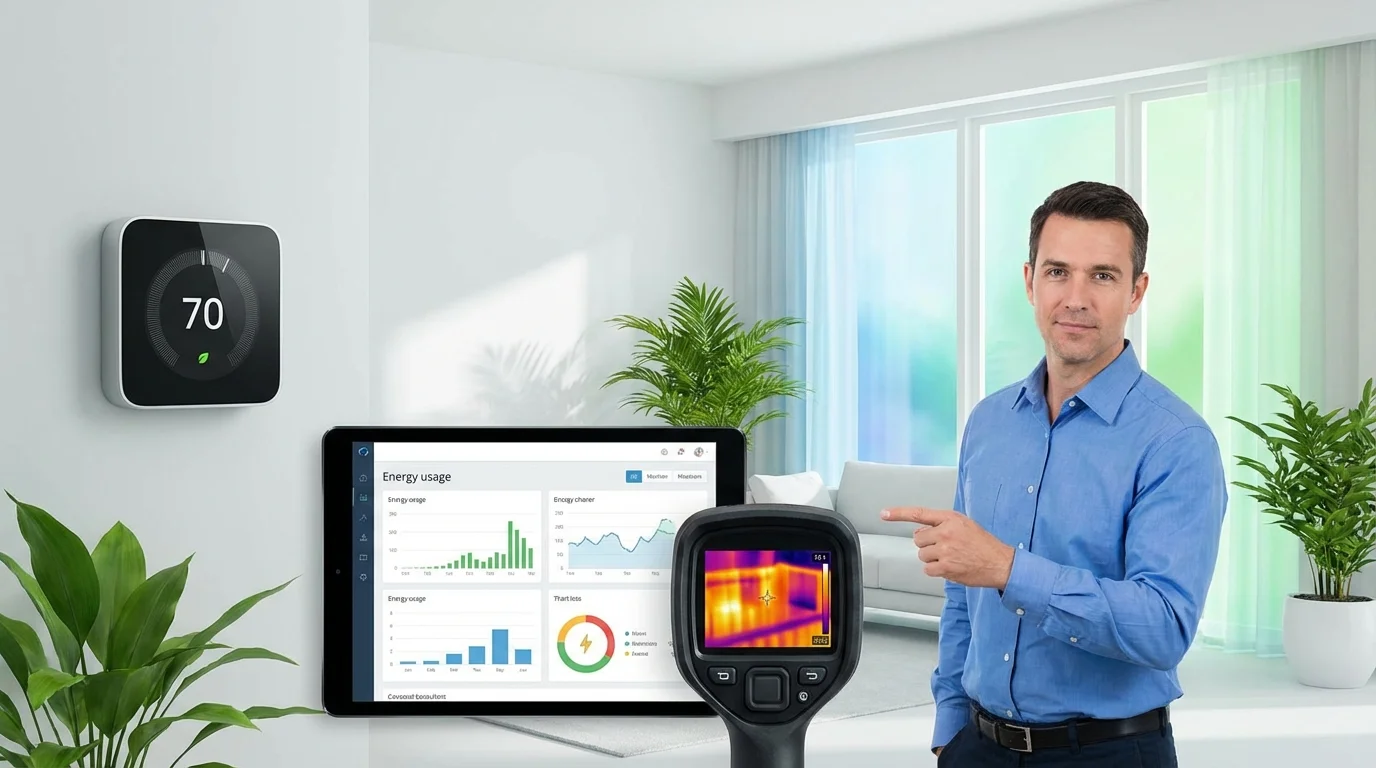
Heating and cooling account for nearly 50% of the average American household's energy bill. So, a small, programmable device on your wall holds the power to unlock hundreds of dollars in annual savings, but only when it's informed by a comprehensive home energy audit. An audit pinpoints exactly where your conditioned air escapes, transforming your smart thermostat from a convenient gadget into a precision savings tool.
How Much Can You Save? Discovering Smart Thermostat Rebate Amounts by State and Utility
Smart thermostat rebates are state and utility programs offering homeowners direct cash back of $50 to $150 for installing qualifying ENERGY STAR models in 2026. These incentives are designed to offset the initial purchase price and accelerate the adoption of energy-saving technology.
Rebate amounts are hyper-local and depend entirely on your utility provider and state of residence. For instance, Con Edison in New York offers a $75 rebate, while California's PG&E provides up to $120 for certain models. And these amounts often change based on available program funding. The key is identifying the specific program tied to your electric or gas account, as eligibility is determined by your service address. So, homeowners must verify the current 2026 rebate amount directly with their local utility. You can use a free rebate calculator to instantly see what you qualify for. But remember, these funds are limited and typically distributed on a first-come, first-served basis each calendar year, making timely application critical.
Do You Qualify? Understanding Income Limits, Eligible Equipment, and Contractor Requirements for Rebates
Qualification for 2026 smart thermostat rebates hinges on specific equipment standards, residential status, and occasionally, income levels. Most programs require the thermostat to be an ENERGY STAR certified model, ensuring it meets federal efficiency standards and delivers proven savings of at least 8% on HVAC costs.
Eligibility is typically restricted to residential customers, including homeowners and sometimes renters with landlord approval. And while most standard rebates don't have income caps, some states offer enhanced rebates for low-to-moderate income (LMI) households, often doubling the standard amount. For example, a program may offer a $75 standard rebate but a $150 rebate for households at or below 80% of the Area Median Income (AMI). Contractor requirements are rare for simple thermostat installations, as most are designed for DIY setup. But for more complex HVAC integrations, some utilities insist on installation by a licensed technician. Always check your utility's specific list of eligible models and requirements before purchasing a device. It's a critical step in a successful home energy audit journey.
What's the Application Process? Navigating Deadlines and Checking Funding Status for Smart Thermostat Programs
The application process for 2026 smart thermostat rebates is typically a straightforward online form, but meeting deadlines and confirming fund availability is crucial. Most utilities require submission within 30 to 90 days of the purchase date, so procrastination voids the opportunity for savings.
To apply, homeowners usually need a digital copy of the dated sales receipt and the device's model or serial number. And the application is almost always submitted through the utility's online rebate portal. But before applying, it’s essential to check the program's funding status. Many state and utility programs operate on a fixed annual budget. So, once the allocated funds for 2026 are depleted, the program closes until the next year. This status is usually displayed prominently on the utility's rebate webpage. Failing to check this can result in a rejected application, even if you meet all other eligibility criteria. The entire process, from submission to receiving a check or bill credit, typically takes 4-8 weeks.
Can You Stack It? Rules for Combining State, Utility, and Other Rebates for Maximum Savings
Stacking rules for smart thermostat incentives allow homeowners to combine rebates from multiple sources, but these regulations vary by location. The most common scenario involves pairing a utility rebate with a manufacturer's instant rebate, effectively lowering the purchase price by $100 or more.
For example, a homeowner can often claim a $75 rebate from their electric company and a separate $25 instant rebate from the thermostat manufacturer at the point of sale. And some states offer their own energy efficiency programs that provide an additional layer of savings. However, it's uncommon to claim two separate utility rebates for the same device (e.g., from both your gas and electric provider). The program terms and conditions will explicitly state whether benefits are stackable.
"Many utilities offer rebates to their customers who purchase ENERGY STAR certified products. Some retailers also offer rebates." — ENERGY STAR
So, carefully reading the fine print for each program is non-negotiable. Combining these smaller incentives with broader energy tax credits for larger projects like insulation or window upgrades maximizes total home savings.
Beyond Rebates: How Does a Smart Thermostat Energy Audit Impact Your Home's Long-Term Efficiency?
A smart thermostat's true value is unlocked when paired with insights from a home energy audit, directly impacting long-term efficiency by 15-25%. The audit identifies critical air leaks and insulation gaps, and the thermostat then uses this data to create a hyper-efficient heating and cooling schedule.
An energy audit provides a thermal blueprint of your home. For example, an infrared scan may reveal a 20% heat loss through an uninsulated attic. So, instead of running the furnace constantly to compensate, you can seal the attic. And the smart thermostat then maintains the desired temperature with 20% less runtime, directly cutting energy consumption. This synergy turns the thermostat into the "brain" of an efficient home, making intelligent adjustments based on real-world performance data rather than just generic programming. This is particularly effective when managing high-efficiency systems like those qualifying for heat pump rebates, ensuring the equipment operates at peak performance and delivers its promised savings.
Smart Thermostat Rebate Program Comparison (2026 Examples)
| Program / Utility | Rebate Amount | Key Eligibility | Application Deadline |
|---|---|---|---|
| Con Edison (NY) | Up to $75 | ENERGY STAR model, residential account | 60 days post-purchase |
| PG&E (CA) | Up to $120 | Must control central A/C, must be on list | 90 days post-purchase |
| Austin Energy (TX) | $50 - $100 | Wi-Fi enabled, residential customer | Within 2026 calendar year |
Official Sources
- ENERGY STAR Rebate Finder — A federal tool to find local rebates and special offers for ENERGY STAR certified products.
- DSIRE (Database of State Incentives for Renewables & Efficiency) — A comprehensive database of state, local, utility, and federal incentives for energy efficiency.
"A home energy assessment (sometimes referred to as an energy audit) can help you understand the whole picture of your home’s energy use..." — U.S. Department of Energy
Frequently Asked Questions
How does having a smart thermostat impact my eligibility for energy audit rebates?
Having a smart thermostat typically doesn't impact your eligibility for a home energy audit rebate. In fact, many 2026 utility programs encourage both. The audit rebate, often between $100 and $400, is designed to identify efficiency opportunities throughout the home. So, the presence of a smart thermostat is seen as a positive step, not a disqualifier for the broader assessment incentive.
Will an energy audit still provide value if I already have a smart thermostat installed?
Yes, an energy audit delivers immense value even with a smart thermostat. The audit identifies the source of energy loss—like air leaks in the attic or poor insulation—which the thermostat can't see. By fixing these issues, you reduce the overall heating and cooling load by 15-30%. And your smart thermostat then works more efficiently, running less often to maintain comfort and maximizing your savings.
Can a smart thermostat help maximize the potential savings identified during an energy audit?
Absolutely. A smart thermostat acts as the command center to implement an audit's findings. For example, if an audit reveals your home loses heat quickly, the thermostat's learning algorithm can adjust by pre-heating the house more efficiently before you wake up. It leverages the audit's data to reduce HVAC runtime by 10-12% on average, turning recommendations into automated, tangible savings on your monthly bill.
Should I install a smart thermostat before or after scheduling a home energy audit?
Installing the smart thermostat after the energy audit is generally more effective. The audit provides a baseline of your home's energy performance and identifies the most critical areas for improvement, like air sealing. Addressing these issues first reduces the overall strain on your HVAC system. So, when you install the thermostat, it learns the behavior of a more efficient home, leading to more accurate scheduling and up to 20% greater savings.
Are there specific rebates for smart thermostats that require a prior energy audit?
While not common, some comprehensive "whole-home" rebate programs in 2026 do require an energy audit as a prerequisite for all other incentives, including for smart thermostats. These programs bundle multiple upgrades (insulation, thermostat, etc.) and require the audit to validate the necessity and impact of each improvement. Always check the specific terms of your local utility's high-performance home programs.
Unlock Your Home's Full Savings Potential
Don't guess what rebates you qualify for. Our tools provide instant, accurate results based on your address and utility provider. Find every available smart thermostat and energy audit rebate in under 60 seconds.
Calculate Your Savings NowLast reviewed: April 14, 2026. Reviewed by DuloCore Energy Specialists. About the team.
Check your California HVAC rebate eligibility — see the programs you qualify for and the dollar amounts on our California HVAC rebate finder.