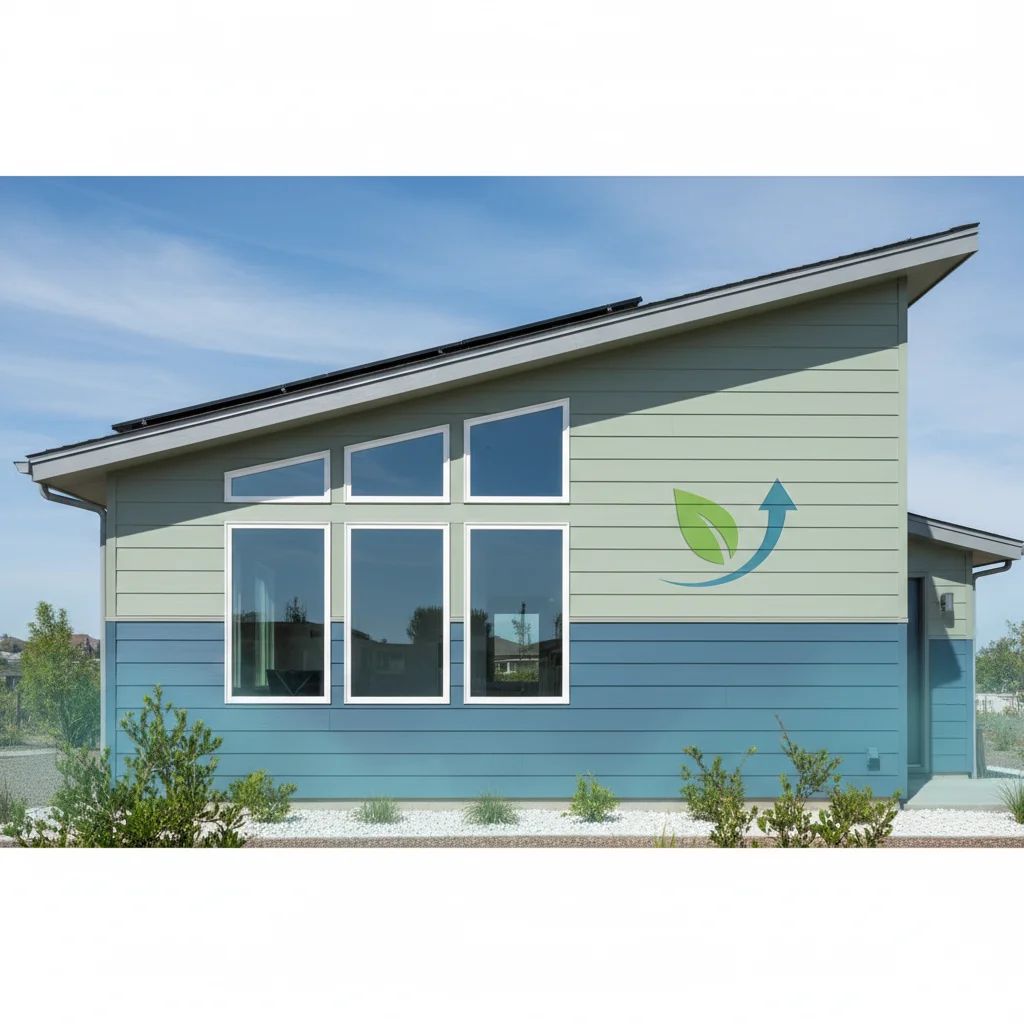
Homeowners lose $200 to $400 annually through walls that aren't properly insulated—and siding upgrades cut that loss by 15% to 30%. Vinyl siding with foam backing reduces heating costs by $150 per year in Sacramento, while fiber cement with R-5 insulation saves $300 annually in San Francisco's fog belt. And California's 2026 energy rebate programs cover 30% to 50% of installation costs for qualifying materials.
How Much Can You Save on Energy Bills With Energy-Efficient Siding?
Energy-efficient siding with insulated backing reduces annual heating and cooling costs by $150 to $400 in California, with R-5 insulated vinyl delivering the highest savings in climate zones 3 and 4. Payback periods range from 7 to 12 years depending on material choice and local utility rates through 2026.
Insulated vinyl siding with foam backing delivers R-2 to R-5 thermal resistance, compared to R-0.6 for traditional vinyl. Homeowners in Sacramento's climate zone 3 save $180 annually on cooling costs after upgrading from aluminum to insulated vinyl. And San Jose residents see $220 in combined heating and cooling savings with fiber cement over foam sheathing.
But payback timelines vary by material cost. Vinyl with foam backing costs $6 to $12 per square foot installed, reaching break-even in 7 to 10 years. Fiber cement with continuous insulation runs $12 to $18 per square foot, extending payback to 10 to 12 years despite higher R-values. So homeowners prioritizing quick ROI choose vinyl, while those seeking maximum efficiency invest in fiber cement systems.
What Siding Materials Qualify for California Energy Rebates?
Insulated vinyl, fiber cement with foam backing, and insulated metal panels qualify for California's 2026 energy upgrade rebates when paired with whole-home efficiency improvements. Materials must meet Title 24 U-factor requirements of 0.40 or lower, and installations require CEC-approved contractor certification to access $1,500 to $3,500 rebates.
The California Energy Commission's 2026 rebate program covers siding as part of weatherization packages that reduce energy use by 15% or more. Insulated vinyl with R-3 or higher backing qualifies when combined with attic insulation upgrades. And fiber cement over R-5 continuous insulation meets Title 24 standards for climate zones 1 through 16.
Metal panels with polyurethane foam cores deliver R-6 to R-8 values and qualify for commercial building upgrades under the same program. But standalone siding replacements don't qualify—homeowners must bundle siding with energy audits and HVAC improvements to access funds. So rebate-eligible projects typically include air sealing, duct testing, and insulation alongside siding installation. Use our free rebate calculator to estimate your total savings across all qualifying improvements.
"Insulated siding systems can improve whole-wall R-values by 20% to 40% when properly installed over existing sheathing" — U.S. Department of Energy
How Do You Apply for Siding Rebates and What's the Income Threshold?
California's 2026 siding rebates require pre-approval through the CEC's online portal, with household income limits set at 80% of area median income for standard rebates and 120% for moderate-income tiers. Applications close 30 days after project completion, and reimbursement arrives within 60 to 90 days of approved submission.
Households earning below $78,000 in Los Angeles County qualify for enhanced rebates of $3,500 for whole-home weatherization including siding. Moderate-income households earning $78,000 to $117,000 receive $2,500, while higher earners access $1,500 through utility-specific programs. And all applicants must submit contractor bids, energy audit reports, and proof of Title 24 compliance before starting work.
The application process starts with a CEC-approved energy assessor conducting a home performance test. Assessors identify cost-effective upgrades and project energy savings using CalTRACK modeling. Homeowners then select licensed contractors with C-54 framing or C-61 classification who submit installation plans to the CEC portal. But projects that begin before approval lose rebate eligibility—so timing the application before demolition is critical.
What Are the Current Deadlines and Funding Status for 2026?
California's 2026 energy rebate program allocated $85 million for residential upgrades, with applications accepted through December 31, 2026, or until funds are depleted. As of April 2026, $62 million remains available, and the CEC processes applications on a first-come, first-served basis with 15-day approval windows for complete submissions.
Southern California Edison and PG&E allocated separate siding rebate pools of $12 million and $18 million respectively for their service territories. SCE's program is 35% subscribed as of March 2026, while PG&E has distributed 28% of available funds. And both utilities extend deadlines quarterly if budgets allow, so checking monthly funding reports on their portals prevents missed opportunities.
The federal home energy tax credits (Sections 25C and 25D) ended for projects completed after December 31, 2025 (IRS FS-2025-05). Federal tax credits for this work have ended, but state, local and utility rebates may still apply; check what is available at your address with the DuloCore rebate calculator. Form 5695 only covers qualifying work completed by December 31, 2025 and claimed on a 2025 return; the federal 25C and 25D credits ended after that date (IRS FS-2025-05). But the credit applies only to materials and labor directly improving energy performance—aesthetic upgrades like trim or paint don't qualify. So documenting R-value improvements and thermal bridging reductions ensures maximum credit eligibility.
"Combining insulated siding with air sealing reduces infiltration losses by 25% to 35%, improving comfort and cutting utility bills" — ENERGY STAR
Can You Stack Siding Rebates With Other Home Efficiency Programs?
California allows stacking siding rebates with federal IRA tax credits, utility-specific incentives, and local weatherization programs, but total rebates cannot exceed 100% of project costs. Homeowners combine CEC rebates averaging $2,500 with 30% federal credit (these federal credits ended for projects completed after December 31, 2025)s and $500 to $1,000 utility bonuses, reducing net siding costs by 60% to 75%.
A $15,000 insulated fiber cement installation qualifies for $2,500 CEC rebate, $4,500 federal tax credit (30% of $15,000), and $750 PG&E efficiency bonus—totaling $7,750 in incentives. And low-income households access GRID Alternatives' weatherization grants that cover remaining costs after rebates, achieving zero out-of-pocket installations. But stacking requires separate applications to each program with coordinated approval timelines.
Combining siding rebates with heat pump rebates creates synergistic savings by addressing both envelope and HVAC efficiency. Homeowners who install insulated siding alongside heat pump HVAC systems claim $10,000 to $12,000 in total rebates—covering 50% to 65% of combined project costs. So bundling envelope and mechanical upgrades maximizes available incentives while reducing energy use by 40% to 50%.
What Contractor Requirements and Certifications Do You Need?
California requires siding contractors to hold active C-54 framing and lathing or C-61 limited specialty licenses to perform rebate-eligible installations, plus completion of CEC-approved energy efficiency training modules. Contractors must also carry $1 million general liability insurance and register with the Contractors State License Board's Home Energy Renovation Opportunity (HERO) program to access rebate portals.
Only contractors with documented Title 24 compliance experience qualify for CEC rebate projects. The CEC maintains a searchable database of approved contractors who've completed 8-hour weatherization certification courses. And contractors must submit proof of workers' compensation coverage and pass background checks before appearing in the public directory.
Homeowners verify contractor credentials through CSLB license lookup at cslb.ca.gov, checking for active status, complaint history, and disciplinary actions. Licensed contractors provide warranties of 5 to 10 years on siding materials and 2 to 5 years on labor. But unlicensed installers void rebate eligibility and leave homeowners without recourse for defective work—so confirming C-54 or C-61 status before signing contracts protects both rebates and installation quality.
| Program | Rebate Amount | Income Limit | Application Deadline |
|---|---|---|---|
| CEC Residential Upgrade | $1,500-$3,500 | 80%-120% AMI | December 31, 2026 |
| PG&E Energy Savings | $500-$1,000 | No limit | Rolling (funds permitting) |
| SCE Home Upgrade | $750-$1,250 | No limit | December 31, 2026 |
| Federal IRA Tax Credit | Ended Dec 31, 2025 | — | Ended Dec 31, 2025 |
Official Sources
- U.S. Department of Energy - Energy Saver — Federal guidance on residential energy efficiency and weatherization rebates
- Database of State Incentives for Renewables & Efficiency — Comprehensive California rebate and incentive program listings
- ENERGY STAR — Standards for energy-efficient building materials and installation practices
Related Reading: Learn more about High Impact Low Cost Energy Fixes.
Frequently Asked Questions
Does siding improve energy efficiency?
Insulated siding improves whole-wall R-values by 20% to 40% when installed over existing sheathing, reducing heat transfer through walls by $150 to $400 annually. Vinyl with R-3 to R-5 foam backing delivers the highest thermal performance at the lowest cost, while fiber cement over continuous insulation maximizes efficiency in extreme climates. But siding alone doesn't qualify for rebates—it must be part of whole-home weatherization packages.
How much can you save with energy efficient siding?
Energy-efficient siding saves California homeowners $150 to $400 per year on combined heating and cooling costs, with insulated vinyl delivering the fastest payback of 7 to 10 years. San Francisco residents see $300 annual savings due to year-round moderate temperatures, while Sacramento homeowners save $180 primarily on summer cooling. And stacking CEC rebates with federal energy tax credits cuts net installation costs by 60% to 75%.
What type of siding is most energy efficient?
Fiber cement over R-5 continuous insulation delivers the highest whole-wall R-values of R-8 to R-10, outperforming insulated vinyl (R-2 to R-5) and metal panels (R-6 to R-8). But insulated vinyl offers the best cost-to-performance ratio at $6 to $12 per square foot versus $12 to $18 for fiber cement. And both materials qualify for California's 2026 CEC rebates when paired with air sealing and HVAC upgrades.
Are siding upgrades eligible for tax credits or rebates?
The federal home energy tax credits (Sections 25C and 25D) ended for projects completed after December 31, 2025 (IRS FS-2025-05). California's CEC program provides $1,500 to $3,500 rebates for insulated siding paired with attic insulation and HVAC upgrades. But standalone cosmetic siding replacements don't qualify—only installations documented to improve thermal performance access incentives.
How long does it take for siding to pay for itself in energy savings?
Insulated vinyl siding pays for itself in 7 to 10 years through $150 to $250 annual energy savings, while fiber cement over continuous insulation takes 10 to 12 years despite higher performance. Homeowners who stack CEC rebates with federal tax credits shorten payback to 4 to 6 years by reducing upfront costs by 60% to 75%. And combining siding with envelope air sealing and HVAC upgrades accelerates ROI by increasing total energy savings to 40% to 50%.
Ready to calculate your siding rebate savings? Use DuloCore's free rebate calculator to estimate your total incentives across California's CEC program, utility bonuses, and federal IRA tax credits. Get your personalized rebate amount in 60 seconds—no email required.
Last updated: April 14, 2026. Reviewed by the DuloCore Editorial Team. About our authors.